
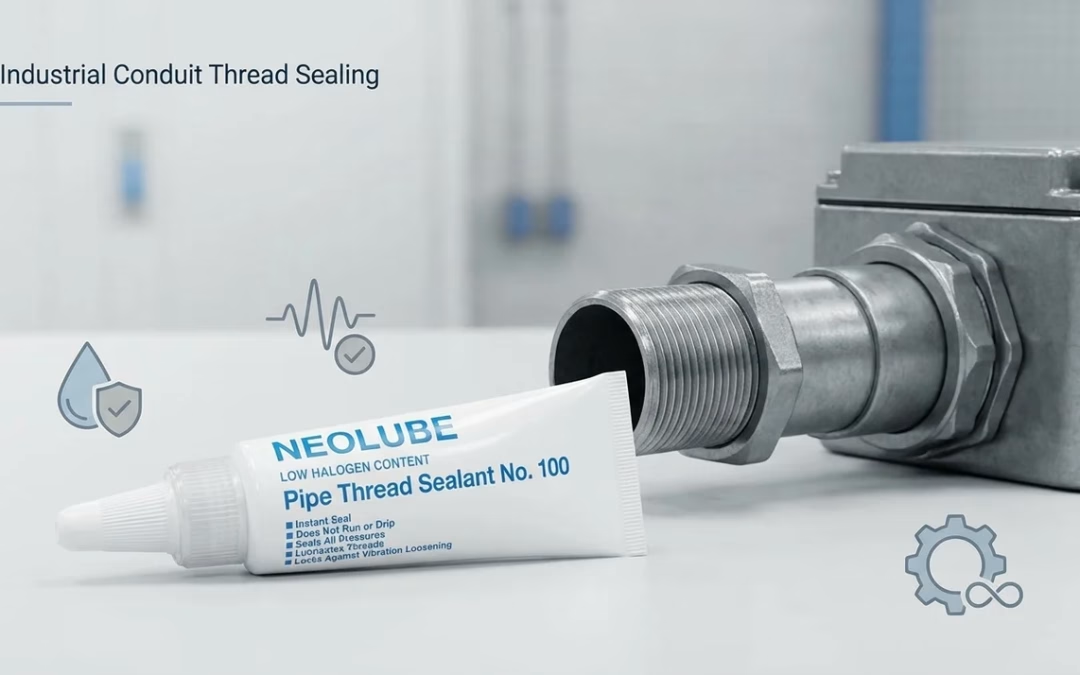
In industrial facilities, threaded conduit connections are expected to stay reliable under real operating conditions, not just look complete on installation day. Moisture, vibration, maintenance access, and repeated service work can all put pressure on the connection over time, especially when the joint is exposed and expected to hold up without becoming a recurring maintenance issue.
That is where the topic starts to get muddled. In electrical work, sealing can refer to more than one kind of job. Sometimes the concern is the threaded metal joint itself, how it goes together, how consistently it seals, and how well it stands up in service. In other cases, the installation calls for a dedicated sealing fitting or another specified sealing method. Those are not the same decision, and treating them like they are usually creates more confusion than clarity.
Why does this question keep coming up
A lot of content on this subject moves too quickly into broad electrical terminology, but the real issue on site is usually much more specific. Most plant electricians and maintenance teams are not looking for a theory lesson on conduit. They are dealing with a connection that has been assembled and reassembled over time, a conduit run exposed to wet or harsh conditions, or a threaded joint that keeps coming back as a reliability concern.
At that point, the question is no longer whether sealing matters in general. The question is whether the threaded joint itself needs more support than a mechanical assembly alone can provide. That is where thread sealant becomes relevant, not as a universal fix, but as a practical option when the connection, the environment, and the service conditions point in that direction.
When the threads are part of the problem
Threaded metal conduit joints do not usually fail in a dramatic way at first. More often, the problems show up slowly. Moisture starts finding its way into exposed areas. Corrosion begins to develop around a connection that sees wet service or repeated maintenance. A fitting that seemed acceptable during installation becomes the point that gets revisited again and again.
In those cases, the issue is not only whether the joint can be tightened. It is whether the connection is going together in a way that supports long-term reliability. Small gaps in the threads, inconsistent assembly, vibration, and service exposure can all make that harder than it looks on paper.
That is why this topic matters in industrial systems. The question is rarely sealing for the sake of sealing. It is whether the threaded connection is likely to stay dependable under the conditions it actually sees.
Not every conduit sealing job is doing the same work
This is the distinction that matters most. If the issue is the threaded metal joint itself, then the conversation is about fit, assembly behavior, and sealing performance at the threads. It is about how the connection goes together, how well the voids in the threads are addressed, and whether the joint is likely to stay dependable in service.
If the requirement is for a dedicated sealing fitting, a seal-off body, or another manufacturer-specified conduit sealing method, that is a different category of solution. It should be discussed on its own terms and selected on that basis. Trying to fold those requirements into the same conversation as thread sealing usually leads to poor comparisons and the wrong product language.
For Huron, the stronger approach is the more disciplined one. Stay with the actual connection problem in front of you. If the application involves a threaded metal conduit joint in an industrial system, then a thread sealant can be evaluated on that basis. If the installation calls for another sealing method, that requirement controls.
What matters in a sealant for threaded metal conduit
A sealant for threaded metal conduit work should be suitable for metal pipes and fittings, support more controlled assembly, and be practical to apply in the field. It should also come with clear operating limits, material guidance, and application instructions that can stand up to technical review.
That is where NEOLUBE® No. 100 fits naturally into the conversation. It is designed for locking and sealing metal pipes and fittings. It is a creamy paste, formulated to impart lubricity during assembly, provide immediate low-pressure sealing, and cure to a solid for sealing and securing threaded pipe connections. Electrical conduit is one of its listed application areas, which makes it a relevant product for this specific topic rather than a forced mention.
Where NEOLUBE® No. 100 makes sense
For threaded metal conduit joints in industrial environments, NEOLUBE® No. 100 speaks to the real installation question. It is not positioned as a catch-all electrical product. It is a pipe thread sealant with a documented fit for metal-threaded assemblies, including electrical conduit.
That matters because the product story is practical. It supports assembly lubricity, it is intended to fill the voids in the threads, it seals instantly to moderate pressures when the fitting is properly tightened, and it cures anaerobically, meaning it cures in the absence of air once confined between close-fitting metal surfaces. Its full strength on steel is listed at 24 hours, and the cured sealant is intended to help prevent loosening and leakage from shock and vibration.
The operating limit also matters here. NEOLUBE® No. 100 is rated for continuous service up to 300°F (149°C), which gives technical buyers and maintenance teams a clearer way to judge whether it fits the conditions they are working with. For applications where conduit runs or surrounding systems see elevated heat, that kind of stated limit helps keep the selection grounded in documented product data rather than assumption.
Just as importantly, the limitations are clear. NEOLUBE® No. 100 is not normally recommended for plastics, especially thermoplastics where stress cracking could result. It is also not recommended for pure oxygen, oxygen-rich systems, chlorine, or other strong oxidizing materials. That kind of boundary-setting is part of what makes the product fit credible.
What creates rework more often than people think
A lot of sealing problems get blamed on the product when the real issue started earlier. Sometimes the connection was never the right fit to begin with. Sometimes the threads are worn, damaged, or poorly prepared. Sometimes the installation method is inconsistent. A sealant can support a sound threaded assembly, but it cannot correct poor threads or make up for poor installation practice.
Material fit matters too. With NEOLUBE® No. 100, that is something to address directly, not gloss over. The product is designed for metal pipes and fittings, and the guidance is clear that plastic compatibility should not be assumed.
Application discipline matters just as much. Clean fittings, proper placement on the leading threads, leaving the first thread free, filling the voids thoroughly, and tightening according to accepted trade practice all make a difference. That is not filler language. It is what keeps a threaded-joint solution practical in the field.
Even routine storage and stock handling are part of the real-world picture. NEOLUBE® No. 100 carries a 24-month shelf life when stored under the recommended conditions, which is a small detail on paper but a useful one for maintenance teams and procurement staff trying to manage inventory responsibly.
A clear way to think about the decision
If the question is whether a threaded metal conduit joint may benefit from better fit-up, more controlled assembly, and added sealing support at the threads, then thread sealant belongs in the discussion.
If the installation calls for a different sealing method, then that should be treated as a separate decision with its own requirements.
For the threaded-joint side of that decision, NEOLUBE® No. 100 gives Huron a credible place in the conversation because the fit is documented clearly. It is designed for metal pipes and fittings, includes electrical conduit among its application areas, supports assembly lubricity, provides immediate low-pressure sealing, cures to a solid through an anaerobic mechanism once air is excluded, and has a continuous service temperature of 300°F (149°C). It also states its limitations without ambiguity, which is exactly what technical readers need when they are evaluating whether a product truly fits the job.