
Metal-threaded joints remain one of the most common points of failure in gas-service piping, typically due to the way threads respond to vibration, thermal cycling, contamination, and mixed metallurgy fit-up. Issues such as residual cutting oils, debris on thread flanks, and over-application of sealing material can compromise the wetting of the metal surface and lead to weeping over time. For industrial environments where consistent makeup and controlled film formation are essential, NEOLUBE® 100 and NEOLUBE® 1260 offer two distinct approaches to sealing metal threads with predictable installation behavior.
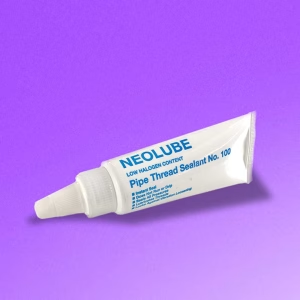
NEOLUBE® 100 is suited to standard metal-threaded applications where smooth makeup and dependable wetting are necessary. Its paste-like consistency provides a uniform film that supports alignment during assembly and cures to a durable coating for long-term industrial service. With an approximate temperature capability up to 300°F (149°C), NEOLUBE 100 is commonly used on metal valves, fittings, instrument ports, and other threaded components exposed to moderate mechanical or thermal demands.
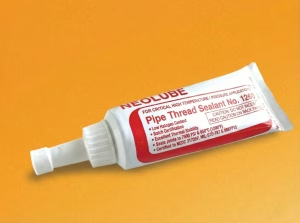
NEOLUBE® 1260, by contrast, is formulated for metal-threaded joints exposed to elevated temperature, cyclic heating, or operating conditions where a non-curing compound is preferred. Its graphite-based formulation remains pliable, allowing components to be reopened for inspection or service without the complications associated with fully cured compounds. With temperature capability up to approximately 1175°F (635°C), 1260 is used in demanding industrial environments where thermal stability, cleanliness, and future disassembly are important. Pressure behavior for both products depends entirely on system design, metallurgy, torque, and assembly practices, and should always be evaluated within the limits of the piping or equipment manufacturer.
Proper thread preparation remains essential regardless of the product selected. Clean, dry metal threads are critical for achieving a uniform sealant film and predictable torque. Applying a thin, even coat to the male threads and minimizing material on the first thread helps prevent extrusion into the bore. Once assembled, the joint must undergo the required leak or pressure testing as determined by facility procedures or applicable codes. NEOLUBE products support a controlled installation process, but the final integrity of the connection depends on system design, thread form, torque application, and commissioning procedures.
Industrial applications for NEOLUBE 100 and 1260 include metal-threaded joints in process facilities, instrumentation loops, industrial gas assemblies, and thermal environments where a paste sealant is appropriate. While these materials may be used in gas-service environments, regulated systems such as natural gas or LPG require strict adherence to industry codes and manufacturer specifications. Suitability must always be confirmed prior to installation, and all required testing should be completed before commissioning.
Safety and Compliance Notice:
Use NEOLUBE® products only on clean, dry metal-threaded joints in accordance with their TDS. Suitability for regulated gas, fuel, or refrigerant systems must be confirmed against applicable codes, equipment manufacturer specifications, and required pressure/leak testing.
Gas Pipe Thread Sealant – Frequently Asked Questions
Can NEOLUBE® products be used on natural gas or LPG metal-threaded assemblies?
NEOLUBE products are used on metal-threaded joints in many industrial environments. For regulated natural-gas or LPG systems, suitability must be confirmed with system specifications, equipment manufacturer requirements, and applicable codes before installation.
Is NEOLUBE® 100 a curing or non-curing compound?
NEOLUBE 100 cures to a durable film after installation. It is intended for standard-duty metal-threaded applications with moderate temperature exposure.
When should NEOLUBE® 1260 be used instead of NEOLUBE® 100?
NEOLUBE 1260 is preferred for metal-threaded joints exposed to elevated temperature, thermal cycling, or applications requiring future disassembly. It is non-curing and remains pliable.
Can NEOLUBE® products be used on plastic gas fittings?
No. NEOLUBE products are designed for metal-threaded joints only and are not recommended for plastic threads.
What temperature range can NEOLUBE® 1260 handle?
NEOLUBE 1260 is suitable for high-temperature industrial environments, with approximate capability up to 1175°F (635°C). Pressure performance depends entirely on system design and testing.
Do NEOLUBE® products prevent leaks?
These products support consistent fit-up and film formation, but leak integrity always depends on system design, thread condition, torque, and required leak/pressure testing.
How should metal threads be prepared before applying NEOLUBE®?
Threads must be clean, dry, and free of debris or oil residues. Proper preparation significantly improves sealing reliability.