
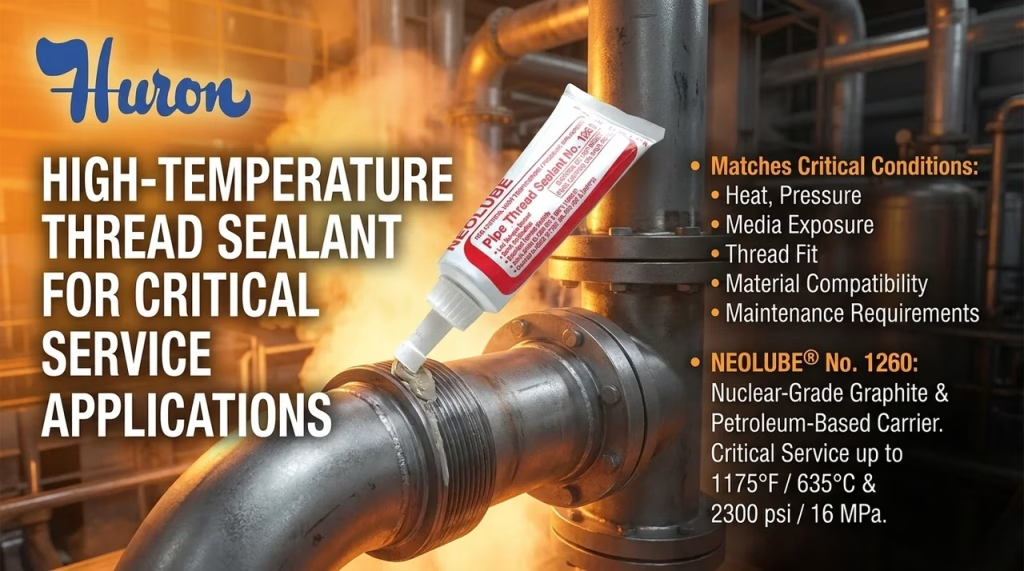
High-temperature threaded pipe joints need a sealant that matches the actual service conditions: heat, pressure, media exposure, thread fit, material compatibility, and maintenance requirements.
For Huron Industries, the best product match for this topic is NEOLUBE® No. 1260. It is a high-temperature pipe thread sealant and lubricant paste made with nuclear-grade graphite and a nuclear-quality petroleum-based carrier. It is designed for critical service applications up to 1175°F / 635°C and 2300 psi / 16 MPa.
What Critical Service Requires from a Thread Sealant
Critical service means the threaded joint operates in conditions where leakage, seizure, contamination, or difficult disassembly can create serious maintenance or reliability problems.
A thread sealant for this type of service must be evaluated against:
- Temperature: Can the material remain suitable at the joint’s operating temperature?
- Pressure: Is the sealant documented for the system pressure?
- Media compatibility: Will it contact steam, gas, hydrocarbons, oxidizers, or other chemicals?
- Thread condition: Is the joint small-diameter and close-tolerance, or does it have wide gaps?
- Serviceability: Will the joint need to come apart after long-term heat exposure?
Temperature alone is not enough. A sealant may be labeled “high temperature” and still be wrong for oxygen service, incompatible gasket materials, poor thread fit, or chemically aggressive media.
Why Standard Thread Sealants May Fall Short
PTFE tape, anaerobic pipe sealants, and general pipe dopes can work in the right conditions. Critical service is different. The sealant must handle the actual combination of heat, pressure, chemistry, and maintenance access.
| Sealant Type | Where It Fits | Critical-Service Limitation |
|---|---|---|
| PTFE tape | General threaded fittings | May not be preferred for severe heat, pressure, or controlled-material applications |
| General pipe dope | Routine maintenance sealing | May lack documented critical-service temperature, pressure, or purity data |
| Anaerobic sealant | Metal threaded joints where curing is desired | Cure behavior and temperature range must match the system |
| Graphite paste | Severe-service threaded pipe joints | Must still be checked for oxygen, oxidizers, gasket compatibility, and pipe size limits |
NEOLUBE® No. 1260: Product Fit for High-Temperature Critical Service
NEOLUBE® No. 1260 is the strongest Huron product fit for high-temperature, high-pressure threaded pipe joints.
The TDS describes it as a high-performance paste and high-temperature anti-seize compound made with nuclear-grade graphite and a nuclear-quality petroleum-based carrier. It is intended for severe conditions, including critical service applications up to 1175°F / 635°C and 2300 psi / 16 MPa.
It also has a documented high-purity profile. The TDS lists low halogen content, excellent thermal stability, and radiation resistance. These details matter in industries where material control and contamination risk are part of the specification process.
NEOLUBE® No. 1260 also supports assembly and future disassembly. It does not harden or cure, so threaded joints can remain serviceable after high-temperature exposure.
When NEOLUBE® No. 1260 Is the Right Product to Consider
NEOLUBE® No. 1260 should be considered when the application matches its documented range and limits.
It is a strong fit for:
- High-temperature threaded pipe joints requiring service up to 1175°F / 635°C.
- High-pressure threaded connections requiring resistance up to 2300 psi / 16 MPa.
- Critical service applications where sealant selection must account for heat, pressure, purity, and serviceability.
- Small-diameter, close-tolerance threaded pipe joints as specified in the product data.
- Applications requiring future disassembly because the paste does not harden or cure.
This is not a general household or low-demand maintenance sealant. It is a specialized product for demanding industrial threaded connections.
Important Compatibility Limits
NEOLUBE® No. 1260 is not suitable for every system. Its limits should be reviewed before use.
Do not use it in oxygen service. The TDS states it is not compatible with oxygen service because the oils could flash at high temperatures.
Avoid contact with strong oxidizing agents. The TDS identifies oxidizing organic chemicals such as nitrates, persulfates, perbenzoates, and peroxides as materials that should not be used with NEOLUBE® No. 1260 unless conditions are specifically reviewed.
Do not use it with gaskets made from EPDM, silicone, or neoprene. The TDS lists nitrile and Viton gasket materials as compatible.
Also check pipe size and thread fit. NEOLUBE® No. 1260 is recommended for small-diameter, close-tolerance threaded pipe joints and lists a pipe size limitation of ≤2 inches / 50.8 mm OD close-fitting threaded joints.
NEOLUBE® No. 1260 vs. NEOLUBE® No. 100
NEOLUBE® No. 1260 is the correct product focus for this article. NEOLUBE® No. 100 is a different type of pipe thread sealant with a lower temperature profile.
NEOLUBE® No. 100 is an anaerobic pipe thread sealant for locking and sealing metal pipes and fittings. It provides lubricity during assembly, immediate low-pressure sealing, and cures to a solid for sealing and securing threaded pipe connections. Its continuous temperature resistance is listed up to 300°F / 149°C.
| Selection Point | NEOLUBE® No. 1260 | NEOLUBE® No. 100 |
|---|---|---|
| Best-fit use | High-temperature, high-pressure critical service | Lower-temperature metal pipe-thread sealing |
| Product type | Graphite paste sealant/lubricant | Anaerobic pipe thread sealant |
| Cure behavior | Does not harden or cure | Cures to a solid |
| Service temperature | Up to 1175°F / 635°C | Up to 300°F / 149°C continuously |
| Pressure data | Up to 2300 psi / 16 MPa | Full pressure and solvent resistance require cure |
| Serviceability | Designed for easier disassembly after high-temperature service | May be disassembled with hand tools; heat may be needed in some cases |
For high-temperature critical service, use NEOLUBE® No. 1260 as the primary product reference. Use NEOLUBE® No. 100 only when the application fits its lower-temperature anaerobic sealant profile.
Application Notes for NEOLUBE® No. 1260
Follow the product data sheet and confirm suitability before use.
Basic application steps:
- Clean the threaded surfaces.
Remove contamination before applying the paste. - Knead the tube well.
This prepares the paste for consistent application. - Apply evenly and fill the threads completely.
The paste should fill the thread area before assembly. - Assemble and tighten the threaded joint.
Use accepted trade practices and the system’s tightening requirements. - Close the cap tightly after use.
This helps prevent contamination and keeps the material usable.