
Metal-threaded HVAC connections in industrial and mechanical-room environments face a range of challenges that stem from thread wear, contamination, misalignment, and thermal expansion. These conditions can make it difficult to achieve a consistent, leak-tight fit-up, especially where water, glycol, and auxiliary hot-water systems are involved. A paste-type sealant is often preferred because it helps stabilize alignment, wets the surface more reliably than tape, and fills micro-irregularities on the thread flanks. In facilities where dependability and clean installation practices are necessary, NEOLUBE® 100 and NEOLUBE® 1260 provide two distinct solutions for metal-threaded HVAC joints.
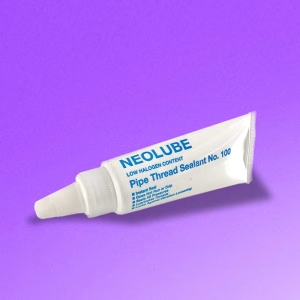
NEOLUBE® 100 is generally suited for threaded joints in chilled water, hot water, glycol circuits, and similar industrial piping. Its smooth application assists in achieving proper alignment and torque while leaving a consistent film that cures to a durable coating once the system is placed in service. With a service temperature capability up to approximately 300°F (149°C), it is used on valves, manifolds, fittings, air-handler accessories, and instrumentation points that require predictable assembly behavior.
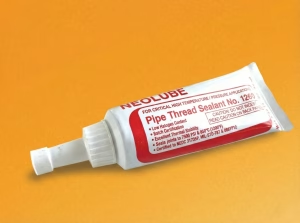
NEOLUBE® 1260 is designed for metal-threaded joints located in higher-temperature zones such as boiler-adjacent piping or industrial hot sections where serviceability is important. The compound does not cure, allowing joints to be reopened for inspection or adjustment without damaging the threads. Its thermal stability—up to approximately 1175°F (635°C)—makes it well suited for environments where metal-threaded components experience significant temperature cycling or mechanical stress. Pressure performance is always governed by system design and must not be interpreted as a standalone product rating.
Successful HVAC assembly depends heavily on preparation. Thorough cleaning and inspection of the threads ensure that contaminants, burrs, or oil residues do not interfere with the sealant’s ability to wet the surface. Applying the material sparingly, particularly on the first threads, helps maintain bore cleanliness and prevents material from entering the system. After assembly, technicians must perform the appropriate leak or pressure tests prescribed by facility protocols or equipment specifications.
Neolube® 100 vs 1260 at a glance
| Attribute | Neolube® 100 | Neolube® 1260 |
| Service temperature (approx.) | Up to 300°F / 149°C | Up to 1175°F / 635°C |
| Service pressure (approx.) | HVAC general service | Up to ≈2300 psi |
| Curing behavior | Pastelike, sets in service | Non-curing for easy disassembly |
| Rework, serviceability | Standard | Excellent for critical joints |
| Typical joints | Valves, fittings, manifolds, unions | High-side, hot sections, boiler-adjacent |
| Typical media | Water, glycol, general HVAC | Elevated temp or pressure services |
| Install feel | Smooth, helps alignment | Dense, stays put under stress |
| Docs | TDS, SDS, spec sheet | TDS, SDS, spec sheet |
Industrial HVAC systems rely on consistent installation practices, and NEOLUBE sealants are frequently used for metal-threaded joints where paste compounds are appropriate. For refrigerant systems or any regulated piping application, suitability must be confirmed with manufacturer recommendations and governing codes before use. The performance of the system depends on proper installation, torque control, and mandated testing procedures.
Safety and Compliance Notice:
Use NEOLUBE® only on clean, dry metal-threaded joints. Confirm suitability for regulated refrigerant, gas, or pressure-rated HVAC systems before application. Follow all applicable codes, manufacturer specifications, and required test procedures.
HVAC Metal-Thread Sealant – Frequently Asked Questions
Can NEOLUBE® be used on HVAC water or glycol piping?
Yes. NEOLUBE 100 is frequently used on metal-threaded joints carrying water or glycol in industrial HVAC systems where a paste-type sealant is appropriate.
Is NEOLUBE® rated for refrigerant systems?
Refrigerant systems are regulated pressure circuits. NEOLUBE may be used on certain metal-threaded accessory fittings only if permitted by the equipment manufacturer. Always follow OEM specifications.
What is the temperature capability of NEOLUBE® 100?
NEOLUBE 100 supports industrial HVAC metal-threaded applications up to approximately 300°F (149°C).
Why would someone choose NEOLUBE® 1260 for HVAC work?
NEOLUBE 1260 is suitable for higher-temperature metal-threaded joints near boilers or industrial hot sections. Its non-curing behavior also helps in applications requiring periodic disassembly.
Do NEOLUBE® products work on tape-damaged threads?
Paste sealants can help improve assembly feel on threads that have minor imperfections, but threads must still be inspected and cleaned before installation.
Can NEOLUBE® be used on plastic HVAC threads?
No. NEOLUBE products are intended only for metal-threaded assemblies.
Do NEOLUBE® products ensure leak-free performance?
They support consistent assembly, but final leak integrity depends on system design, thread quality, torque control, and required pressure/leak testing.