
Why do buyers ask for low halogen in the first place
In many industrial environments, the issue is not just whether a sealant can stop leakage. The issue is whether the product is suitable for the level of review the application calls for. That is why low-halogen requirements tend to show up in jobs where the buyer is looking more carefully at chemistry, material compatibility, and documentation, not just basic sealing performance.
This usually happens in systems where the threaded connection is part of something more sensitive or more tightly controlled. The spec may be trying to reduce uncertainty around impurities. It may be tied to the materials in the joint. Or it may simply reflect the fact that the buyer needs a product that can be approved with confidence, not just installed.
That is also why low halogen often sits alongside other purity-related checks rather than standing alone. In real buying decisions, it is rarely the only question that matters.
Where the requirement usually matters
Low-halogen requirements tend to matter most in metal-threaded systems that already receive closer technical review. Instrumentation lines, power plant piping, electrical conduit, and other industrial threaded-joint applications are common examples. In those settings, the buyer often needs something more specific than a general-purpose sealant, especially when chemistry, material fit, and documentation are being reviewed together.
It can also matter where the fitting materials or operating environment raise the stakes of product selection. That does not automatically make the application critical service, but it does explain why low-halogen language appears more often in spec-driven industrial work than in everyday maintenance conversations.
When the spec may be asking for more than the job needs
Low halogen can also be overused. Sometimes the requirement is inherited from an older project and carried forward without much review. Sometimes it is treated like a shortcut for premium quality. And sometimes it gets more attention than the actual service conditions deserve.
Stainless steel is a good example. A stainless fitting does not automatically mean a low-halogen thread sealant is required. The better question is whether the application, project standard, or plant requirements actually call for that level of impurity control. If they do, the requirement is meaningful. If they do not, the buying decision should return to the broader operating conditions instead of defaulting to a more specialized product than the job needs.
That matters because the wrong kind of over-specification can make product selection more complicated without improving the outcome. A sealant still has to fit the service, not just the language in the document.
What else should be checked before approval
Low halogen should never be reviewed in isolation. A product can look right on one line of a data sheet and still be the wrong choice for the application. Temperature, pressure, service chemistry, material compatibility, and the way the sealant behaves in the joint all need to be checked alongside impurity-related requirements.
That is usually where the real decision becomes clearer. Some jobs need a sealant with cleaner chemistry and solid industrial documentation, but otherwise fall within a more general operating range. Other jobs involve higher temperatures, tighter tolerances, more demanding service, or stricter qualification requirements. In those cases, the product choice should follow the full service profile, not just one phrase in the spec.
The same is true for chemical restrictions. If the service environment rules out a product because of oxygen-rich conditions, strong oxidizers, or another compatibility issue, that will matter more than low halogen by itself. In other words, low halogen can be important, but it is still only one part of a proper review.
Choosing between NEOLUBE® No. 100 and NEOLUBE® No. 1260
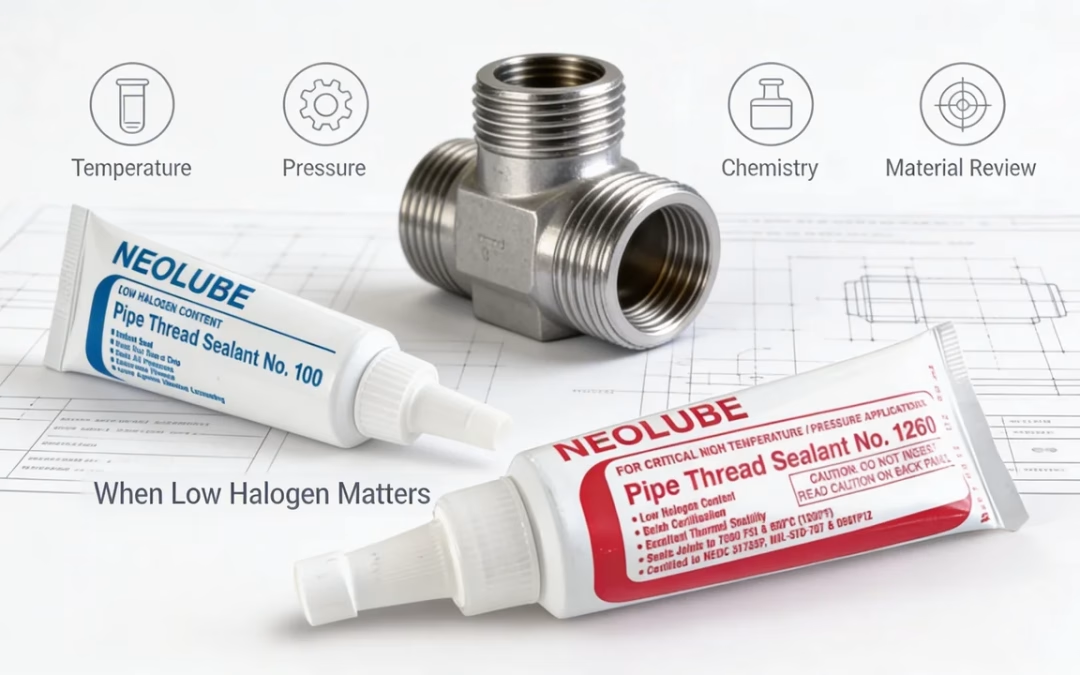
When the requirement is mainly about cleaner chemistry for metal-threaded service, NEOLUBE® No. 100 is the practical place to start. Huron presents it as a high-performance thread sealant with low halogen content and high chemical purity for locking and sealing metal pipes and fittings. Its listed uses include instrumentation, electrical conduit, power plant piping systems, pumps and valves, low-pressure steam lines, and rad-waste systems, which makes it a strong fit for many industrial applications where the review is focused on controlled chemistry and documented metal-thread performance.
The documented numbers help make that more concrete. NEOLUBE® No. 100 lists halogen content at 200 ppm maximum, along with chlorine content at 200 ppm maximum, and is rated for continuous service up to 300°F (149°C). For many industrial metal-thread applications, that is a practical fit when the need is cleaner chemistry and reliable sealing performance without stepping into a more severe-service product category.
When the application moves into a more demanding category, NEOLUBE® No. 1260 becomes the better path to review. Huron positions it for small-diameter, close-tolerance threaded pipe joints in critical service, with high chemical purity, low halogen content, excellent thermal stability, and excellent radiation resistance. Its typical purity data lists total halogen below 25 ppm, and its service limits extend to 1175°F (635°C) and 2300 psi (16 MPa).
That is the real step-up distinction. NEOLUBE® No. 100 covers many low-halogen industrial sealing needs, but NEOLUBE® No. 1260 moves into a different class of service when the application involves substantially higher temperature, higher pressure, tighter joint conditions, or more demanding qualification requirements.
Why the limitations matter too
A comparison like this is only useful if the limits are just as clear as the benefits. NEOLUBE® No. 100 is not normally recommended for use on plastics, especially thermoplastics where stress cracking could result. It is also not recommended for pure oxygen or oxygen-rich systems and should not be selected for chlorine or other strong oxidizing materials.
That matters because low-halogen language by itself does not override compatibility limits. A product may look right from a purity standpoint and still be the wrong choice for the system. That is one reason a low-halogen review should always sit inside a broader application check, not replace it.
What a spec reviewer should confirm
Before approving a low-halogen thread sealant, it helps to ask a few simple questions. Is the requirement tied to a real project or plant standard, or is it older wording that has simply been reused? Do the fitting materials, operating temperature, pressure, and service chemistry align with the product’s intended use? And does the application only call for cleaner chemistry, or does it also call for a more demanding level of service and qualification?
That kind of review usually leads to better decisions than focusing on one phrase by itself. It also helps separate a genuinely useful requirement from language that sounds important but may not actually change the right product choice.
Final thought
Low-halogen thread sealant matters when the requirement is tied to something real, such as impurity control, sensitive-metal service, approval risk, or a more demanding operating environment. It matters much less when it is being used as a general signal of quality without checking the rest of the application.
For many industrial metal-thread applications, NEOLUBE® No. 100 is the practical low-halogen path, especially where the service profile fits a product rated to 300°F (149°C) with 200 ppm maximum halogen content. When the application becomes tighter, hotter, more demanding, or more heavily reviewed, NEOLUBE® No. 1260 is the stronger product to evaluate next, with typical total halogen below 25 ppm, service up to 1175°F (635°C), and pressure resistance to 2300 psi (16 MPa). That is the better way to make the decision, by matching the sealant to the service, not just to the wording in the spec.