
HVAC/R systems often incorporate metal-threaded accessories such as gauge ports, service valves, adapters, and instrumentation tees that benefit from a paste-type thread sealant during installation. These components rely on the thread interface rather than a flare or gasketed face to achieve tightness, and a consistent, uniform film can significantly improve alignment and assembly feel. NEOLUBE® 100 and NEOLUBE® 1260 are used on such metal-threaded joints in industrial environments where a paste formulation is appropriate and where permitted by equipment manufacturer guidelines.
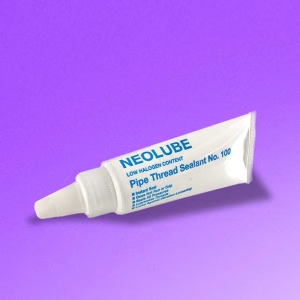
Refrigerant circuits themselves are regulated pressure systems, and any thread sealant used in these applications must align with the manufacturer’s specifications and applicable codes. When used on metal-threaded accessories external to the refrigerant sealing faces, NEOLUBE® 100 provides smooth makeup and predictable performance in standard environments. Its approximate temperature limit of 300°F (149°C) makes it suitable for compressors, condensers, receivers, and auxiliary piping components where a clean, cured film is acceptable.
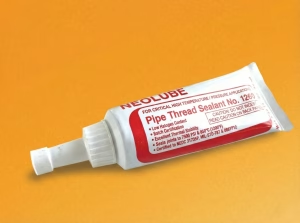
NEOLUBE® 1260 offers a non-curing alternative for higher-temperature industrial environments and for applications that may require future disassembly. Its graphite-based structure allows it to remain pliable while maintaining film integrity, making it well suited for metal-threaded joints exposed to thermal cycling, elevated temperature, or periodic inspection. The approximate temperature capability extends to 1175°F (635°C), although actual performance always depends on system design, metallurgy, torque, and installation practices.
Thread preparation is essential for successful assembly in HVAC/R environments. Refrigerant oils such as POE, PAG, and mineral oil can leave residues on metal surfaces that interfere with sealant wetting and may contribute to weeping after startup. Cleaning the threads, ensuring proper alignment, and applying a thin coat of sealant to the male threads while keeping sealing faces clean helps maintain system integrity. Once assembled, the joint must undergo nitrogen pressure testing and vacuum hold testing according to the equipment manufacturer’s procedures.
NEOLUBE® products improve assembly consistency on metal-threaded components, but they are not applied to flare faces, O-rings, Schrader cores, or any sealing faces integral to the refrigerant seal itself. Their use is limited to metal threads that rely on the thread interface for engagement and where equipment specifications permit paste application. The system’s final performance depends on proper preparation, torque, and compliance with OEM and regulatory requirements.
Safety and Compliance Notice:
Use NEOLUBE® products only on clean, dry metal-threaded joints in accordance with the TDS. For refrigerant systems, always follow equipment manufacturer specifications, applicable codes, and required leak/pressure testing.
Refrigerant & AC Metal-Threaded Accessories – Frequently Asked Questions
Can NEOLUBE® be used directly on refrigerant sealing faces?
No. NEOLUBE should never be applied to flare faces, O-rings, gasket surfaces, or Schrader cores. It is only for metal threads that rely on the thread interface for engagement.
Is NEOLUBE® compatible with common refrigerant oils?
NEOLUBE may be used on metal-threaded accessories where the equipment manufacturer allows paste sealants. Always review system chemistry and OEM guidance before use.
What role does oil contamination play in refrigerant leaks?
Refrigerant oils such as POE, PAG, and mineral oils can leave films that prevent sealants from properly wetting the metal surface, leading to weeping or instability after startup.
When should NEOLUBE® 1260 be used in an HVAC/R environment?
NEOLUBE 1260 is chosen for industrial or elevated-temperature situations involving metal-threaded components that may require future disassembly or that experience thermal cycling.
Can NEOLUBE® be used on straight-thread gauge ports?
Yes, if the port relies on the thread interface for sealing and the OEM allows paste sealants. Always follow the equipment manufacturer’s instructions.
How should a technician prepare metal threads before applying a sealant?
Threads must be completely degreased, dried, and inspected to remove oil films, burrs, or debris. Preparation is critical to achieving a stable assembly.
Does NEOLUBE® help systems pass nitrogen or vacuum tests?
NEOLUBE supports consistent assembly of metal-threaded components, but system performance depends on proper installation, torque, cleaning, and mandatory pressure/vacuum testing.