
Leaks in hydraulic fittings and compressor lines are not always caused by missing sealant. In many cases, the real problem is the fitting type, thread condition, torque, alignment, or a sealing surface that was never designed to rely on the threads in the first place. Sealant choice should begin with how the fitting is designed to seal, not with the product being considered.
In hydraulic and compressed-air systems, some metal-threaded connections are designed to seal on the threads and can benefit from a properly selected thread sealant. Others seal at a flare, an O-ring, a bonded washer, or a compression surface. In those cases, adding sealant may be unnecessary or simply the wrong approach. For Huron, the practical question is where sealant actually belongs in the assembly, and where it does not.
Quick answer
Thread sealant can be useful on hydraulic fittings and compressor lines, but only when the connection is designed to seal on the threads. Many hydraulic and air-system fittings seal through flare, compression, bonded washer, or O-ring geometry instead, so adding sealant may be unnecessary or incorrect. For suitable metal-threaded fittings, the right sealant should support leak prevention, assembly reliability, and material compatibility.
Start with the fitting, not the sealant
Before choosing any sealant, three questions matter most:
- Does the fitting seal on the threads
- Is it a metal-threaded connection
- Do the materials and service conditions match the sealant
That sequence helps prevent the most common mistake in this category, using a thread sealant on a connection that was never meant to seal at the threads. A correctly selected sealant can support a properly designed joint. It cannot turn the wrong fitting style into the right one.
Why hydraulic and compressor fittings leak in the first place
Leaks are often blamed on the visible threads, but that is only part of the story.
A flare fitting may leak because the flare seat is damaged. A straight-thread fitting may leak because the O-ring is cut, missing, or out of place. A compression fitting may leak because the ferrule was installed incorrectly. Even on threaded joints, the cause may be worn threads, contamination, poor alignment, or incorrect tightening.
That is why sealant should be treated as one part of assembly logic, not as a universal fix for every leak.
Which fittings seal on the threads, and which do not
For hydraulic and compressor systems, the most useful distinction is whether the connection seals on the threads or somewhere else.
| Fitting style | Where it usually seals | Thread sealant usually needed |
|---|---|---|
| NPT-style tapered metal threads | On the threads | Often yes |
| Straight thread with O-ring | At the O-ring | Usually no |
| Flare fittings, including JIC-style | At the flare seat | Usually no |
| Compression fittings | At the ferrule or compression surface | Usually no |
| Bonded washer style connections | At the washer interface | Usually no |
This does not need to become a full guide to fitting standards. The key point is simpler than that. If the fitting is not intended to seal on the threads, thread sealant is unlikely to be the real solution.
Where thread sealant belongs in hydraulic and compressor systems
Thread sealant belongs where the fitting is metal-threaded, designed to seal on the threads, and operating conditions fit the product.
In those cases, the right sealant can help with:
- Thread Void Filling
- Lubricity During Assembly
- Immediate Low-Pressure Sealing
- Resistance To Loosening From Shock And Vibration
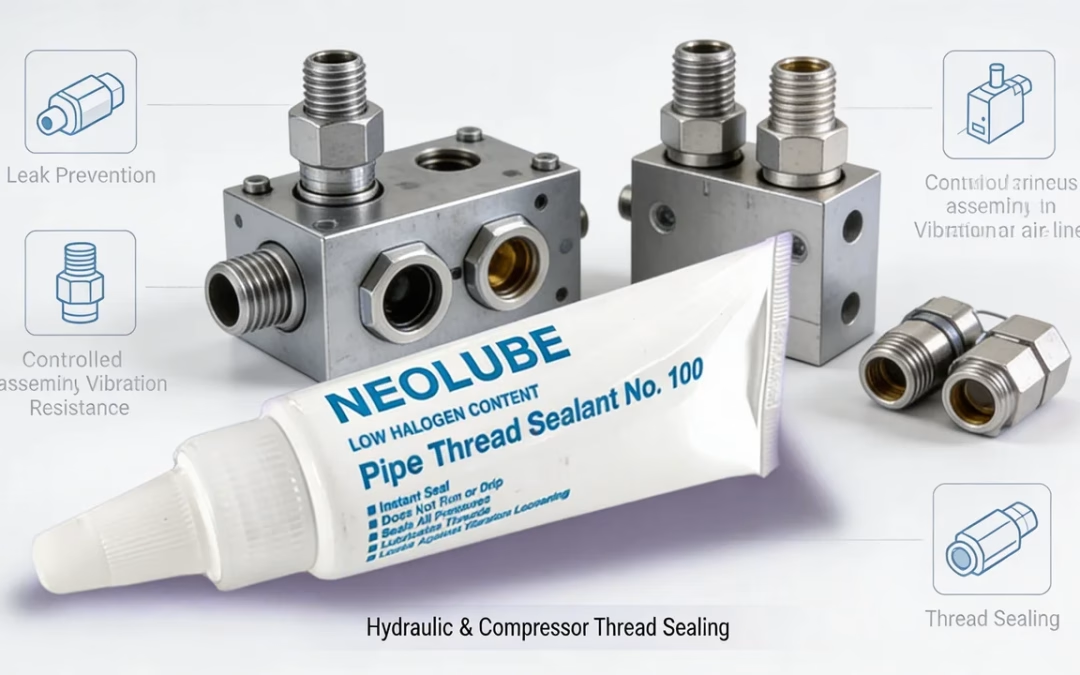
Within Huron’s pipe thread sealant range, NEOLUBE® No. 100 is formulated for locking and sealing metal pipes and fittings. It is a smooth, creamy, off-white paste with very high viscosity and an anaerobic cure profile. It is also recommended for application areas that include hydraulics, compressors, instrumentation, pumps and valves, water and coolant systems, gas lines, controls, and electrical conduit. Properly tightened fittings seal instantly to moderate pressures, while maximum pressure and solvent resistance develop after a minimum 24-hour cure.
Where thread sealant should not be used
This is where many articles become too broad. Sealant does not belong on every hydraulic or compressor connection.
It may be the wrong choice when:
- The fitting seals at a flare, O-ring, bonded washer, or compression surface
- The leak is being caused by thread damage, misalignment, or poor sealing geometry
- The connection uses materials that may be incompatible with the sealant
- The service involves pure oxygen, oxygen-rich conditions, chlorine, or other strong oxidizing materials
With NEOLUBE® No. 100, plastics require added caution. It is not normally recommended for plastics, especially thermoplastics where stress cracking may occur. Materials such as ABS, polycarbonate, vinyl, and methacrylates may also soften or craze, so compatibility should always be reviewed before the product is specified.
What changes between hydraulic service and compressor service
Hydraulic systems and compressor lines are often discussed together, but the operating concerns are not always identical.
Hydraulic systems are usually more sensitive to fluid containment, fitting integrity, and correct assembly under pressure. Compressor lines often bring more concern around vibration, repeated cycling, and maintenance intervals. Even so, the same rule applies in both cases: sealant should be used only where the fitting design calls for thread sealing.
That is one reason NEOLUBE® No. 100 fits this topic well. Its listed application areas include both hydraulics and compressors, and its cure behavior is intended to help prevent loosening and leakage from shock and vibration in close-fitting metal-threaded assemblies.
What to look for in a sealant for metal-threaded connections
If the connection is designed to seal on metal threads, the useful product traits are usually practical and application-specific.
Look for:
- Suitability for metal pipes and fittings
- Lubricity during assembly
- Clear cure behavior
- Clear material compatibility guidance
- Clear operating limits for temperature and media
For NEOLUBE® No. 100, those traits include a one-component anaerobic formulation, very high viscosity, lubricity during assembly, immediate low-pressure sealing, and continuous temperature resistance to 300°F and 149°C. Huron’s product guidance also keeps the limitations visible, which is important for specification work and procurement review.
Where a paste-style anaerobic sealant fits
For metal-threaded hydraulic fittings and compressor-related threaded joints that are intended to seal on the threads, a paste-style anaerobic sealant can make sense when fuller thread coverage and controlled assembly feel matter.
That is where NEOLUBE® No. 100 fits best. It is positioned for locking and sealing metal pipes and fittings, with common use across hydraulics, compressors, pumps and valves, instrumentation, and related piping systems. The fit is specific rather than universal, which is exactly how this type of product should be positioned in industrial content.
For applications outside that range, selection should be based on the specific operating conditions, materials, and service requirements of the joint. Huron also offers NEOLUBE® No. 1260 for higher-temperature and more severe-service threaded applications, but it should be reviewed as a separate product choice rather than treated as interchangeable with NEOLUBE® No. 100.
What thread sealant cannot correct
Even when the product is well matched, thread sealant cannot correct:
- Damaged sealing surfaces
- The wrong fitting type
- Misalignment during assembly
- Damaged or missing O-rings
- Poor torque practices
- Worn or poorly cut threads
That distinction matters because maintenance problems are often assigned to the sealant when the real cause is elsewhere in the joint.
Common installation mistakes that create leaks
A few mistakes show up repeatedly in hydraulic and compressor maintenance work:
- Using Sealant where the fitting does not seal on the threads: This is the most common selection error.
- Applying too much product: Excess material does not compensate for the wrong fitting type or poor thread condition.
- Ignoring material compatibility: This is especially important where plastics or coated surfaces are involved.
- Skipping surface preparation: Clean threads matter. Product guidance for No. 100 calls for clean internal and external surfaces before application.
- Ignoring application guidance: For No. 100, the recommended method is a 360-degree bead on the leading male threads while leaving the first thread free, with additional material on female threads when larger voids require it.