
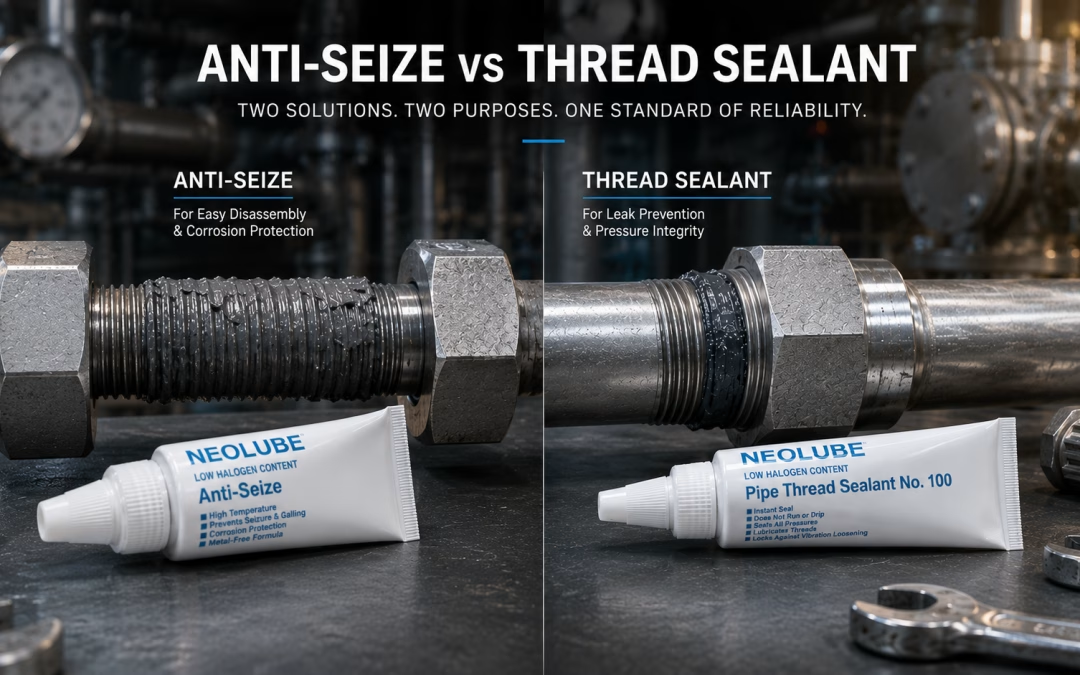
When threaded connections face heat, pressure, vibration, or corrosive service, product selection should start with the failure risk. Use anti-seize when the concern is galling, seizure, corrosion, or disassembly. Use thread sealant when the concern is leakage through pipe threads or fittings.
Some compounds support both lubrication and sealing. For high-temperature, high-pressure threaded pipe joints, NEOLUBE® No. 1260 is the key Huron product to evaluate because it combines thread sealing, anti-seize performance, pressure resistance, and non-hardening serviceability.
Anti-Seize vs Thread Sealant: The Short Answer
Anti-seize is mainly for thread protection and serviceability. It helps threaded parts assemble smoothly and reduces the risk of seizure in demanding environments.
Thread sealant is mainly for leakage control. It fills gaps between mating threads so pipe and fitting connections can better resist fluid, gas, steam, or oil leakage.
Some products can serve both roles. NEOLUBE® No. 1260 is a high-temperature anti-seize compound, thread sealant paste, bolt lubricant, and sealant/lubricant for critical service applications up to 1175°F / 635°C and 2300 psi / 16 MPa.
| Selection Factor | Anti-Seize | Thread Sealant |
|---|---|---|
| Main purpose | Lubrication and anti-seize performance | Leakage control |
| Main concern | Galling, corrosion, seizure, disassembly | Fluid, gas, steam, or oil leakage |
| Common use | Bolts, studs, threaded parts, high-heat assemblies | Pipe threads and fittings |
| Cure behavior | Often non-hardening, depending on product | May cure or remain paste-like, depending on product |
Why High Temperature Changes the Decision
Heat can increase oxidation, change material behavior, make removal harder, and expose weak sealing choices.
For fasteners, the main issue is often galling or seizure. For pipe threads, the main issue is often leakage. For critical threaded pipe joints, both can matter.
That is why high-temperature service needs more than a generic thread compound. The selected product must match the operating temperature, pressure, media, materials, and maintenance requirements.
When to Use Anti-Seize
Use anti-seize when the priority is lubrication, galling resistance, corrosion-related seizure control, or future disassembly.
Typical selection drivers include:
- High operating temperature
- Dissimilar metals
- Corrosive or difficult service conditions
- Repeated maintenance or inspection
- Risk of damaged threads during removal
NEOLUBE® No. 1260 fits this side of the comparison because it is a high-temperature anti-seize compound and can also be used as a bolt lubricant or anti-seize compound.
Disassembly Matters
High-temperature connections often create the biggest maintenance problem during removal. Heat and oxidation can lock threaded parts together.
NEOLUBE® No. 1260 remains non-hardening and non-curing, which supports disassembly after high-temperature service.
When to Use Thread Sealant
Use thread sealant when the connection must help prevent leakage. This applies to threaded pipe and fitting connections carrying compatible media such as air, water, gas, hydrocarbons, coolants, or low-pressure steam, depending on the product and service conditions.
NEOLUBE® No. 100 is a curing pipe thread sealant for locking and sealing metal pipes and fittings. It provides lubricity for assembly, immediate low-pressure sealing, and cures to a solid for sealing and securing threaded pipe connections. It withstands continuous temperatures to 300°F / 149°C.
Curing Sealant vs Non-Hardening Paste
Cure behavior affects installation, sealing, and maintenance. NEOLUBE® No. 100 cures anaerobically when confined between close-fitting metal surfaces. It is suited for metal pipe and fitting sealing where a cured sealant is appropriate.
NEOLUBE® No. 1260 does not harden or cure. It is used where the application requires high-temperature service, pressure resistance, lubrication, sealing support, and later disassembly within product limits.
What to Check Before Choosing
Before selecting anti-seize or thread sealant, confirm:
- Operating temperature
- System pressure
- Thread type and pipe size
- Process media
- Metal and gasket compatibility
- Need for future disassembly
- Oxygen or oxidizer exposure
- Cure or non-hardening behavior
For high-temperature, high-pressure threaded pipe joints, NEOLUBE® No. 1260 is the closest Huron match because it is rated for critical service up to 1175°F / 635°C and 2300 psi / 16 MPa.
Where NEOLUBE® No. 1260 Fits
NEOLUBE® No. 1260 is the primary Huron product for high-temperature anti-seize vs thread sealant applications.
It is used as:
- A high-temperature anti-seize compound
- A thread sealant paste
- A bolt lubricant
- A sealant/lubricant for critical service
- A non-hardening paste for easier disassembly
- A product for small-diameter, close-tolerance threaded pipe joints in critical service
NEOLUBE® No. 1260 is rated up to 1175°F / 635°C and 2300 psi / 16 MPa. Above 255°F, the petroleum-based carrier begins to volatilize, while the graphite component remains present and performs up to 1175°F.
Important Limits
It is not compatible with oxygen service because the oils could flash at high temperatures. It should also avoid strong oxidizing agents. It should not be used with EPDM, Silicone, or Neoprene gaskets. Nitrile and Viton gasket materials are compatible. Pipe size is limited to close-fitting threaded joints up to 2 inches / 50.8 mm OD.
NEOLUBE® No. 100 also has limits. It is not normally recommended for plastics, especially thermoplastics where stress cracking may occur. It is not recommended for pure oxygen or oxygen-rich systems and should not be selected for chlorine or other strong oxidizing materials.
NEOLUBE® No. 1.1 should not be treated as a pipe thread sealant. It is a dry-film lubricant, anti-seize compound, thread lubricant, and lubricant for moving parts and rubbing surfaces. It is also not recommended for oxygen systems.
Quick Selection Guide
| Situation | Product Direction |
|---|---|
| Fastener needs lubrication and later removal | Anti-seize |
| Pipe thread needs leakage control | Thread sealant |
| High-temperature, high-pressure close-tolerance threaded pipe joint | Evaluate NEOLUBE® No. 1260 |
| Metal pipe thread needs curing sealant up to 300°F / 149°C | Evaluate NEOLUBE® No. 100 |
| Dry-film lubrication or anti-seize without pipe-thread sealing | Evaluate NEOLUBE® No. 1.1 |
FAQs
Can anti-seize seal pipe threads?
Only when the product is designed for thread sealing. General anti-seize should not be assumed to seal pipe threads.
NEOLUBE® No. 1260 is both a high-temperature anti-seize compound and thread sealant paste.
Can thread sealant work as anti-seize?
Only when the product is intended for that role. NEOLUBE® No. 100 provides lubricity during assembly, but it is primarily a curing pipe thread sealant. NEOLUBE® No. 1260 is the better fit when anti-seize behavior, high-temperature service, sealing support, and disassembly are all part of the requirement.
What should be used on high-temperature threaded pipe joints?
For high-temperature, high-pressure, close-tolerance threaded pipe joints, evaluate NEOLUBE® No. 1260 against the application requirements. It is rated up to 1175°F / 635°C and 2300 psi / 16 MPa.
What if the joint must be disassembled later?
Use a non-hardening product with suitable temperature, pressure, media, and compatibility limits. NEOLUBE® No. 1260 does not harden or cure, which supports disassembly after high-temperature service.
Is NEOLUBE® No. 1260 suitable for oxygen service?
No. NEOLUBE® No. 1260 is not compatible with oxygen service.