
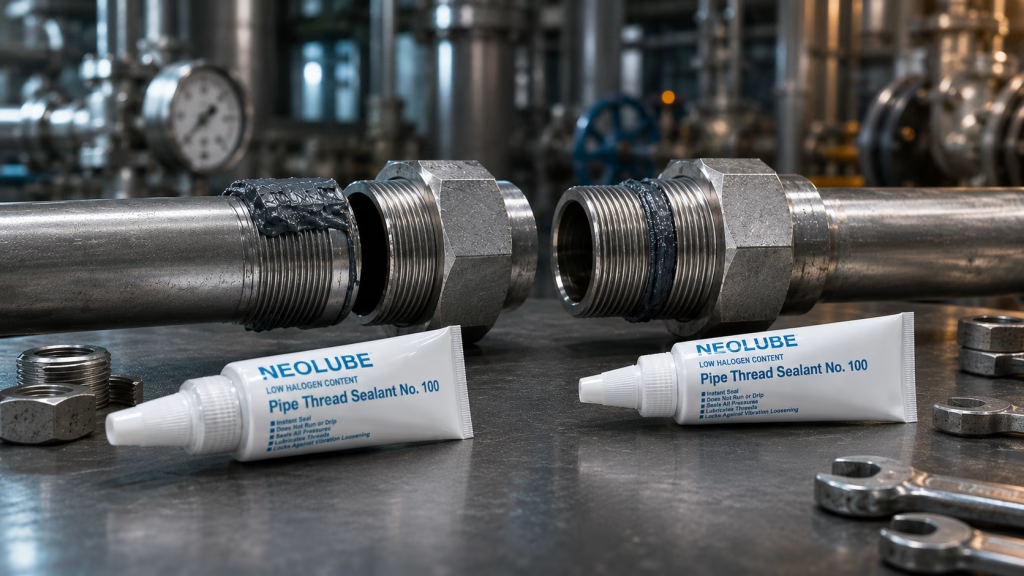
A threaded connection has to do more than seal. In maintenance work, it also has to support the way the joint will be serviced later, including disassembly, rework, heat exposure, pressure demands, and material compatibility.
That is why the difference between a non-hardening thread sealant and a hard-setting compound matters. A non-hardening sealant is typically selected when service access and future disassembly are priorities. A hard-setting compound is selected when the application needs a cured seal on compatible threaded connections.
For Huron, the product fit is clear: NEOLUBE® No. 1260 aligns with non-hardening, high-temperature, high-pressure service where disassembly matters, while NEOLUBE® No. 100 fits the hard-setting side because it cures to a solid on compatible metal pipe and fitting assemblies.
What Is a Non-Hardening Thread Sealant?
A non-hardening thread sealant remains paste-like or serviceable after assembly. It does not form a rigid solid. This matters when threaded joints may need to be opened later for inspection, repair, replacement, or adjustment.
NEOLUBE® No. 1260 fits this non-hardening use case. Joints sealed with NEOLUBE® No. 1260 are easy to disassemble even after years of high-temperature service because the paste does not harden or cure. It is also rated for service up to 1175°F / 635°C and 2300 psi / 16 MPa.
That makes non-hardening behavior useful where service access matters. Temperature, pressure, thread size, materials, media, and compatibility still need to match the application.
What Is a Hard-Setting Thread Sealant?
A hard-setting thread sealant cures or sets after assembly. In anaerobic products, curing happens when the sealant is confined between close-fitting metal surfaces without air.
NEOLUBE® No. 100 is the curing comparison product. It is a pipe thread sealant for locking and sealing metal pipes and fittings. It provides lubricity for assembly, immediate low-pressure sealing, and cures to a solid for sealing and securing threaded pipe connections.
This type of sealant is useful when a cured seal is the desired behavior. It also requires cure-time planning. NEOLUBE® No. 100 can seal properly tightened fittings instantly to moderate pressures, but maximum pressure and solvent resistance require a minimum 24-hour cure.
Non-Hardening vs Hard-Setting Thread Sealants
| Selection Factor | Non-Hardening Thread Sealant | Hard-Setting / Curing Compound |
|---|---|---|
| Cure behavior | Remains serviceable; does not harden or cure when designed that way | Cures or sets after assembly |
| Main advantage | Easier future disassembly and rework | Cured sealing and securing |
| Maintenance fit | Useful where joints may need inspection or removal | Useful where a cured seal is preferred |
| Service planning | Check pressure, temperature, materials, and media | Check cure time, pressure, temperature, materials, and media |
| Huron product fit | NEOLUBE® No. 1260 | NEOLUBE® No. 100 |
| Key limitation | Not for every chemical or gasket material | Not for all substrates or oxygen-rich systems |
When to Choose a Non-Hardening Thread Sealant
Choose a non-hardening thread sealant when future maintenance access matters. This includes threaded joints that may need to be disassembled after heat exposure, inspection points, equipment that may be serviced regularly, and assemblies where anti-seize behavior is useful.
NEOLUBE® No. 1260 is the product to feature for this topic. It is a high-performance paste and high-temperature anti-seize compound composed of nuclear-grade graphite and a nuclear-quality petroleum-based carrier. It is recommended for small-diameter, close-tolerance threaded pipe joints in critical service.
Use this positioning carefully: NEOLUBE® No. 1260 is not a universal sealant. It is not compatible with oxygen service, and it should not be used with EPDM, silicone, or neoprene gaskets.
When to Choose a Hard-Setting Compound
Choose a hard-setting compound when the application needs a cured seal on compatible threaded metal connections.
NEOLUBE® No. 100 fits that side of the comparison. It is designed for metal pipes and fittings and cures to a solid. Typical applications include instrumentation, hydraulics, pumps and valves, fuel oil piping, water/coolant systems, compressors, gas lines, electrical conduit, and low-pressure steam lines.
Do not position NEOLUBE® No. 100 as non-hardening. Its value is different: it is a curing anaerobic pipe thread sealant. It is also not normally recommended for plastics and is not recommended for pure oxygen, oxygen-rich systems, chlorine, or other strong oxidizing materials.
Huron Product Fit
| Product | Best Role in This Article | Cure Behavior | Key Use Case | Important Limits |
|---|---|---|---|---|
| NEOLUBE® No. 1260 | Primary product match | Does not harden or cure | High-temperature, high-pressure threaded joints where disassembly matters | Not compatible with oxygen service; avoid EPDM, silicone, and neoprene gaskets |
| NEOLUBE® No. 100 | Secondary comparison product | Cures to a solid | Metal pipe and fitting applications needing a cured anaerobic seal | Not normally recommended for plastics; not for oxygen-rich systems or strong oxidizers |
FAQs
Does non-hardening thread sealant cure?
No, not when the product is designed as non-hardening. NEOLUBE® No. 1260 does not harden or cure.
Is hard-setting thread sealant permanent?
Not always. A curing sealant forms a solid seal, but removability depends on the product and joint conditions. NEOLUBE® No. 100 can be disassembled with normal hand tools.
Which type is better for maintenance access?
A non-hardening sealant is usually the better direction when future disassembly is a priority, provided the product matches the service conditions.
Which Huron product fits non-hardening thread sealant needs?
NEOLUBE® No. 1260 is the correct product to feature for this intent. It does not harden or cure and is rated for high-temperature and high-pressure critical service applications.
Which Huron product fits hard-setting thread sealant needs?
NEOLUBE® No. 100 fits the hard-setting side. It is an anaerobic pipe thread sealant that cures to a solid on compatible metal pipe and fitting assemblies.