
Why EAL Grease Matters for Marine Equipment
EAL grease is an environmentally acceptable lubricant used where marine equipment could release grease into water. A suitable product is designed to biodegrade, have low aquatic toxicity, and avoid building up in marine life while still protecting parts from wear, rust, heavy loads, and water washout.
For procurement and maintenance teams, the practical first step is simple:
- Identify every oil-to-sea interface, such as deck machinery, wire ropes, rudder systems, and exposed bearings.
- Check the vessel's operating area and discharge requirements.
- Select a grease with documented environmental test data and performance properties that match the load, temperature, water exposure, and equipment manufacturer's requirements.
This matters because a small leak from a frequently lubricated component can become an environmental and compliance issue. Modern EAL formulations, often based on biodegradable synthetic esters or other readily biodegradable fluids, help reduce that risk without treating lubrication performance as an afterthought.
I am Nicholas Cunha, founder of CreatiVertical and a technical-content specialist for regulated industrial markets, including specialty lubricants and compliance-focused product sourcing. My work with Huron Industries helps engineering and procurement teams make clearer decisions about products such as EAL grease, anti-seize compounds, thread sealants, and colloidal graphite lubricants.
Understanding EAL Grease and Marine Environmental Standards
When operating commercial vessels, dredging fleets, offshore platforms, or port machinery, grease leakage into surrounding waterways is a constant operational risk. To qualify as an Environmentally Acceptable Lubricant (EAL), a grease must meet rigorous standards established by global maritime authorities and environmental regulators.
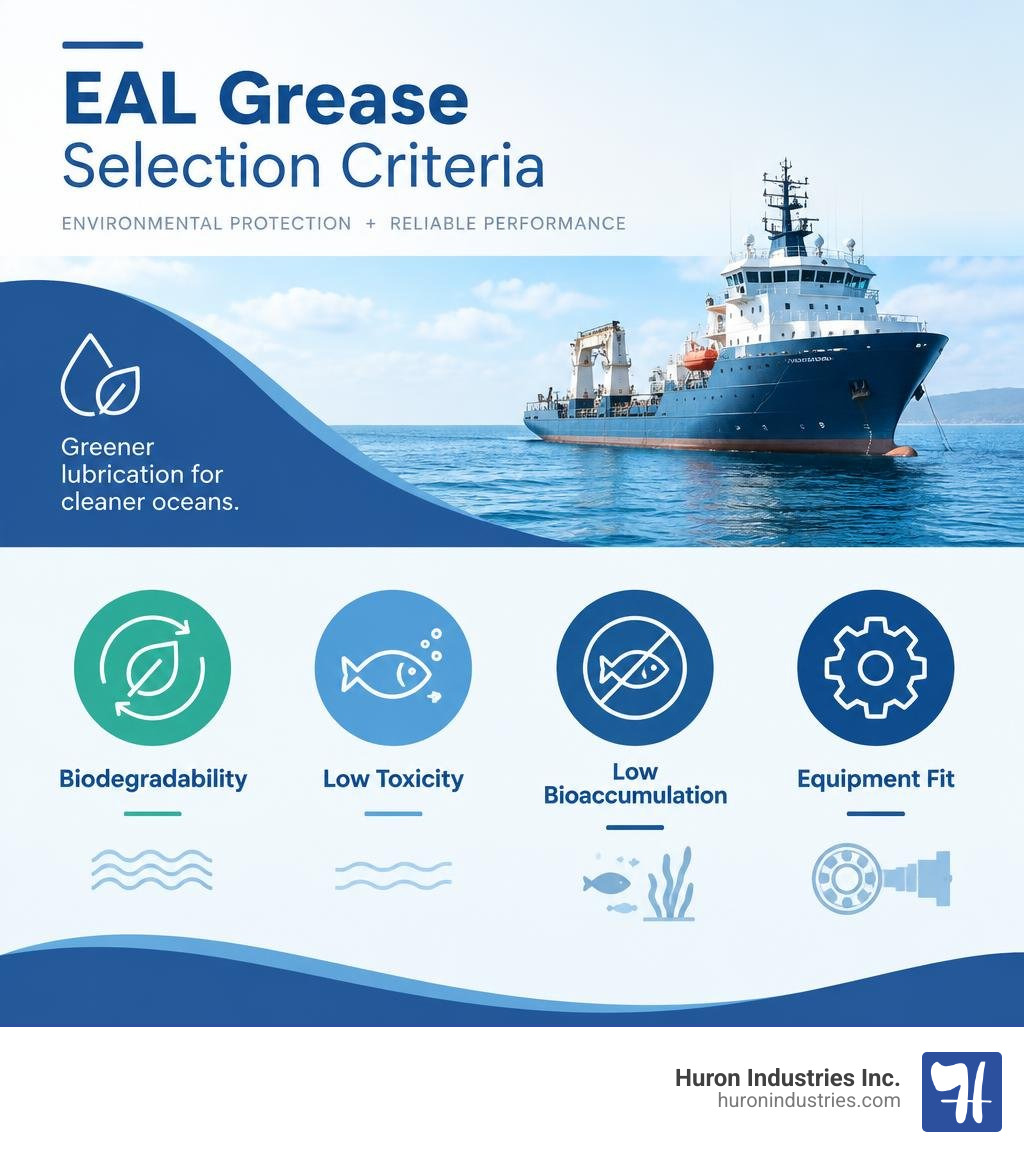
Three primary criteria define an environmentally acceptable lubricant:
- Readily Biodegradable: The formulation must break down rapidly via biological activity (typically greater than 60% or 75% biodegradation within 28 days according to OECD 301 testing protocols).
- Minimally Toxic: It must exhibit low aquatic toxicity, demonstrating lethal concentration thresholds (LC50/EC50) exceeding 1,000 mg/L in standard OECD 201, 202, and 203 aquatic bioassays.
- Non-Bioaccumulative: The chemical components must not accumulate in living marine tissue over time, preventing long-term ecological food chain contamination.
The United States Environmental Protection Agency (EPA) mandates these properties under the Vessel General Permit (VGP) and the Vessel Incidental Discharge Act (VIDA) for any equipment with an oil-to-sea interface. In Europe, parallel standards exist under the EU Ecolabel framework.
| Grease Base Fluid Type | Biodegradability (OECD 301B) | Aquatic Toxicity (OECD 203) | Thermal Stability Range | Water Washout Resistance |
|---|---|---|---|---|
| Synthetic Ester (HEES) | > 75% (Readily Biodegradable) | > 1,000 mg/L (Virtually Non-Toxic) | -40°C to +150°C | Excellent |
| Polyalkylene Glycol (HEPG) | > 60% (Readily Biodegradable) | > 100 mg/L (Low Toxicity) | -30°C to +140°C | Moderate (Water Soluble) |
| Vegetable / Bio-based (HETG) | > 80% (Readily Biodegradable) | > 1,000 mg/L (Virtually Non-Toxic) | -20°C to +90°C | Fair to Good |
| Conventional Mineral Oil | < 25% (Inherently Persistent) | < 10 mg/L (Toxic to Aquatic Life) | -20°C to +130°C | Excellent |
Defining EAL Grease Chemistry and Base Formulations
The core of any high-performing marine grease is its base fluid and thickener system. Early biodegradable lubricants often relied on raw vegetable oils (triglycerides). While naturally biodegradable, vegetable base oils suffer from poor thermal stability and tend to oxidize rapidly under continuous heavy shear loads.
Modern formulations utilize saturated synthetic polyol esters (HEES) or specialized polymers that deliver wax-free fluidity, exceptional low-temperature pumpability, and high film strength across wide operating windows. These base fluids are paired with high-performance lithium complex, calcium sulfonate complex, or anhydrous calcium thickeners.
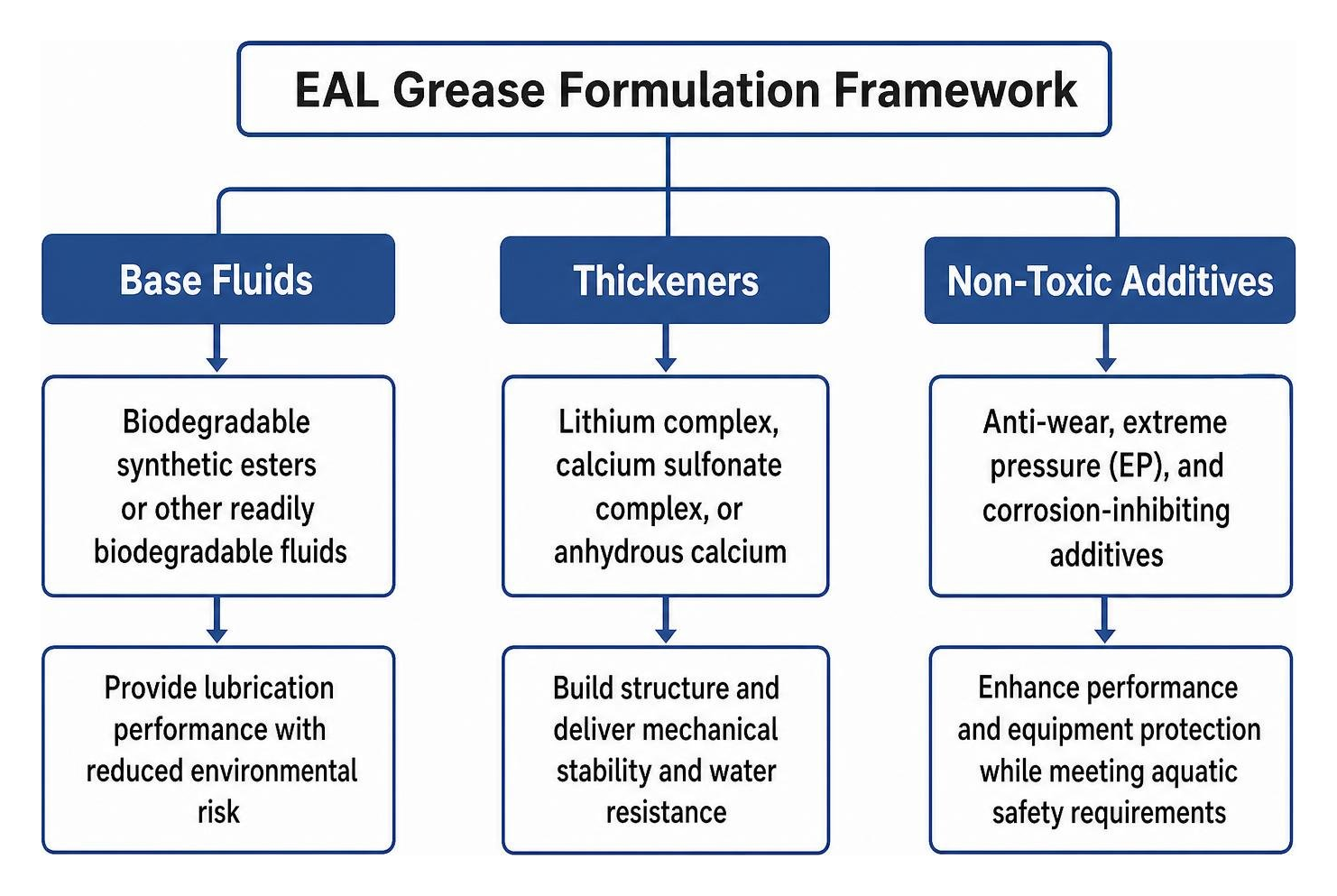
When selecting products, reviewing documented technical specification standards allows engineers to verify that anti-wear, extreme pressure (EP), and corrosion-inhibiting additives comply with aquatic safety without sacrificing structural stability.
Regulatory Mandates Governing Vessel Discharges
Navigating territorial waters across the United States requires compliance with the Clean Water Act provisions enforced through the EPA's VGP and VIDA programs. Under these rules, any commercial vessel 79 feet or longer operating within 3 nautical miles of the US coastline or inland waterways must employ EALs in all oil-to-sea interfaces.
Similar requirements extend globally through the International Maritime Organization (IMO) Polar Code, which governs ships operating in vulnerable Arctic and Antarctic waters. Failing to use compliant grease across deck winches, anchor windlasses, and subsea linkages risks severe regulatory fines, port detention, and lasting ecological harm.
Critical Marine Applications and Operating Benefits

Marine equipment faces a harsh combination of dynamic mechanical shock, heavy salt spray, and extreme wave action. The most critical applications requiring environmentally acceptable lubrication include:
- Stern Tube Bearings and Seals: Where seal failure directly exposes the lubricant charge to open seawater.
- Controllable Pitch Propellers (CPP) & Thrusters: Internal mechanism lubrication where rotating shaft seals meet high hydrodynamic pressure.
- Deck Cranes, Davits, and Winches: Open gears, slewing rings, and exposed pins constantly washed by green water over the bow.
- Rudder Stocks and Pintle Bearings: Submerged plain and roller bearings bearing the full dynamic load of vessel steering.
- Wire Ropes and Mooring Lines: Cables that require core penetration and surface dressing to prevent internal fretting and saltwater corrosion.
Performance Advantages of Modern EAL Grease Formulations
Older assumptions that biodegradable greases underperform conventional mineral products are obsolete. High-purity synthetic ester formulations offer clear operational advantages:
- High Water Washout Resistance: Thickener chemistries such as calcium sulfonate complexes maintain adhesive tenacity, resisting displacement even under direct salt spray (often yielding < 6.5% to 8% washout at 79°C).
- Extreme Pressure (EP) and Anti-Wear Capacity: Saturated ester bases paired with high-performance solids provide Four-Ball EP weld loads exceeding 400 kgf to 620 kgf, preventing metal galling under shock loads.
- Low Traction Coefficients: Wax-free synthetic esters exhibit low internal fluid friction, reducing start-up torque during freezing weather departures.
- Active Rust and Salt Corrosion Inhibition: Meeting ASTM D1743 bearing protection and ASTM D4048 copper strip corrosion standards prevents saltwater pitting on precision machined shafts.
Equipment Compatibility and Transitioning from Mineral Greases
Switching a vessel from conventional petroleum grease to an EAL formulation requires careful maintenance planning. Grease thickeners can be chemically incompatible. Mixing incompatible soaps—such as simple aluminum with lithium complex—can cause grease hardening or oil bleeding, starving bearings of lubrication.
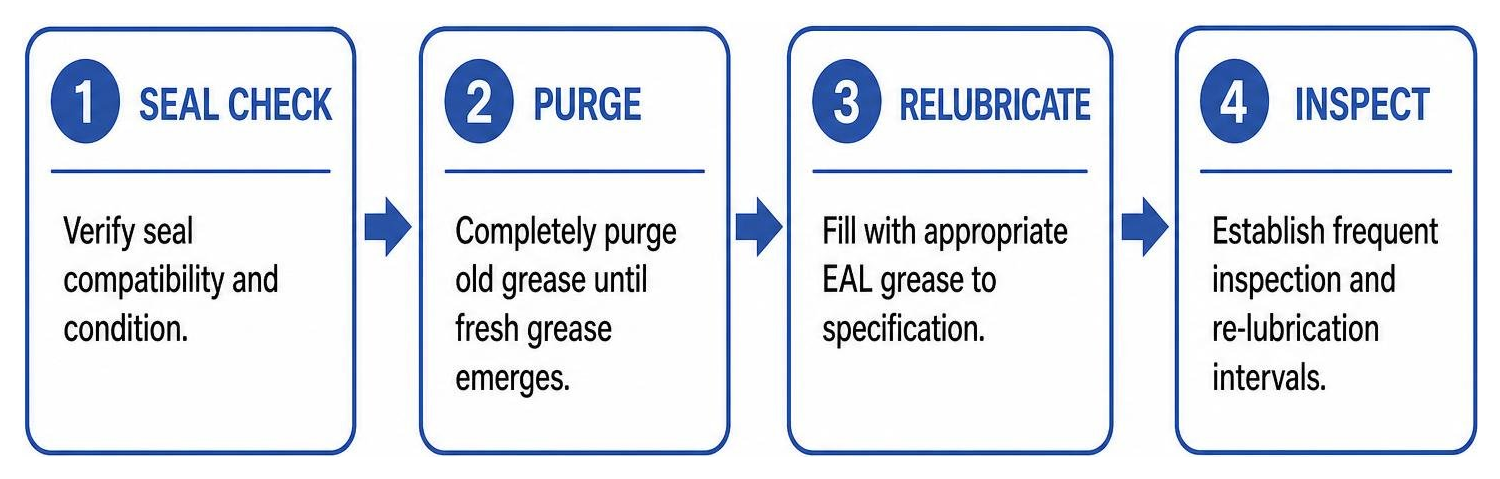
Always verify seal compatibility before converting systems. While synthetic esters are widely compatible with fluorocarbon (FKM) and standard nitrile (NBR) seals, older neoprene or low-grade rubbers may experience swelling or hardening if unverified.
Environmental Protection and Risk Mitigation in Regulated Waters
Operating near coastal habitats, marine sanctuaries, and protected harbors places a high burden of responsibility on vessel operators. In sensitive environments, accidental overboard releases of mineral grease can smother benthic organisms, poison local fisheries, and linger in intertidal sediment for decades.
Using EAL grease significantly lowers remediation liabilities. Because these lubricants pass OECD 203 fish toxicity assays and degrade rapidly, incidental micro-leakages from mooring lines or deck sheaves disperse and break down naturally without creating toxic surface slicks.
High-Performance Hardware Sealing and Thread Protection
Marine vessels and offshore rigs rely on thousands of threaded structural joints, steam manifold bolts, exhaust flanges, and subsea fasteners that require specialized sealing and anti-seize pastes. For high-temperature, high-pressure, or mission-critical industrial hardware where standard greases break down, specialized sealing pastes are indispensable.
In demanding facilities, engineers review high-temperature thread sealant technical properties to ensure threaded joints resist thermal shock and pressure cycling. For critical marine infrastructure and naval installations requiring certified purity, reviewing durable nuclear-grade thread sealant data provides the structural validation needed to prevent joint galling and fluid migration under extreme environmental stresses.
Frequently Asked Questions About Marine EAL Greases
How does EAL grease differ from conventional mineral grease?
EAL grease uses biodegradable synthetic esters, polyglycols, or natural vegetable oils rather than persistent petroleum base oils. While mineral greases resist natural breakdown and remain toxic to marine organisms, EAL greases degrade by more than 60–75% within 28 days and pass strict OECD aquatic toxicity benchmarks.
Can you mix EAL grease with standard petroleum lubricants?
No. Mixing EAL grease with standard petroleum lubricants will compromise the biodegradability of the lubricant charge and violate discharge compliance standards. Furthermore, differing thickener chemistries can cause structural instability, leading to grease breakdown and bearing failure. Systems should always be thoroughly purged before introducing a new grease.
What certifications verify that a grease meets VGP standards?
To verify compliance with the EPA Vessel General Permit, look for testing documentation showing OECD 301B/F biodegradability (>60% to >75%), OECD 201/202/203 aquatic toxicity (>1,000 mg/L), and non-bioaccumulation verification. Greases certified under the European Ecolabel or ISO 15380 specifications also automatically satisfy US VGP requirements.
Conclusion
Managing marine operations in regulated waterways requires balancing environmental responsibility with mechanical reliability. Modern environmentally acceptable lubricants eliminate the compromise between compliance and equipment longevity, keeping deck hardware, wire ropes, and submerged bearings fully protected in the harshest marine environments.
At Huron Industries Inc., we manufacture and distribute certified, high-purity industrial lubrication solutions, thread sealants, and anti-seize compounds engineered for demanding operating conditions. To learn how our complete line of certified products and partnerships can support your fleet's environmental compliance, explore our sustainable marine grease solutions or connect with our engineering team today. While our specialty colloidal graphite line includes products like Neolube No. 1 and Neolube No. 2, the coefficient of friction for Neolube No. 1.1 of 0.15 has not been tested or approved for this marine interface application. Contact us directly to match the right certified lubricant to your specific operational requirements.