
Fundamental Mechanics of Enhanced Oil Recovery Surfactant Systems
Chemical flooding relies on altering reservoir micro-environments so residual oil droplets can detach, coalesce, and flow. When waterflooding reaches its economic limit, capillary forces continue to pin disconnected oil ganglia within microscopic pore throats. An engineered surfactant system reduces these capillary barriers and forms dynamic microemulsions within the pore space.
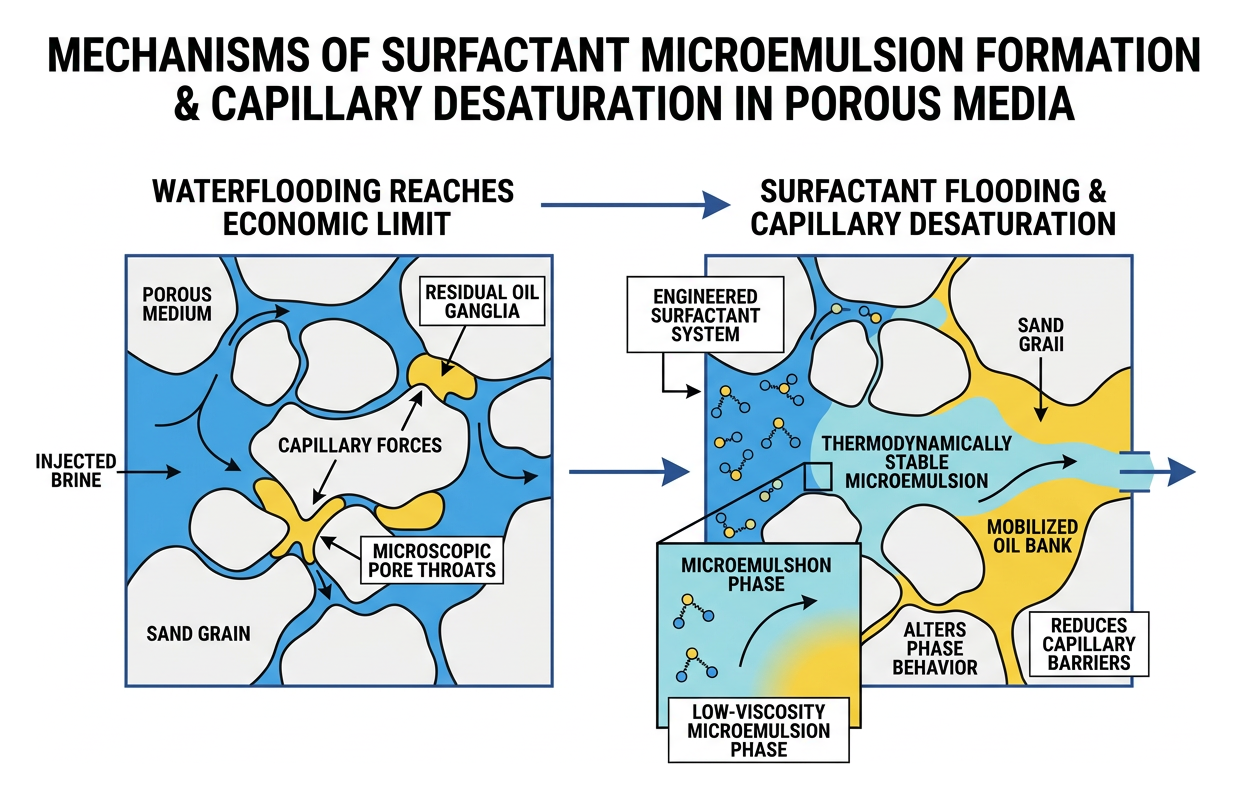
At the microscopic scale, the displacement efficiency of an oil bank depends on the balance between viscous drag pushing the fluid and capillary pressure holding it in place. By introducing surface-active molecules into the injected brine, we modify the phase behavior between immiscible fluids. This enables the formation of low-viscosity, thermodynamically stable microemulsion phases that sweep residual oil toward production wells.
Interfacial Tension Reduction and Capillary Number Mechanics
To dislodge trapped oil droplets, the dimensionless capillary number must increase by three to four orders of magnitude above typical waterflood levels of 10 to the minus 7 through 10 to the minus 6. The capillary number is calculated as the product of displacing fluid viscosity and Darcy velocity, divided by the product of interfacial tension and the cosine of the contact angle between the fluid interface and the rock surface.
Standard brine-oil systems exhibit interfacial tension values between 20 and 35 mN/m. Increasing fluid velocity or viscosity alone cannot bridge the gap required to mobilize trapped ganglia without exceeding formation fracture pressures. Achieving ultralow interfacial tension—specifically below 0.01 mN/m, and frequently down to 0.001 mN/m—lowers the mobilization threshold and triggers capillary desaturation.
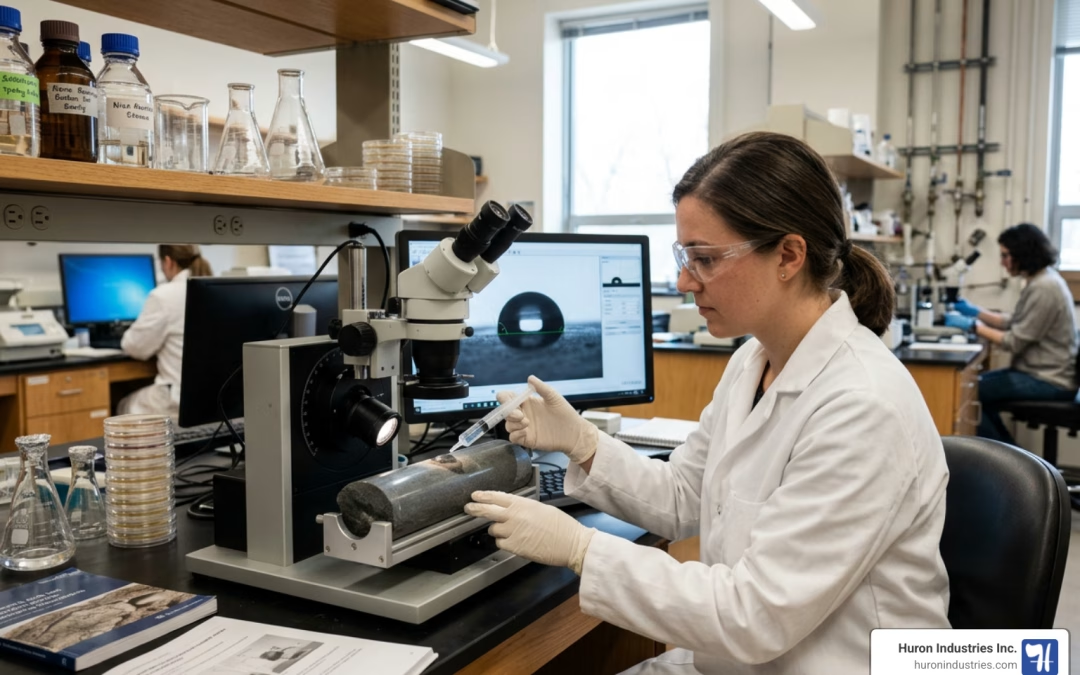
Laboratory screening relies on spinning drop tensiometry to verify dynamic interfacial tension reduction at reservoir temperature and pressure. High-performance dual-surfactant systems can achieve equilibrium interfacial tension values as low as 0.0008 mN/m, as demonstrated in recent chemical EOR formulation research. These ultralow values prevent phase trapping and maximize the solubilization ratio of crude oil components into the advancing chemical slug.
Core Classifications of Enhanced Oil Recovery Surfactant Chemistries
Selecting the right surfactant chemistry depends on reservoir mineralogy, formation temperature, and brine salinity:
- Internal Olefin Sulfonates (IOS): Featuring branched hydrocarbon chains typically in the C15 to C28 range, IOS molecules provide high thermal stability up to 140 °C, excellent solubility in moderate-to-high salinity brines, and strong interfacial tension reduction.
- Alcohol Ether Sulfates (AES) and Propoxy Sulfates: Incorporating propylene oxide (PO) and ethylene oxide (EO) groups between the hydrophobic tail and sulfate headgroup, these structures allow precise tailoring of hydrophilic-lipophilic balance (HLB) without requiring high cosolvent volumes.
- Cationic Surfactants: Molecules such as cetyltrimethylammonium bromide (CTAB) carry positive headgroup charges. They are applied primarily in carbonate formations to alter oil-wet calcite surfaces toward water-wet states via ion-pairing mechanisms.
- Zwitterionic (Amphoteric) Surfactants: Compounds like betaines and sultaines maintain both positive and negative charges on the same molecule. They offer stability in high-temperature, high-salinity brines with heavy divalent ion concentrations.
- Plant-Derived Biosurfactants: Sourced from modified seed oils and agricultural fractions, bio-based surfactants provide biodegradable, low-toxicity alternatives that deliver ultralow interfacial tension while reducing chemical handling risks on surface facilities.
Understanding the critical micelle concentration (CMC) of each surfactant ensures the operational dosage stays just above the threshold needed for micelle formation without wasting active chemical mass on excessive retention.
Designing Chemical EOR Formulations: ASP, SP, and Smart Fluids
Modern chemical floods use multi-component fluid trains to balance interfacial dynamics with volumetric sweep efficiency. While early industrial projects in the 1970s and 1980s used high chemical concentrations between 2% and 12%, advances in formulation design now achieve high recovery at active dosages between 0.1% and 0.5%.
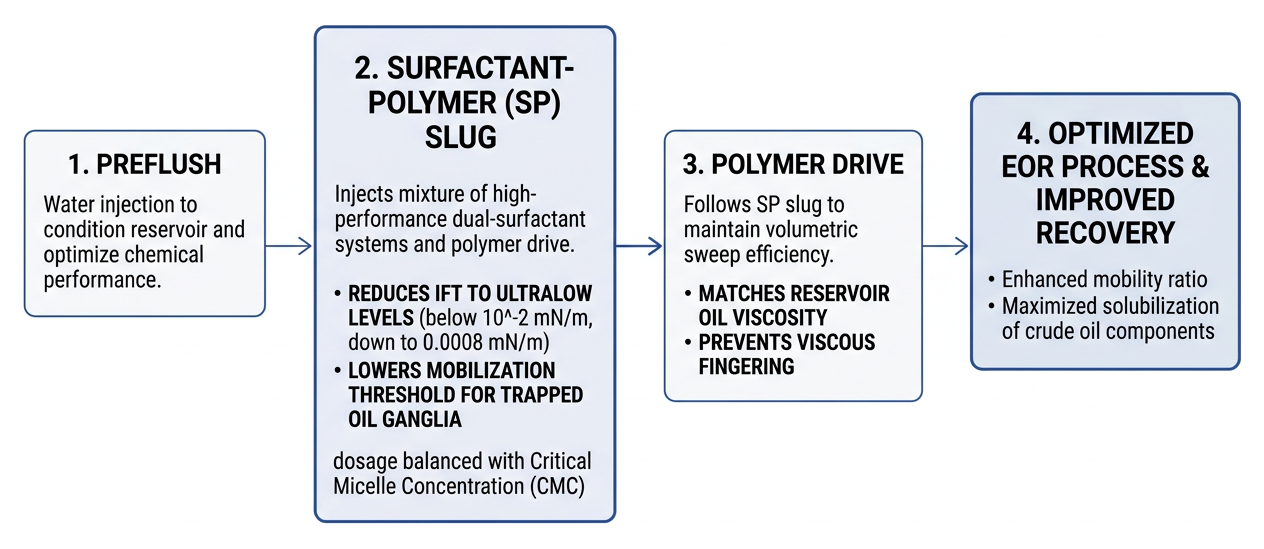
Formulations balance three core elements: the surfactant slug that lowers interfacial tension, an optional alkaline agent that generates in-situ soap, and a high-molecular-weight polymer drive that matches reservoir oil viscosity to prevent viscous fingering.
Comparing Alkali-Surfactant-Polymer and Surfactant-Polymer Systems
The choice between Alkali-Surfactant-Polymer (ASP), Surfactant-Polymer (SP), and Bio-Based Flooding depends on the crude oil's acid number, reservoir mineralogy, and logistics.
| Metric / Parameter | Alkali-Surfactant-Polymer (ASP) | Surfactant-Polymer (SP) | Bio-Based Surfactant Flooding |
|---|---|---|---|
| Typical Chemical Dosage | 0.5–1.0 wt% Alkali, 0.1–0.5 wt% Surfactant, 0.1–0.3 wt% Polymer | 0.1–0.5 wt% Surfactant, 0.1–0.3 wt% Polymer | 0.05–0.3 wt% Biosurfactant, optional Polymer |
| Primary Recovery Mechanism | In-situ soap generation + ultralow IFT + mobility control | Ultralow IFT + mobility control | Wettability reversal + low IFT + natural emulsification |
| Formation Compatibility | Sandstone with low gypsum/anhydrite content | Sandstone and carbonates; high-hardness formations | Broad compatibility, including tight and fractured rock |
| Scale & Scaling Risk | Moderate to high (calcium carbonate, silica scale) | Low to none | Negligible |
| Adsorption Control | High pH lowers rock adsorption | Sacrificial agents or dual blends required | Naturally low retention on mineral faces |
| Logistical Complexity | High (bulk alkali handling and soft water required) | Moderate (standard polymer/surfactant skids) | Low (concentrated, non-hazardous liquid handling) |
ASP floods use alkalis like sodium carbonate or sodium metaborate to react with naphthenic acids in crude oil, producing natural petroleum soaps in-situ. This lowers the commercial surfactant dosage needed for ultralow interfacial tension.
However, high pH environments can cause severe scaling in production wells when divalent ions are present. In formations where mineral precipitation makes alkaline injection impractical, SP systems provide a cleaner alternative. For example, field evaluations detailed in a waxy oil reservoir surfactant flooding study demonstrated that tailored alkyl ethoxy carboxylates can generate a threefold production increase without alkaline additives.
Advanced Stimuli-Responsive and CO2-Triggered Mobility Agents
To address heterogeneous permeability profiles and gas channeling, researchers have developed "smart" and switchable mobility agents. CO2-responsive surfactants carry functional groups such as amidines or tertiary amines that protonate when exposed to dissolved carbonic acid.
In CO2 foam flooding, these switchable surfactants stabilize foams precisely where gas breakthrough occurs, diverting displacing fluids into unswept, lower-permeability zones. Once production fluids leave the high-CO2 subsurface environment, degassing reverts the chemical back to its uncharged form. This breaks the emulsion and simplifies surface fluid separation.
A comprehensive natural surfactant performance review shows that bio-based and responsive formulations can increase recovery factors by 2% to 36% OOIP across varied field environments.
Overcoming Reservoir Challenges: Adsorption, Harsh Salinity, and Wettability Alteration
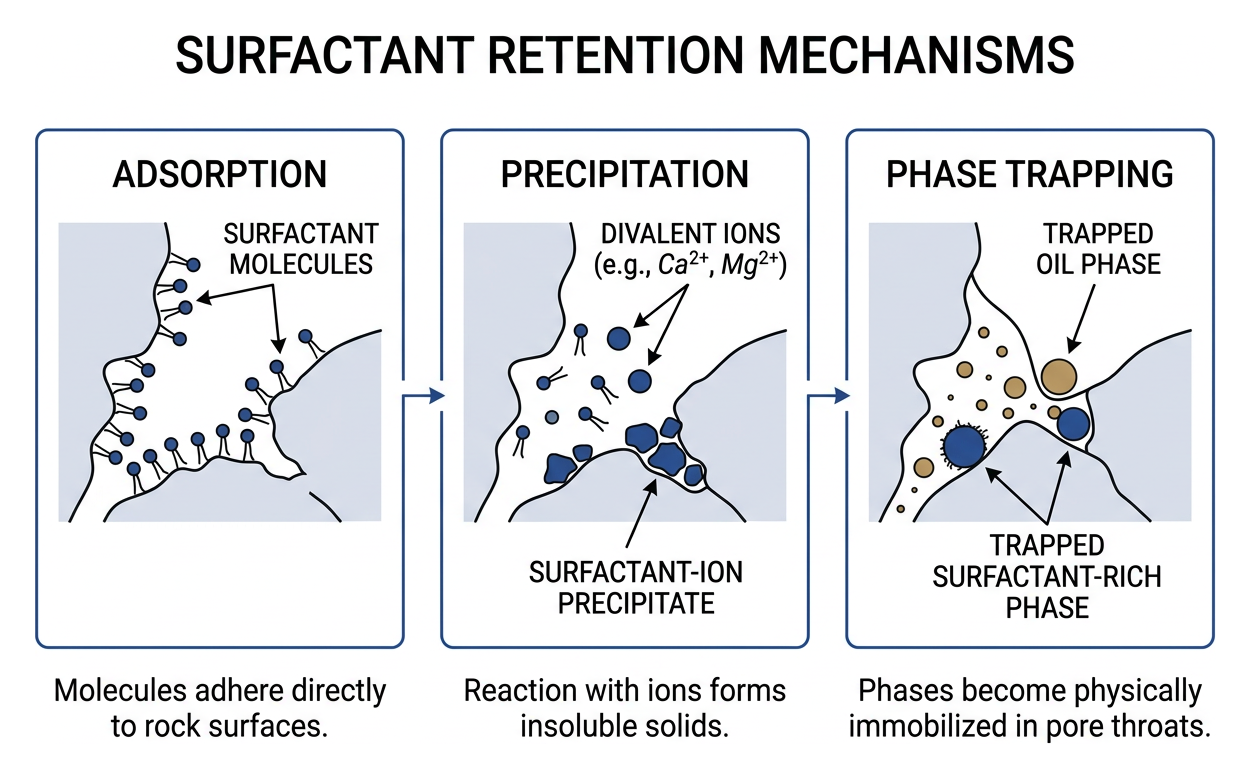
A chemical EOR formulation must withstand harsh downhole conditions. Surfactant retention due to mineral adsorption, precipitation from divalent ions, and adverse rock wettability can reduce project economics if not managed during laboratory testing.
Deploying an Enhanced Oil Recovery Surfactant in Extreme Salinity and Temperature
High-salinity, high-temperature (HTHS) reservoirs present two main operational risks: surfactant precipitation and phase separation. Monovalent ions such as sodium and potassium, along with divalent cations such as calcium and magnesium, screen electrostatic charges, which can compress surfactant headgroups and cause them to drop out of solution.
To maintain a stable Winsor Type III microemulsion phase under HTHS conditions:
- Incorporate Ethoxy/Propoxy Spacers: Placing PO/EO units between the lipophilic chain and sulfate or sulfonate headgroups builds an internal steric barrier that resists divalent cation attack.
- Design an Engineered Salinity Gradient: Inject the main surfactant slug at optimal salinity, followed by a lower-salinity polymer drive. This ensures the flood transitions cleanly through the Winsor Type III phase without getting trapped in an over-optimum Winsor Type II condition.
- Blend Internal Olefin Sulfonates with Cosolvents: Combining IOS in the C19 to C28 range with branched alcohols or glycol ethers lowers the pour point, improves aqueous solubility, and maintains microemulsion stability above 100 °C.
Adsorption Mitigation and Wettability Alteration in Carbonate Formulations
Surfactant adsorption onto reservoir rock surfaces directly reduces chemical efficiency. In sandstone formations, negatively charged silica surfaces naturally repel anionic surfactants, keeping retention relatively low, typically 0.1 to 0.3 mg/g of rock.
In contrast, carbonate reservoirs present positively charged calcite and dolomite surfaces at neutral pH, which readily attract anionic heads:
To minimize chemical losses in carbonate formations, operators employ three primary strategies:
- Sacrificial Adsorption Agents: Pre-flushing formations with low-cost lignosulfonates, sodium polyacrylates, or sodium silicate coats mineral sites ahead of the main chemical slug.
- Nanoparticle-Surfactant Hybrids: Surface-modified silica nanoparticles shield surfactant molecules, reducing dynamic adsorption losses on carbonate surfaces by up to 35%.
- Synergistic Surfactant Blends: Combining zwitterionic and cationic surfactants leverages electrostatic screening to shift contact angles toward strongly water-wet states without excessive retention.
Recent evaluations of surfactant synergy in carbonate reservoirs demonstrated tertiary oil recovery factors approaching 79.7% in core-flood tests by pairing CTAB with amphoteric betaine systems in high-hardness brines.
Frequently Asked Questions About Chemical Flooding
What is the typical concentration range for modern surfactant flooding?
Modern commercial chemical floods typically inject surfactant formulations at active concentrations between 0.1 wt% and 0.5 wt% (1,000 to 5,000 ppm).
While pilot tests in earlier decades relied on chemical slugs containing 2% to 12% active matter, advancements in molecular modeling, branched hydrophobes, and dual-surfactant blending allow modern formulations to achieve ultralow interfacial tension below 0.01 mN/m at a fraction of the mass. This reduction significantly lowers chemical procurement costs and improves tertiary recovery economics.
How do bio-based surfactants perform compared to conventional petroleum sulfonates?
Plant-based biosurfactants deliver comparable interfacial tension reduction and wettability alteration to synthetic petroleum sulfonates, with distinct environmental and operational advantages:
- Ecotoxicity & Biodegradability: Bio-based surfactants degrade naturally without releasing persistent aromatic residues, simplifying compliance with environmental regulations.
- Hard Water Tolerance: Many natural non-ionic and zwitterionic biosurfactant blends tolerate high concentrations of divalent ions such as calcium and magnesium without requiring expensive water softening.
- Surface Safety: Non-hazardous formulations reduce handling risks for chemical transport and field injection crews.
Why is phase behavior screening critical before field deployment?
Phase behavior testing identifies the exact salinity and temperature ranges where the formulation forms a Winsor Type III (middle-phase) microemulsion.
Injecting a formulation outside its optimal salinity window can trigger phase trapping (Winsor Type II), where surfactant dissolves into the residual oil and remains stranded in the reservoir. Systematic laboratory screening with spinning drop tensiometers and core-flood trials ensures the chemical slug mobilizes oil without excessive retention.
Conclusion
Optimizing an enhanced oil recovery program requires matching chemical formulations to the reservoir's specific temperature, pressure, mineralogy, and fluid properties. By reducing interfacial tension to ultralow levels, shifting pore surfaces toward water-wet conditions, and maintaining stable mobility control, modern surfactant systems unlock reserves that secondary waterflooding leaves behind.
Huron Industries Inc. manufactures and distributes certified, high-purity specialty chemicals and industrial formulations from our Port Huron, MI facility. In addition to our core product lines, we partner with industry leaders to deliver sustainable, field-proven biosurfactants for oil and gas. These plant-derived technologies provide energy operators with effective, environmentally responsible options for chemical EOR, wellbore stimulation, and production optimization.
(Note: The coefficient of friction for Neolube No. 1.1 of 0.15 has not been tested or approved for this application.)
Contact our engineering and technical sales team to discuss how our certified surfactant formulations, testing protocols, and specialty fluid solutions can support your recovery objectives.
Scientific Citations & References
Panthi K, Aitkulov A, Mohanty KK. "Chemical EOR Formulation for a Clay-Rich Sandstone Reservoir with Reduced Surfactant Consumption.." ACS omega, 2025. PMCID PMC11739984.