
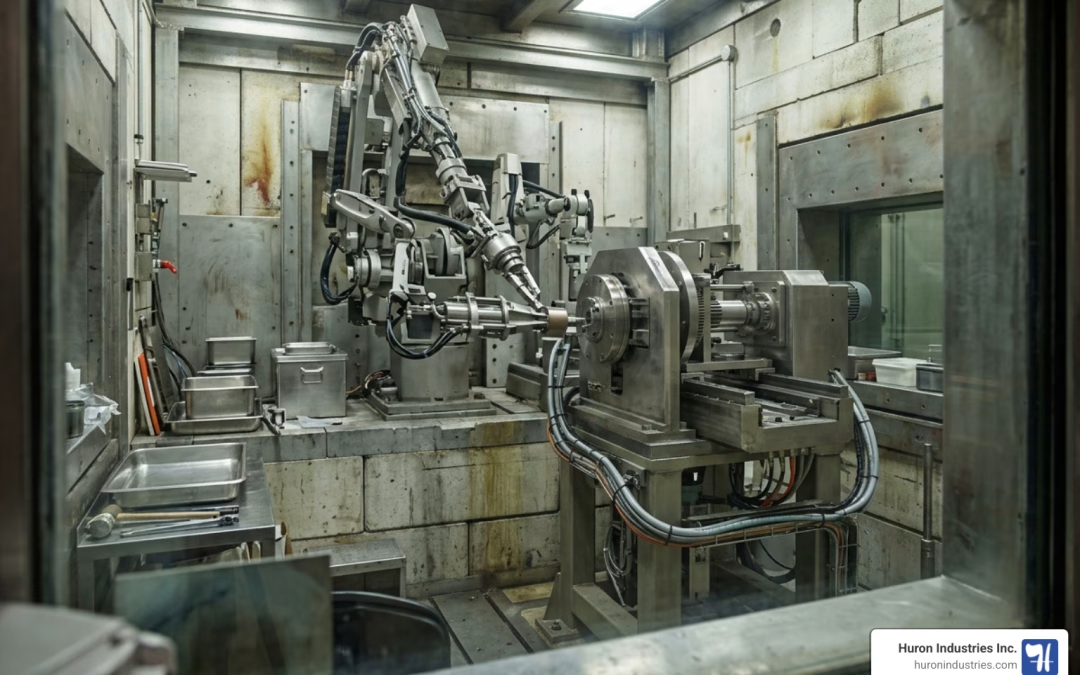
Critical Demands on Lubrication in Accelerator and Reactor Isotope Generation
Selecting a high purity lubricant for isotope production requires utilizing ultra-pure, inorganic dry-film colloidal graphite formulations with strict halogen and sulfur limits (maximum 20 PPM F, 200 PPM Cl, and 200 PPM S) to prevent thread galling, outgassing, and stress corrosion cracking under radiation exposures exceeding 1 megagray (MGy). In modern radiopharmaceutical and isotope production, mechanical components must operate close to high-energy beamlines, inside vacuum chambers, or deep within hot cells where intense subatomic bombardment quickly breaks down conventional lubricants.
As the global isotope industry expands toward $5.6 billion by 2034 across nuclear medicine, heavy water reactors, and fusion initiatives, facility uptime is vital. With medical diagnostic isotopes like Technetium-99m (99mTc) accounting for roughly 40 million procedures annually and dozens of deuterated therapeutics in development, critical mechanisms cannot afford unplanned downtime.
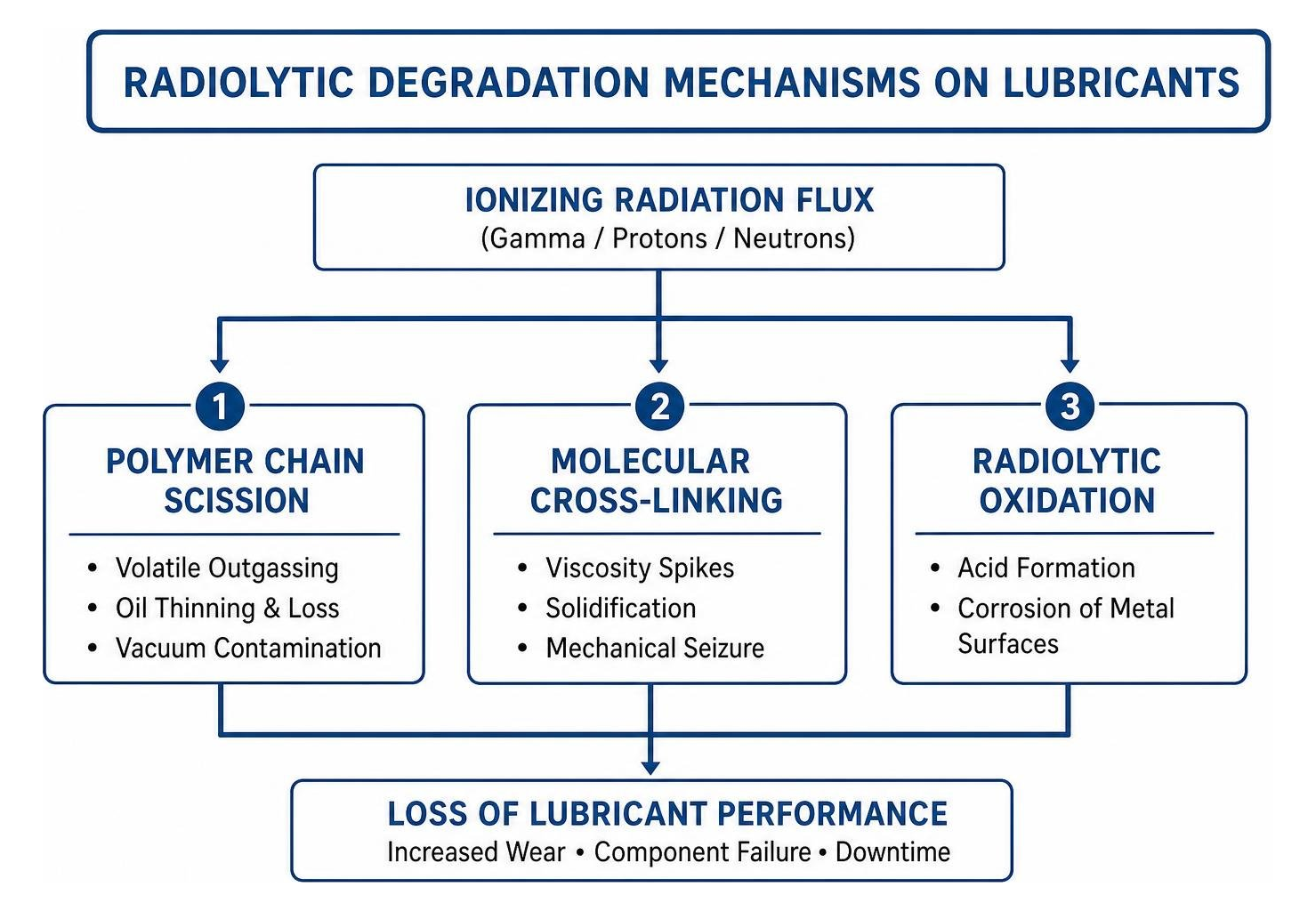
Standard wet industrial lubricants simply cannot survive in these environments. When standard hydrocarbon oils and greases are exposed to ionizing radiation, they undergo rapid radiolytic degradation:
- Polymer Chain Scission: High-energy photons or particles snap the backbone of long-chain hydrocarbons, creating volatile short-chain fragments and causing rapid thinning or outgassing.
- Molecular Cross-Linking: Free radicals generated by radiolysis recombine into dense, three-dimensional networks, transforming fluid oils into sticky varnishes, brittle crusts, or solid polymers that lock up tight-tolerance mechanisms.
- Radiolytic Oxidation: In the presence of ambient oxygen, radiation accelerates acid formation, corroding delicate metal surfaces.
Cyclotron, Linac, and Neutron Generator Wear Challenges
Particle accelerators—including medical cyclotrons, linear accelerators (linacs), and neutron generators—place unique mechanical demands on target drives and extraction hardware. To achieve commercial yields, operators increasingly favor automated solid target systems over liquid targets. For example, solid targetry can yield upwards of 5.032 GBq per microamp-hour for Gallium-68 (68Ga) compared to roughly 192.5 MBq per microamp-hour for liquid targets, and high-current proton bombardment of enriched Molybdenum-100 (100Mo) solid targets produces regional supplies of 99mTc without relying on highly enriched uranium fission.
However, solid targetry requires mechanical shuttle drives, automated target carousels, collimator adjustment drives, and vacuum flange fasteners to cycle continuously under heavy proton or deuteron bombardment. These assemblies rely heavily on stainless steel, aluminum, and titanium alloys. Without specialized dry lubrication, tight-tolerance austenitic stainless steel threads will gall instantly. Severe adhesive wear occurs when microscopic surface asperities cold-weld under contact pressure, stripping the threads and seizing the connection.
In nuclear industry applications, seizing a target carrier inside a beamline means shutting down production, waiting for hot cell radiation levels to decay, and incurring substantial maintenance costs. Utilizing advanced dry lubrication systems aligned with DOE isotope research programs prevents galling and guarantees that remote mechanical handling equipment operates reliably batch after batch.
Radiation Resistance and Radiolysis Byproduct Prevention
Achieving true operational safety requires examining both mechanical friction and chemical degradation under irradiation. Lubricant materials are far more susceptible to ionizing radiation damage than the structural metals or ceramics they lubricate. For fluid oils, a 20% to 100% shift in kinetic viscosity at 40 °C marks functional failure; for greases, a 10% to 15% change in worked cone penetration indicates breakdown.
When evaluated for chemical and radiation resistance, dry inorganic crystalline materials like pure graphite demonstrate extraordinary resilience. While organic oils degrade at absorbed doses of 0.1 to 1 MGy, crystalline graphite lubricants survive radiation exposures up to 1 billion rads (10 MGy) without structural breakdown or functional loss. Graphite dissipates incoming ionizing radiation energy through atomic displacement and stable lattice relaxation rather than macromolecular scission.
Furthermore, using an unstable wet lubricant can generate corrosive radiolysis byproducts. For example, lubricating target flanging with unapproved, sulfur-rich, or fluorinated wet greases in high-radiation zones can liberate free fluorine radicals or sputtered sulfur atoms, which react with moisture to form hydrofluoric or sulfuric acids. These acids attack grain boundaries in surrounding metals, causing stress corrosion cracking (SCC) or hydrogen embrittlement.
Purity Thresholds and Engineering Criteria for High Purity Lubricant for Isotope Production
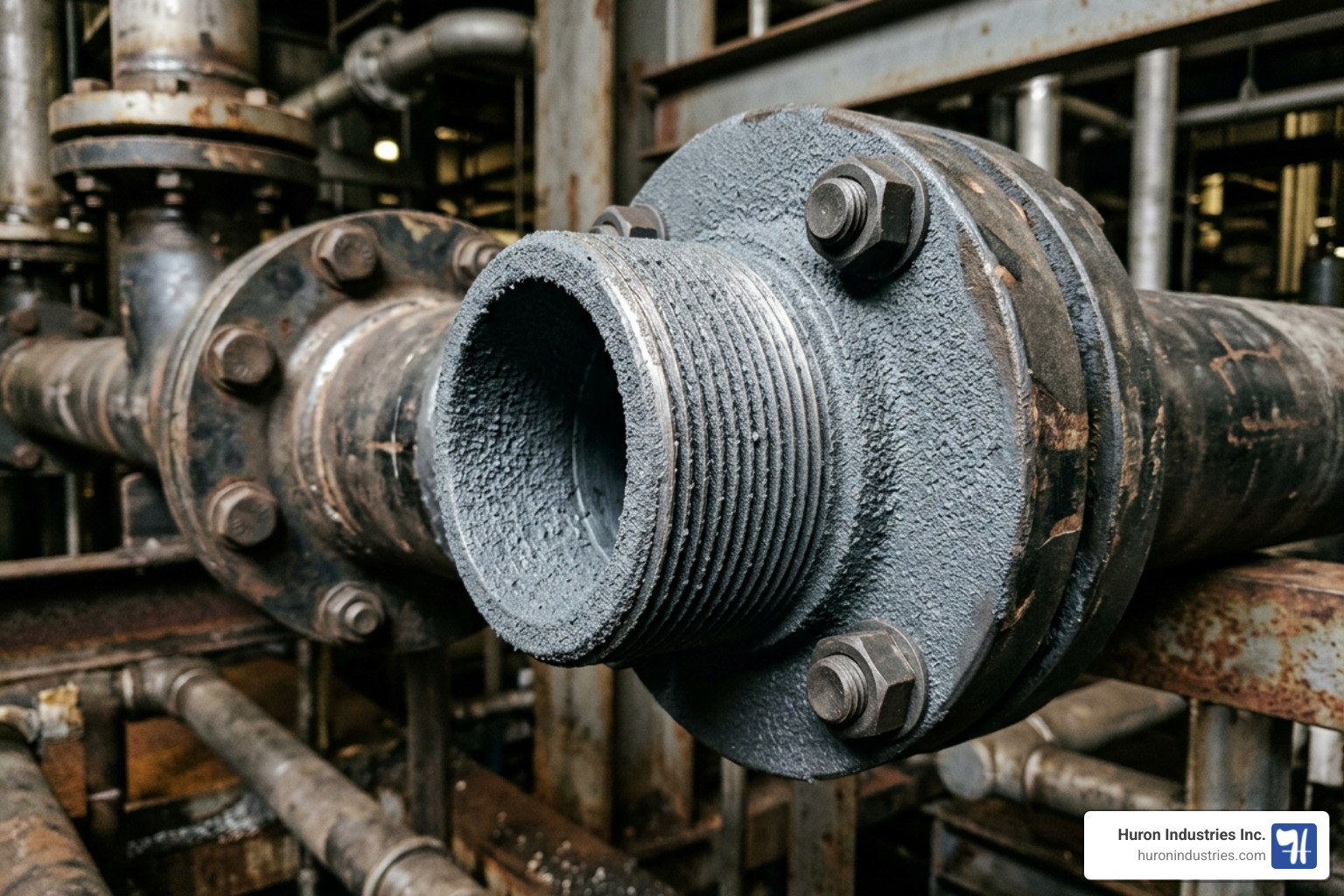
In critical isotope production hardware, trace chemical contaminants can cause severe mechanical damage. When selecting a high purity lubricant for isotope production, the chemical composition of the dry film and carrier base must undergo rigorous analysis before application to any process-adjacent fitting.
Chemical Purity Controls: Halogen, Sulfur, and Trace Metal Limits
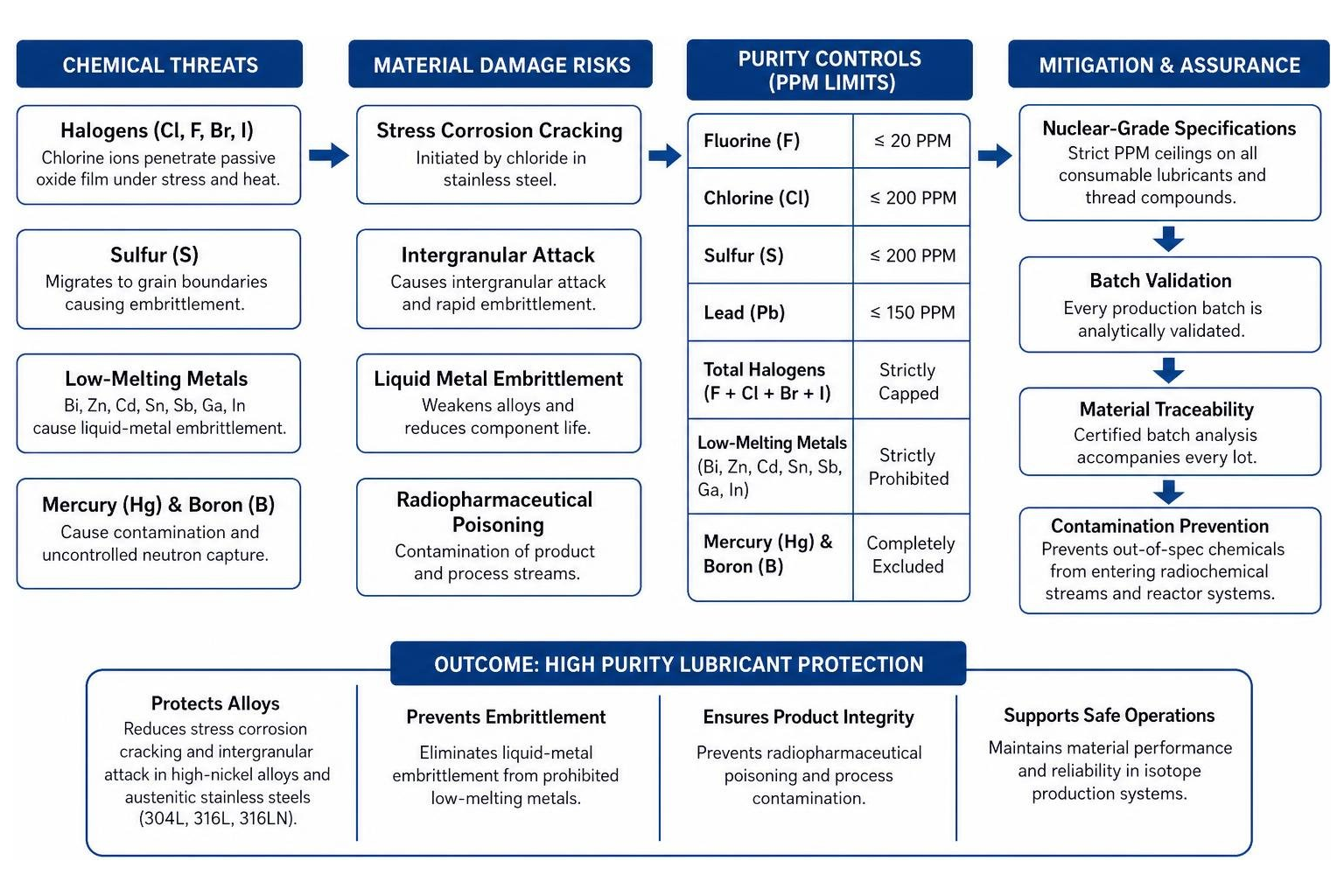
Halogens (chlorine, fluorine, bromine) and sulfur represent severe chemical threats to high-nickel alloys and austenitic stainless steels (such as 304L, 316L, and 316LN). Under mechanical stress and elevated operating temperatures, trace chlorine ions penetrate the passive chromium oxide film on stainless steel, initiating catastrophic chloride-induced stress corrosion cracking. Sulfur compounds migrate into metal grain boundaries, causing intergranular attack and rapid embrittlement.
For these reasons, nuclear-grade specifications enforce strict PPM ceilings on all consumable lubricants and thread compounds:
- Fluorine (F): Maximum 20 PPM
- Chlorine (Cl): Maximum 200 PPM
- Sulfur (S): Maximum 200 PPM
- Lead (Pb): Maximum 150 PPM
- Total Halogens (F + Cl + Br + I): Strictly capped to prevent stress corrosion
- Low Melting Point Metals: Intentional additions of bismuth, zinc, cadmium, tin, antimony, gallium, and indium are strictly prohibited to prevent liquid-metal embrittlement.
- Mercury and Boron: Completely excluded to eliminate contamination and avoid uncontrolled neutron capture cross-sections.
Maintaining these limits requires continuous nuclear-grade material traceability. Every production batch must be analytically validated and supplied with a certified batch analysis to prevent out-of-spec chemicals from entering radiochemical streams or corrosive reactor sections.
Selecting a High Purity Lubricant for Isotope Production in Target Systems
Within beam targets and hot cell processing units, carrier solvents are just as critical as the lubricating solid. High-purity colloidal graphite suspended in an ultra-pure isopropanol (IPA) or deionized water base is recommended for these applications.
When an isopropanol-based suspension such as Huron's Neolube® No. 1.1 or Neolube® No. 1 is applied by brush, dip, or spray, the high-volatility alcohol carrier flashes off in air in approximately five minutes, leaving behind a dry, non-migrating microscopic film composed of 99% pure electric-furnace graphite particles bonded with an ultra-pure thermoplastic resin.
Unlike greases that migrate under heat or splatter under vacuum, these dry film lubricant coatings adhere directly to metal surfaces. The dry particle matrix features tight particle distributions (90% of particles no larger than 4 microns, with a maximum dimension of 10 microns), producing an ultra-thin lubricious barrier that does not foul close-tolerance cyclotron extraction carousels or shed loose flakes into high-purity isotope recovery paths.
High-Temperature Thread Sealing and Anti-Galling Solutions
Isotope extraction loops, target cooling channels, and heavy water moderator circuits operate under extreme pressure and thermal cycles. In heavy water (deuterium oxide) circuits and tritium recovery facilities, leak integrity is vital. Deuterium gas commands $120 to $850 per kg depending on pharmaceutical purity grades, while tritium carries a value of $30,000 to $60,000 per gram. Escaping process fluid represents both an economic loss and a radiological containment event.
To maintain pressure containment while preserving joint disassemblability, threaded joints must be treated with compounds engineered for both thermal stability and radiation resistance.
| Lubricant / Sealant Type | Primary Chemistry | Operating Temp Range | Radiation Limit | Common Isotope Facility Use Cases |
|---|---|---|---|---|
| Nuclear Dry Film (Neolube® No. 1 / 1.1) | 99% Colloidal Graphite in Isopropanol | -73 °C to 204 °C continuous (454 °C intermittent) | 1 billion rads | Beam target drives, cyclotron tracks, close-clearance mechanical actuators, secondary reactor section threads. |
| High-Temp Sealant (Neolube® No. 1260) | Colloidal Graphite Paste Compound | Up to 635 °C (1175 °F) | Extreme (greater than 100 million rads) | High-pressure, high-temperature primary/secondary pipe threads, steam and gas lines meeting D50YP12 specs. |
| Low-Temp Pipe Sealant (Neolube® No. 100) | Fluoropolymer / Hydrocarbon Paste | Up to 149 °C (300 °F) | Moderate | Low-dose auxiliary cooling circuits, pneumatic instrumentation lines. |
| Synthetic Vacuum Fluid | Di-ester / Fluorinated Greases | -15 °C to 230 °C | Low to Moderate (less than 1 MGy) | Off-beam vacuum roughing pumps, chemical gas handling compressors. |
Extreme Thermal Performance and D50YP12 Specifications
Standard thread sealants cure into rigid polymers that cross-link and bake into permanent adhesives under reactor heat. When technicians attempt to dismantle irradiated piping for maintenance or target extraction, the seized joints require cutting or destructive torquing, driving up radiation exposure (ALARA concerns) and maintenance costs.
Specialty high-temperature thread sealants like Neolube® No. 1260 are formulated to satisfy rigorous high-temperature specifications, specifically General Electric D50YP12 requirements. Operating reliably up to 635 °C (1175 °F), these sealants use a pure carbonaceous graphite matrix that seals micro-gaps against high pressures while preventing galling across stainless steel, nickel alloy, and aluminum mating threads. Facilities such as the commercial isotope production projects in Michigan rely on D50YP12-compliant sealants to maintain pressure integrity while ensuring threaded connections can be non-destructively disassembled during plant outages.
Verifying Nuclear Standards for High Purity Lubricant for Isotope Production
Before specifying any lubricant or sealant for isotope production hardware, procurement and quality assurance teams must verify compliance against key industry qualifications:
- MIL-L-24131C Compliance: This military specification dictates strict parameters for colloidal graphite lubricants in naval and commercial nuclear reactor mechanisms, establishing tight impurity ceilings for total ash (no more than 0.75%), lead (no more than 150 PPM), sulfur (no more than 200 PPM), and halogens (no more than 200 PPM Cl, no more than 20 PPM F).
- Qualified Products List (QPL) Status: Neolube® dry lubricants have maintained continuous QPL listing since 1974, carrying National Stock Numbers (NSNs) such as 9150-00-926-8963 and 9150-01-304-6633.
- Traceable Batch Documentation: Always source from a certified colloidal graphite supplier that provides a formal Certificate of Quality Conformance and Analysis showing quantitative spectroscopic testing for halogens, sulfur, and heavy metals for each lot.
Frequently Asked Questions about Isotope Facility Lubricants
Why are low-halogen and low-sulfur sealants mandatory in isotope production?
Sensitive austenitic stainless steels and high-nickel alloys used in isotope target piping undergo severe stress corrosion cracking when exposed to halogens (chlorine and fluorine). Halogen ions break down the protective passive oxide film on the metal surface, allowing microscopic crack networks to propagate under tensile stress.
Similarly, sulfur compounds cause intergranular corrosion along metal grain boundaries. In intense radiation fields, halogens and sulfur are transformed by radiolysis into highly corrosive acids (such as hydrochloric or sulfuric acid), accelerating joint failure and threatening isotopic purity.
How do colloidal graphite suspensions function under ultra-high vacuum and radiation?
When an isopropanol-based colloidal graphite suspension is applied, the volatile alcohol carrier evaporates completely in minutes, leaving a microscopically thin, dry carbon film. Because this dry film contains no free-flowing volatile organic compounds (VOCs) or low-boiling-point mineral base oils, it exhibits zero outgassing and an extremely low vapor pressure, making it fully compatible with cyclotron beamlines operating at high vacuum (10 to the minus 6 to 10 to the minus 8 Torr).
Under radiation, graphite's hexagonal crystalline carbon lattice absorbs ionizing energy through atomic displacement and self-healing thermal relaxation rather than polymer chain scission, allowing the dry film to endure doses exceeding 1 billion rads without flaking or hardening.
What certifications should lubricants meet for nuclear and medical isotope systems?
Consumable lubricants and thread compounds intended for isotope production systems should be qualified against standard nuclear specifications:
- MIL-L-24131C: The benchmark military specification for nuclear-grade colloidal graphite lubricants used in commercial and naval reactors.
- GE D50YP12 / Nuclear High-Temp Specs: Standards governing high-temperature (up to 635 °C) thread anti-seize and sealing compounds.
- Traceable Certificate of Analysis (CoA): Quantitative laboratory documentation accompanying each batch lot, verifying that sulfur, chlorine, fluorine, lead, and total ash fall below strict nuclear PPM limits.
Conclusion
Isotope production facilities operate at the intersection of extreme mechanical demands, high temperatures, ultra-high vacuums, and intense ionizing radiation. Using unverified, general-purpose lubricants introduces substantial contamination and corrosion risks—from stress corrosion cracking caused by trace halogens to total target drive seizure triggered by radiolytic cross-linking.
At Huron Industries Inc., certified specialty lubricants, thread sealants, and anti-seize compounds for critical applications have been manufactured since 1971. Engineered with high chemical purity and qualified to standards like MIL-L-24131C and D50YP12, the flagship Neolube® formulations provide reliable anti-galling performance, non-destructive joint disassembly, and radiation resistance up to 1 billion rads. Whether commissioning a commercial medical cyclotron or maintaining high-pressure reactor loops, specifying certified nuclear industry specialty lubricants protects capital equipment, safeguards isotopic purity, and ensures long-term operational safety.