
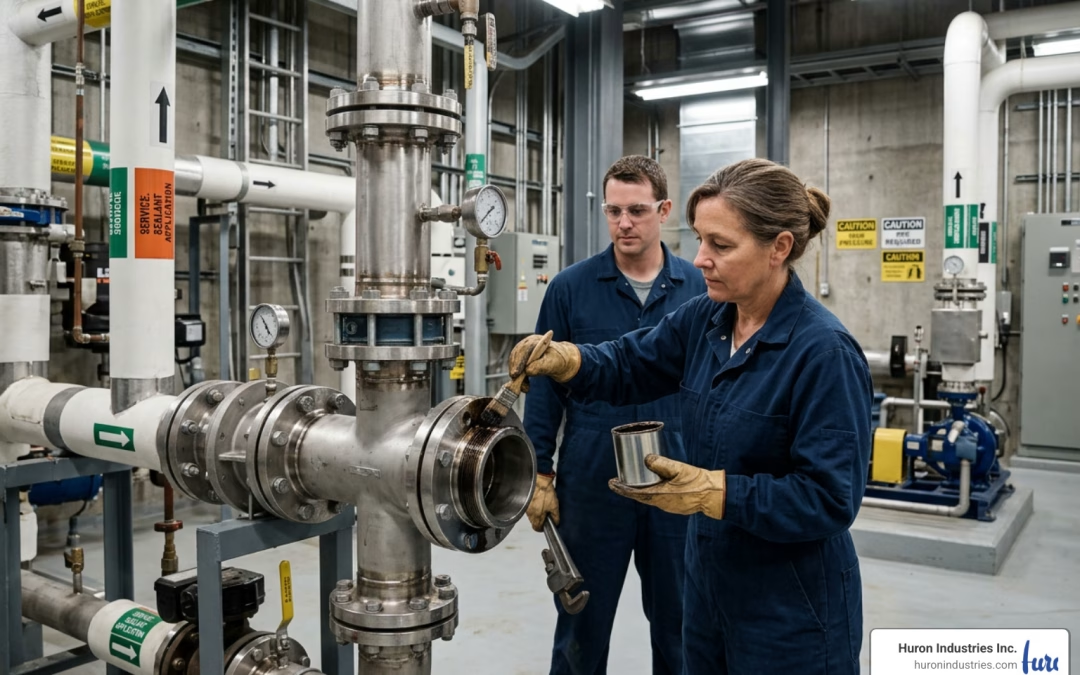
When the Specification Says D50YP12, Only One Sealant Fits
NEOLUBE No. 1260 is a nuclear-grade, graphite-based pipe thread sealant and anti-seize compound rated for service up to 635°C (1175°F) and 2300 psi (16 MPa). Here is what you need to know at a glance:
| Property | Value |
|---|---|
| Max Service Temperature | 635°C / 1175°F |
| Max Pressure Rating | 2300 psi / 16 MPa |
| Carbon Purity | 99.5% minimum |
| Total Halogen Content | < 25 ppm |
| Leachable Chloride | < 10 ppm |
| Shelf Life | 2 years minimum from first use |
| Package Size | 1.69 oz (50 cc) tube |
| Cures or Hardens? | No — stays flexible indefinitely |
| Oxygen Service Compatible? | No |
| Specification Met | GE D50YP12 Rev 2 |
Most thread sealants work fine in ordinary industrial settings. But when your system runs at reactor-level temperatures, high radiation exposure, and pressures that would destroy a standard paste — the sealant selection becomes a safety and compliance decision, not just a maintenance one.
Specifying the wrong product in a nuclear or critical-service environment is not a small mistake. It can mean seized joints, failed seals, or a product that simply does not meet the qualification standard your facility requires. That is where GE D50YP12 Rev 2 comes in — and why not every graphite paste qualifies.
I'm Nicholas Cunha, founder of CreatiVertical and the content strategist behind Huron Industries Inc.'s digital presence. My work involves translating the highly technical specifications of products like NEOLUBE No. 1260 into clear guidance for the engineers and procurement teams who source them. In this guide, I'll walk you through everything you need to confidently specify, apply, and qualify this product for your critical service application.
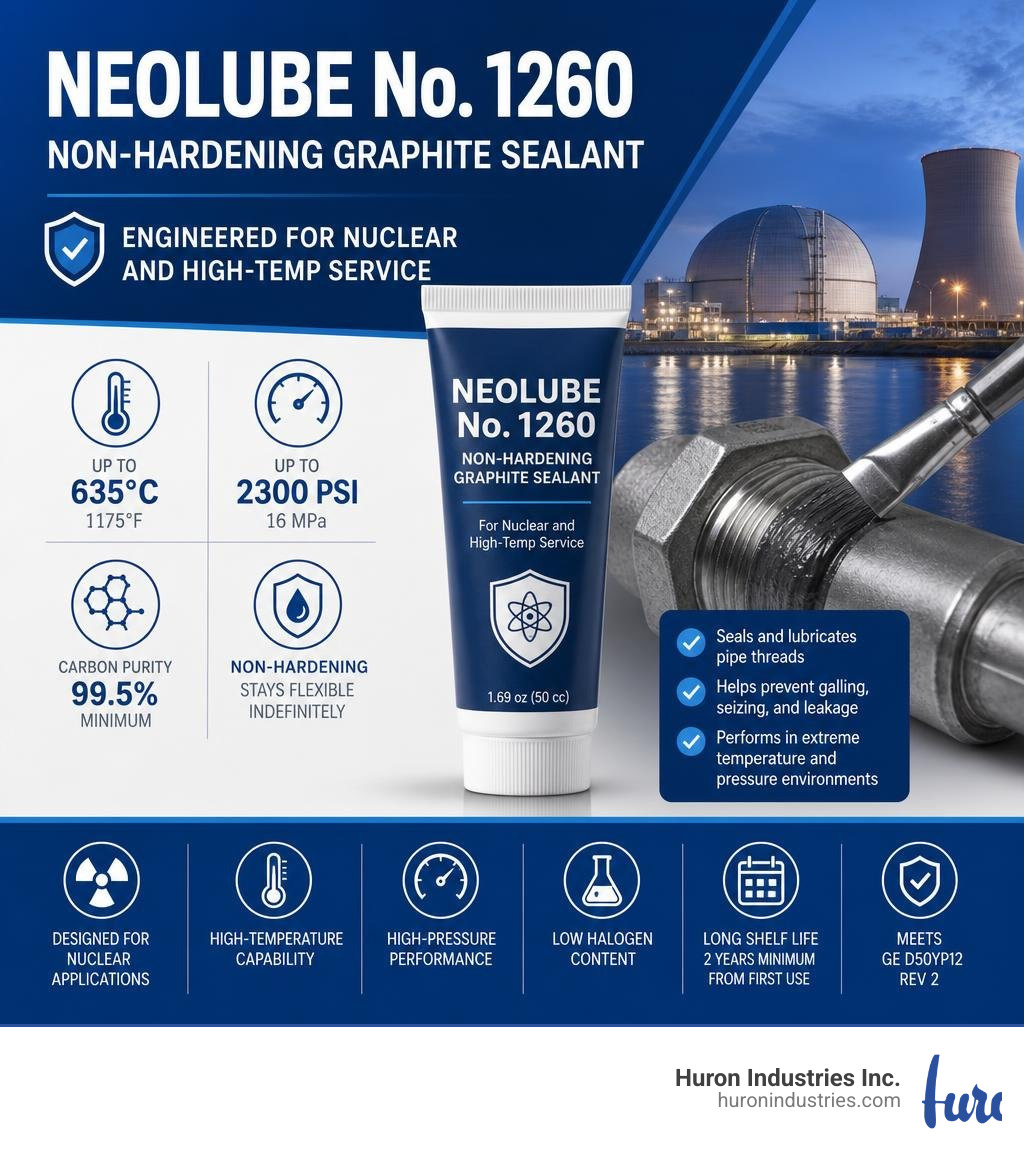
What is neolube no 1260 and How Does It Work?
At its core, neolube no 1260 is a specialized, graphite-based paste designed to act as both an industrial pipe thread sealant and an anti-seize compound. Unlike standard commercial sealants that dry into a rigid, plastic-like barrier, this product utilizes a non-hardening formula.
When you apply neolube no 1260, it relies on a high-quality petroleum carrier to evenly distribute the ultra-pure graphite particles across the metal threads. As the system heats up in service, this carrier begins to volatilize above 255°F (124°C). Once the carrier evaporates, it leaves behind a highly dense, conforming, and resilient dry graphite barrier. This process of carrier volatilization ensures that the joint remains sealed by the graphite itself, which can withstand extreme heat without cracking, shrinking, or degrading.
To explore the wider family of our specialized industrial formulations, you can check out the Neolube Brand Products page.
Composition and the Role of Nuclear-Grade Graphite
The secret to the performance of neolube no 1260 lies in its purity. The graphite used in this formula features a carbon content of 99.5% minimum. Because it uses such high-purity colloidal graphite, the compound exhibits exceptional thermal stability and virtually no creep relaxation.
In high-pressure piping, creep relaxation is a common cause of joint failure. Standard sealants slowly deform under constant pressure and thermal cycling, requiring maintenance teams to repeatedly re-tighten the joints. With neolube no 1260, the graphite particles pack tightly into the thread clearances, maintaining a stable, rigid-yet-flexible mechanical block. This unique structure ensures easy disassembly even after years of continuous high-temperature service. You do not have to worry about galling, seizing, or damaging expensive alloy threads when it comes time for routine inspection or repair.
The GE D50YP12 Rev 2 Specification
In the nuclear power industry, safety and material traceability are paramount. neolube no 1260 is specifically qualified to meet the stringent GE D50YP12 Rev 2 specification. This qualification is highly respected because it dictates strict limits on impurities that could cause stress corrosion cracking (SCC) or embrittlement in nuclear reactor components.
To verify these ultra-low impurity levels, our products have undergone rigorous laboratory testing, including historical evaluations by Oak Ridge National Laboratory. This testing ensures that every batch produced at our Port Huron, Michigan facility complies with the extreme purity standards required for the containment and secondary sides of nuclear power plants. For a complete breakdown of these certified values, you can view the Neolube No. 1260 Technical Datasheet.
Technical Specifications and Performance Limits
When I talk to design engineers, they do not want marketing fluff—they want hard data. To help you evaluate whether neolube no 1260 is appropriate for your system, I have compiled its key technical specifications and compared them to standard industrial thread sealants in the table below.
| Specification Parameter | NEOLUBE No. 1260 | Standard Industrial Sealants (PTFE / Curing Anaerobics) |
|---|---|---|
| Maximum Temperature | 635°C (1175°F) | 150°C to 260°C (300°F to 500°F) |
| Maximum Pressure | 2300 psi (16 MPa) | 1000 to 2000 psi (typically lower at high temp) |
| Carbon Content | 99.5% minimum | N/A |
| Total Halogen Content | < 25 ppm (Spec Max: 450 ppm) | Often unmonitored (high risk of chlorides) |
| Leachable Chlorides | < 10 ppm (Spec Max: 50 ppm) | High risk of stress corrosion cracking |
| Total Sulfur Content | < 150 ppm | Often unmonitored |
| Embrittling Metals | < 250 ppm | Often contains heavy metals or zinc |
| Curing Mechanism | Non-hardening (carrier volatilizes) | Chemical cure or solvent evaporation |
Temperature and Pressure Thresholds of neolube no 1260
In extreme environments, pressure and temperature work together to challenge your seals. neolube no 1260 performs reliably up to 2300 psi (16 MPa) in high-pressure systems while simultaneously withstanding temperatures up to 635°C (1175°F).
At these elevated temperatures, standard PTFE tape or synthetic anaerobic sealants will simply melt, char, or gas out, leaving the joint unprotected. Because the graphite in neolube no 1260 is virtually impervious to thermal degradation within this service range, the seal remains fully intact. For more background on these impressive limits, you can refer to the Neolube No. 1260 Tech - Huron Industries page.
Radiation Resistance and Weight Loss Characteristics
Nuclear applications expose materials to intense radiation fields that can alter the molecular structure of standard lubricants, causing them to harden, crumble, or lose adhesion. neolube no 1260 has been tested under extreme radiation conditions with no apparent effect on its physical properties:
- Neutron Radiation: Exposed to 5.5 x 10^21 NVT at 1000°C.
- Gamma Radiation: Exposed to 1.5 x 10^9 RADS.
Additionally, when evaluating the thermal behavior of the carrier, the product exhibits a modest 6% weight loss at 390°F (198°C) as the petroleum carrier volatilizes. It maintains excellent lubrication properties up to this temperature and beyond. With a high flash point of 320°F (160°C), the carrier is safe to handle in industrial environments before the system reaches its operating temperature.
Compatibility, Incompatibility, and Gasket Guidelines
Even the best sealant cannot do its job if it is paired with incompatible chemicals or gasket materials. Ensuring chemical compatibility is vital for protecting your seal integrity in critical service applications.
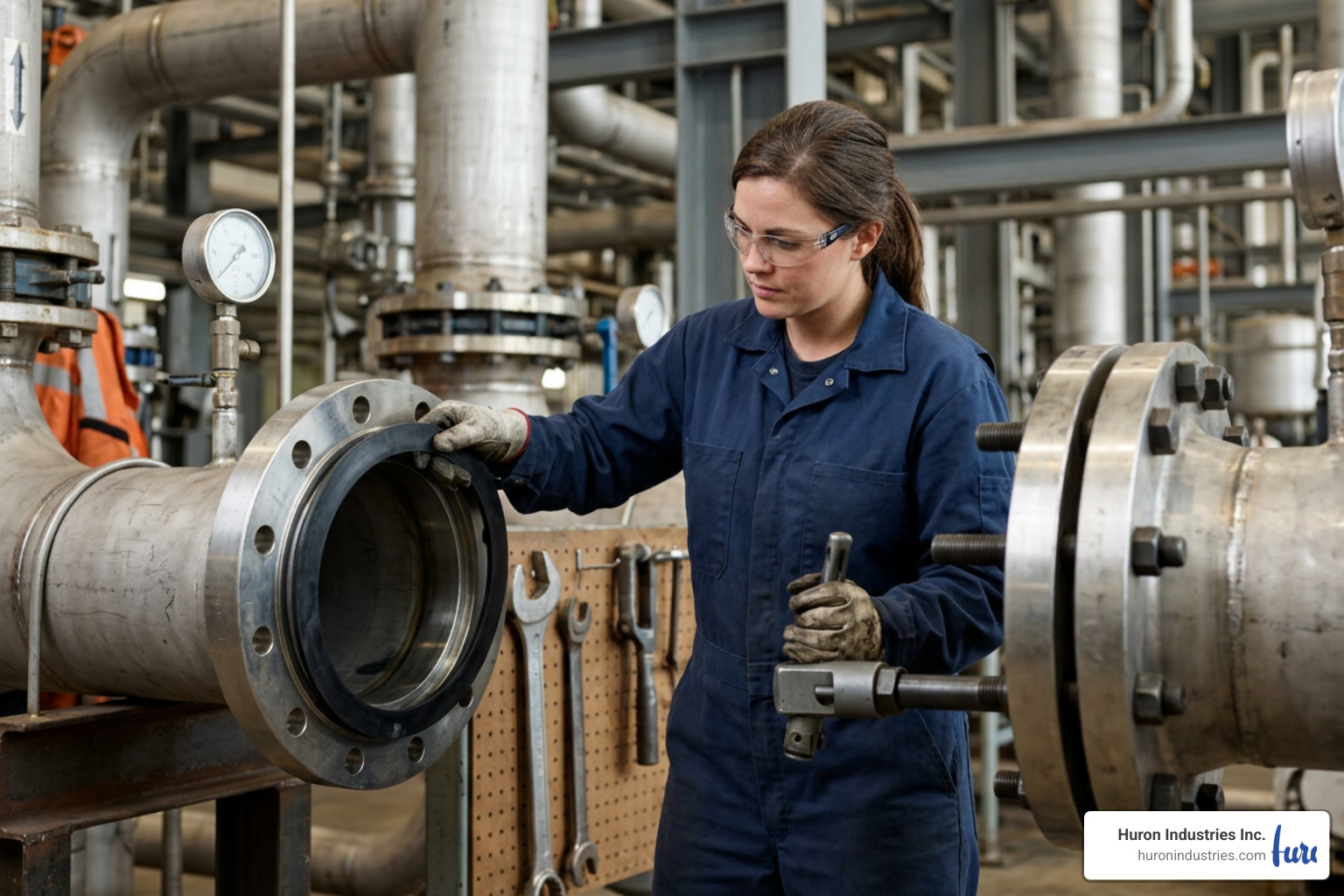
Approved Chemical Services and Gasket Materials
neolube no 1260 is highly recommended for use in demanding chemical environments, including ethylene oxide service.
When it comes to sealing systems that utilize gaskets alongside threaded connections, you must select the right elastomer. neolube no 1260 is fully compatible and recommended for use with:
- Nitrile (Buna-N) gaskets
- Viton (FKM) gaskets
These combinations ensure that the petroleum carrier in the paste does not degrade or swell the elastomeric seals, preserving the long-term integrity of the entire joint assembly.
Critical Incompatibilities: Oxygen and Oxidizing Agents
There are several strict limitations that you must observe when specifying neolube no 1260:
- Oxygen Service Restriction: Do not use neolube no 1260 in oxygen-only service. It is highly incompatible with pure oxygen systems due to the presence of the organic petroleum carrier.
- Strong Oxidizing Agents: Avoid contact with strong oxidizers, including nitrates, persulfates, perbenzoates, and peroxides.
- Incompatible Gasket Materials: Do not use this sealant in systems containing EPDM, Silicone, or Neoprene gaskets. The carrier can cause these specific elastomers to degrade, swell, or lose their sealing properties.
Comparing Neolube No. 1260 to Other Neolube Formulations
We manufacture several distinct variations of dry film lubricants and thread sealants here at Huron Industries Inc. Each is optimized for specific industrial roles. To ensure you choose the right product, you can access our comprehensive Neolube Data Sheets - NEOLUBE® Industrial Dry Lubricants page.
Key Differences Between neolube no 1260 and No. 100
A common point of confusion is deciding between neolube no 1260 and Neolube No. 100.
- Neolube No. 100 is an anaerobic pipe thread sealant designed for metal pipes and fittings. It relies on a chemical curing process that hardens in the absence of air. It is rated for a continuous service temperature up to 300°F (149°C).
- neolube no 1260 is a non-hardening, non-curing paste designed specifically for extreme high-temperature environments up to 1175°F (635°C) and high-pressure systems up to 2300 psi.
If your application requires regular disassembly after exposure to intense heat, or operates well above the limits of standard polymers, neolube no 1260 is the correct choice. To read more about high-pressure selection, visit our guide on the High Pressure Thread Sealant 2300 PSI Neolube 1260 page.
Neolube No. 1260 vs. Neolube No. 1
Neolube No. 1 is our legendary dry film conductive lubricant. It consists of high-purity colloidal graphite dispersed in an isopropanol diluent, qualified to the military specification MIL-L-24131C.
- Neolube No. 1 is designed to be applied as a thin, fast-drying liquid (drying in about 5 minutes) to lubricate moving parts, rubbing surfaces, and threaded joints in commercial and naval nuclear reactor systems. However, it is not recommended for use in reactor primary containment areas where temperatures exceed 400°F (204°C).
- neolube no 1260 is a thick paste formulation specifically designed to fill the larger clearances in threaded pipe joints and withstand temperatures more than double the limit of No. 1, making it the preferred choice for primary containment and high-temperature secondary side piping.
Application Instructions and Best Practices
To achieve a reliable, leak-free seal that can withstand 2300 psi, proper application technique is just as important as the quality of the sealant itself.
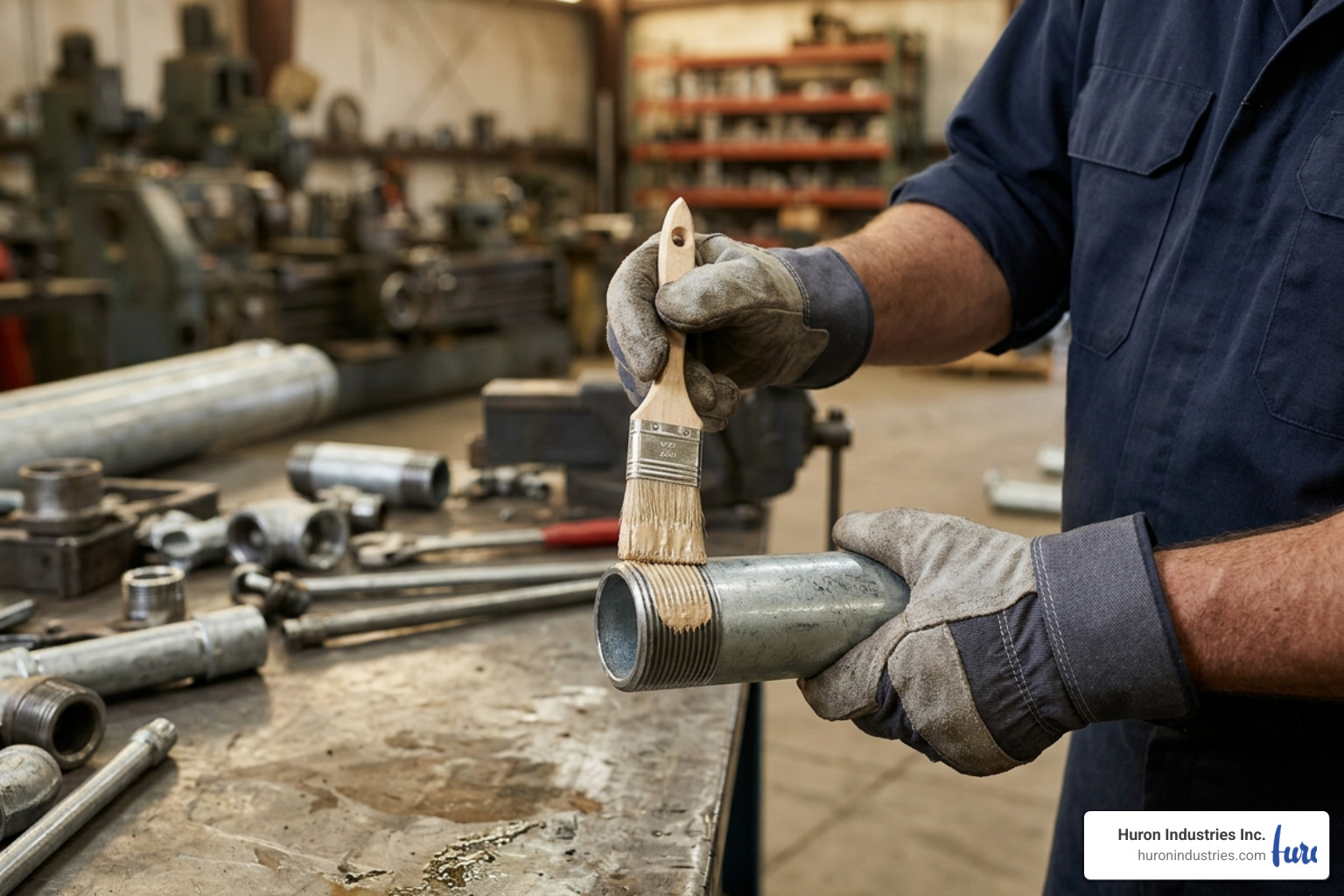
Surface Preparation and Joint Assembly
Follow these step-by-step instructions to ensure optimal performance:
- Thoroughly Clean the Surfaces: Ensure that the male and female threads are completely clean, dry, and free of old sealant, grease, rust, or cutting oils.
- Knead the Tube Well: Before applying, make sure the cap is on and thoroughly knead the tube with your hands. This redistributes any petroleum carrier that may have settled during storage. Snipping the cap and expelling any trapped air beforehand can make this easier.
- Apply the Paste Evenly: Apply a generous, even layer of neolube no 1260 to the male threads. Ensure that you completely fill the thread roots.
- Assemble the Joint: Thread the joint together according to your facility's torque specifications. The non-hardening paste will flow and compress to fill all microscopic clearances.
- Close the Cap Tightly: Always seal the tube tightly immediately after use to prevent the carrier from drying out.
Note: neolube no 1260 is specifically recommended for small-diameter, close-fitting threaded joints up to 2 inches (50.8 mm) OD.
Storage, Shelf Life, and Packaging Options
To ensure your sealant performs perfectly when you need it, observe these storage guidelines:
- Shelf Life: Minimum of two years from the date of first application when stored properly.
- Storage Temperature: Store the tubes at or below 38°C (100°F) in a dry location.
- Packaging: Conveniently packaged in 1.69 oz (50 cc) squeeze tubes, which are easy to carry in a maintenance toolbox.
For safety and handling precautions, always consult the Neolube No. 1260 Safety Datasheet before use.
As of 2026, our volume-based pricing tiers (FOB Port Huron, Michigan, subject to a standard $36.00 handling charge) allow organizations to optimize their procurement budgets:
- 1–3 tubes: $308.97 each
- 4–11 tubes: $212.97 each
- 12–29 tubes: $164.97 each
- 30–109 tubes: $155.97 each
- 110–199 tubes: $131.97 each
- 200+ tubes: $119.97 each
Frequently Asked Questions about High-Pressure Sealants
Does NEOLUBE No. 1260 cure or harden over time?
No. neolube no 1260 features a non-curing formula. While the petroleum carrier volatilizes at high temperatures, the remaining high-purity graphite paste does not harden, cure, or bake onto the metal. This ensures long-term flexibility and allows for easy, damage-free disassembly of pipe joints even after years of extreme thermal exposure.
Can NEOLUBE No. 1260 be used in oxygen-only service?
No. Because it contains a petroleum-based carrier, neolube no 1260 is highly incompatible with oxygen-only service. Using it in pure oxygen environments presents a severe fire and safety hazard. It should also be kept away from strong oxidizing chemicals such as nitrates, persulfates, and peroxides.
What pipe sizes are recommended for this sealant?
It is highly recommended for small-diameter, close-tolerance threaded pipe joints with an outer diameter (OD) of 2 inches (50.8 mm) or less. This ensures the graphite particles can bridge and seal the thread clearances effectively under high pressure.
Conclusion
When your operations demand nuclear-grade reliability, standard industrial sealants are a liability. neolube no 1260 delivers the ultimate combination of high-temperature performance (up to 635°C), high-pressure resistance (up to 2300 psi), and ultra-pure chemical compliance (GE D50YP12 Rev 2). By remaining flexible and non-hardening over years of service, it protects your valuable piping assets from galling, seizing, and costly downtime.
If you are ready to secure your high-pressure systems with the industry standard in graphite sealing, you can purchase the Neolube No. 1260 1.69 oz Tube directly from our online store. For more detailed technical specifications and application guidance, visit our dedicated page on High Pressure Thread Sealant 2300 PSI Neolube 1260. Let's make sure your next critical shutdown goes exactly as planned.