
What Case Neck Lube Does — and Why It Matters
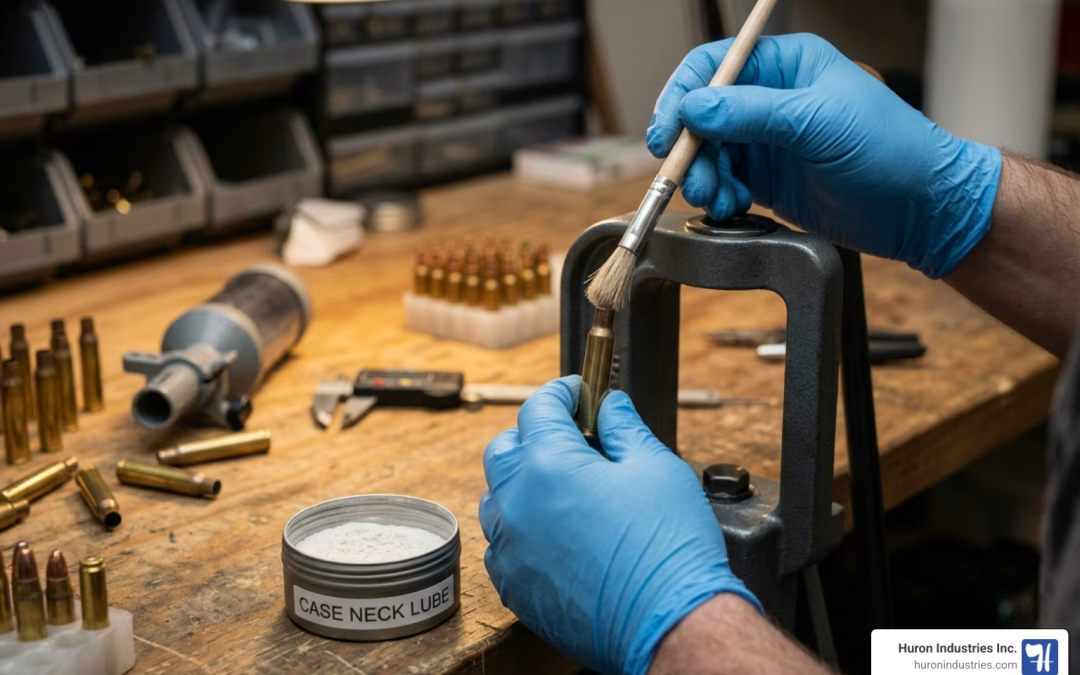
Case neck lube is a lubricant applied to the inside of a cartridge case neck to reduce friction during two key steps: sizing and bullet seating.
Quick answer — what you need to know:
- Purpose: Reduces friction as the expander ball or sizing mandrel passes through the neck
- Why it matters: Without it, the expander ball drags through the brass, stretching the neck unevenly and creating inconsistent neck tension
- Best type: A dry-film lubricant (like liquid colloidal graphite) that flashes off clean and won't contaminate powder or primers
- When to apply: Before sizing, before bullet seating, or both — especially with clean, new, or freshly annealed brass
- What happens if you skip it: Inconsistent bullet seating force, wider muzzle velocity spread, accelerated brass wear, and possible galling on the mandrel
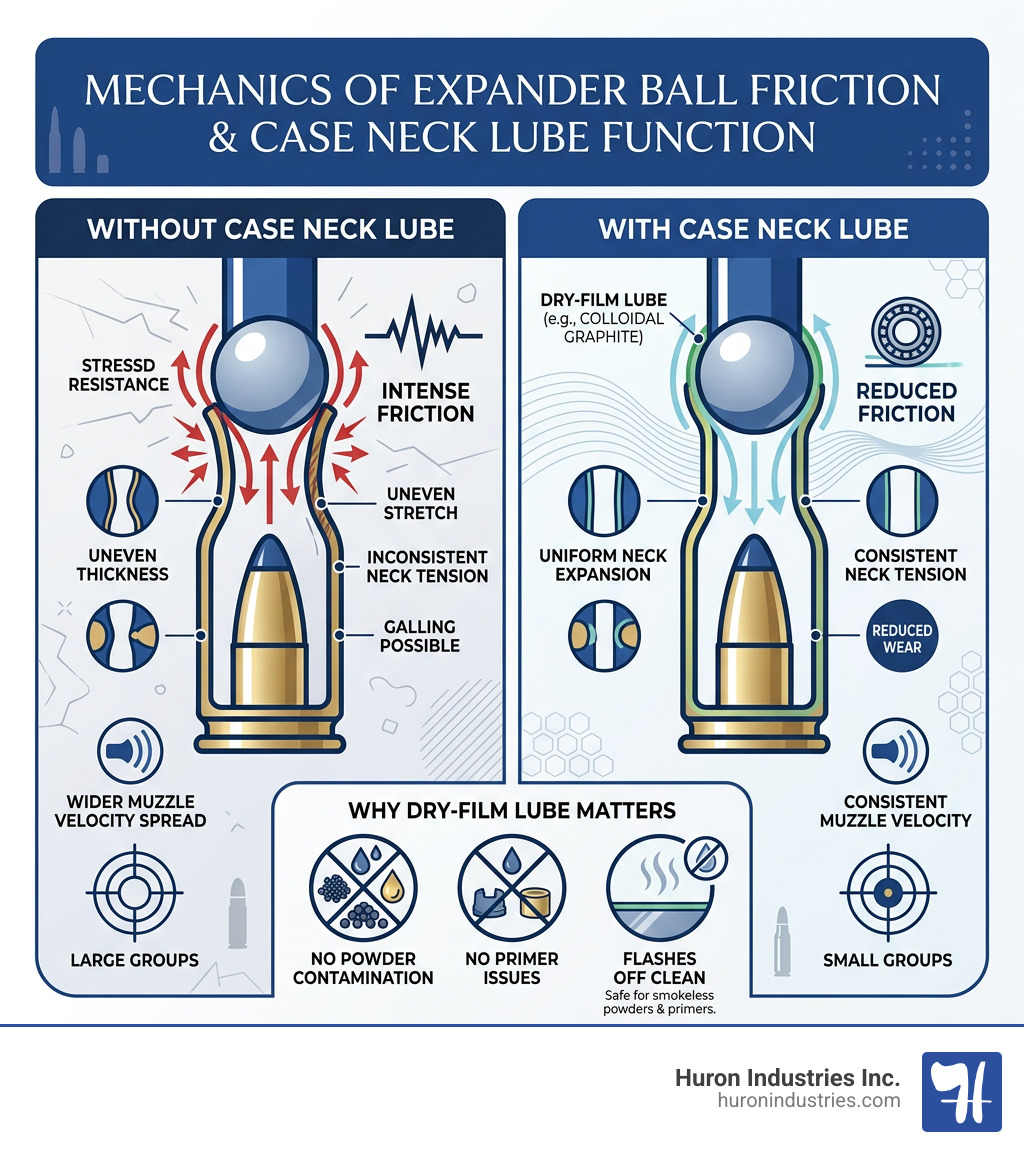
Here is the core problem: when you resize a fired case, the expander ball pulls back through the neck on the upstroke. That creates intense friction against the brass. If there is no lubricant, the ball grabs the neck and stretches it unevenly. That stretch changes your neck tension from case to case — and inconsistent neck tension means inconsistent bullet release, which directly affects your muzzle velocity and group size.
Forum discussions among experienced reloaders confirm this. One shooter noted that after forgetting to lube a batch of case necks, their groups opened up noticeably. Another described how wet tumbling — which strips the natural carbon residue left by firing — makes lubrication essential, not optional. Carbon residue inside fired, uncleaned necks acts as a built-in lubricant. Once you clean it out, you need to replace it with something intentional.
The good news: the right lubricant, applied correctly, is simple, fast, and lasts thousands of rounds.
I'm Nicholas Cunha, founder of CreatiVertical and the content strategist behind Huron Industries Inc.'s digital presence — including their case neck lube product line and technical documentation. I work directly with Huron's engineering team to translate the science behind their colloidal graphite formulations into clear, practical guidance for precision reloaders and industrial buyers alike.
Why You Need Case Neck Lube for Precision Reloading
To understand why we need to lubricate the inside of a case neck, we have to look at the immense physical forces at play inside our reloading dies.
When a cartridge is fired, the intense pressure expands the brass case to seal the chamber. After extraction, that brass is dirty, stretched, and slightly oversized. To make it usable again, we run it through a full-length sizing die. This die squeezes the entire case—including the neck—down to a dimension slightly smaller than the final desired size.
As the ram of your press is lowered, an expander ball (or a mandrel on a separate step) is pulled back up through the squeezed case neck to set the final inner diameter. This is where the "tug-of-war" begins.
Without proper lubrication, the metal-on-metal contact between the expander ball and the raw brass creates extreme friction. This friction causes several major issues:
- Inconsistent Neck Tension: Neck tension is the mechanical grip the brass case has on the bullet. If the expander ball drags unevenly, it stretches the neck walls to varying thicknesses and lengths. This results in some bullets being held tightly while others are relatively loose.
- Brass Stretching and Distortion: Unlubricated expander passes can stretch the case neck and shoulder forward by $0.002''$ to $0.004''$. This ruins your carefully measured head clearance (shoulder bump) and forces you to trim your brass far more often.
- High Bullet Seating Force Variability: Squeaky-clean brass necks that have been wet-tumbled or ultrasonically cleaned have zero natural lubrication. When you seat a bullet into a dry neck, the force required to push the bullet home varies wildly.
- Muzzle Velocity Extreme Spread (ES) and Standard Deviation (SD): There is a direct, proven correlation between bullet seating force consistency and muzzle velocity consistency. If it takes 15 pounds of force to seat one bullet and 40 pounds to seat the next, those two cartridges will build pressure differently, leading to vertical stringing on your target.
Using a high-quality case neck lube solves these issues by establishing a thin, uniform boundary layer. It ensures the expander ball or mandrel glides effortlessly through the brass.
As highlighted in Do You Lube Brass Necks? A Reloader's Guide , skipping this step is the root cause of many frustrating, hard-to-diagnose accuracy issues. By controlling this single friction point, you can dramatically reduce your Case Neck Friction Extreme Spread, leading to single-digit muzzle velocity SDs and tighter groups downrange.
Choosing the Right Lubricant: Liquid Colloidal Graphite vs. Traditional Methods
Reloaders have tried almost everything to reduce neck friction. Some methods work reasonably well but are incredibly messy, while others introduce serious risks of powder contamination.
Let's break down the three main categories of case neck lubricants:
1. Traditional Dry Powders (Graphite and Mica)
These are fine, airborne powders like white motor mica or dry graphite. Reloaders typically apply them by dipping the case necks into a container filled with ceramic beads or steel shot coated in the powder.
- Pros: They are inert and will not contaminate gunpowder.
- Cons: They are incredibly messy. Dry graphite turns your fingers black and leaves you looking like a coal miner after a long loading session. Furthermore, inhaling fine dry lubricant dust poses respiratory risks. Ceramic beads can also occasionally stick inside the case neck; if you miss one, it can easily destroy your sizing die or ruin your brass.
2. Sticky Sizing Waxes and Oils
These are heavy, petroleum- or lanolin-based liquid and wax lubricants designed for the exterior of the cartridge case.
- Pros: Excellent boundary lubrication for heavy-duty resizing.
- Cons: High risk of powder contamination. If even a microscopic amount of wet wax or oil remains inside the neck, it can migrate into the powder charge, deactivating the gunpowder or primer. This leads to hangfires, squibs, or wild velocity drops. Wet lubes also cause powder kernels to stick to the inner walls, creating physical bulges during bullet seating.
3. Liquid Colloidal Graphite (CaseLube™)
Liquid colloidal graphite consists of sub-micron, high-purity graphite particles suspended in a fast-evaporating solvent carrier like isopropyl alcohol.
- Pros: It offers the best of both worlds. You apply it as a liquid, which gives you absolute control over placement. The carrier solvent evaporates within minutes, leaving behind an incredibly thin, dry, and chemically bonded film of pure graphite. This film cannot migrate, will not attract dirt, and is completely inert—meaning zero risk of powder contamination.
- Cons: Requires a few minutes of dry time before use.
According to the CaseLube Technical Data Sheet, this formulation provides a static Coefficient of Friction of just 0.19 and cures to an ultra-thin dry film thickness of only 0.2 to 0.5 mil ($0.0002''$ to $0.0005''$).
| Lubricant Type | Application Method | Contamination Risk | Mess Factor | Film Consistency |
|---|---|---|---|---|
| Sticky Sizing Waxes / Oils | Cotton swab / fingers | High (can deactivate powder) | High (requires post-sizing wash) | Poor (heavy, uneven buildup) |
| Traditional Dry Powders | Dipping into coated beads | Low (inert) | High (dusty, black residue) | Moderate (loose powder can migrate) |
| Liquid Colloidal Graphite | Foam swab (CaseLube™) | None (solvent evaporates completely) | Low (precise, localized film) | Excellent (0.2–0.5 mil bonded layer) |
Application Methods for Liquid Colloidal Graphite
Using a liquid colloidal graphite suspension like CaseLube™ is incredibly simple, but the key is moderation. Because it is highly concentrated, a single 2 oz bottle lasts for thousands of cases.
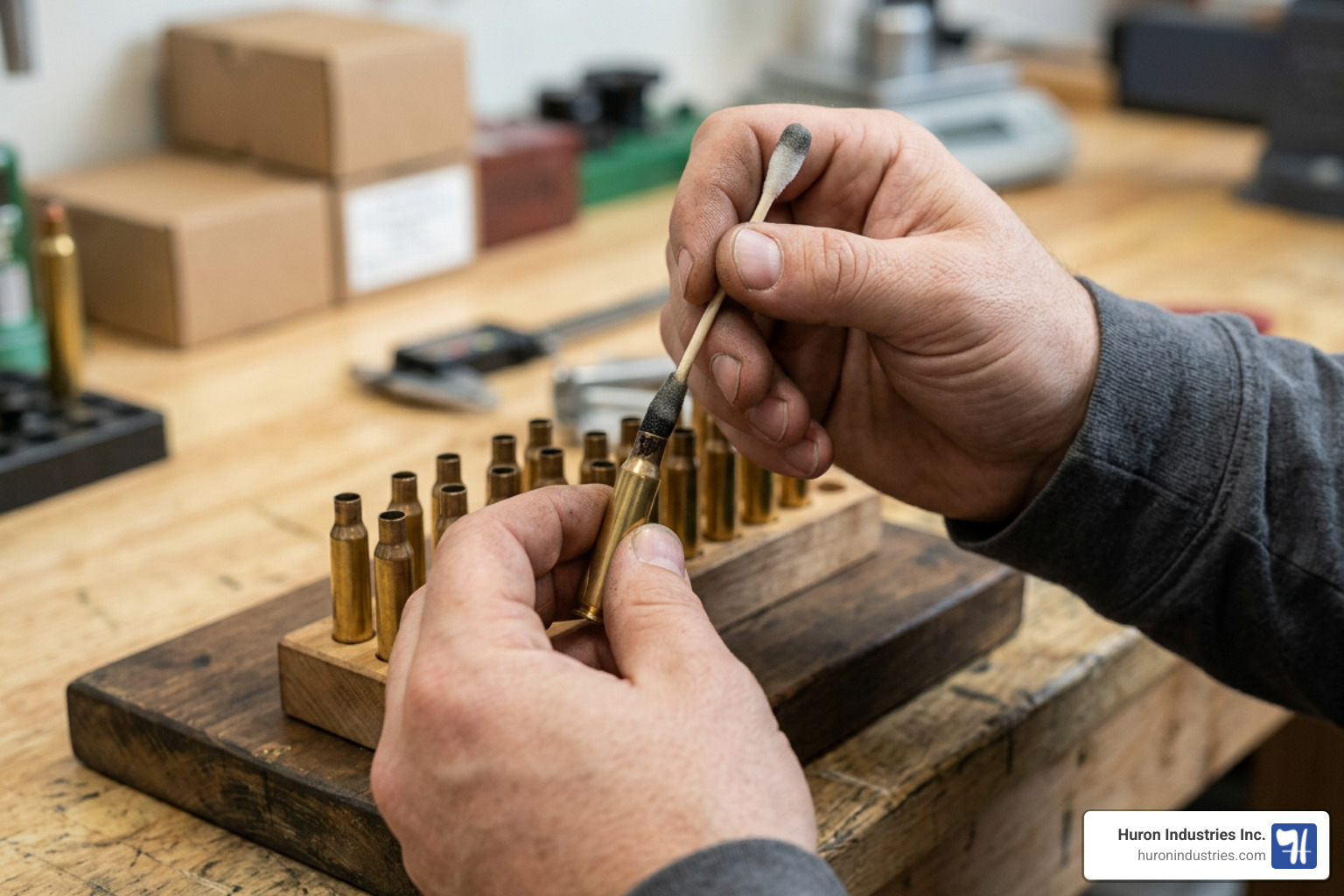
The goal is to apply a microscopic, uniform layer inside the case neck. To achieve this, I recommend the foam-swab method. It provides the most controlled, repeatable application without any of the waste or mess associated with spray-on alternatives.
For a deeper dive into this technique, you can read our complete guide on how to Apply Liquid Graphite to Case Necks.
Step-by-Step Application of CaseLube Liquid Graphite
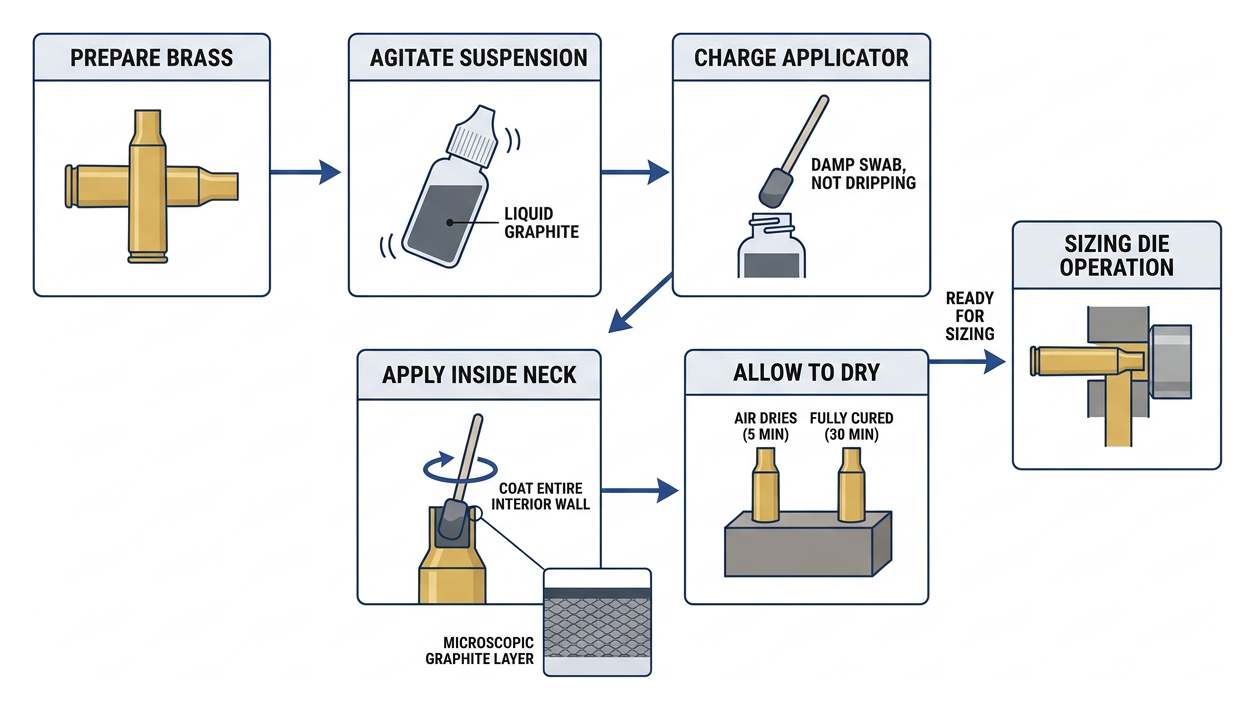
Follow these steps to achieve a perfect dry-film coating on your brass:
- Prepare Your Brass: Start with clean, dry, and deprimed cases. If you have just wet-tumbled or annealed your brass, ensure it is completely cool and free of any residual moisture or cleaning agents.
- Agitate the Suspension: Colloidal graphite naturally settles over time. Shake the bottle of CaseLube Liquid Graphite Case Neck Lubricant 2 oz Bottle thoroughly before use to ensure the graphite particles are evenly dispersed in the isopropyl alcohol carrier.
- Charge Your Applicator: Dip the tip of a non-abrasive polyurethane foam swab (recommended size C5709C) into the liquid. Press the swab against the inside rim of the bottle to squeeze out any excess. The swab should be damp, not dripping wet.
- Apply Inside the Neck: Insert the swab into the case mouth and rotate it once or twice. Ensure you coat the entire interior wall of the neck, but avoid pushing the swab so deep that liquid puddles at the base of the shoulder.
- Allow to Dry: Place your coated cases upright in a loading block. The isopropanol carrier will flash off quickly. It air dries to the touch in approximately 5 minutes and is fully cured and ready for sizing or bullet seating in 30 minutes.
Why Traditional Dipping and Powders Fall Short
While some reloaders still use the old-school method of dipping case necks directly into dry graphite powder or motor mica, the drawbacks are hard to ignore.
As discussed on the Case neck lube? | Shooters' Forum , dipping often leads to inconsistent coverage. The powder simply sits loosely on the surface of the brass. When you run the case into the die, a large portion of that loose powder is scraped off, building up in the shoulder area of your sizing die. Over time, this buildup can cause hydraulic-like dimples on your brass shoulders.
Furthermore, loose powder can easily migrate down into the case body. While dry graphite is inert, having loose, floating carbon inside your cases is far from ideal.
By contrast, liquid colloidal graphite chemically bonds to the brass surface as the carrier solvent evaporates. This creates a durable, non-migrating dry film that stays exactly where you put it—providing smooth lubrication through both the sizing and bullet seating steps without the mess.
Integrating Neck Lubrication into Your Reloading Workflow
Where exactly does case neck lubrication fit into your reloading sequence? The answer depends on your specific tooling and workflow.
Sizing Mandrels vs. Expander Balls
If you use a standard full-length sizing die with an internal expander ball, you must apply case neck lube before sizing. This prevents the expander ball from stretching the neck on the upstroke.
If you use a two-step sizing method—squeezing the necks down with a bushing die and then pushing a precision sizing mandrel down through the neck—lubrication is even more critical. Mandrels operate with very tight clearances. Running a dry mandrel into a dry, clean neck can cause the brass to gall (cold-weld) directly onto the mandrel.
Once brass galling occurs, the surface of your mandrel becomes rough, ruining the inside of every subsequent case neck. If you notice your mandrel getting sticky, soak it in a copper-removing solvent to dissolve the built-up brass, and always lube your necks beforehand.
The Role of Annealing
Annealing restores the malleability of your brass by relieving the work-hardening caused by firing and sizing. However, freshly annealed brass is incredibly soft and "sticky" at a molecular level.
If you run freshly annealed, unlubricated cases over an expander mandrel, the soft brass will grab the steel or carbide aggressively. Always ensure your brass has cooled completely after annealing, and then apply a thin layer of CaseLube™ to preserve the uniform softness of the necks during expansion.
Cleaning After Sizing
If you use sticky waxes or oils, you must completely wash or tumble your brass after sizing to remove the residue. This adds a tedious, time-consuming step to your workflow.
With liquid colloidal graphite, there is no need for post-sizing cleanup. The dry graphite film is incredibly thin (0.2 to 0.5 mil) and completely stable. You can leave it inside the case neck, charge your powder, and seat your bullets directly over it.
In fact, leaving the dry film in place for bullet seating is highly beneficial, as it ensures a smooth, uniform seating stroke and prevents "cold welding" (where the bullet jacket bonds to the brass neck over months of storage).
For highly detailed technical advice on this interaction, review the Technical Notes Neolube 2 for Lubricating Internal Case Necks.
Frequently Asked Questions
Does Neck Lubricant Contaminate Gunpowder?
This is the single most common concern among reloaders. With petroleum- or silicone-based wet lubes, the risk of contamination is exceptionally high.
However, CaseLube™ is completely safe. As detailed in the CaseLube Safety Data Sheet, the isopropyl alcohol carrier evaporates entirely, leaving behind only pure, inert colloidal graphite. Because this graphite dry-film is chemically bonded to the brass, it will not migrate into, react with, or deactivate your powder charge or primer.
Can I Use Standard Sizing Wax Inside Case Necks?
I strongly advise against this. While case sizing wax is excellent for the exterior of the brass body, using it inside the neck is a recipe for trouble.
As shared in the Case Neck Lube thread, sticky waxes leave a wet residue that attracts gunpowder kernels. These kernels can bridge inside the neck, causing inconsistent powder charges or creating physical bulges when the bullet is seated.
Save the wax for the outside of the case, and use a dedicated dry-film lubricant for the interior.
How Long Does Liquid Case Neck Lube Take to Dry?
At room temperature, CaseLube™ air dries to the touch in about 5 minutes.
However, to ensure that the isopropyl alcohol carrier has completely flashed off from the deep interior of the neck, we recommend waiting 30 minutes before running the cases through your sizing dies or charging them with powder.
Conclusion
Precision reloading is a game of eliminating variables. We weigh our powder to the hundredth of a grain, measure our bullet runout, and carefully sort our brass by weight. Yet, many shooters completely overlook the physical friction occurring inside the case neck.
Skipping neck lubrication—or using the wrong lubricant—introduces massive consistency issues right at the critical junction where the brass releases the bullet.
Since 1971, Huron Industries Inc. has manufactured high-purity, high-performance graphite lubricants in Port Huron, Michigan. Our legacy of producing certified formulations for demanding naval and commercial nuclear applications is built directly into every bottle of CaseLube™.
By upgrading your reloading bench with a high-purity colloidal graphite dry-film, you can eliminate expander drag, achieve incredibly consistent bullet seating force, and shrink your muzzle velocity standard deviations.
Ready to take control of your neck tension and experience incredibly smooth expander passes? Explore our specialized CaseLube product line today and give your match-grade handloads the consistency they deserve.