
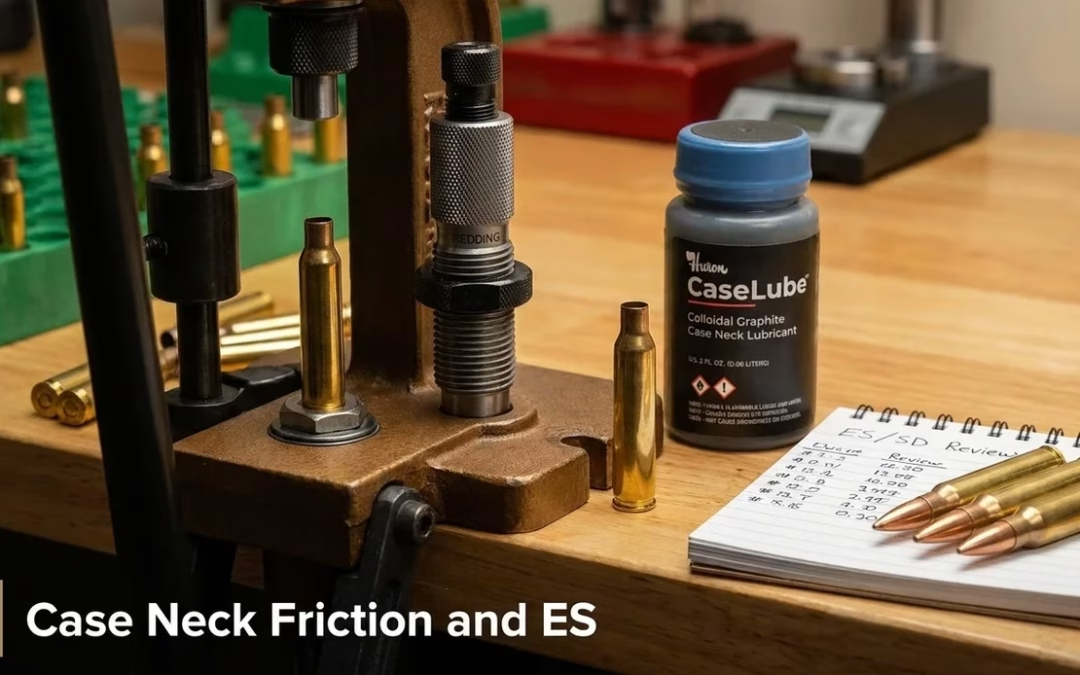
When a load starts showing a wider extreme spread (ES) than expected, most handloaders look first at powder charge, primer selection, case capacity, annealing, seating depth, and chronograph setup. Those are all valid places to start. The part that gets less attention is the contact between the inside of the case neck and the bullet jacket, because that variable is hidden inside a cartridge that may still measure correctly at the bench.
Case neck friction matters because the bullet does not begin each shot in free space. It starts held in the case neck. Before it moves, pressure has to overcome the grip and surface resistance holding it in place. If that resistance changes from round to round, the load may begin each shot under slightly different conditions, even when the powder charge, seating depth, and brass lot look controlled.
This is not an argument that every load needs case neck lubricant. It is a mechanical look at why friction belongs in the same conversation as neck tension, seating force consistency, and consistent bullet release.
Neck tension sets the dimension, but friction controls the feel
Reloaders often describe neck tension as a number. A common example would be 0.002 inch of interference between bullet diameter and the sized inside neck diameter. That number is useful because it gives the reloader a measurable setup target. It also keeps the conversation grounded in something more specific than tight or loose.
The limitation is that the number only describes geometry. It does not fully describe how much force is required to seat the bullet, how smoothly the bullet enters the neck, or how repeatably the bullet releases when pressure starts to build.
Two cases can have the same-sized neck diameter and still feel different at the press. One case neck may have a light, uniform surface condition inside the neck. Another may be freshly cleaned and more grabby. One piece of brass may have slightly different springback after several firings. Another may have a smoother inside neck after mandrel use. The final measurement can look the same while the seating force tells a different story.
That is why serious reloaders look beyond the caliper. Neck tension gives the starting dimension. Case neck friction affects the actual metal-to-jacket contact during seating and release.
Seating force is where the problem usually shows up first
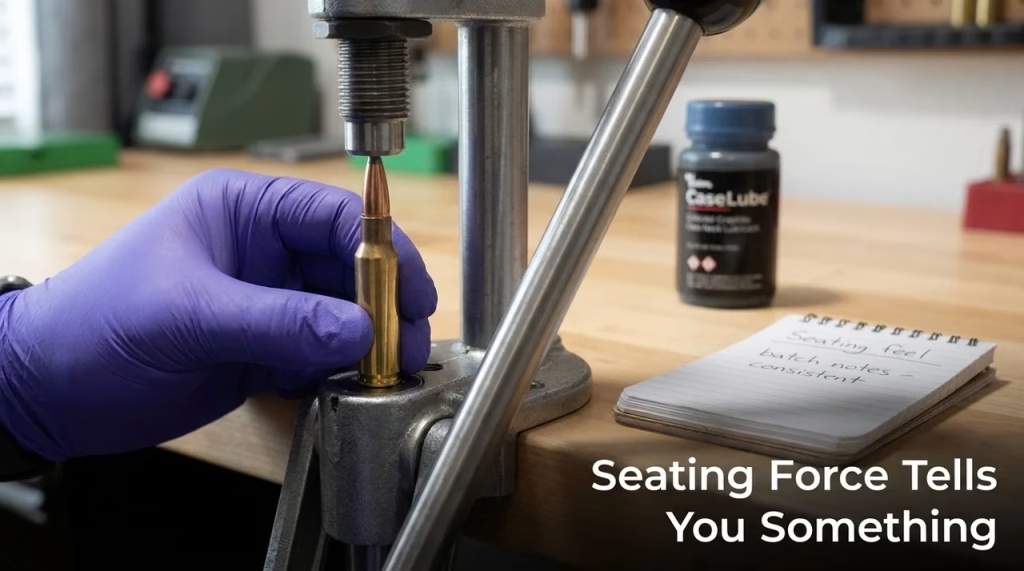
A friction problem often announces itself during bullet seating. The finished cartridge may still land on the correct base-to-ogive measurement, but the press handle tells you that each round did not get there the same way.
A consistent batch has a familiar feel. The bullet starts into the neck smoothly, pressure builds in a predictable way, and the handle stroke repeats. A less consistent batch feels different from case to case. Some bullets start cleanly, while others take more initial force. Some feel rough through the first part of travel. Others feel normal after a hard break at the beginning.
That variation is useful information. With a standard single-stage press, the feedback comes through the handle. With an arbor press or seating-force measuring setup, it may show up as a wider spread in seating force. Either way, the point is the same. If the bullet does not seat with similar resistance from round to round, the case neck condition is not as repeatable as it looks on paper.
Seating force consistency does not prove that a load will have a lower ES. It does give the handloader a practical signal. When seating feel is inconsistent, neck friction should be investigated before changing unrelated parts of the load.
Why friction can affect extreme spread
Extreme spread is the difference between the fastest and slowest recorded velocity in a shot string. It is easy to calculate and much harder to diagnose. A wide ES can come from several places, including powder variation, primer behavior, case capacity, inconsistent ignition, brass condition, or measurement error. Case neck friction is one of the smaller variables that can still add noise when the rest of the process is already tight.
The reason is simple enough. The bullet is held in the neck at the start of the pressure event. If one bullet begins moving under lower resistance and the next begins moving under higher resistance, pressure and timing may not develop in the same way. The difference may be small, but at a distance, small velocity differences can become vertical spread.
The practical takeaway is not that neck lube fixes ES by itself. That would be an unsupported claim. The better takeaway is that inconsistent neck friction can make an otherwise careful load less repeatable. For a precision handloader, any variable that changes bullet release from round to round deserves attention.
Clean necks are not always repeatable necks
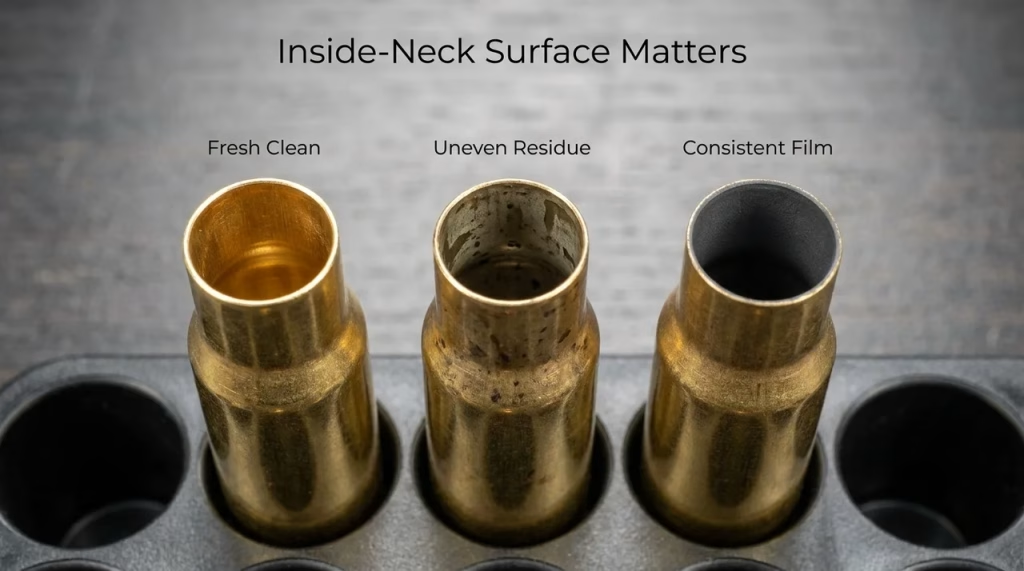
Clean brass is usually a good thing. It protects dies, makes inspection easier, and keeps grit out of the loading process. The problem starts when the cleaning process creates a different inside-neck condition from case to case.
A neck that has been cleaned aggressively may not behave like a neck with a light, consistent surface film. A case that still has uneven residue may not behave like one that is clean and dry. The issue is not whether the neck looks clean from the outside. The issue is whether the bullet sees the same surface condition every time it is seated.
This is one reason a load can change after a reloader changes cleaning media, wet-tumbling routine, brushing process, annealing schedule, or expander method. The brass may be cleaner, but the bullet may now be seating against a different surface.
Consistency matters more than the label attached to the process. A reloader can build accurate ammunition with different methods, but the method has to repeat.
Controlled friction is the goal
Case neck lubricant is sometimes discussed as if the goal is simply to reduce grip. That is not the right way to think about it for precision reloading.
The goal is controlled friction. The case neck still needs to hold the bullet correctly. The sizing setup still needs to be safe and appropriate for the rifle, chamber, brass, and load. A lubricant should not be used to cover up poor die setup, mixed brass, damaged necks, or inconsistent annealing. Its value is in helping create a more repeatable contact condition inside the neck.
A thin, even dry film can reduce the difference between a neck that feels sharp and grabby and another that feels smoother. When applied consistently, inside-neck lubrication becomes part of the process rather than a random residue left behind.
That distinction is important. Too much lubricant, uneven application, or wet residue can create new variables. A controlled process uses the same applicator, the same amount, the same dry time, and the same sequence for the whole batch.
Where CaseLube™ belongs in the friction conversation
For neck-friction work, the lubricant has to be predictable. A slick feel by itself is not enough. The inside of the neck needs a surface that stays thin, dry, and repeatable without adding a wet coating or another variable the reloader has to chase.
CaseLube™ fits that role because it is a liquid graphite case neck lubricant made for the interior of the case neck during precision ammunition reloading. It works as a dry-film graphite surface, not a grease or oil film. After the carrier flashes off, what remains is an ultra-thin graphite film at the contact point where sizing feel, seating feel, and bullet release are affected.
That film gives the process a measurable surface instead of guesswork. Its static coefficient of friction is 0.19, and the typical dry film thickness is 0.2–0.5 mil when applied correctly. In a loading process where small changes in neck condition can show up as different seating resistance, that kind of thin, controlled film matters.
The value is not only lower friction. It is more controlled friction. CaseLube™ is built to reduce galling during sizing, support consistent neck tension, help bullet release stay more uniform, and minimize dimensional change when the film is applied properly. Those are the exact points that matter when a reloader is trying to remove one more source of variation from the cartridge.
CaseLube™ should not be framed as a guaranteed fix for extreme spread. A wide ES can still come from powder charge variation, primer behavior, case capacity spread, inconsistent annealing, or an unstable load. Its role is more specific. It gives reloaders a dry graphite film for one contact point that can influence seating force consistency and bullet release.
A practical way to test neck friction in your own load
The cleanest way to evaluate neck lubrication is to treat it as one controlled variable. Use the same brass lot, the same firing count, the same die setup, the same annealing condition, the same bullet, the same seating depth, and the same powder charge. Change only the inside-neck lubrication step.
Seat the control batch with your normal process. Seat the test batch with a thin, consistent dry film applied inside the neck. Pay attention to the feel of the press handle and mark any rounds that seat noticeably harder or smoother than the rest. If you use seating-force measurement, record the spread instead of relying only on feel.
At the range, record velocity carefully and avoid reading too much into a tiny sample. One short test is not enough to make a universal claim about ES or standard deviation (SD). It can still tell you whether your rifle and load respond to a more consistent inside-neck condition.
Good load work is not about proving a product right. It is about removing one source of uncertainty at a time.
What Case Neck Lubrication Can and Cannot Fix
Case neck lubrication should stay in its lane. It will not correct mixed brass, loose primer pockets, poor shoulder bump control, inconsistent annealing, damaged necks, rough seating technique, or a load that is already unstable. It also should not be treated as a substitute for safe load development.
If a wide ES is coming from inconsistent powder charges, primer variation, case capacity spread, or chronograph placement, inside-neck lubrication will not solve the root cause. The honest role of a case neck lubricant is narrower and more useful than that. It helps the reloader control friction at one contact point in the cartridge.
That makes it worth testing when seating force feels inconsistent, freshly cleaned necks seat rough, bullets show signs of jacket scraping, or a disciplined loading process still has unexplained variation.
Final takeaway
Neck friction is easy to overlook because it hides inside a finished round. The cartridge may measure correctly, chamber correctly, and still carry a small difference in how the bullet is held and released. For short-range or general loading, that difference may not matter. For precision handloading, especially when ES and vertical spread are already under review, it deserves a place in the process audit.
The best way to approach case neck friction is not with a promise. It is with a repeatable method. Keep the brass consistent. Keep the sizing setup consistent. Keep the inside-neck surface consistent. If you use a case neck lubricant, apply a thin, even film and allow it to dry before moving forward.
CaseLube™ gives reloaders a liquid graphite option for that specific job. It is designed for the interior of the case neck, where a controlled dry film can support smoother sizing and bullet seating without turning the workflow into something unfamiliar.
For handloaders who are already paying attention to neck tension, seating force consistency, and extreme spread, CaseLube™ belongs on the bench as a process tool rather than a shortcut.
Common Questions About Case Neck Friction
1. Should you lube the inside of case necks before or after annealing?
You should apply inside-neck lubricant after annealing, cleaning, and any prep step that changes the neck surface. Annealing changes brass hardness, while cleaning changes the surface condition inside the neck, so lubrication should come after those variables are settled. That keeps the final neck condition more repeatable before sizing or seating.
2. Do you still need case neck lube if you use a mandrel?
You may still use case neck lube with a mandrel if the mandrel stroke feels rough, inconsistent, or grabby. The mandrel controls inside-neck diameter, while the lubricant helps control friction between the tool and brass. Use a thin, even film and keep the process the same across the whole batch.
3. Can too much case neck lubricant cause problems?
Too much case neck lubricant can create uneven residue and add another variable to the loading process. The goal is not to wet the case neck heavily, but to leave a thin, controlled film where metal-to-metal or bullet-to-neck contact occurs. A light, repeatable application is more useful than a heavy application.
4. Is liquid graphite the same as regular case sizing lube?
Liquid graphite is not the same as regular case sizing lube because it is used to leave a dry graphite film rather than a wet or greasy coating. In a case-neck workflow, the goal is controlled dry lubrication inside the neck. General sizing lubes are mainly used to prevent cases from sticking during resizing.
5. How long should liquid graphite case neck lube dry before seating bullets?
Liquid graphite case neck lube should be allowed to dry before sizing or seating. CaseLube guidance lists touch-dry time at about 5 minutes and ready-for-use time at about 30 minutes. For a precision loading process, keep the dry time consistent across the whole batch instead of rushing some cases and waiting longer on others.
6. Can case neck lube affect powder?
Case neck lube can become a concern if it is applied too heavily or left wet before charging or seating. A dry-film lubricant should be allowed to flash off before the next step in the loading process. The safer workflow is thin application, full drying, and visual control so no wet residue reaches the powder column.
7. What is the easiest way to keep neck lube application consistent?
The easiest way to keep neck lube application consistent is to use the same applicator, same amount, same motion, and same dry time for every case. A foam swab or fine brush works well because it gives controlled contact inside the neck. Consistency matters more than speed when you are loading for ES and seating-force control.