
Why Environmentally Acceptable Lubricants Matter for Marine and Industrial Operations
An environmentally acceptable lubricant (EAL) is a lubricant that meets verified standards for three things:
- Biodegradability — it breaks down naturally in the environment
- Low aquatic toxicity — it doesn't harm fish, algae, or other marine life
- Low bioaccumulation potential — it doesn't build up in living organisms over time
EALs are required by the U.S. EPA's Vessel General Permit (VGP) at any point where lubricant can contact water on a vessel — stern tubes, thrusters, hydraulic systems, and more.
Here's why this matters at scale.
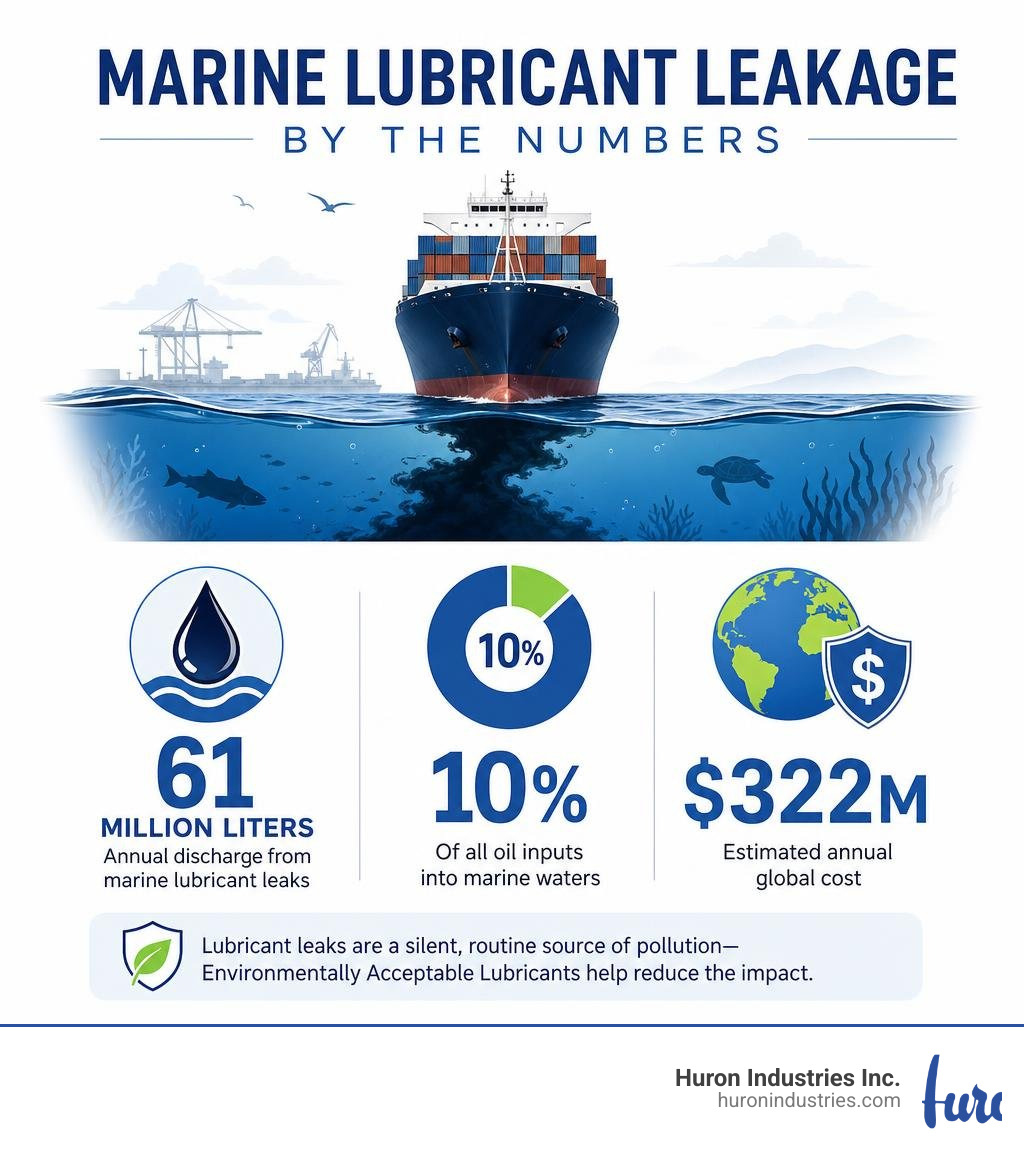
Commercial vessels make over 1.7 million port visits per year. Stern tube leakage alone releases an estimated 4.6 to 28.6 million liters of lubricating oil into marine port waters annually. Add other operational discharges, and the total reaches nearly 61 million liters per year — roughly equivalent to 1.5 Exxon Valdez spills. That's not accidents. That's routine operations.
Lubricant leaks represent 10% of all oil inputs into marine waters worldwide, with estimated annual damage and cleanup costs of $322 million globally.
EALs exist to cut that impact — without sacrificing equipment protection.
I'm Nicholas Cunha, founder of CreatiVertical, and I work hands-on with Huron Industries Inc. to make their specialty lubricant and anti-seize lines — including products that qualify as environmentally acceptable lubricants — easier to find, compare, and source online. My background spans compliance-aware technical content for regulated industries, which is exactly where EAL requirements live.
Defining the Environmentally Acceptable Lubricant (EAL)
To truly understand what makes a fluid an environmentally acceptable lubricant, we have to move past marketing buzzwords and look at concrete, scientifically measurable criteria. The term isn't just a green badge; it is a legally defined regulatory category. According to the U.S. Environmental Protection Agency (EPA), an EAL must demonstrate specific, standardized thresholds of environmental safety.
If you dive into the technical documentation, such as the Environmentally Acceptable Lubricants - epa nepis guidelines, you will find that a lubricant must satisfy three core pillars to earn this designation: biodegradability, minimal aquatic toxicity, and low bioaccumulation potential.
Traditional petroleum-based lubricants are incredibly stable, meaning they persist in marine environments for decades, coating aquatic life and poisoning ecosystems. An EAL, by contrast, is engineered to perform its mechanical duties diligently and then, in the event of an inevitable leak or spill, quietly disappear without leaving a toxic legacy behind.
Key Criteria of an Environmentally Acceptable Lubricant
Let's break down the exact scientific metrics required to earn the EAL title. The standards are rigorous, leaving no room for guesswork:
- Biodegradability: This measures how quickly and completely the lubricant can be broken down by micro-organisms into simple, harmless substances like carbon dioxide and water. The gold standard for measuring this is the OECD 301B test (or equivalent standards). To be considered "readily biodegradable," the lubricant's base oil must degrade by more than 60% within a strict 28-day window.
- Aquatic Toxicity: EALs must prove they are minimally toxic to marine life. This is determined by exposing sensitive organisms—such as fish, daphnia (water fleas), and algae—to the lubricant. Under the EU Ecolabel User Manual guidelines, candidates are tested for acute and chronic toxicity. For instance, accidental loss lubricants (ALL) must show acute ecotoxicity thresholds of at least 100 mg/L, meaning a very high concentration is required before any adverse effect is observed.
- Bioaccumulation Potential: Some chemicals do not break down inside an animal’s body; instead, they build up in fat tissues, concentrating further up the food chain (a process called biomagnification). EALs must use ingredients with low bioaccumulation potential, typically verified by a low octanol-water partition coefficient ($log K_{ow} < 3$ or $> 10$, or a bioconcentration factor $< 100$).
EALs vs. Environmentally Friendly Lubricants (EFLs)
There is a massive difference between an EAL and an "environmentally friendly lubricant" (EFL). I always warn vessel operators to watch out for this distinction.
"Environmentally friendly" is a broad, unregulated marketing term. A manufacturer can slap a green leaf on a bottle of oil because it contains 5% canola oil, even if the remaining 95% is toxic mineral oil that will persist in a harbor for fifty years. These EFLs do not have to undergo rigorous third-party testing, nor do they comply with federal vessel permits.
An EAL, however, has been independently verified to meet strict international standards. When you invest in certified, High Quality Lubrication from trusted partners, you are buying peace of mind, knowing the fluid has been scientifically proven to protect both your machinery and our shared waterways.
The Four Main Types of EAL Base Oils
When we formulate or select an environmentally acceptable lubricant, the magic starts with the base oil. Base oils make up 75% to 90% of a lubricant's total volume (and up to 90% for grease, with the remainder being thickeners and additives).
To achieve Precision Lubrication while meeting strict environmental laws, formulators rely on four primary biodegradable base stock families. Each has its own distinct chemistry, advantages, and limitations.
| Base Oil Type | ISO Code | Key Advantages | Major Disadvantages | Best Applications |
|---|---|---|---|---|
| Vegetable Oils | HETG | Excellent lubricity, high viscosity index, lower cost. | Poor oxidative stability, high pour point (freezes easily). | Low-temperature hydraulic systems, total loss applications. |
| Synthetic Esters | HEES | Outstanding temperature range, superb wear protection, long life. | Higher cost, susceptible to hydrolysis (breakdown by water). | Stern tubes, thrusters, high-performance hydraulics. |
| Polyalkylene Glycols | HEPG | Excellent shear stability, handles water ingress up to 20% well. | Can be incompatible with paints, seals, and mineral oils. | Stern tubes, heavy-duty marine gears, thrusters. |
| Water-Based Fluids | — | Zero fire risk, completely non-toxic, excellent cooling. | Limited temperature range ($0^circtext{C}$ to $60^circtext{C}$), low film strength. | Seawater-lubricated stern tubes, specialized subsea systems. |
For greases, the thickening agent also matters. In wet marine environments, calcium-based thickeners are highly favored because they offer excellent water resistance and lower aquatic toxicity compared to some heavy metal-complex thickeners.
Vegetable Oils and Synthetic Esters
Vegetable oils (classified as HETG) are harvested from natural crops like rapeseed, canola, or sunflower seeds. They possess natural, high-performing lubricity and a very high viscosity index, meaning they maintain their thickness well across temperature swings. However, vegetable oils suffer from poor oxidative stability. If exposed to high heat and oxygen, they break down, turn gummy, and clog filters. This makes them less ideal for heavy-duty, continuous-use machinery.
Synthetic esters (classified as HEES) were originally developed in the 1950s for jet engines. They are synthesized by reacting organic acids with alcohols, creating tailored hydrocarbon molecules without the impurities found in crude petroleum.
By upgrading to synthetic esters, you get the best of both worlds: the excellent biodegradability of a natural oil combined with the high-temperature stability of a synthetic. They offer a massive operating temperature range, but they do come with a cost premium and require careful monitoring for hydrolysis—a chemical reaction where water splits the ester molecules apart back into acids and alcohols. Choosing high-purity, saturated synthetic esters, like those found in premium High Quality Lubrication lines, significantly minimizes this risk.
Polyalkylene Glycols and Water-Based Fluids
Polyalkylene Glycols (HEPG), commonly known as PAGs, are synthetic lubricants polymerised from ethylene oxide or propylene oxide. They are highly shear-stable and possess incredible low- and high-temperature viscosity performance.
One of their unique tricks is water solubility. While water ingress can ruin other oils, certain PAGs can absorb up to 20% water by volume without losing their lubrication performance. However, because they dissolve in water, they don't form a visible sheen on the water's surface in a spill. This means they must be carefully managed to ensure they do not carry additives deep into the water column.
Water itself is the ultimate environmentally acceptable fluid. Seawater-lubricated stern tube systems utilize non-metallic bearings (often made of advanced polymers or composites) and use the surrounding ocean water as the lubricant. This completely eliminates the risk of oil pollution.
While water-lubricated systems are incredibly clean and are installed on hundreds of modern commercial vessels, they require specialized, corrosion-resistant shaft materials and cannot be easily retrofitted to existing conventional stern tubes without significant dry-dock modifications. For conventional systems, water-based hydraulic fluids offer a highly fire-resistant, biodegradable alternative that ensures Smooth Operation in sensitive near-shore zones.
Regulatory Drivers and Certification Programs
The rapid adoption of EALs isn't just driven by corporate goodwill; it is pushed forward by strict, legally binding environmental regulations. If your vessel operates in commercial or international waters, compliance is non-negotiable.
The primary driver in the United States has been the EPA's Vessel General Permit (VGP), which was first introduced in 2013. The VGP mandates that all vessels larger than 79 feet operating in U.S. waters must use an environmentally acceptable lubricant in all oil-to-sea interfaces.
This regulatory landscape is currently transitioning. The Vessels Incidental Discharge Act (VIDA) is set to fully replace the VGP. Under VIDA, the EPA and the U.S. Coast Guard are establishing new national standards of performance for incidental discharges. This transition ensures that the requirement for biodegradable, non-toxic lubricants remains a permanent fixture of U.S. maritime operations.
In the offshore oil and gas sectors, particularly in the North Sea, the OSPAR Commission (Oslo-Paris Convention) regulates the use of chemicals. Under OSPAR's Harmonised Offshore Chemical Notification Scheme (HOCNF), lubricants and thread compounds must be rigorously tested and registered.
Agencies like CEFAS in the UK and KPD/SFT in Norway classify these compounds. Achieving a "Norway Yellow" or "CEFAS E" rating represents the gold standard of environmental safety for offshore exploration. Formulating products to meet these standards requires advanced green chemistry, such as utilizing eco-friendly Biosurfactants for Oil and Gas and metal-free anti-seize compounds.
Labeling and Certification Programs
To help operators identify compliant lubricants without wading through mountains of chemical test data, several third-party labeling programs have emerged globally. If a lubricant carries one of these certifications, it automatically qualifies as an EAL under the U.S. VGP and international marine laws:
- EU Ecolabel: One of the most respected certifications in the world. It evaluates the entire lifecycle of the lubricant, from raw material sourcing to packaging. It sets strict limits on hazardous substances (such as CMRs—carcinogenic, mutagenic, or toxic to reproduction) and demands verified biodegradability and low toxicity.
- Blue Angel (Germany): The world's oldest environmental label. It requires high proportions of renewable raw materials and strict aquatic safety profiles.
- Nordic Swan (Nordic Countries): Highly popular in Scandinavia, this label focuses heavily on sustainable sourcing, biodegradability, and minimizing the use of bioaccumulative additives.
- Swedish Standard (SS 155434 & 155470): A highly technical standard that classifies both the environmental profile and the mechanical performance of hydraulic fluids and greases, ensuring a Non-Corrosive Formula that won't damage sensitive yellow metals or seal elastomers.
Critical Marine Applications for EALs
Where exactly must an EAL be used? The general rule of thumb under the VGP is simple: any "oil-to-sea interface" requires an EAL. This refers to any mechanical component where a seal failure, wear, or normal operation could result in oil escaping directly into the surrounding water.
These interfaces are harsh, high-pressure environments where equipment must operate flawlessly. Using the right Sealants Protection and lubricants is vital to prevent both mechanical failures and environmental fines.
Stern Tubes and Thrusters
The stern tube is the critical passage where the vessel's propeller shaft exits the hull. To prevent water from entering the ship and oil from escaping into the sea, the shaft is surrounded by a series of rubber seals and lubricated with oil.
Because the shaft is constantly spinning, these seals wear down. On average, a typical commercial vessel consumes 2.6 liters of stern tube lubricant per day through normal, minor weeping. Over a year, across a global fleet of tens of thousands of ships, this routine loss represents a massive environmental burden.
Furthermore, stern tubes are highly susceptible to water ingress. If sea water bypasses the outer seals, it mixes with the lubricant. Traditional mineral oils form a milky emulsion that loses its load-carrying capacity, leading to rapid bearing wear.
EALs designed for stern tubes must not only biodegrade if they leak, but they must also maintain excellent Lubrication Wear Reduction properties even when contaminated with up to 10% or 20% water.
Deck Equipment and Hydraulic Systems
While deck equipment like cranes, winches, windlasses, and capstans sit above the water, they are constantly exposed to wind, salt spray, and rain. A ruptured hydraulic hose on a deck crane can instantly spray hundreds of liters of high-pressure hydraulic fluid over the deck and directly over the side into the harbor.
Using an EAL in deck hydraulics, wire ropes, and open gears ensures that any accidental wash-off or line break does not trigger an environmental disaster. For wire ropes and cables, using highly adhesive, water-resistant EAL greases ensures Smooth Operation and prevents the lubricant from being washed off by heavy seas.
Operational Challenges and Performance Trade-offs
Switching from traditional mineral oils to an environmentally acceptable lubricant is not as simple as draining the old oil and pouring in the new. It requires careful planning, technical understanding, and an awareness of the operational trade-offs involved.
The first hurdle is the cost premium. Because EAL base stocks (especially synthetic esters and PAGs) require complex chemical synthesis and high-purity raw materials, they are more expensive to manufacture.
Typically, vegetable-based EALs cost about 1.2 times more than conventional mineral oils, while high-performance synthetic esters and PAGs can cost 2 to 3 times more.
Additionally, during an initial changeover, the solvent effect of synthetic esters can clean out years of accumulated varnish and sludge left behind by mineral oils. While this keeps your system clean in the long run, it can initially cause rapid filter clogging, requiring operators to monitor and change system filters frequently during the first few weeks of operation to ensure continuous Lubrication Wear Reduction.
Performance Trade-offs of an Environmentally Acceptable Lubricant
While modern EALs are highly advanced, they do have specific chemical vulnerabilities compared to stable petroleum products:
- Oxidative Degradation: Vegetable-based fluids (HETG) have a lower resistance to thermal oxidation. If run too hot, they can polymerize, thickening the oil and forming deposits that restrict flow.
- Hydrolysis: Ester-based fluids (HEES) can react with water under high temperatures, breaking down into acidic components that can attack system metals and degrade seals. Regular oil analysis is crucial to monitor the Total Acid Number (TAN) and water content.
- Temperature Limits: Some EALs have narrower operating temperature limits. While a synthetic ester can handle extreme cold and heat, vegetable oils can become sluggish and freeze (high pour point) in arctic conditions.
By utilizing Precision Lubrication practices, such as routine oil sampling and installing efficient desiccant breathers to keep moisture out of reservoirs, these chemical vulnerabilities can be easily managed.
Seal Compatibility and System Changeover
One of the most critical aspects of transitioning to an EAL is seal compatibility. Elastomers (rubber seals) used in marine systems—such as Nitrile Rubber (NBR), Fluorocarbon Rubber (FKM), and Polyurethane (AU)—react differently to different base oils.
For example, switching from a mineral oil to a synthetic ester without verifying seal compatibility can cause seals to swell, shrink, harden, or soften excessively, leading to catastrophic seal failure and massive leaks.
Before making the switch, always consult the Original Equipment Manufacturer (OEM) and follow standard changeover guidelines, such as ISO 15380. A typical changeover requires a thorough drain, a system flush with a compatible flushing fluid to reduce mineral oil contamination to less than 1% or 2%, and a seal inspection. This diligent process ensures long-term Sealants Protection and leak-free performance.
Frequently Asked Questions about EALs
What is the difference between VGP and VIDA?
The 2013 Vessel General Permit (VGP) is an EPA regulation that manages incidental discharges from commercial vessels. The Vessels Incidental Discharge Act (VIDA) is a legislative framework enacted to streamline these rules.
Under VIDA, the EPA is responsible for establishing the technical standards of performance (such as requiring EALs), while the U.S. Coast Guard is responsible for enforcing those standards. The transition to VIDA simplifies compliance by creating a single, uniform national standard for vessel discharges in U.S. waters.
Ensuring compliance during this transition involves using certified lubricants and advanced green technologies, such as plant-based Biosurfactants for Oil and Gas.
Can EALs be mixed with mineral oils?
Generally, no. Mixing an EAL with conventional mineral oil is highly discouraged.
First, even a small amount of mineral oil contamination (typically more than 1% to 5%) can void the lubricant’s environmental certifications, meaning you are no longer in compliance with VGP or VIDA.
Second, mixing different base oil chemistries can cause chemical incompatibility, leading to additive dropout, fluid separation, rapid foaming, and severe loss of lubrication performance. If you must top off a system, always use the exact same brand and grade of EAL, or perform a complete flush.
Why are synthetic esters preferred over vegetable oils?
While vegetable oils are highly biodegradable and cost less, synthetic esters offer vastly superior thermal and oxidative stability. Synthetic esters can withstand much higher operating temperatures and have a much lower pour point, meaning they remain fluid in freezing northern waters.
For high-pressure, continuous-use systems like marine thrusters and main hydraulic pumps, synthetic esters provide much longer service intervals and significantly extend the life of your expensive machinery.
Conclusion
Navigating the transition to environmentally acceptable lubricants can feel daunting, but it is a vital step toward protecting our marine ecosystems and ensuring regulatory compliance. At Huron Industries Inc., we have spent decades formulating high-purity, high-performance solutions for the most demanding industries.
From our trusted Neolube® nuclear-grade colloidal graphite lines to our partnerships in supplying Van Meeuwen Green Point® biodegradable marine lubricants, we are dedicated to helping you achieve both environmental compliance and mechanical reliability.
If you are ready to transition your fleet or facility to high-performance, High Quality Lubrication that meets VGP and EU Ecolabel standards, explore our Green Point Biodegradable Lubricants program today. Let's work together to keep our industries running smoothly and our waters clean.