
Start QPL Lubricant Procurement With Verified Qualification Data
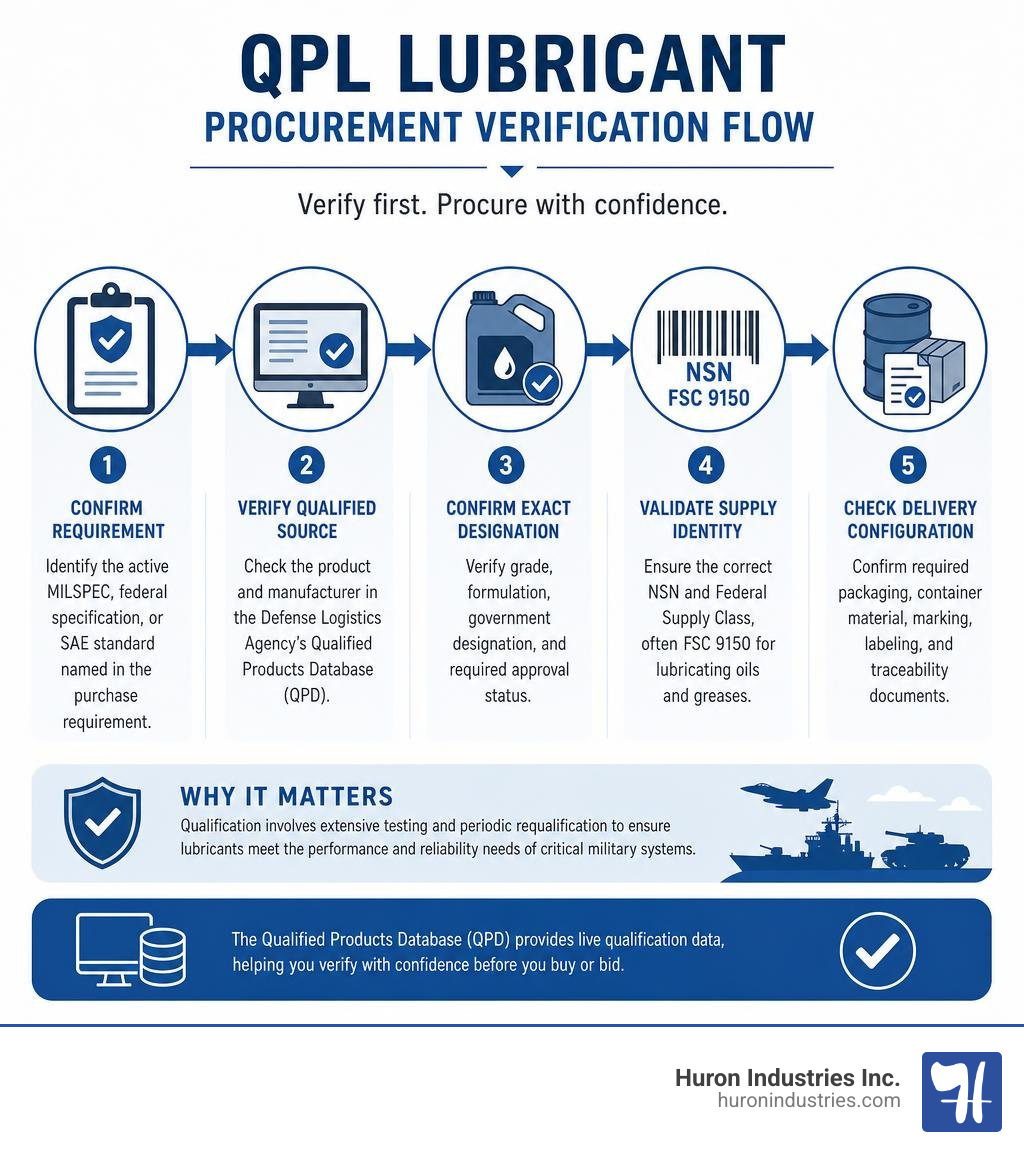
QPL lubricant procurement starts by confirming that the exact lubricant, manufacturer, and applicable specification are qualified before you buy or bid. For defense, nuclear, and other high-consequence work, a product data sheet alone is not enough when the solicitation requires a Qualified Products List (QPL) source.
| Quick sourcing check | What to verify |
|---|---|
| Governing requirement | The active MILSPEC, federal specification, or SAE standard named in the purchase requirement |
| Qualified source | The product and manufacturer in the Defense Logistics Agency's Qualified Products Database (QPD) |
| Exact designation | Grade, formulation, government designation, and any required approval status |
| Supply identity | The correct NSN and Federal Supply Class, often FSC 9150 for lubricating oils and greases |
| Delivery configuration | Required packaging, container material, marking, labeling, and traceability documents |
The QPD is the current electronic source for qualification records maintained by the responsible Qualifying Activities. It replaces legacy paper-style QPL documents with electronic Qualification Data Sets, helping buyers see updates without waiting for a revised PDF to appear in the older ASSIST document system.
That matters because military lubricants may support aircraft, propulsion, hydraulic, weapons, or other critical systems. A qualifying activity can require extensive physical-property and performance testing - sometimes more than 30 tests - before approving a formulation. Packaged lubricants also commonly require requalification every five years to remain eligible.
At Huron Industries Inc., our experience with QPL lubricant procurement focuses on making dense qualification, traceability, and sourcing requirements easier for engineering and procurement teams to navigate before placing an order.
Navigating Digital QPL Lubricant Procurement via the Qualified Products Database
Managing QPL lubricant procurement effectively requires navigating the digital shift from physical documents to live electronic databases. For decades, federal contractors relied on paper documents or static PDF files stored in the ASSIST system. Today, qualification data lives in the Defense Logistics Agency's Qualified Products Database (QPD). Accessing QPD/QPL Information allows procurement agents to verify manufacturer credentials instantly before placing bids or issuing purchase orders.
The QPD replaces traditional document-based Qualified Products Lists with dynamic Qualification Data Sets (QDS). Rather than waiting for a formal document revision cycle to publish an updated PDF, qualifying activities enter approvals, scope changes, or status updates directly into the central database. This single digital source eliminates ambiguity, ensuring that contractors purchasing critical fluids or solid film lubricants are viewing live authorization data.
How QPD Improves Data Timeliness Over ASSIST
In the legacy ASSIST system, paper-based QPL updates suffered from publication lag. A manufacturer might secure qualification approval, yet defense buyers could wait weeks or months to see an updated document uploaded. Conversely, if a formulation lost its qualification status, buyers might inadvertently source non-compliant materials based on outdated PDFs.
The QPD resolves this issue by turning qualification listings into real-time records. When a Qualifying Activity modifies a company's listing status, the change reflects immediately across the database. As legacy QPL documents transition into electronic QDS formats, the older static PDFs are archived offline for historical reference, keeping active procurement workflows clean and accurate.
Troubleshooting Missing Products in QPD Searches
When I search the QPD and fail to find an expected lubricant product or manufacturer, I follow a systematic troubleshooting process rather than assuming the product is unqualified:
- Check specification status: Verify whether the governing military specification (MILSPEC) remains active, has been canceled, or was revised to eliminate pre-solicitation qualification requirements.
- Search by designation: Search using both the exact government designation and manufacturer part number, as spacing or formatting differences can affect search results.
- Confirm publication timing: Recent testing approvals may be in the final administrative stage before live QDS publishing.
- Verify Design Control Authority requirements: For Critical Safety Items (CSI), confirm if explicit Design Control Authority approval is required alongside basic QPD listings.
Step-by-Step Guide to MILSPEC Qualification and Product Listing
Securing a spot on a Qualified Products List is a demanding process designed to prevent component failure in mission-critical applications. Obtaining QPL certification for military-grade lubricants requires rigorous laboratory and field testing. Physical property and performance evaluations can include upwards of 30 distinct test parameters, assessing kinematic viscosity, load-carrying capacity, oxidation stability, extreme pressure performance, and corrosion resistance.
Adhering to Lubricant Review Institute Guidelines helps manufacturers establish testing frameworks that satisfy federal custodial requirements across Army, Navy, and Air Force activities.
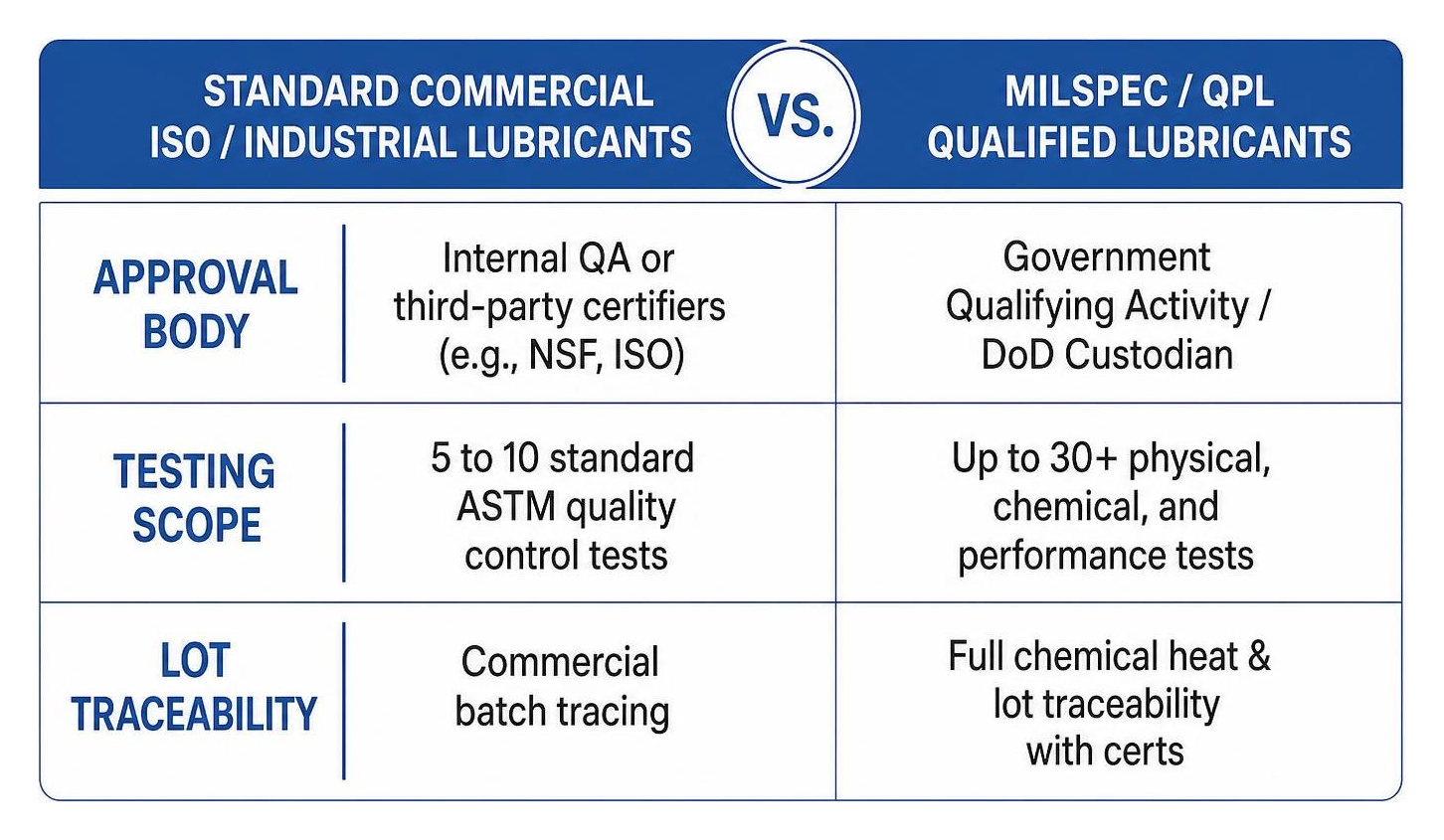
| Testing Dimension | Standard Commercial ISO/Industrial Lubricants | MILSPEC / QPL Qualified Lubricants |
|---|---|---|
| Approval Body | Internal QA or third-party certifiers (e.g., NSF, ISO) | Government Qualifying Activity / DoD Custodian |
| Testing Scope | 5 to 10 standard ASTM quality control tests | Up to 30+ physical, chemical, and performance tests |
| Lot Traceability | Commercial batch tracing | Full chemical heat & lot traceability with certs |
| Requalification | Periodic internal audit / customer review | Mandatory cycles (e.g., 5-year packaged rule) |
| Packaging Rules | Commercial plastic or steel pails | Spec-grade metal cans, barrier materials, specific labeling |
Initiating Contact with Qualifying Activities for QPL Lubricant Procurement
To begin the qualification journey, a manufacturer must contact the designated Qualifying Activity responsible for the specific governing specification. The Qualifying Activity acts as the gatekeeper, establishing test protocols and reviewing laboratory results.
Under Federal Acquisition Regulation (FAR) Part 9.2, qualification must be completed before contract award. Attempting to submit a proposal while qualification testing is still in progress generally leads to a non-responsive bid determination. Establishing early communication with the Qualifying Activity ensures your formulation meets every technical baseline long before active solicitations open.
Testing Requirements and 5-Year Requalification Intervals
Achieving initial QPL approval is not a one-time event. Government standards mandate continuous quality verification to retain active listing status:
- Standard non-lubricant commodities: Most general defense items require periodic certification every 24 months.
- Packaged lubricants: Packaged lubricants are subject to a strict 5-year requalification cycle.
- Qualifying Activity discretion: The responsible authority reserves the right to shorten or extend certification intervals based on performance history, field feedback, or material shelf-life evaluations.
Staying compliant requires rigorous self-certification protocols and proactive submission of re-test data before the five-year mark expires.
Commercial vs. MILSPEC Lubricants: Key Sourcing Differences
Sourcing commercial off-the-shelf (COTS) lubricants differs sharply from procuring military-specification fluids. While commercial products focus on cost-efficiency and broad industrial utility, MILSPEC lubricants prioritize survival under extreme operating conditions—including radiation exposure, ocean water immersion, extreme pressure, and high-temperature thermal stress.
For high-consequence environments, trust is built on strict compliance. Discovering Why the US Navy Trusts Neolube for Nuclear Propulsion highlights why specialized formulations—like our high-purity colloidal graphite suspended in isopropanol (qualified under MIL-L-24131C)—are specified for critical reactor thread sealing and friction control where failure is not an option.
Military Packaging, Labeling, and Container Rules
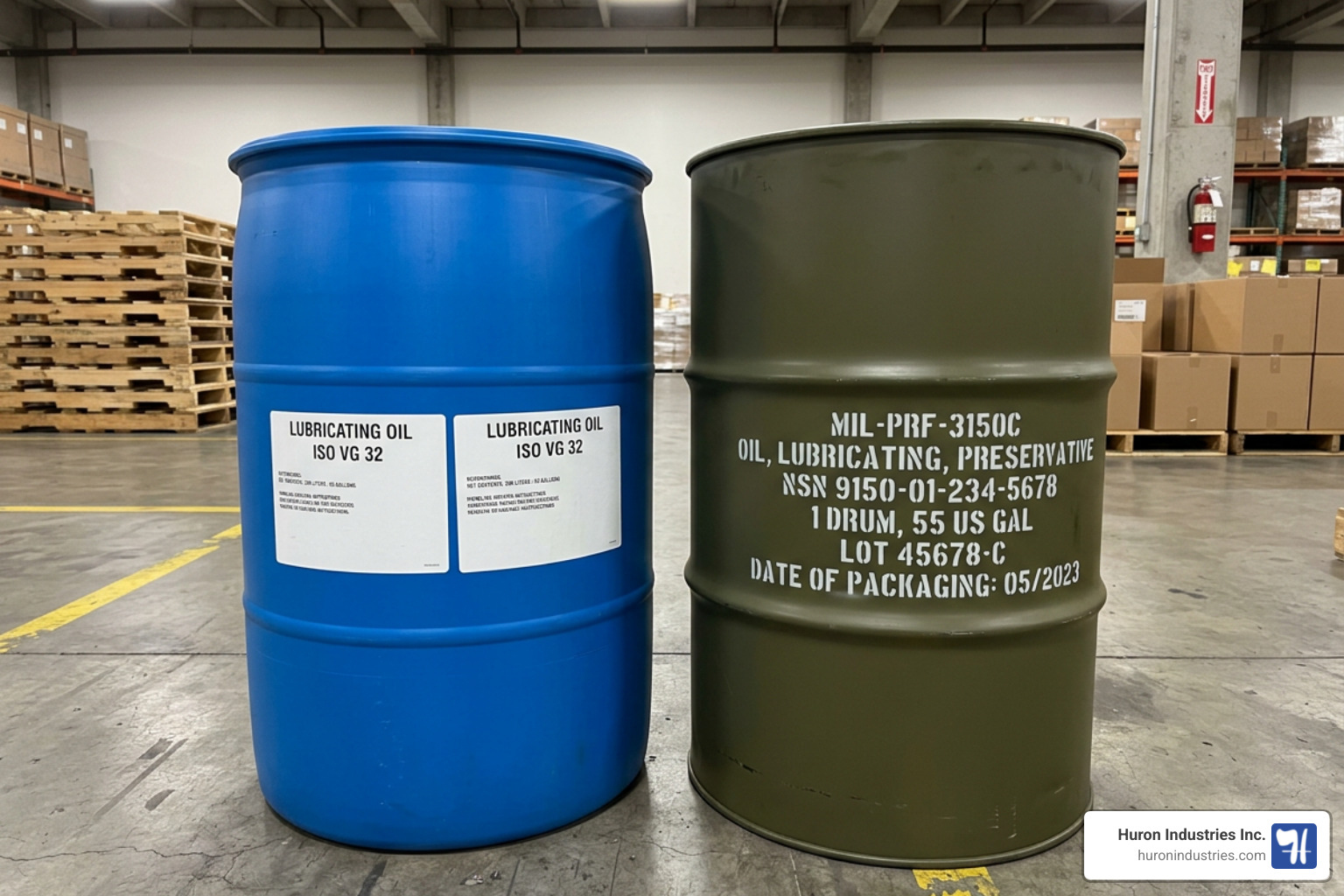
A major point of divergence between commercial and defense procurement is packaging engineering. A commercial lubricant formulation might perform flawlessly in testing, but if it arrives in standard commercial plastic drums, it will be rejected at the depot.
- Container durability: Military specifications often dictate specific container materials, such as heavy-gauge metal cans or cans with internal linings, to withstand rough field handling and prolonged storage in severe climates.
- Unique NSN assignments: The exact same chemical formulation receives entirely different National Stock Numbers based on its packaging configuration (e.g., a 1.6 oz tube versus a 1-gallon drum).
- Labeling precision: Markings must feature military-compliant barcoding, contract numbers, lot designations, batch numbers, and manufacture dates to maintain complete supply chain visibility.
Defense Logistics Framework: DLA, POLCHEM, and FSC Identifiers
The Defense Logistics Agency (DLA) manages central petroleum and chemical logistics for the United States military. A major driver in modern supply distribution is the centralized POLCHEM (Petroleum, Oil, Lubricants, and Chemicals) contract program, a massive privatization effort budgeted at $6 billion over a 10-year execution period.
Under this framework, primary contractors manage warehousing across strategic U.S. facilities to support thousands of active National Stock Numbers. Reviewing opportunities like the DLA Energy Bulk Petroleum Products Solicitation reveals how the government packages requirements for bulk turbine oils, steam turbine gear lubricants, and specialized hydraulic fluids.
Primary Federal Supply Classes (FSC) relevant to lubricant procurement include:
- FSC 9150: Oils and Greases: Cutting, Lubricating, and Hydraulic (the core category for most QPL lubricants).
- FSC 6850: Miscellaneous Chemical Specialties (covering specialized industrial sealants, thread compounds, and chemical treatments).
- FSC 9110 / 9160: Bulk fuels and specialty waxes or solid-state additives.
Navigating FSC 9150 and NSN Codes in QPL Lubricant Procurement
A National Stock Number (NSN) is a 13-digit code recognized throughout NATO logistics networks. It consists of two primary segments: the 4-digit Federal Supply Class (such as 9150) and the 9-digit National Item Identification Number (NIIN).
Understanding NSN structures is vital when procuring lubricants designated as Critical Safety Items (CSI). In CSI applications, any change in chemical formulation, manufacturing origin, or sourcing requires explicit Design Control Authority sign-off. Learning How to Ensure Nuclear Grade Material Traceability in Your Supply Chain provides a roadmap for maintaining batch purity and chemical verification from raw material processing through final delivery.
Frequently Asked Questions About QPL Lubricants
How often do packaged lubricants require requalification?
Packaged lubricants require requalification every five years under standard military qualification rules. While general military components may operate on a 24-month re-certification cycle, packaged lubricants follow this five-year rule, though individual Qualifying Activities retain authority to shorten or lengthen this timeframe based on technical evaluations.
Can a supplier bid on contracts while product qualification is pending?
Generally, no. Under FAR Part 9.2, product qualification testing must be fully completed and approved prior to contract award. Solicitations requiring a QPL product treat bids offering unqualified items as non-responsive, meaning testing cannot be performed concurrently with active contract execution.
Why might a qualified lubricant fail to appear in QPD search results?
A product or manufacturer may not appear in QPD search queries for several reasons:
- The governing specification has been canceled or revised to eliminate QPL requirements.
- The Qualifying Activity has removed the supplier due to expired 5-year requalification data.
- Search term formatting issues exist (e.g., entering incorrect punctuation or incomplete part numbers).
- The electronic Qualification Data Set is currently undergoing administrative updates before live publication.
Conclusion: Ensuring Compliance in High-Consequence Lubricant Sourcing

Navigating QPL lubricant procurement demands meticulous attention to detail, from verifying active listings in the Qualified Products Database to ensuring full compliance with packaging, labeling, and lot-traceability standards. Standard commercial alternatives simply cannot replace verified, military-qualified formulations when safety, system integrity, and regulatory compliance are on the line.
At Huron Industries Inc., we have specialized in high-purity, high-performance industrial formulations since 1971. Operating from Port Huron, Michigan, our flagship Neolube® colloidal-graphite products carry formal qualification under MIL-L-24131C, earning the trust of commercial and naval nuclear propulsion programs nationwide. Whether you require reactor-grade graphite sealants, specialized industrial anti-seize compounds, or precision reloading lubricants, our products deliver uncompromised quality and complete lot traceability.
Ready to streamline your regulated lubricant supply chain? Explore Specialized CaseLube Solutions or contact our engineering support team today to verify specifications, request technical data sheets, and secure qualified products for your next critical project.