
Why Nuclear Grade Material Traceability Is Non-Negotiable in Safety-Critical Supply Chains
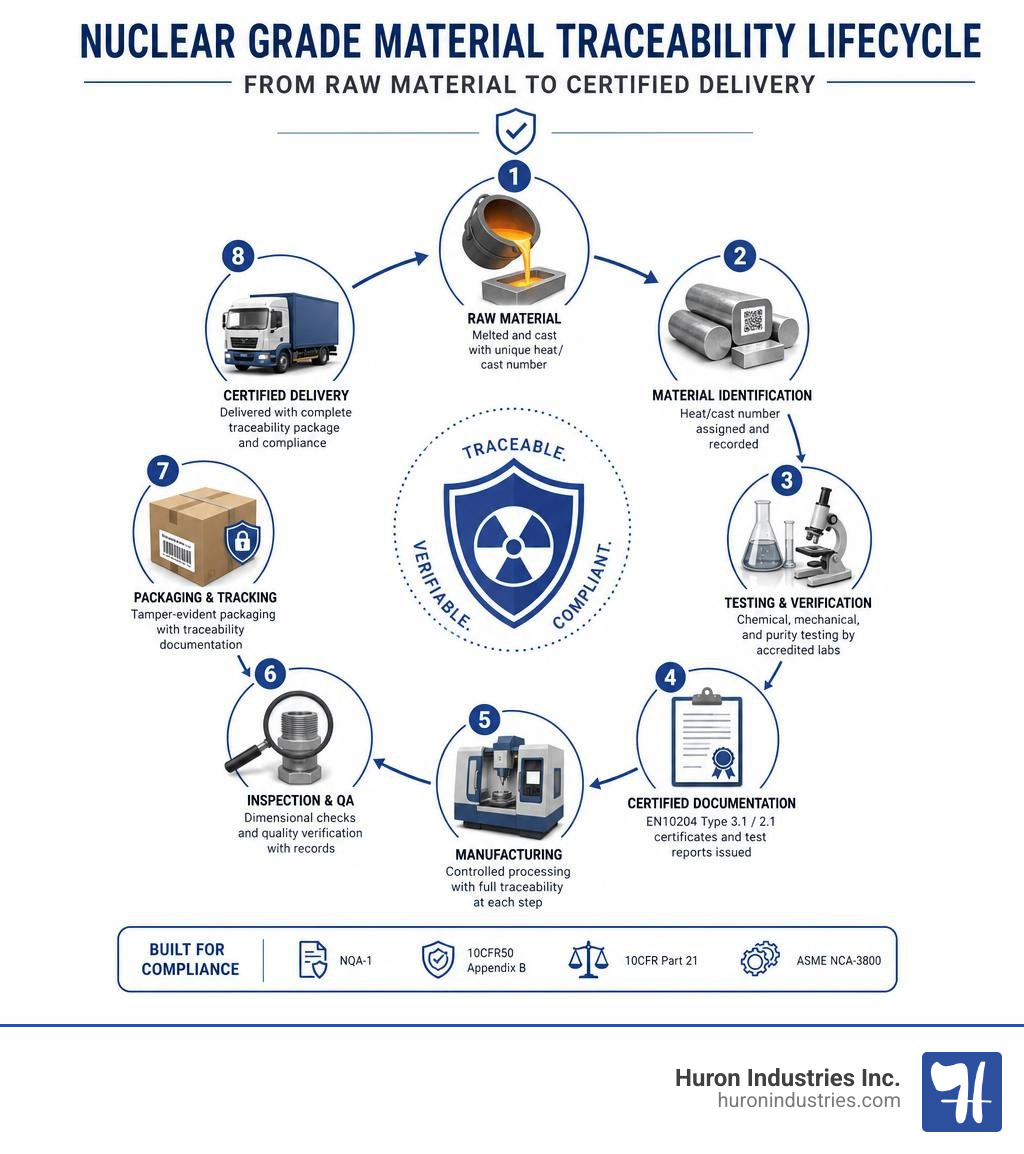
Nuclear grade material traceability is the documented ability to track every material in a nuclear application — from its original cast or heat number, through manufacturing and testing, all the way to final installation. It is a regulatory requirement, not an optional best practice.
Here's what nuclear grade material traceability requires at a glance:
| Requirement | What It Means |
|---|---|
| Cast/heat number tracking | Every piece links back to its original melt or batch |
| Certified documentation | EN10204 Type 3.1 or 2.1 certificates depending on material class |
| Approved suppliers only | Materials must originate from pre-qualified mills and stockists |
| Accredited testing | Chemical, mechanical, and purity tests by ISO/IEC 17025-accredited labs |
| Regulatory compliance | Must satisfy NQA-1, 10CFR50 Appendix B, 10CFR Part 21, and ASME NCA-3800 |
| Full lot or piece records | Fraud-proof retention required for nuclear-grade applications |
Nuclear applications leave no room for error. A single unverified component — a seal, a forging, a thread lubricant — can compromise reactor safety, trigger regulatory shutdowns, or introduce contaminants that degrade fuel performance. The stakes are that high.
That is why the nuclear industry operates under some of the most demanding quality assurance frameworks in the world. And why procurement, engineering, and maintenance teams working in this space need to understand exactly what traceability means — and what it costs when it breaks down.
I'm Nicholas Cunha, founder of CreatiVertical and the content strategist behind Huron Industries Inc.'s digital presence, where I've developed in-depth technical content on nuclear grade material traceability as it applies to certified lubricants, thread sealants, and anti-seize compounds used in nuclear and defense applications. This guide breaks down the full traceability lifecycle — from regulatory frameworks and material classifications to documentation requirements, analytical chemistry, and non-metallic material purity standards — so you can confidently source and qualify the right materials for your application.
Understanding Nuclear Grade Material Traceability and Its Critical Safety Role
When we talk about material integrity in safety-critical systems, we are looking at the fundamental provenance of the material. Every alloy, non-metal, or chemical compound must be fully accounted for before it ever gets near a reactor core or auxiliary cooling loop. In my years working with high-purity materials, I have seen how even minor deviations in chemical makeup can lead to stress corrosion cracking, premature component failure, or system contamination.
Traceability ensures that the physical and chemical properties of a product delivered to your facility in Port Huron, MI, or anywhere else in the world, exactly match the specifications approved during the engineering phase. If a pipe fitting fails or a valve leaks, a robust traceability system allows engineers to instantly pull the original mill test reports (MTRs), identify other parts from the same heat number, and isolate the issue before it escalates into a safety incident.
The safety functions of nuclear components are divided into safety-related and non-safety-related categories. For items that support critical safety functions, nuclear operators must rely on strict procurement guidelines. This includes methodologies outlined in the QUALITY ASSURANCE GUIDELINE FOR PROCURING HIGH-QUALITY INDUSTRIAL GRADE ITEMS AIMED AT SUPPORTING SAFETY FUNCTIONS IN NUCLEAR FACILITIES , which helps operators safely bridge the gap between commercial availability and nuclear-grade safety requirements. To see how these requirements translate to practical chemical and lubrication solutions, you can explore the various Nuclear Industry Applications that rely on these high-purity standards.
The Regulatory Framework: NQA-1, 10CFR50 Appendix B, and ASME NCA-3800
Navigating the regulatory landscape of the nuclear industry can feel like decoding an alphabet soup of standards. However, these regulations are the backbone of nuclear safety. The primary standards governing quality assurance and nuclear grade material traceability in the United States include:
- ASME NQA-1 (Nuclear Quality Assurance-1): This is the gold standard for nuclear quality assurance. It establishes structured requirements for material identification, control, and traceability throughout the entire supply chain.
- 10 CFR Part 50 Appendix B: This federal regulation mandates the quality assurance criteria for nuclear power plants and fuel reprocessing plants. It legally binds licensees to establish comprehensive material control programs.
- 10 CFR Part 21: This regulation requires suppliers to report any material defects or non-compliance that could create a substantial safety hazard. It ensures accountability across the supply chain.
- ASME NCA-3800: This standard specifically details the quality assurance requirements for material organizations producing metallic products for ASME Section III Division 1 construction.
Additionally, strict internal controls and accounting are legally mandated under federal law. For example, 10 CFR § 74.43 - Internal controls, inventory, and records. | Electronic Code of Federal Regulations (e-CFR) | US Law | LII / Legal Information Institute outlines the mandatory internal controls and recordkeeping systems needed to track nuclear materials. To ensure absolute compliance, the Nuclear Regulatory Commission enforces rigorous quality assurance and accounting systems as detailed in § 74.59 Quality assurance and accounting requirements. | Nuclear Regulatory Commission . These requirements ensure that every gram of strategic material is mathematically accounted for, with statistical control limits set at strict significance levels of 0.05 and 0.001.
Material Classifications: Class A, Class B, and Commercial-Grade Dedication
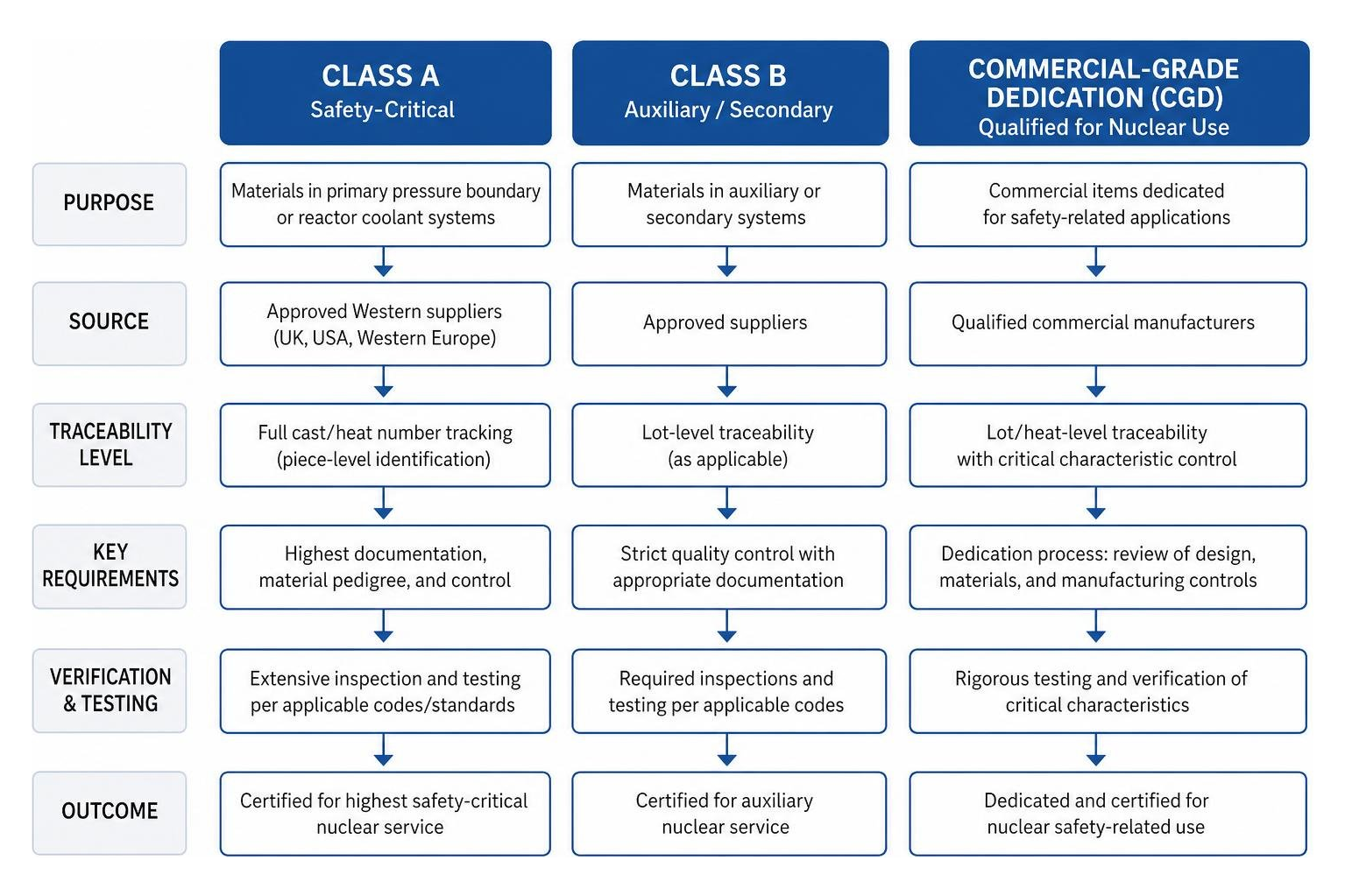
Not all materials in a nuclear facility are treated equally. To optimize procurement costs while maintaining absolute safety, materials are divided into distinct classes. Understanding these classifications is vital when establishing procurement protocols.
- Class A Materials: These are safety-critical materials used in the primary pressure boundary or systems directly exposed to reactor coolant. They require the highest level of traceability, typically requiring full cast number tracking back to approved Western suppliers (located in the UK, USA, or Western Europe).
- Class B Materials: These are used in auxiliary or secondary systems. While they still require strict quality control, the documentation burden may be slightly lower (e.g., allowing lot-level traceability rather than individual piece-mark tracking in certain non-critical zones).
- Commercial-Grade Dedication (CGD): Because nuclear-specific manufacturers are limited, the industry uses CGD to qualify high-quality commercial items for safety-related applications. Through rigorous testing, inspection, and verification of critical characteristics, a standard industrial item is "dedicated" and certified for nuclear use.
To better understand these requirements, operators refer to standardized Metallic material traceability and approval requirements. , which define how metallic raw materials must be purchased and certified.
Documentation, Testing, and Certification Requirements for Nuclear Components
A high-quality nuclear component is only as good as the paperwork that accompanies it. In the nuclear industry, a physical part without its corresponding documentation is essentially scrap metal. The primary mechanism for proving nuclear grade material traceability is the material test certificate.
EN10204 Type 3.1 vs. Type 2.1 Certificates in Nuclear Grade Material Traceability
The European standard EN10204 defines the different types of inspection documents provided to the purchaser for metallic and non-metallic materials. In nuclear applications, the distinction between these certificates is critical:
- EN10204 Type 3.1 Certificate: This is a document issued by the manufacturer in which they declare that the products supplied are in compliance with the requirements of the order and in which they provide test results. Crucially, the test unit must be validated by the manufacturer's authorized inspection representative, who must be completely independent of the manufacturing department. For Class A nuclear materials, a Type 3.1 certificate is mandatory to provide irrefutable proof of material provenance and cast number traceability.
- EN10204 Type 2.1 Certificate: This is a simple declaration of compliance with the order. It does not include specific test results. While acceptable for Class B materials or non-critical applications, it is insufficient on its own for safety-related pressure boundaries.
Traceability in Forgings and Metallic Components
For heavy industrial forgings — such as those used in small modular reactors (SMRs) or commercial reactor pressure vessels — the manufacturing journey must be fully documented. Quality assurance programs must maintain complete traceability from the raw material melt (the cast or heat number) through forging, heat treatment, non-destructive testing (NDT), and final machining.
To ensure the integrity of this process, suppliers must utilize accredited test facilities. Testing laboratories must hold ISO/IEC 17025 accreditation or be approved by industry auditing bodies, such as the Nuclear Industry Assessment Committee (NIAC). This ensures that chemical composition, mechanical properties (such as tensile strength and impact resistance), and microstructural purity are analyzed using validated, calibrated equipment.
Advanced Analytical Chemistry: Trace Impurities and Rare Earth Elements (REEs)

Traceability extends beyond simple paperwork; sometimes, it requires diving into the atomic structure of the material itself. In nuclear forensics and nuclear fuel fabrication, analyzing trace impurities and rare earth elements (REEs) is critical for identifying the origin of materials and ensuring reactor control.
Certain REEs, such as Samarium (Sm), Erbium (Er), Gadolinium (Gd), and Dysprosium (Dy), have incredibly high neutron absorption cross-sections. In the reactor core, they can act as soluble neutron poisons. While this is sometimes done intentionally to regulate reactivity, unplanned trace impurities of these elements at levels as low as $10^{-8}$ to $10^{-7}$ can severely degrade fuel efficiency.
Furthermore, analyzing these trace signatures is essential for global nonproliferation efforts. For example, research supported by initiatives like the Nuclear nonproliferation: $1.9M to improve detection of ... program and projects aimed at Preventing the spread of nuclear weapons relies on ultra-precise chemical signatures to trace the origin of interdicted materials.
Analyzing Rare Earth Elements in High-Uranium Matrices
Analyzing parts-per-trillion (ppt) levels of REEs inside a heavy matrix of uranium is an analytical nightmare. The massive concentration of uranium ions creates severe spectral and physical interferences during Inductively Coupled Plasma Mass Spectrometry (ICP-MS) analysis.
To overcome this, chemists use advanced chromatographic separation techniques. By utilizing specialized extraction resins, such as UTEVA (Uranium and Tetravalent Actinides) resin, they can selectively bind and isolate the uranium, allowing the trace REEs to pass through for clean analysis.
- Decontamination Factors: To achieve reliable ultra-trace REE measurements, nuclear-grade processes must achieve a uranium decontamination factor of $10^5$ (a 100,000x reduction in uranium concentration).
- Detection Limits: Validated methods can achieve method detection limits below 10 ppt (parts per trillion) for all REEs except Cerium (Ce).
- Precision: The Relative Standard Deviation (RSD) for these validated measurements remains below 6%, with recovery rates exceeding 80% across spiked samples.
Overcoming Analytical Challenges in Nuclear Grade Material Traceability
Achieving these ultra-low detection limits requires absolute control over the laboratory environment. Procedural blanks must be run in parallel with all samples to account for any background environmental contamination. Additionally, internal standards, such as Indium-115 ($^{115}text{In}$) and Rhenium-185 ($^{185}text{Re}$), are introduced to dynamically correct for physical matrix effects and instrument drift during testing.
These strict analytical processes are vital not only for fuel fabrication but also when transporting and managing radioactive materials. State-level regulators monitor these activities closely; in our home state, the Michigan Department of Environment, Great Lakes, and Energy (EGLE) oversees the handling of Radioactive materials . This oversight is critical when dealing with situations like a Small amount of radioactive spent nuclear fuel to go ... through transit corridors, where material verification and public safety are paramount.
Non-Metallic Materials: Nuclear-Grade Elastomers, Polymers, and Lubricants
While metallic components form the physical structure of a nuclear facility, non-metallic materials — such as O-rings, gaskets, thread sealants, and lubricants — keep those systems running safely. However, standard industrial-grade polymers and lubricants cannot survive the harsh radiation, high temperatures, and chemistry of a nuclear reactor.
Under intense gamma radiation, conventional elastomers undergo molecular chain scission. This causes them to lose their elasticity, become brittle, and fail prematurely. Furthermore, radiation can cause heavy metals or chemical additives to leach out of the polymer matrix, contaminating the reactor coolant.
To prevent this, nuclear-grade EPDM (Ethylene Propylene Diene Monomer) compounds are specially formulated and tested. These materials are certified to have ultra-low levels of halogens, sulfur, and heavy metals. Testing is conducted using strict standards, such as EN 14582 for total halogen and sulfur content, and EPA 3052 for trace heavy metal analysis.
Sealing and Lubrication Purity Requirements
In nuclear steam supply systems, the presence of halogens (like chlorine and fluorine) and sulfur must be strictly controlled. When exposed to high temperatures and water, these elements can form acids that trigger Intergranular Stress Corrosion Cracking (IGSCC) in stainless steel and nickel-alloy piping.
This is where Huron Industries Inc. steps in. Established in 1971 in Port Huron, MI, we have spent decades formulating high-purity graphite lubricants and sealants specifically to prevent this type of degradation. Our flagship Neolube® line is trusted across both commercial and naval nuclear reactor systems.
- Neolube® No. 1: This is our premier colloidal graphite-in-isopropanol lubricant, qualified to the rigorous MIL-L-24131C military specification. It provides a dry, low-friction, high-purity graphite film that resists radiation and high temperatures without outgassing or introducing harmful impurities. You can review its properties via the Neolube No. 1 Lubricant Technical Datasheet and the Neolube No. 1 Lubricant Safety Datasheet.
- Neolube® No. 100: Formulated as a high-purity, low-halogen thread sealant, this product is designed for critical pipe joints where leakage is not an option. It ensures a tight, reliable seal while keeping halogen and sulfur levels well below the strict thresholds demanded by nuclear operators. For detailed technical specifications, refer to the Neolube No. 100 Thread Sealant Technical Datasheet and the Neolube No. 100 Thread Sealant Safety Datasheet.
When selecting sealants for critical applications, choosing a Low Halogen Thread Sealant When It Matters is a fundamental safety decision that prevents long-term corrosion and protects reactor catalyst beds.
Cost Implications: Full Piece Traceability vs. Lot Traceability
Implementing nuclear grade material traceability is an expensive endeavor. There is a direct correlation between the depth of traceability required and the final cost of the project.
- Lot Traceability: This associates a group of parts produced under the same conditions (a "lot") with a single set of test documents. It is highly cost-effective and suitable for most non-safety-related components.
- Piece-Mark Traceability: This requires every single individual part to be marked with a unique identifier (such as a serial number or etched heat number) that links directly to its specific MTR. This is mandatory for Class A components.
- The Price of Certainty: Moving from standard commercial identification to fraud-proof, full-piece nuclear traceability can increase procurement costs by 200% to 500%. This is due to the extensive documentation, independent third-party audits, and dedicated storage requirements needed to prevent material mixing.
Frequently Asked Questions About Nuclear Grade Material Traceability
What is the difference between EN10204 3.1 and 3.2 certificates?
An EN10204 3.1 certificate is validated solely by the manufacturer's authorized inspection representative, who must be independent of the manufacturing department. An EN10204 3.2 certificate takes this a step further by requiring joint verification. The tests must be witnessed and validated both by the manufacturer's representative and an independent, third-party inspection representative (such as an authorized nuclear inspector or Lloyd's Register) to provide the highest level of material provenance.
Why are halogens and sulfur strictly limited in nuclear-grade materials?
Under the high-temperature, high-pressure, and radiation-rich conditions of a nuclear reactor, halogens (fluorine, chlorine, bromine) and sulfur can react to form highly corrosive acids. These acids collect in microscopic crevices and grain boundaries of stainless steel and nickel alloys, leading to rapid Intergranular Stress Corrosion Cracking (IGSCC). Limiting these elements to ultra-low parts-per-million (ppm) levels is essential to preserve the structural integrity of the reactor pressure boundary.
How does commercial-grade dedication work for nuclear applications?
Commercial-Grade Dedication (CGD) is a structured quality assurance process used to qualify standard industrial items for safety-related nuclear applications. Under a CGD plan, engineers identify the "critical characteristics" of the item (such as material hardness, chemical purity, or dimensions) that ensure it can perform its safety function. These characteristics are then verified through independent testing, source verification, or supplier audits before the item is formally "dedicated" and certified for nuclear service.
Conclusion
In the zero-tolerance regulatory environment of the nuclear industry, nuclear grade material traceability is the foundation upon which safety is built. From massive metallic forgings to the high-purity lubricants and thread sealants applied to critical piping, every material must have a clear, documented, and verifiable history.
At Huron Industries Inc., we have spent over 50 years perfecting the art of high-purity, high-performance chemical manufacturing. From our facility in Port Huron, MI, we supply the nuclear and defense sectors with lubricants and sealants that meet the most stringent purity standards in the world. When you choose our Neolube® line, you aren't just buying a product — you are buying the peace of mind that comes with certified, fully traceable quality.
If you are currently evaluating your piping and assembly sealing options, I encourage you to read our detailed comparison on Pipe Thread Sealant vs PTFE Tape to learn why high-purity sealants are the preferred choice for critical, high-vibration, and high-temperature nuclear environments.