
1. Governance & Management: Understanding the Organizations Behind QPL
Here is your complete guide to decoding QPL lubricant specifications step by step.
Understanding who sets the rules makes navigating QPL lubricant specifications much easier. Qualified Products Lists for military and defense applications do not exist in a vacuum; they rely on decades of structured governance to ensure consistency across critical operations. Military platforms operate in extreme environments where fluid failure can lead to catastrophic hardware damage or loss of life, making centralized governance indispensable.
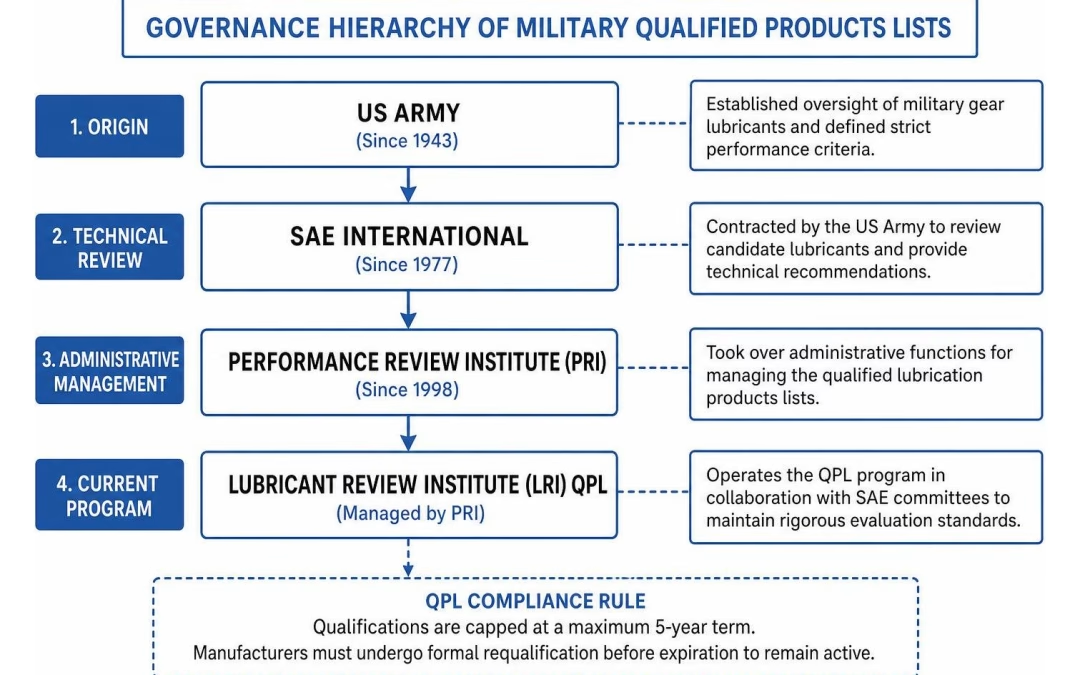
The historical oversight of military gear lubricants dates back to 1943 during World War II, when the US Army began qualifying lubricants against strict performance criteria to maintain vehicle reliability in punishing combat zones. To refine this process and incorporate cutting-edge technical expertise, the US Army contracted SAE International in 1977 to review candidate lubricants, analyze laboratory data, and offer technical recommendations.
By 1998, administrative functions for managing these qualified lists transferred to the Performance Review Institute (PRI). Today, PRI manages the administrative functions of the Lubricant Review Institute (LRI) QPL, working alongside SAE International committees to maintain rigorous evaluation standards. These organizations collaborate closely with military procurement officers and defense engineering commands to guarantee that listed products continuously satisfy updated defense requirements.
The LRI program operates under a firm compliance rule: qualifications are capped at a maximum 5-year term. A manufacturer cannot simply pass a test once and retain an active military listing indefinitely. Before the five-year mark expires, the manufacturer must go through formal requalification to maintain its status on the official database. This mandatory cycle prevents formulation drift and verifies that manufacturing plants continue to meet stringent quality assurance standards.
2. Decoding Key Military and Industry QPL Lubricant Specifications
When reviewing military and government specification documents, you will notice different naming conventions depending on the governing body and the intended environment. Achieving Precision Lubrication in regulated sectors requires knowing exactly which standard applies to your equipment and how each specification safeguards mechanical components.
For marine applications, QPL Specifications - NAVSEA - Navy dictate the material requirements for products used aboard naval vessels and submarine systems. These standards account for severe conditions such as saltwater exposure, continuous duty cycles, and submarine environmental air quality guidelines. Meanwhile, standards like SAE-J1966 govern non-dispersant mineral lubricating oils used in aircraft piston engines, ensuring stable oil pressure and thermal stability under high-altitude flight operations.
In government cataloging systems, military gear oils, engine lubricants, and specialized industrial fluids are assigned to Federal Supply Class 9150 (Oils, Greases, and Specialty Lubricants). This grouping standardizes logistics management across defense organizations worldwide.
Essential Elements of QPL Lubricant Specifications
Every qualified product entry in military supply channels carries specific identifiers. Understanding these terms helps you verify compliance quickly through official references like [PDF] Qualified Products List - ASSIST-QuickSearch.
- National Stock Number (NSN): A unique 13-digit sequence used across federal agencies to procure identical items reliably regardless of vendor brand.
- FSC and NIIN Components: An NSN is broken down into a 4-digit Federal Supply Class (such as 9150 for lubricants) and a 9-digit National Item Identification Number (NIIN) that pinpoints the precise chemical formulation and packaging size.
- Critical Safety Items (CSI): Parts or materials where failure could result in loss of life, severe injury, or mission failure. Any sourcing modification or chemical alteration for a CSI lubricant strictly requires Design Control Authority approval prior to procurement.
- DLA ASSIST & QPD Navigation: Publicly releasable specifications are retrieved via ASSIST Quick Search, while active product approvals are verified on the Defense Logistics Agency’s Qualified Products Database (QPD), ensuring engineers access real-time approval status.
Standardized Testing Protocols for Qualification
A lubricant achieves military qualification only after passing exhaustive physical and mechanical evaluations designed to verify its Condition Performance. For example, gear lubricants evaluated under LRI guidelines must successfully undergo rigorous ASTM calibration tests:
- L-42 Gear Test: Evaluates the anti-scoring properties of gear lubricants under severe high-speed and shock-load conditions, simulating heavy vehicular maneuvers.
- ASTM D5704: Measures the thermal and oxidative stability of gear oils under elevated operating temperatures, assessing sludge buildup, deposit formation, and viscosity increase.
- ASTM D7038: Evaluates the rust and corrosion prevention properties of gear lubricants under high-humidity operating environments, preventing moisture damage during extended storage or deployment.
- ASTM D6121 and ASTM D8165: Benchmarks the load-carrying capacity, wear performance, and extreme pressure protection of lubricants under severe high-torque and low-speed gear operations.
3. The 4-Step Qualification Process: How Lubricants Join the QPL

Getting a product on a military Qualified Products List is a structured, four-step journey. Manufacturers must submit physical samples, calibration data, and formula documentation to prove their fluid can handle real-world operational stress without breaking down or damaging machinery.
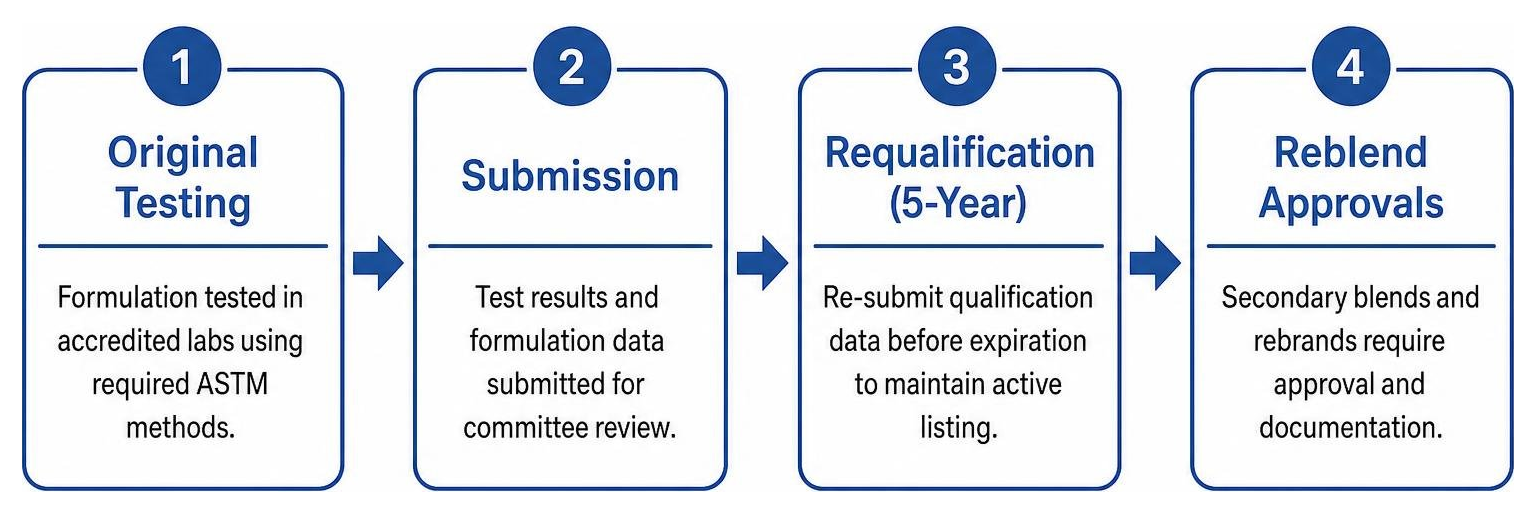
- Original Qualification Track: The manufacturer subjects the candidate formulation to accredited laboratory testing using required ASTM methods. Test results, chemical analysis, and formulation secrets are submitted for formal review by the LRI committee.
- 5-Year Requalification Mandate: Because listings expire after five years, suppliers must re-submit qualification data and verification samples prior to the cutoff date to prevent listing gaps and maintain uninterrupted eligibility for government defense contracts.
- Second-Party Reblending: If a secondary manufacturing plant produces an approved formulation, it must follow formal reblend protocols, undergo quality audits, and demonstrate exact blending consistency to mirror the original reference formulation.
- Rebranding Procedures: Companies looking to market an existing qualified fluid under a new commercial product name must obtain written authorization from the original manufacturing facility and submit official rebranding documentation to PRI.
Navigating Required Documentation and Forms
Managing a QPL qualification involves detailed paperwork overseen by PRI under administrative frameworks like Program Document PD4000. Suppliers must accurately complete several standard submissions:
- GL Forms 0 through 4: Standardized spreadsheets detailing base stock origin, chemical additive breakdown, physical laboratory performance, and inspection properties such as viscosity index, pour point, and flash point.
- RGL Calibration Reports: Formal test lab results covering mandatory ASTM gear evaluations (such as D5704 or D7038) conducted at certified reference testing facilities.
- Affidavits 1 through 5: Legal declarations used to verify product lineage, formulation locks, non-disclosure agreements, and second-party manufacturing agreements during reblending or rebranding requests.
- Facility Approval Documentation: Verification that the manufacturing plant maintains strict quality control systems and batch-to-batch tracking necessary to reproduce the exact qualified formulation consistently.
4. Comparing Regulatory Frameworks: Food-Grade vs. Military QPL
It is easy to confuse different industrial lubricant qualification schemes, but food-grade certifications and military QPL listings serve entirely different purposes and follow distinct governing philosophies.
Food-grade lubricants rely on standards like NSF H1 registration, which certifies a product for safe use in food processing equipment where incidental contact with consumable goods might occur. These products often use high-purity white mineral oils or synthetic polyalphaolefin (PAO) base stocks combined with specialized thickeners like calcium sulfonate complex or lithium complex to maintain water washdown resistance and non-toxic profiles.
While NSF H1 focuses primarily on toxicological safety and consumer health protection, military QPL lubricant specifications focus strictly on operational survival under extreme environmental stresses, shock loads, thermal exposure, and severe mechanical shear.
How Commercial Oils Differ from QPL Lubricant Specifications
Commercial maintenance oils and off-the-shelf industrial gear fluids may offer excellent everyday performance in factory environments, but they lack the audit controls required for government procurement and defense logistics.
For specialized military and Marine Industry Applications, a standard commercial lubricant manufacturer can change its base oil supplier or fine-tune its additive package at any time—provided the final blend meets general commercial catalog specifications.
In contrast, a product qualified under a military QPL is subject to a strict formulation lock. The manufacturer cannot alter the additive package, base oil source, or chemical makeup by even a fraction of a percent without triggering a formal requalification process. This defense audit trail guarantees that every batch delivered under a National Stock Number behaves identically in the field, ensuring predictable performance in life-critical equipment.
Frequently Asked Questions About QPL Lubricant Specifications
How long does a product remain listed on the LRI QPL?
A listing on the LRI Qualified Products List remains valid for a maximum term of five (5) years. To prevent listing expiration and maintain contract eligibility, the supplier must complete formal submission for requalification prior to the five-year cutoff date.
How do you search the Qualified Products Database (QPD)?
You can search for active QPL listings online via the Defense Logistics Agency's QPD portal within the DLA ASSIST ecosystem. Users can filter search results by government document number, Federal Supply Class (such as FSC 9150), National Stock Number (NSN), or specific vendor trade names.
What is required to rebrand or reblend an existing QPL lubricant?
Rebranding or reblending an existing qualified product requires formal submission through PRI under Program Document PD4000 guidelines. Applicants must complete standard legal affidavits (Affidavits 1–5), provide written consent from the original manufacturing facility, and submit facility verification details confirming identical blending capability and quality control.
Conclusion
Reading QPL lubricant specifications does not have to be overwhelming once you understand the governance structure, required ASTM testing, and cataloging systems behind them. Whether you are managing marine systems, verifying NSNs for defense procurement, or sourcing certified products for mission-critical hardware, checking active database listings is essential to maintain full compliance and operational readiness.
At Huron Industries Inc., we have specialized in high-purity, high-performance solutions since 1971. Our flagship Neolube® colloidal-graphite line is qualified to MIL-L-24131C and relied upon in demanding commercial and naval nuclear reactor systems where absolute purity and performance are required. For specialized industrial and sporting needs, our CaseLube Reloading Lubricant offers precision performance for reloading operations.
When your applications demand traceable, certified lubrication backed by proven military and industrial compliance, work with a partner that understands qualification specs inside and out.