
Why Nuclear Grade Lubricant Standards Exist — and Why They Matter
A nuclear grade lubricant is not just a high-performance product — it is a chemically controlled substance that must meet strict purity limits before it ever touches reactor equipment.
Quick answer: What makes a lubricant "nuclear grade"?
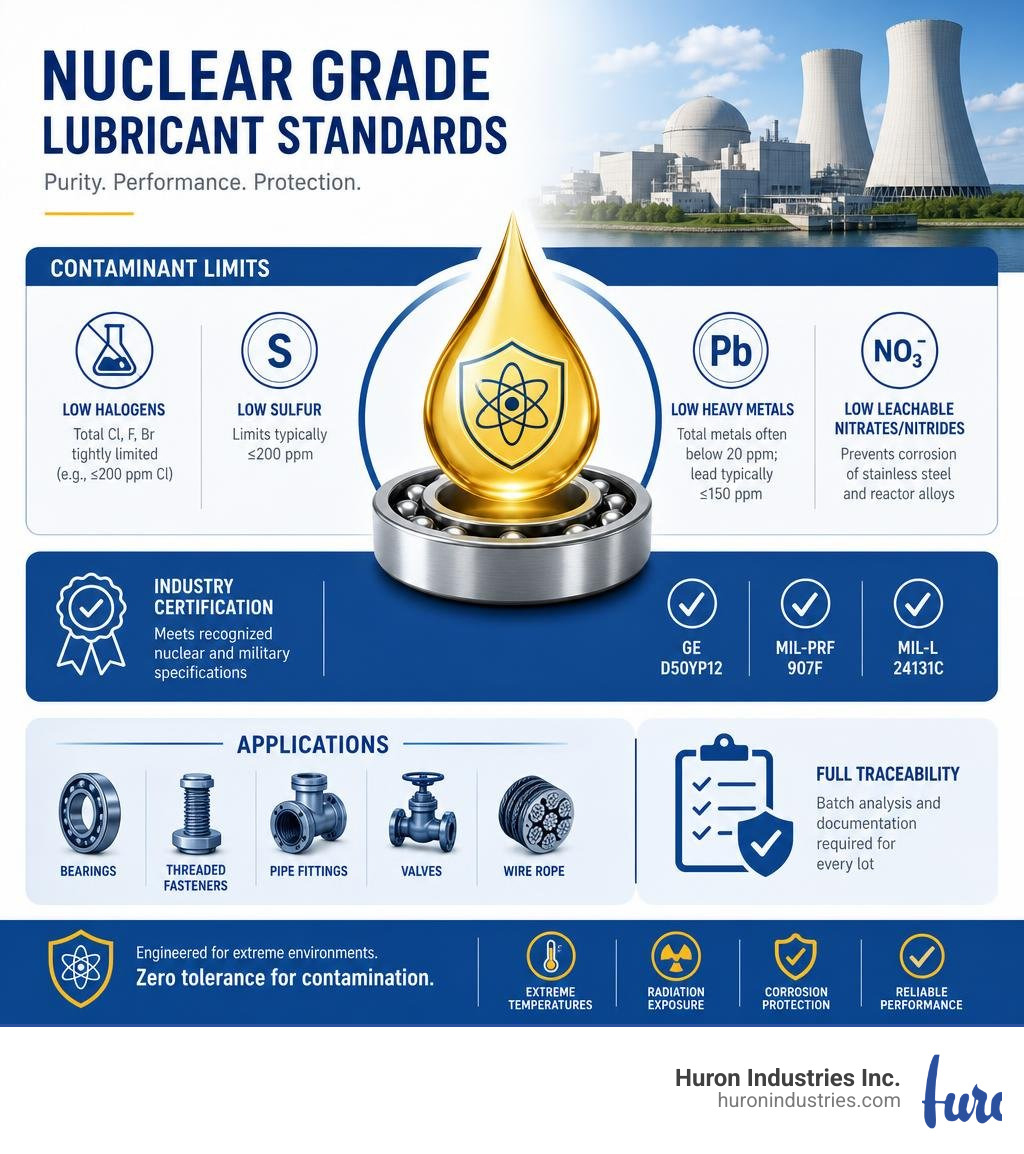
| Requirement | What it means |
|---|---|
| Low halogens | Total chlorine, fluorine, and bromine tightly limited (e.g., ≤200 ppm chlorine) |
| Low sulfur | Limits typically ≤200 ppm to prevent stress corrosion and H₂S formation |
| Low heavy metals | Total metals often below 20 ppm; lead typically ≤150 ppm |
| Low leachable nitrates/nitrides | Prevents corrosion of stainless steel and reactor alloys |
| Industry certification | Must conform to specs like GE D50YP12, MIL-PRF-907F, or MIL-L-24131C |
| Full traceability | Batch analysis and documentation required for every lot |
Nuclear power plants run at extreme temperatures, under intense radiation, and with zero tolerance for unplanned failures. The lubricants used inside — on bearings, threaded fasteners, pipe fittings, valves, and wire rope — have to perform without introducing contaminants that could corrode metal, poison reactor catalyst beds, or trigger a safety event.
The stakes are high. A 1984 technical report found that even a common lubricant additive — molybdenum disulfide — can break down at just 100°C to form hydrogen sulfide gas, which causes stress corrosion cracking in the very bolting materials used to hold reactor components together. That kind of failure is not a maintenance inconvenience. It is a safety problem.
This guide breaks down exactly what separates a nuclear grade lubricant from a standard industrial one, which specifications matter most, and how to choose the right product for your application.
I'm Nicholas Cunha, founder of CreatiVertical and the content and SEO strategist behind Huron Industries Inc.'s digital program — a specialty manufacturer of colloidal graphite dry film lubricants, including products qualified to MIL-L-24131C and used as nuclear grade lubricant solutions across commercial and naval reactor systems. Working directly with Huron's technical team, I've spent considerable time translating the chemistry, compliance requirements, and real-world application data behind these products into content that procurement and engineering buyers can actually use.
The Chemistry and Standards of a Nuclear Grade Lubricant
When we talk about standard industrial lubricants, the primary goals are simple: reduce friction, prevent wear, and keep heat at bay. But in a nuclear environment, the chemistry of the lubricant itself is a critical safety variable. Every single element inside the formula must be accounted for because under intense heat and radiation, trace elements can undergo chemical transformations that threaten structural integrity.
This is why a nuclear grade lubricant must exhibit exceptional Chemical Radiation Resistance while maintaining strict chemical purity limits.
Strict Chemical Purity and Contaminant Limits
The defining characteristic of any certified nuclear lubricant is its microscopic purity. Standard lubricants often contain sulfur-based extreme pressure additives, halogenated solvents, or heavy metal stabilizers. In a reactor, these are structural poison.
Let’s look at the hard limits. High-purity standards require trace contaminants to be measured in parts per million (ppm). For example, our flagship dry-film lubricant, NEOLUBE® No. 1, operates under strict limits on total solids:
- Fluorine: Maximum 20 ppm
- Chlorine: Maximum 200 ppm
- Sulfur: Maximum 200 ppm
- Lead: Maximum 150 ppm
Other commercial nuclear-grade greases strictly limit total halogens and total metals to prevent chemical degradation.
Why are these limits so low? If halogens like chlorine or fluorine leach onto hot stainless steel surfaces, they break down the protective oxide layer, sparking rapid pitting and stress corrosion cracking. Similarly, keeping lead and other low-melting-point heavy metals out of the formula is vital because they can cause liquid metal embrittlement, effectively making strong steel components as brittle as glass.
Furthermore, we must prevent "catalyst poisoning." Reactor systems use precious metal catalysts to recombine hydrogen and oxygen. Elements like sulfur, lead, or copper can coat these catalyst beds, rendering them useless and creating dangerous gas buildups.
Key Industry Specifications for a Nuclear Grade Lubricant
To ensure these strict chemical limits are met, the nuclear industry relies on several foundational specifications:
- MIL-L-24131C: This is the military specification governing high-purity colloidal graphite in isopropanol dry-film lubricants. Our NEOLUBE® No. 1 dry-film lubricant was on the Qualified Products List (QPL) for this specification since 1974, and its modern direct successor, NEOLUBE® No. 1.1, maintains full compliance.
- GE D50YP12 (Rev. 2): A stringent General Electric specification for nuclear-grade synthetic greases, ensuring low-halogen, low-metal, and low-sulfur compositions for rotating machinery and bearings.
- MIL-PRF-907F: The military performance specification for high-temperature anti-seize thread compounds.
- NAVSEAINST 9210.36B: The Naval Sea Systems Command instruction governing radiological controls and material compatibility for naval nuclear propulsion plants.
- MIL-L-24478: The military specification certifying molybdenum disulfide in isopropanol lubricants (typically used in very specific, non-wetted applications where graphite is restricted).
How Nuclear Lubricants Differ from Standard Industrial Formulations

If you were to use a premium, off-the-shelf industrial grease in a reactor environment, you would quickly run into catastrophic failure. The base oils, thickeners, and additives that make standard greases excellent in a steel mill or automotive plant fail under ionizing radiation and high-temperature thermal cycles.
To understand how these formulations differ, we have to look at how radiation and extreme heat alter molecular structures.
Radiation Resistance and Thermal Stability
Ionizing radiation (specifically gamma radiation) acts like a molecular pair of scissors. When radiation strikes the hydrocarbon chains of a standard lubricant's base oil, it causes two main reactions:
- Molecular Breakdown (Scission): The long hydrocarbon chains are chopped into smaller pieces, rapidly lowering the lubricant's viscosity and causing it to run out of the component like water.
- Cross-Linking: The severed molecules bond back together in chaotic, highly dense networks, turning the lubricant into a thick, hard, tar-like varnish.
Nuclear-grade formulations use highly stable base fluids—such as synthetic hydrocarbons (PAOs) or specialized synthetic esters—that resist scission and cross-linking. Furthermore, dry-film lubricants like graphite are completely immune to radiation-induced viscosity changes because they do not rely on liquid organic carrier oils to lubricate.
In terms of Thermal Stability, these products are engineered to withstand massive operating ranges. While a standard grease might oxidize and fail at 150°C, high-temperature nuclear anti-seize compounds can prevent component welding at temperatures up to 2600°F (1427°C).
Material Compatibility and Stress Corrosion Cracking
One of the most dangerous phenomena in a nuclear facility is stress corrosion cracking (SCC). High-strength bolting alloys, such as A540 B24 and A193 B7, are highly susceptible to transgranular SCC when exposed to high temperatures, tensile stress, and corrosive chemical agents.
According to extensive Testing of nuclear grade lubricants and their effects on A540 ... , both A193 B7 and A540 B24 bolting materials undergo rapid transgranular stress corrosion cracking when exposed to demineralized water at 280°C if corrosive lubricant residues are present. When standard lubricants break down under thermal stress, they release sulfur or antimony compounds. These elements act as hydrogen recombination poisons, forcing hydrogen atoms directly into the steel lattice, leading to hydrogen embrittlement and sudden, catastrophic bolt snaps.
Primary Applications in Nuclear Power Plants

Lubricants are deployed in almost every corner of a nuclear plant, divided strictly between wetted (inside the primary coolant loop) and non-wetted (auxiliary) environments. We categorize these applications into Class 1, 2, and 3 safety-related systems.
To explore how these lubricants keep systems running safely, you can read more about Nuclear Industry Applications.
Threaded Fasteners and Anti-Seize Compounds
Reactor pressure vessel head bolts, steam generator manway studs, and high-pressure pipe flange fasteners are under immense tension. During outages, these fasteners must be detensioned and removed. If galling or seizing occurs, the bolts must be drilled out—a process that costs millions in extended downtime.
Nuclear-grade anti-seize compounds are applied to these threads to establish a predictable torque coefficient (friction/nut-factor of around 0.15). By layering pure metallic flakes (like nickel) or dry-film solids (like graphite) in a clean synthetic carrier, they prevent metal-to-metal welding under extreme loads while ensuring clean disassembly years later.
Bearings, Valves, and Rotating Equipment
For rotating equipment, such as electric motor bearings, pump seals, and ventilation fans, synthetic greases meeting NLGI Grade 2 specifications are the industry standard. These greases must:
- Remain stable in high-radiation zones.
- Resist water washout from steam or high-pressure spray.
- Provide excellent dielectric properties to prevent electrical tracking in motorized valve actuators.
- Lubricate critical moving parts in control rod drive mechanisms (CRDMs) where precision positioning is a matter of reactor safety.
Comparing Product Types: Greases, Anti-Seize, and Dry-Film Lubricants
Choosing the right nuclear grade lubricant requires matching the component's mechanical demands with the correct product category.
| Lubricant Type | Primary Base / Solids | Key Specs | Max Temperature | Best For |
|---|---|---|---|---|
| Synthetic Grease | PAO / PFAS-free / Complex Soap | GE D50YP12 Rev. 2 | ~500°F (260°C) | Ball & roller bearings, electric motors, wire ropes, gears |
| Nickel Anti-Seize | Nickel Flake / Synthetic Fluid | MIL-PRF-907F | 2600°F (1427°C) | High-temp threaded fasteners, non-wetted pipe fittings |
| Dry-Film Graphite | Colloidal Graphite / Isopropanol | MIL-L-24131C | 400°F (204°C) continuous / 850°F (454°C) intermittent | Reactor internals, close-clearance moving parts, threaded fasteners |
Synthetic Bearing Greases
Synthetic nuclear greases use advanced polyalphaolefin (PAO) base oils thickened with highly stable complex soaps. They are formulated to be completely fluorine-free and PFAS-free, eliminating the risk of acidic fluorine compounds forming under radiation. These greases outlast conventional lubricants by 3 to 4 times, keeping electric motor bearings spinning smoothly without dry-out or oil separation.
Nickel-Based Anti-Seize Compounds
When temperatures exceed the limits of synthetic greases, nickel-based anti-seize compounds step in. Formulated with chemically pure nickel flake in an ashless synthetic carrier, these compounds contain absolutely no copper, lead, or molybdenum disulfide. They prevent metal-to-metal contact up to 2600°F (1427°C), ensuring that auxiliary steam line fittings can be disassembled without shearing.
Dry-Film Graphite and the Ideal Nuclear Grade Lubricant
For the most sensitive reactor applications, liquid oils and greases are completely off the table because they can migrate, attract dust, or break down into sticky residues. This is where dry-film colloidal graphite shines.
Our flagship product line, Neolube, uses 99% pure furnace-grade graphite particles suspended in an isopropanol carrier. Once applied, the isopropanol evaporates rapidly, leaving behind a thin, dry, non-corrosive film of pure graphite.
- Zero Migration: Because it is dry, it does not migrate or attract abrasive contaminants.
- Radiation Immune: Pure graphite is unaffected by extreme radiation doses.
- Perfect for Close Clearances: With particle sizes averaging under 4 microns, it lubricates moving parts with incredibly tight tolerances.
Testing, Compliance, and Quality Assurance
In the nuclear supply chain, documentation is just as important as the physical product. You cannot simply buy a can of lubricant and assume it is safe; you must prove it with a rigorous paper trail.
Batch Analysis and Traceability Requirements
Every single batch of a certified nuclear grade lubricant must undergo 100% testing prior to packaging and shipping. At Huron Industries, we provide a comprehensive Certifying Analysis with every shipment, verifying that the batch meets the strict elemental limits of MIL-L-24131C.
To review safety and handling guidelines, refer to the Neolube No. 1 Lubricant Safety Datasheet.
Our quality control process ensures:
- No Intentional Additions: No low-melting-point metals (lead, bismuth, zinc, antimony) or mercury compounds are ever used in our manufacturing facility in Port Huron, Michigan.
- Strict Batch Separation: Every production run is isolated, analyzed, and assigned a unique batch number for lifetime traceability.
- Comprehensive Documentation: Customers receive a detailed Certificate of Conformance (CoC) and a batch-specific analysis report detailing exact halogen, sulfur, and heavy metal concentrations.
For a complete breakdown of physical and chemical testing limits, see the Neolube No. 1 Lubricant Technical Datasheet.
Frequently Asked Questions about Nuclear Lubrication
Why is molybdenum disulfide restricted in nuclear environments?
Molybdenum disulfide ($MoS2$) is an excellent high-pressure lubricant in standard industrial settings, but it is highly restricted in nuclear plants. At temperatures as low as 100°C, $MoS2$ can hydrolyze in the presence of moisture or demineralized water. This chemical reaction produces hydrogen sulfide ($H_2S$), a highly corrosive gas that causes rapid stress corrosion cracking in high-strength steel bolting materials like A540 B24.
What is the difference between Neolube No. 1 and Neolube No. 1.1?
To maintain the highest quality standards and secure our supply chains, Neolube No. 1 was discontinued as of July 11, 2024, and replaced by Neolube No. 1.1.
Neolube No. 1.1 is manufactured and tested entirely in the USA at our Port Huron, Michigan facility. It maintains identical compliance with military specification MIL-L-24131C, ensuring the same low-halogen, high-purity colloidal graphite performance that the nuclear industry has trusted for decades. Additionally, Neolube No. 1.1 is packaged in non-halogenated plastic bottles with convenient brush-in-cap applicators to prevent trace halogen contamination during field application.
How do leachable halogens affect stainless steel in reactors?
Stainless steel relies on a microscopic chromium oxide "passive layer" to resist corrosion. Leachable halogens—specifically chlorides and fluorides—penetrate this passive layer at elevated temperatures. Once inside, they react with the underlying metal, causing localized pitting and transgranular stress corrosion cracking. Because reactor components are under constant mechanical stress, these microscopic cracks can propagate rapidly, leading to sudden component failure.
Conclusion
In the high-stakes world of nuclear power generation, there is absolutely no room for compromise. A single trace contaminant, an unverified batch of grease, or an uncertified lubricant can lead to millions of dollars in stress corrosion damage, component failures, and unscheduled maintenance shutdowns.
Since 1971, Huron Industries Inc. has manufactured high-purity, certified lubricants from our facility in Port Huron, Michigan. Our flagship Neolube® colloidal-graphite line is qualified to MIL-L-24131C and trusted across commercial and naval nuclear reactor systems. We are dedicated to providing the ultimate in chemical purity, thermal stability, and rigorous quality assurance to keep your critical systems running safely.
To find the certified, high-purity lubricant solutions your facility requires, explore our dedicated Nuclear Industry Applications resources or contact our technical team today.