
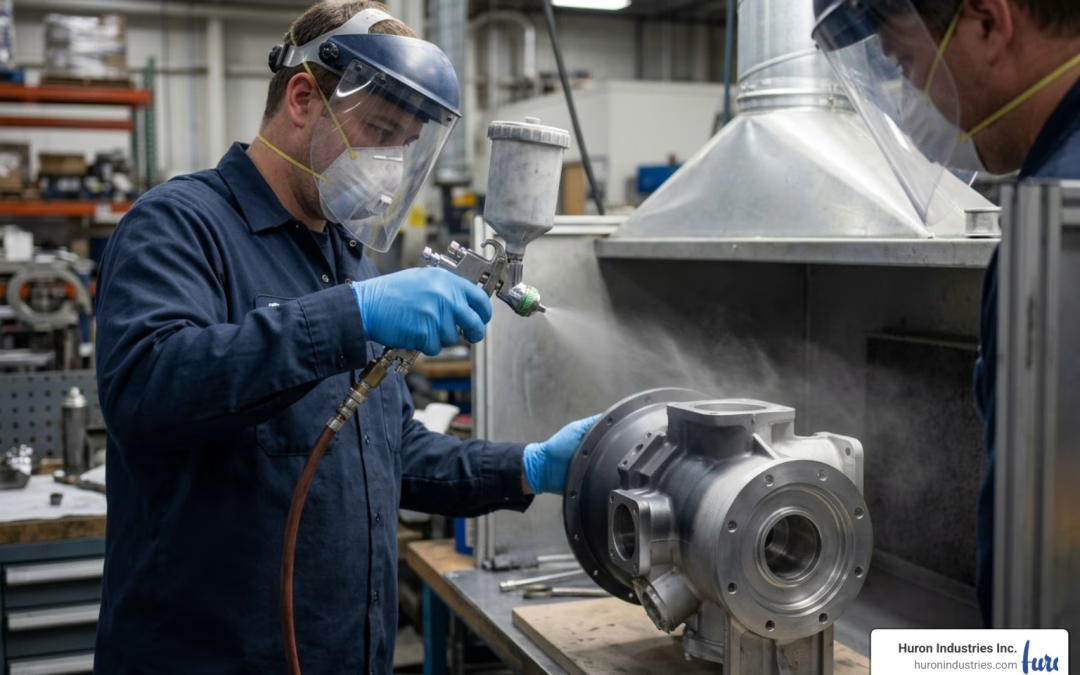
Why Engineers and Procurement Teams Are Evaluating Dry Film Lubrication Alternatives
Finding a reliable dry film lubrication alternative is a top priority for engineers, EHS managers, and procurement teams across aerospace, nuclear, and heavy industrial sectors — and for good reason.
Here are the most common dry film lubrication alternatives:
| Alternative | Best For | Key Advantage |
|---|---|---|
| Neolube No. 2 (Huron Industries) | Nuclear, defense, aerospace | High-purity, MIL-L-24131C qualified, low halogens |
| Legacy graphite dispersions | General industrial, legacy users | Familiar application profile |
| Other nonlead graphite dispersions | Forging, casting, assembly | Reduced VOCs, no lead |
Legacy colloidal graphite lubricants have been used in aircraft engine assembly, forging, casting, and high-temperature fastener applications for decades. But many older formulations carry a serious compliance burden.
Complex solvent carriers can push VOC content high. Lead has historically appeared in dry film lubricant formulations of this type, and lead is one of the EPA's 17 high-risk priority chemicals. The permissible exposure limit (PEL) is just 0.05 mg/m³.
The numbers tell the story clearly:
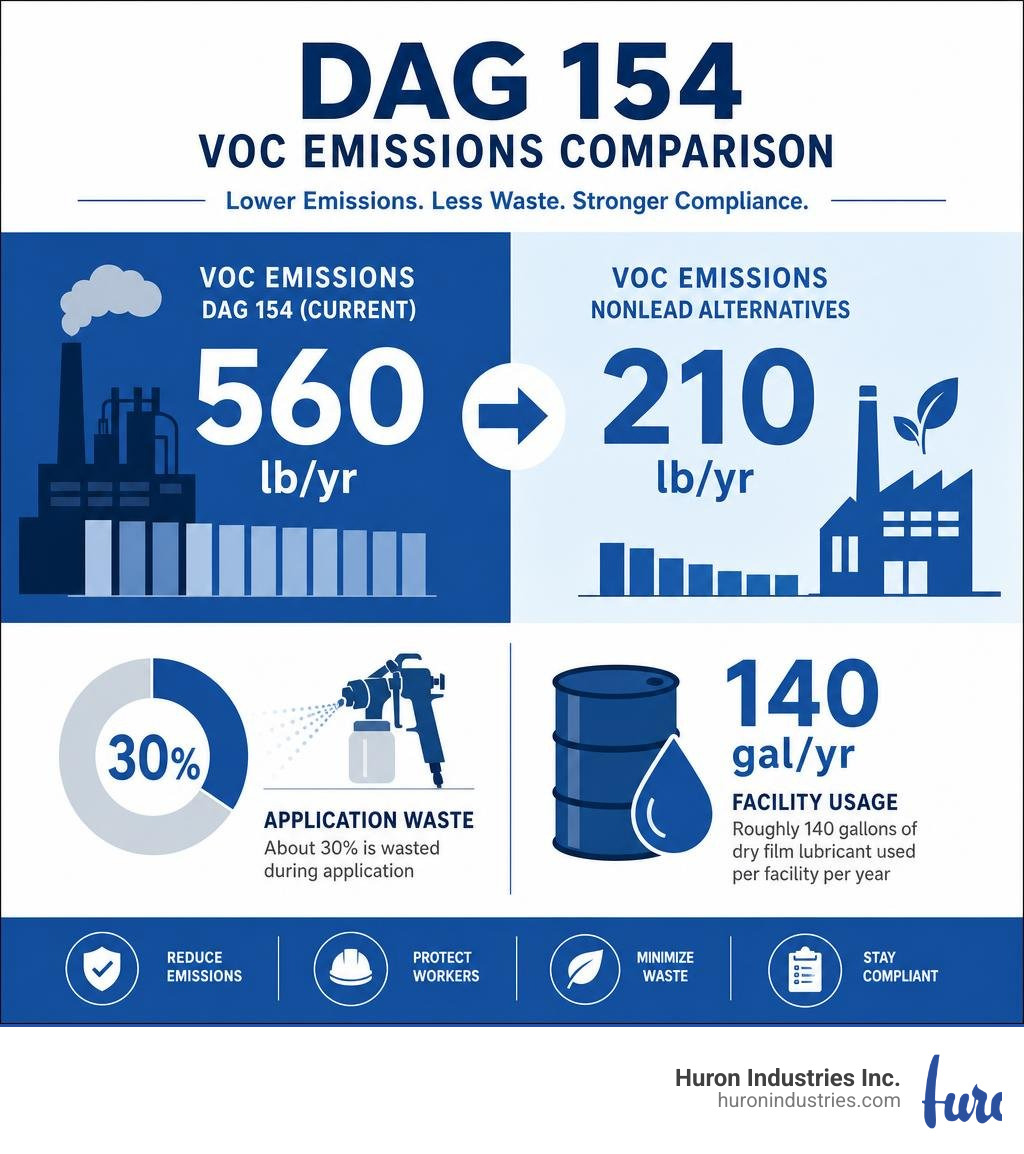
- A single aircraft engine manufacturing facility uses roughly 140 gallons of dry film lubricant per year
- About 30% of that is wasted during application
- Average VOC emissions run around 560 lb per year per facility
- Switching to nonlead alternatives can cut that to roughly 210 lb per year
That's not a minor compliance tweak. That's a meaningful reduction in worker exposure, waste, and environmental liability.
Regulatory pressure from the Clean Air Act (CAA), RCRA, and EPCRA has made this switch from optional to essential for many facilities. A joint tri-service initiative — the JG-APP Potential Alternatives Report — screened 69 nonlead dry film lubricants, narrowed the field to 37 viable candidates, and ultimately recommended 13 for formal testing under the Joint Test Protocol.
This guide walks through what those alternatives actually look like in practice.
I'm Nicholas Cunha, founder of CreatiVertical and the content strategist behind Huron Industries Inc.'s digital program, where I've spent considerable time researching the colloidal graphite lubricant market — including the regulatory and procurement landscape around dry film lubrication alternatives. My work sits at the intersection of technical accuracy and search visibility for industrial manufacturers, so the guidance here is grounded in both engineering specs and real sourcing needs.
Understanding Legacy Graphite Lubricants and the Need for Alternatives
To find the right dry film lubrication alternative, we first have to look closely at what made legacy graphite products so widely adopted. Traditional liquid-dispersion dry film lubricants are typically composed of high-purity colloidal graphite suspended in an alcohol-based solvent carrier. When applied to a surface, the solvent evaporates quickly at room temperature, leaving behind a thin, dry, and highly adherent film of graphite.
For cataloging and procurement, these materials are often sourced through federal databases, aerospace distributor listings, or military specification references. Procurement specialists may encounter older part numbers, legacy drawings, and discontinued product names that need to be cross-referenced before any approved material change is made.
The primary carrier system of older formulations may include volatile organic solvents such as:
- Isopropanol (isopropyl alcohol)
- n-Butyl alcohol
- Hexylene glycol
- Propylene glycol methyl ether
While this type of solvent blend allows the dry film to air-dry rapidly without requiring a high-temperature baking cycle, it can also create a high VOC (Volatile Organic Compound) profile. In an era of strict environmental controls, these solvents present occupational hazards, including inhalation risks, skin irritation, and flammability concerns.
Furthermore, historical dry film lubricants in this class often contained trace heavy metals or were used alongside lead-containing primers and additives to prevent galling and seizing in high-stress aerospace environments. With modern regulations like the Clean Air Act (CAA), the Resource Conservation and Recovery Act (RCRA), and the Emergency Planning and Community Right-to-Know Act (EPCRA) tightening restrictions on heavy metals and high-VOC solvent emissions, relying on legacy formulations is becoming an operational liability.
Evaluating the Dry Film Lubrication Alternative Landscape
When I evaluate the landscape for a suitable dry film lubrication alternative, I look at it through the lens of systematic pollution prevention. In high-performance sectors like aerospace manufacturing, you cannot simply swap one chemical for another without a rigorous screening process.
The process of finding viable alternatives involves multiple stages of evaluation:
- Initial Screening: Identifying products that match the basic physical properties of colloidal graphite. For example, during the Joint Group on Acquisition Pollution Prevention (JG-APP) initiatives, investigators initially compiled a list of 69 nonlead dry film lubricants.
- Technical and ESOH Analysis: Eliminating candidates that contain highly toxic elements, carcinogens, or excessive VOC levels. This step narrowed the JG-APP list down to 37 viable options.
- Targeted Testing: Selecting the absolute best performers for physical validation. Only 13 potential alternatives were recommended for rigorous laboratory and field testing to ensure they could handle the extreme temperatures and load requirements of aircraft engines without failing.
The goal is to find an alternative that matches or exceeds the anti-galling, anti-fretting, and anti-seizing performance of the legacy formulation while drastically lowering the facility's overall hazardous material footprint.
Top Commercial Dry Film Lubrication Alternative Options

When sourcing a replacement, it helps to understand that the commercial market has evolved. Some alternatives are designed to maintain a familiar application profile for legacy drawings, while others represent true upgrades in purity, environmental compliance, and performance.
Direct Drop-In Graphite Lubricant Replacements
If you are looking for a direct, drop-in replacement for an older colloidal graphite lubricant, the first step is confirming whether the replacement is a true formulation upgrade or simply a continuation of an older chemistry under a different product name.
A drop-in replacement can be useful when engineering drawings, maintenance procedures, or procurement systems require exact continuity. However, it is important to realize that a direct substitute may not solve VOC, worker exposure, or environmental compliance challenges if it uses the same volatile solvent carriers as the original material.
Neolube No. 2 as a High-Purity Dry Film Lubrication Alternative
For industries that require the absolute highest level of purity and strict compliance with military specifications, Neolube No. 2 by Huron Industries Inc. stands out as a strong alternative.
Manufactured in Port Huron, Michigan, Neolube No. 2 is a high-purity colloidal graphite dispersion in an easy-to-apply isopropanol carrier. It is fully qualified to MIL-L-24131C, the rigorous military specification for high-purity colloidal graphite lubricants.
You can explore the product details directly at Neolube No. 2 - 2 fl oz and learn more about the broader family of Neolube Colloidal Graphite Lubricants.
What makes Neolube No. 2 a superior alternative to commercial-grade graphite dispersions is its ultra-pure formulation. It is designed specifically for environments where even minor chemical impurities can lead to stress-corrosion cracking or catastrophic material failure. This makes it the industry standard for Precision Lubrication and critical Lubrication & Wear Reduction in commercial nuclear power plants, naval nuclear reactor systems, and aerospace components.
Technical Comparison: Performance, ESOH, and Lifecycle Costs
Choosing between a standard commercial graphite coating and a high-purity alternative requires a side-by-side look at their technical profiles.
Performance and Application Characteristics
To understand how these lubricants perform under real-world operating conditions, let's compare their key physical and chemical characteristics:
| Property | Legacy Graphite Lubricants | Neolube No. 2 |
|---|---|---|
| Lubricant Solid | Colloidal Graphite | Ultra-Pure Colloidal Graphite |
| Carrier Solvent | Multi-solvent alcohol/glycol blends | Isopropanol (Isopropyl Alcohol) |
| Specification Compliance | General Industrial | MIL-L-24131C |
| Purity Level | Commercial Grade | Nuclear Grade (Low Halogens & Sulfur) |
| Dry Time (Touch) | 5 minutes | 5 minutes |
| Curing Method | Air dry (room temp) | Air dry (room temp) |
| Primary Applications | Forging, casting, general assembly | Nuclear reactors, aerospace, threaded fasteners |
Both product types offer excellent dry film lubrication, forming a thin, slippery barrier that prevents metal-to-metal contact. However, the application process highlights a major difference in ease of use.
Because many legacy formulations utilize complex blends of multiple heavy alcohols and glycols, they can be more difficult to clean up, and the vapors are significantly more complex to manage in enclosed workspaces. Neolube No. 2, by contrast, uses a straightforward, single-solvent isopropanol carrier that evaporates cleanly, leaving a highly uniform, ultra-pure graphite film with no gummy residue.
Environmental, Safety, and Occupational Health (ESOH) Profiles
From an ESOH perspective, the differences are even more stark. When a facility transitions from a legacy dry film lubricant containing heavy solvents (or older lead-bearing formulas) to a clean, nonlead alternative like Neolube No. 2, the environmental benefits are immediate:
- VOC Reduction: Standard baseline dry film lubricants can contain up to 7 lb/gal of VOCs. High-purity single-solvent dispersions help minimize the variety of hazardous air pollutants (HAPs) emitted during spray or brush application.
- Heavy Metal Elimination: Neolube No. 2 is completely lead-free, sulfur-free, and halogen-free, eliminating the risk of heavy metal exposure for workers and simplifying waste disposal under RCRA guidelines.
- Worker Safety: By avoiding complex glycol ethers and butyl alcohols, the safety profile of the workspace is vastly improved, lowering inhalation hazards and reducing the need for specialized respiratory monitoring.
These benefits translate directly to lower lifecycle costs. By reducing VOC emissions, facilities can often simplify their Clean Air Act Title V permits, reduce hazardous waste disposal fees, and lower the costs associated with personal protective equipment (PPE) and environmental monitoring.
Frequently Asked Questions about Dry Film Lubrication Alternatives
Can dried colloidal graphite lubricant be re-liquefied?
Yes, dried legacy colloidal graphite lubricant can sometimes be re-liquefied, but it requires care. If the product has dried out in the container, it may be possible to break up the hardened mass into small pieces, cover it with denatured alcohol or isopropyl alcohol, and allow it to sit.
Over time, with occasional stirring, the graphite particles may re-disperse into the solvent carrier until it reaches a usable, brushable consistency. However, for critical aerospace or nuclear applications, re-liquefying dried product is generally not recommended, as the exact ratio of solids to solvent may be compromised, altering the film thickness and performance characteristics.
What is the difference between standard commercial graphite dispersions and nuclear-grade alternatives?
The primary difference lies in the level of impurities. Commercial-grade graphite lubricants often contain trace amounts of sulfur, halogens (like chlorine and fluorine), and heavy metals. While these impurities are harmless in general industrial forging or casting, they can cause catastrophic stress-corrosion cracking in high-stress, high-temperature environments like nuclear reactors or aerospace turbine blades.
Nuclear-grade alternatives like Neolube No. 2 are manufactured under strict quality control to guarantee extremely low levels of these corrosive elements, meeting the strict requirements of MIL-L-24131C.
How do non-lead alternatives reduce VOC emissions in aerospace manufacturing?
In typical aerospace engine manufacturing facilities, dry film lubricants are sprayed onto components, resulting in approximately 30% material waste due to overspray. When using legacy high-VOC formulations, this wasted coating evaporates directly into the atmosphere, contributing to high annual VOC calculations.
By switching to modern, optimized dry film lubricants, facilities can reduce their annual VOC emissions from an average of 560 lbs per year down to 210 lbs per year, dramatically improving environmental compliance and air quality.
Conclusion
Whether you are looking to replace a legacy dry film lubricant to meet stricter environmental laws, simplify your chemical inventory, or upgrade to a higher-purity lubricant for critical components, there is a clear path forward. While direct drop-in replacements may suit standard industrial applications, high-performance and regulated sectors are better served by a true high-purity alternative.
For critical applications where performance, purity, and compliance cannot be compromised, I highly recommend exploring the specialized line of Neolube Brand Products. Made in the USA by Huron Industries Inc., these qualified lubricants provide the ultimate combination of wear reduction, extreme temperature stability, and peace of mind.
To find the exact dry film lubricant for your specific application, visit the Huron Industries Neolube Category to request a technical consultation or product sample.