
When a Spill Becomes a Food Safety Incident
A food safe spill absorbent is any sorbent material certified — typically through NSF International's Nonfood Compounds Program — to be used in areas where food is processed, stored, or handled without posing a contamination risk.
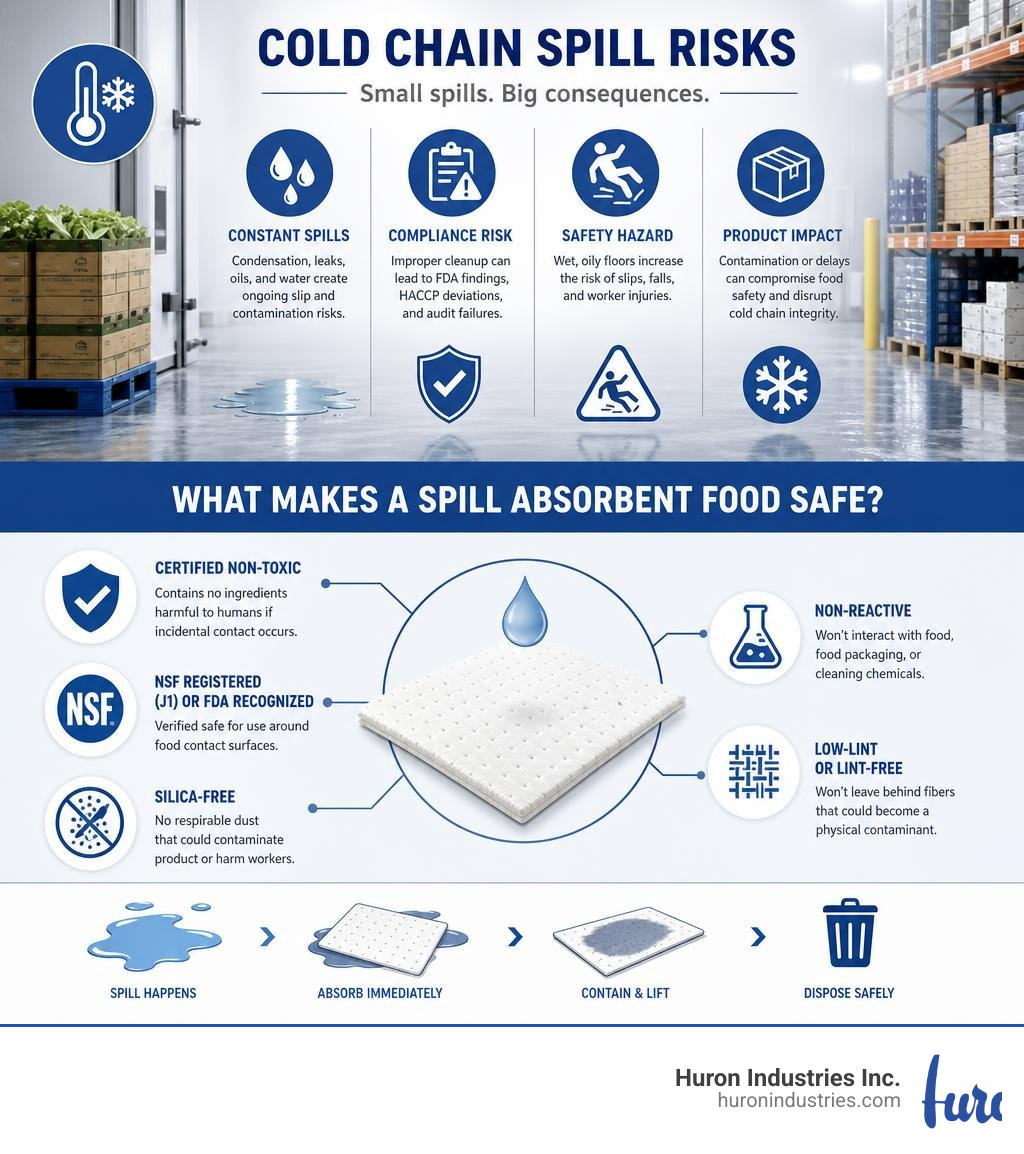
Here is a quick answer to what makes a spill absorbent food safe:
- Certified non-toxic — contains no ingredients harmful to humans if incidental contact occurs
- NSF registered (J1 category) or FDA-recognized ingredients — verified safe for use around food contact surfaces
- Silica-free — no respirable dust that could contaminate product or harm workers
- Non-reactive — won't interact with food, food packaging, or cleaning chemicals
- Low-lint or lint-free — won't leave behind fibers that could become a physical contaminant
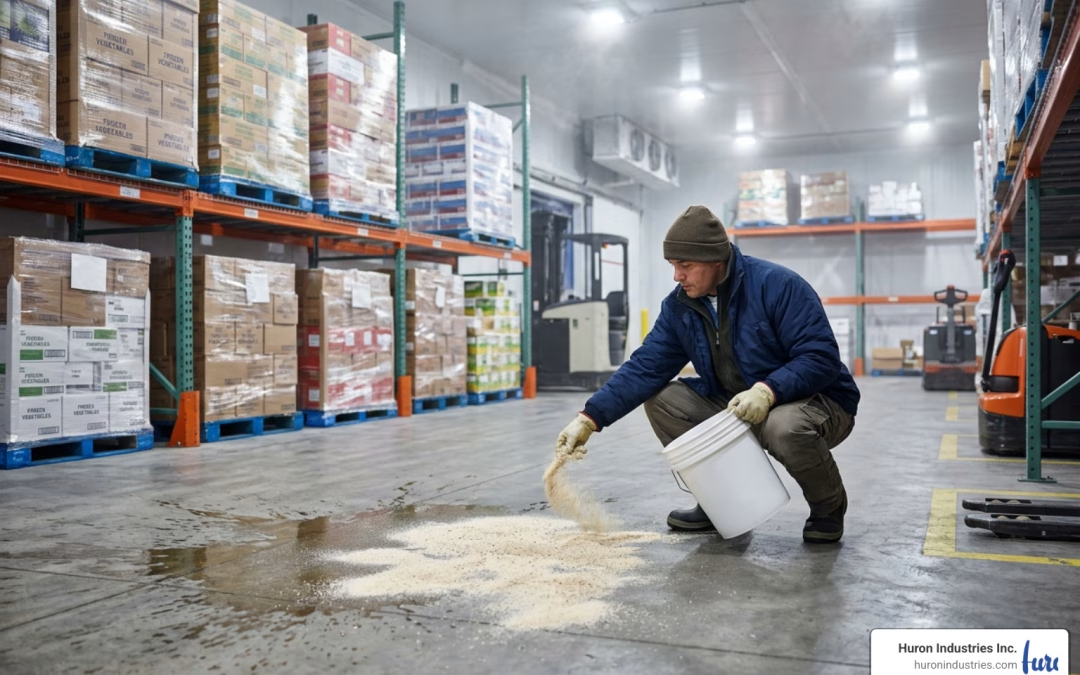
Cold chain facilities — refrigerated warehouses, food processing plants, distribution centers — deal with spills constantly. Condensation drips from refrigeration units. Cooking oils and food-grade lubricants leak from machinery. Water pools on loading dock floors.
Most facilities reach for whatever absorbent is on the shelf. And that's often a problem.
Standard clay absorbents generate silica dust, leave abrasive residue, and carry no food-safe certification. In a regulated food environment, that's not just a cleanup issue — it's a compliance issue.
The wrong absorbent can turn a minor floor spill into an FDA audit finding, a HACCP deviation, or a worker injury from a contaminated slip hazard.
I'm Nicholas Cunha, the digital marketing strategist behind Huron Industries Inc.'s content program, where I've spent considerable time helping industrial and EHS buyers understand how certified specialty products — including food safe spill absorbent solutions — meet the strict regulatory and safety standards their facilities require. In the sections below, we'll walk through exactly what NSF certification means, why it matters in cold chain environments, and how to choose the right sorbent for your operation.
What is an NSF Certified Sorbent?
To understand why a specialized sorbent is necessary, we must first look at what makes a product "food safe" in an industrial context. In the food and beverage sector, everything that enters a facility is scrutinized. This includes the chemicals used to clean the floors, the lubricants keeping the conveyor belts moving, and yes, the materials used to clean up unexpected messes.
NSF International (formerly the National Sanitation Foundation) manages the Nonfood Compounds Program, which is a continuation of the USDA product approval and listing program. When a manufacturer develops a spill absorbent for food environments, they submit it to NSF for evaluation.
For spill absorbents, the most common registration category is J1 (Absorbents/Anti-slip Agents). A J1 registration means the product is acceptable for use as an absorbent or anti-slip agent on floors and other hard surfaces in and around food processing areas.
To achieve this certification, the sorbent must be formulated using FDA-recognized ingredients that are inherently non-toxic. If a worker drops a bag of granular sorbent near a packaging line, the dust must not pose a chemical contamination hazard to the food being packaged. This is why traditional industrial absorbents, which often contain heavy metals, chemical colorants, or respirable crystalline silica, fail to meet these standards.
When you choose a certified food-safe option, you are choosing a product designed from the ground up to prevent chemical and physical contamination. For a deeper look at how these non-toxic materials are formulated to protect both food safety and worker health, you can read about Non-Toxic Absorbents - Zero Respirable Silica, Spill Cleanup .
Why Your Cold Chain Needs a Food Safe Spill Absorbent
The cold chain is a highly sensitive logistics environment. Because cold chain facilities operate at low, controlled temperatures to preserve perishable food items, they face unique physical and environmental challenges that make spills both more common and harder to manage.
First, consider the environmental physics of cold storage. When warm, humid air from a loading dock meets the sub-freezing or refrigerated air of a cold warehouse, condensation forms. This condensation pools on smooth concrete floors, creating slick surfaces that are prime slip-and-fall hazards.
Furthermore, cold chain equipment relies on heavy refrigeration systems, forklifts, motorized pallet jacks, and conveyor systems. All of these machines require hydraulic fluids, gear oils, and lubricants to run. In cold temperatures, these fluids can become more viscous, causing seals to shrink and leak.
If a hydraulic line leaks on a loading dock, you cannot simply wash it down the drain or use a standard mop and bucket, which would only spread the oil and create a wider slip hazard. You need an immediate, dry cleanup solution. However, using a non-certified absorbent risks introducing airborne dust or synthetic fibers into the recirculated air of the refrigeration system, potentially contaminating open food products several aisles away.
Using a certified food safe spill absorbent ensures compliance with:
- HACCP (Hazard Analysis Critical Control Point) Plans: HACCP requires facilities to identify physical, chemical, and biological hazards. Standard clay absorbents introduce a physical hazard (silica dust) and potential chemical hazards. A food-safe sorbent mitigates these risks.
- FDA Regulations: The FDA requires that all substances used in food facilities be controlled to prevent food contamination.
- OSHA Standards: OSHA strictly regulates slip-and-fall hazards as well as workplace exposure to respirable crystalline silica dust.
To keep your facility prepared for any unexpected fluid release, it is highly recommended to establish a dedicated spill response protocol. For practical tips on setting up your facility's response gear, you can consult this guide to Keep a spill kit handy in case of a chemical spill - MSU Extension .
Selecting the Right Food Safe Spill Absorbent for Cold Chain Facilities
When selecting a sorbent for a refrigerated or frozen environment, facility managers must look beyond basic absorbency. The physical properties of the sorbent dictate how well it performs on cold, slick surfaces.
Granular food-safe sorbents are generally preferred over lightweight pads or socks for floor-level spills in cold chains. While pads are excellent for catching steady drips under a machine, they struggle to recover liquids that have already spread across a wide, uneven concrete floor. Loose-fill granular sorbents can be swept into the cracks, expansion joints, and textured surfaces common in industrial food facilities, achieving a completely dry, slip-free finish.
When evaluating a granular food-safe option, keep this checklist in mind:
- Absorption Efficiency: How much liquid does it hold? High-performance mineral or organic sorbents can absorb up to 7 to 10 times more liquid than clay by weight.
- Temperature Performance: Does the sorbent work effectively at sub-zero temperatures? Some synthetic absorbents can freeze or lose their capillary action when applied to chilled liquids, whereas high-quality mineral and organic sorbents remain highly effective.
- Dust Levels: Is the product genuinely dust-free? Dust can coat refrigeration coils, reducing cooling efficiency and increasing energy costs.
- Abrasiveness: Will the granules scratch or damage polished concrete floors or sensitive packaging machinery?
At Huron Industries Inc., we offer specialized solutions designed to meet these exact requirements. You can browse our dedicated offerings in the Neosafe Category or check out our broader range of industrial spill control solutions in the Sorbent Category.
Best Practices for Deploying a Food Safe Spill Absorbent on the Shop Floor
Having the right product is only half the battle; your team must know how to use it correctly to maximize safety and minimize waste. Here is a step-by-step best practice guide for cleaning up a spill on a cold chain shop floor:
- Isolate the Area: Immediately mark the spill with high-visibility safety cones to prevent foot or forklift traffic from spreading the liquid.
- Apply the Sorbent: Do not dump the sorbent directly onto the center of the wet pool, as this can cause splashing. Instead, pour a continuous barrier or "dam" around the perimeter of the spill to contain it. Once contained, lightly cover the rest of the spill working from the edges toward the center.
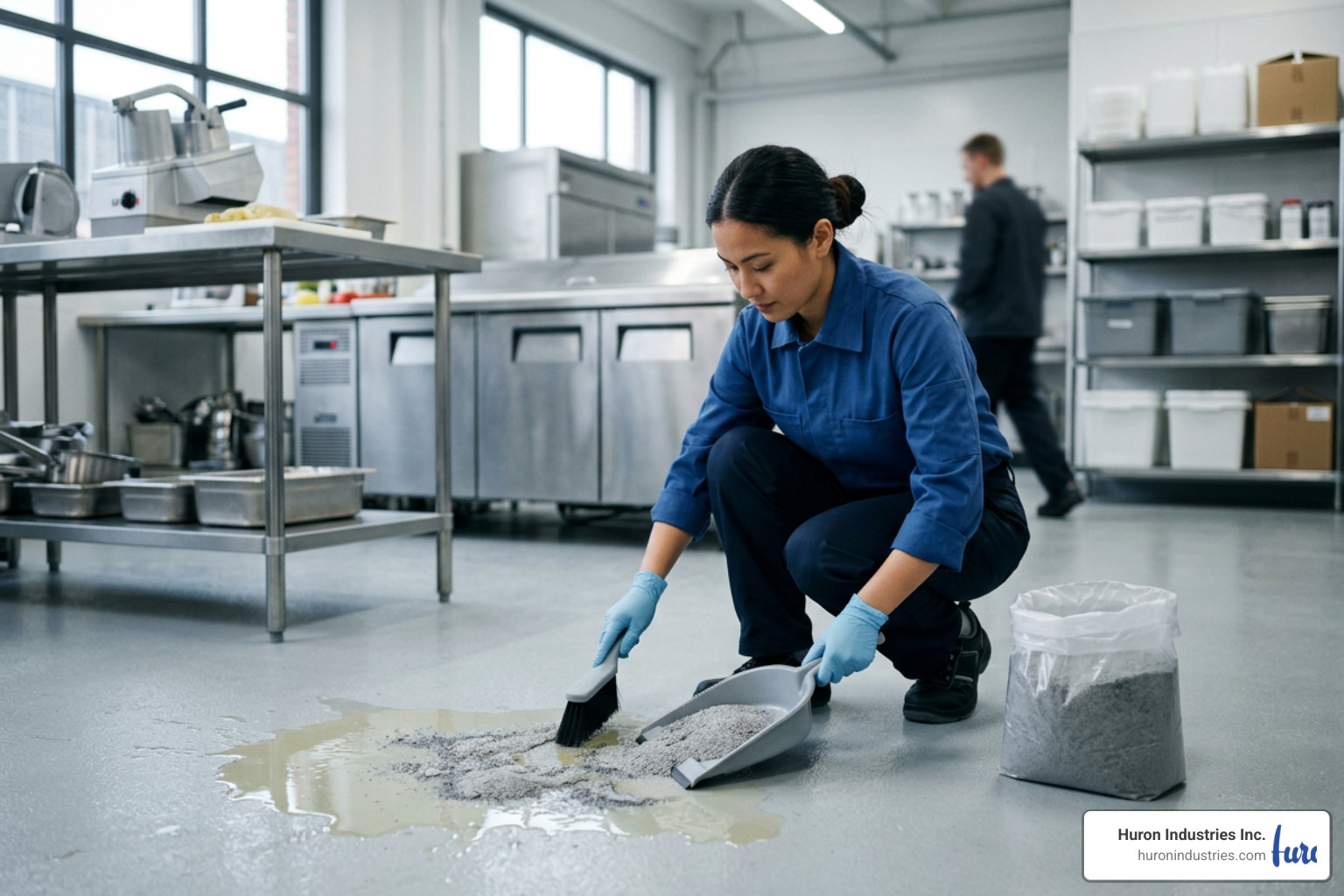
- Agitate and Sweep: Using a stiff-bristled broom, work the granules back and forth through the liquid. This mechanical action ensures the liquid makes full contact with the sorbent's surface area, accelerating the encapsulation process.
- Assess the Surface: Once the liquid is absorbed, sweep the saturated granules into a pile. If any oily residue or slickness remains on the concrete, apply a very light "dusting" of fresh sorbent, sweep it vigorously over the spot, and collect it.
- Recover and Inspect: Sweep the used material into a heavy-duty disposal bag or container. The floor should be left completely dry and slip-free, with no secondary mopping required.
For detailed technical specifications, application rates, and chemical compatibility charts for our leading food-safe sorbent, please refer to the Neosafe All Purpose Technical Datasheet.
Comparing Traditional Clay vs. Modern Food-Safe Sorbents
For decades, traditional clay (often referred to as "kitty litter") was the default choice for industrial spill cleanup. It was cheap to buy by the bag, widely available, and familiar to maintenance crews. However, modern environmental, health, and safety standards have revealed that clay is one of the least efficient and most hazardous materials you can introduce to a food facility.
Let's look at how traditional clay stack up against modern, high-performance food-safe sorbents:
| Feature / Metric | Traditional Clay Absorbents | Modern Food-Safe Sorbents (e.g., NEOSafe®) |
|---|---|---|
| Absorption Ratio | ~1:1 (Requires 24 lbs of clay to clean 1 gallon of liquid) | Up to 1:10 (Requires as little as 2.5 to 3 lbs of sorbent to clean 1 gallon) |
| Health Hazards | High risk of respirable crystalline silica (Class 1 carcinogen) | Silica-free, non-toxic, safe for skin contact |
| Floor Impact | Highly abrasive; ruins polished concrete and scratches machinery | Non-abrasive; safe for delicate equipment and sealed floors |
| Disposal Weight | Extremely heavy when saturated; dramatically increases disposal costs | Lightweight; reduces disposal weight and associated fees by up to 80% |
| Cleanup Time | Slow absorption; often requires hours or secondary mopping | Instant encapsulation; dry, slip-free finish in under 2 minutes |
| Food Safety | Not certified; high risk of airborne product contamination | NSF J1 Certified / FDA-recognized ingredients |
Using a high-performance modern sorbent instead of clay directly translates to a safer workplace, faster cleanup times, and significant cost savings over time.
The Hazards of Clay and Standard Sorbents in Food Facilities
The primary hazard of traditional clay absorbents is respirable crystalline silica. When clay granules are poured, moved, or swept, they release a fine, white dust. This dust contains microscopic silica particles that, when inhaled, lodge deep in the lungs. Over time, exposure to this dust can cause silicosis, lung cancer, and chronic obstructive pulmonary disease (COPD).
In a food processing or cold chain facility, this dust does not just threaten the worker holding the broom. It travels through the air, settling on food processing equipment, packaging lines, and the food itself. Introducing a known carcinogen into a sterile food environment is a massive liability.
Additionally, clay is highly abrasive. As forklifts and pallet jacks drive over clay residue, the hard mineral particles grind into the concrete, wearing down protective floor coatings and generating even more dust. If these abrasive particles find their way into the bearings or chains of a conveyor system, they can cause premature mechanical failure and costly downtime.
Finally, clay does not chemically lock in liquids. It merely holds them on the surface of the clay particles. Under pressure — such as a forklift tire rolling over the saturated clay — the absorbed liquid can be squeezed back out onto the floor, re-creating the slip hazard.
High-Performance Synthetic and Mineral Sorbents
To solve these challenges, modern material science has introduced silica-free, non-toxic, and non-leaching alternatives. These products fall into two primary categories: organic agricultural byproducts (such as processed coconut coir) and high-purity synthetic or natural mineral structures.
These modern sorbents work via micro-encapsulation. Instead of holding liquid on the outer surface of a heavy stone granule, they feature highly porous, honeycomb-like internal structures. When liquid touches the granule, capillary action draws the fluid deep inside the material, permanently locking it in.
Because they encapsulate the fluid, these sorbents do not leach or release the liquid when compressed under heavy foot or vehicle traffic. They are incredibly lightweight, dust-free, and completely non-abrasive.
At Huron Industries, our flagship food-safe sorbent is engineered to deliver this exact level of high-performance encapsulation. It is non-reactive, completely safe to use around sensitive food processing lines, and leaves floors bone-dry on contact. To learn more about this solution, you can explore the Neosafe All Purpose Sorbent Solution.
Frequently Asked Questions about Food Safe Spill Absorbents

How do food-safe absorbents help businesses comply with health and safety regulations?
Food-safe absorbents act as a multi-regulatory shield for your business. First, they help you comply with OSHA's Walking-Working Surfaces standard (29 CFR 1910.22), which mandates that all workplace floors be kept clean and dry. By using a highly effective sorbent that leaves a dry, residue-free floor, you drastically reduce the risk of slip-and-fall injuries, which are among the leading causes of workplace workers' comp claims.
Second, they keep your facility compliant with OSHA's Respirable Crystalline Silica standard (29 CFR 1910.1053). By replacing dusty clay absorbents with a silica-free alternative, you eliminate the need for costly air-monitoring programs and specialized respiratory protection for your cleanup crews.
Lastly, from a food safety perspective, they satisfy FDA and USDA sanitary requirements by ensuring that cleanup materials do not introduce chemical or physical contaminants into the food production environment, preserving the integrity of your HACCP program.
What are the disposal requirements for used food-safe absorbents?
A common point of confusion is whether a "food-safe" or "biodegradable" sorbent can be thrown directly into standard trash bins regardless of what was cleaned up.
The rule of thumb for spill disposal is simple: The sorbent takes on the regulatory profile of the liquid it absorbs.
- Non-Hazardous Spills: If you use a food-safe sorbent to clean up water, condensation, organic juices, syrups, or food-grade vegetable oils, the saturated material can typically be disposed of in a standard municipal solid waste dumpster (local regulations permitting).
- Hazardous Spills: If the sorbent is used to clean up hazardous materials, such as toxic chemical cleaners, non-food-grade machine lubricants, or fuel, the used material must be handled, labeled, and disposed of as hazardous waste in accordance with local, state, and federal EPA regulations.
Fortunately, because high-performance food-safe sorbents are highly efficient, they use up to 80% less material by weight than clay. This significantly reduces the total weight of your waste stream, leading to dramatic savings in disposal and hauling fees.
Are there any limitations when using absorbents in food processing environments?
While food-safe absorbents are incredibly versatile, they are not magic dust, and there are a few practical limitations to keep in mind:
- Direct Food Contact: "Food safe" in the context of a J1 NSF registration does not mean the sorbent is an edible food ingredient. It is approved for use around food processing areas, but it should never be mixed directly with food intended for consumption. If a spill occurs directly inside a batch of food product, that batch must be discarded.
- Linting and Fibers: Some organic fiber absorbents can leave behind fine hairs or lint. In ultra-clean environments, such as high-tech packaging lines or dairy processing rooms, look for low-linting mineral or synthetic granular sorbents to prevent fibers from drifting into open packaging.
- Secondary Sanitization: While a food-safe sorbent will remove 100% of a liquid spill and leave the floor dry, it does not disinfect the surface. If you clean up a spill of raw meat juices, dairy, or egg products, you must follow up the dry absorbent cleanup with an approved chemical sanitizer to address biological pathogens.
Conclusion
Managing a cold chain facility requires constant vigilance. Between maintaining strict temperature controls, keeping up with logistics, and meeting rigid sanitary standards, there is no room for error. A single slip-and-fall accident or a minor chemical contamination incident can disrupt your entire operation, leading to lost productivity, regulatory fines, and damaged brand reputation.
Investing in a high-quality, certified food safe spill absorbent is a simple, highly effective way to protect your workers, your products, and your bottom line. By moving away from heavy, dusty, and hazardous clay absorbents, you can establish a faster, cleaner, and fully compliant spill response protocol.
At Huron Industries Inc., we have spent over 50 years manufacturing and supplying high-purity, high-performance products for the most demanding regulated industries in North America. From our facility in Port Huron, Michigan, we are proud to offer our NEOSafe® line of industrial spill sorbents to help food processing and cold chain businesses maintain the highest standards of safety and efficiency.
If you are ready to upgrade your facility's spill response plan with a certified, dust-free, and high-performance solution, explore our complete line of Neosafe products today.