
Why the U.S. Navy Relies on Neolube for Naval Nuclear Propulsion
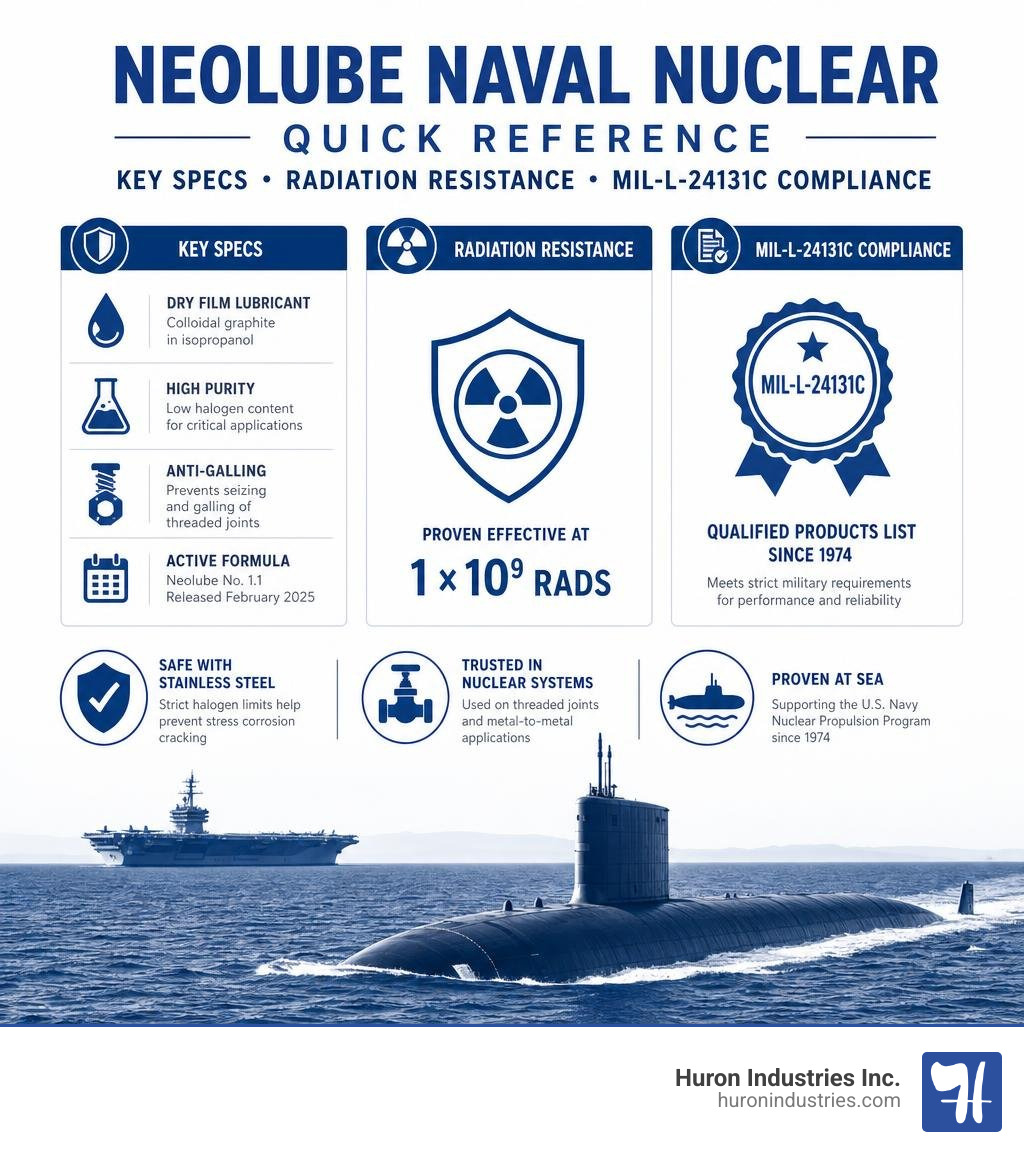
Neolube in naval nuclear propulsion systems has been a trusted solution since 1974 — here's a quick summary of why:
| Question | Quick Answer |
|---|---|
| What is Neolube? | A dry film lubricant made of colloidal graphite in isopropanol |
| Why is it used in nuclear reactors? | High chemical purity, low halogen content, and proven anti-galling performance |
| Which military spec does it meet? | MIL-L-24131C (Qualified Products List since 1974) |
| How radiation-resistant is it? | Proven effective at radiation levels up to 1 x 10⁹ rads |
| Is it safe near stainless steel? | Yes — strict halogen limits prevent stress corrosion cracking |
| Current active formula? | Neolube No. 1.1, released February 2025 |
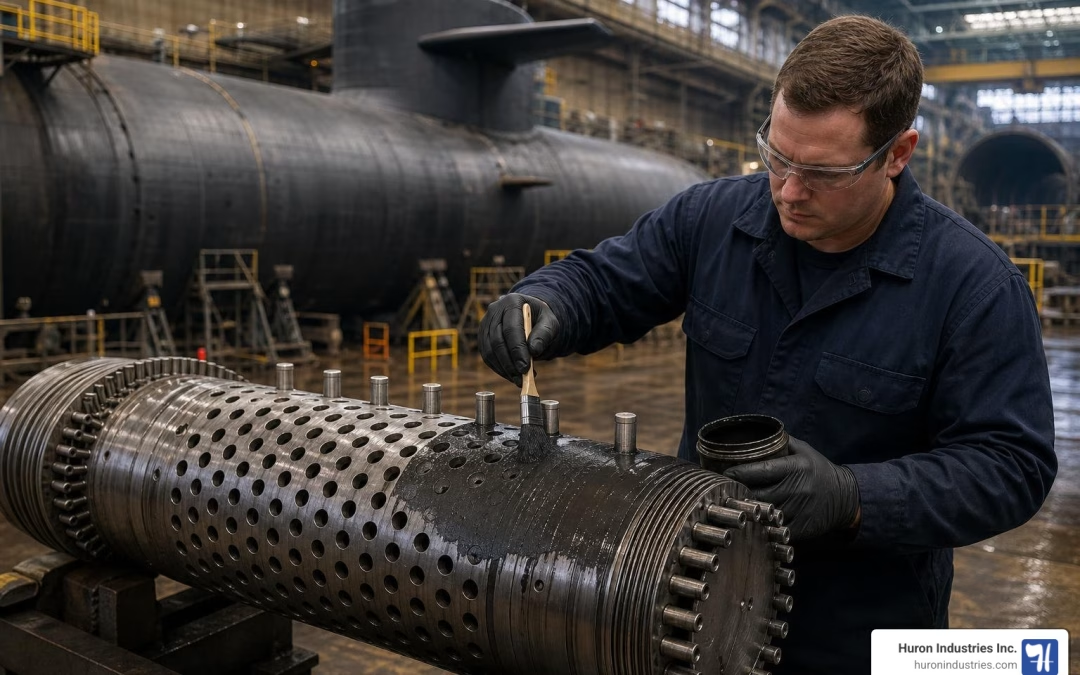
In the high-stakes world of nuclear-powered submarines and aircraft carriers, a stuck valve isn't just a maintenance headache — it can take a strategically vital vessel offline entirely. In the early days of the U.S. Navy Nuclear Propulsion Program, that's exactly what was happening. Primary coolant valve caps were seizing so badly they had to be cut off, damaging the valves and costing thousands of dollars in repairs and downtime.
The fix turned out to be surprisingly simple: a thin coat of dry graphite lubricant applied to threaded joints before assembly. One Navy captain later called it one of the "hidden secrets" that made the nuclear power program so successful.
That lubricant was Neolube.
Since then, the U.S. Navy has safely steamed more than 177 million miles on nuclear power, operated 97 reactors, and accumulated over 7,600 reactor-years of safe operation — with Neolube qualified for use throughout that entire era.
I'm Nicholas Cunha, founder of CreatiVertical and the content strategist behind Huron Industries Inc.'s digital program, where I work directly with the team to translate the precise technical requirements of Neolube naval nuclear applications into clear, credible content for engineers and procurement professionals. In the sections below, I'll walk you through exactly why Neolube has earned its place on the U.S. Navy's Qualified Products List — and how to select the right formulation for your application.
The History of Neolube Naval Nuclear Applications
The story of the U.S. Naval Nuclear Propulsion Program is one of unprecedented engineering triumph. From the moment the USS Nautilus (SSN 571) signaled its historic message, "UNDERWAY ON NUCLEAR POWER," in June 1955, the Navy redefined maritime strategy. No longer bound by the need to refuel, nuclear-powered vessels gained the ability to operate undetected under polar ice caps, execute high-speed deployments across oceans, and maintain global presence without logistics support.
However, operating a nuclear reactor at sea introduces extreme mechanical, thermal, and radiological challenges. Because of battle shock, radiated noise limits, and rapid power fluctuations, naval reactors are subjected to far more rigorous physical demands than civilian power plants. Every component must be built to survive, and every lubricant used must perform flawlessly without degrading under intense radiation or high temperatures.
Enter Huron Industries. Founded in 1971, my company set out to manufacture high-purity, high-performance specialty lubricants. By June 21, 1974, the Naval Ship Engineering Center in Hyattsville, Maryland, approved Neolube No. 1 under Test Report QPL 10744. This officially placed Neolube on the Qualified Products List (QPL) for Military Specification MIL-L-24131C—a designation it has proudly maintained for over 50 years.
Throughout this half-century of service, Neolube has been used in the construction and maintenance of every single nuclear power plant in the United States, as well as across the Navy's entire nuclear fleet. As the Navy has accumulated over 7,600 reactor-years of safe operation and steamed More than 177 million miles safely steamed on nuclear power, our dry film lubricants have worked quietly in the background to keep critical systems moving. To see our complete product lineup and history, you can Learn more about Neolube products.
Solving the Galling Crisis in Neolube Naval Nuclear Systems
In the earliest days of naval nuclear propulsion, engineers ran into a critical mechanical bottleneck: thread galling. Galling is a form of severe adhesive wear that occurs when two metal surfaces slide against each other under high pressure. In stainless steel piping systems—the backbone of a nuclear reactor's primary coolant loop—the protective oxide layer on the metal can break down under load. Without this layer, the microscopic high points (asperities) on the mating threads literally weld together.
When maintenance crews attempted to unscrew primary coolant valve caps, the seized threads would tear apart. The caps would lock up completely, forcing workers to cut the expensive valves out of the system. This didn't just cost thousands of dollars per valve; it kept multi-million dollar submarines stuck in drydock, directly compromising national defense readiness.
Traditional oils and greases were useless in this environment. Under intense radiation and heat, conventional petroleum-based lubricants congeal, decompose, and attract dust, which can introduce dangerous contaminants into the reactor system. Furthermore, many commercial lubricants contain halogens (such as chlorine or fluorine), which cause severe crevice corrosion in stainless steel under high temperatures and pressures.
The introduction of Neolube No. 1 solved this crisis overnight. By applying a thin, 1-minute coat of our colloidal graphite formula to the valve caps and threaded joints, crews achieved 100% confidence that the components could be safely disassembled during routine maintenance. Because the graphite forms a dry, non-migrating barrier, there is no risk of the lubricant washing away or congealing.
Even better, maintenance teams discovered that there is no need to clean old Neolube off the threads before reapplication. A fresh coat can be applied directly over the old film, drastically reducing maintenance downtime and radiation exposure for the crew. For modern naval and industrial operations, you can Discover lubrication wear reduction solutions to keep your critical machinery running without interruption.
Chemical Purity and Radiation Resistance in Nuclear Environments
To understand why Neolube succeeds where other lubricants fail, we have to look at its fundamental chemistry. Neolube is formulated using ultra-pure colloidal graphite dispersed in an isopropanol carrier, combined with a specialized thermoplastic resin binder.
When you apply Neolube, the isopropanol carrier evaporates rapidly, leaving behind an incredibly thin, highly adherent, and uniform dry film of graphite. Graphite is naturally lubricious because of its layered, planar molecular structure. The carbon atoms within each layer are tightly bound, but the forces between the layers are weak, allowing them to slide over one another with a static coefficient of friction of just 0.15.

In a nuclear reactor, however, physical slipperiness is only half the battle. The lubricant must also withstand intense radiation. When exposed to high-energy neutrons and gamma radiation, the molecular bonds in traditional synthetic and mineral oils break down, causing them to polymerize, harden, or volatilize. Neolube, by contrast, has been used successfully in applications where radiation levels of 1 x 10⁹ rads prevail. Because graphite is an elemental form of carbon, its crystalline structure is exceptionally stable under radiation, ensuring it won't congeal or lose its lubricating properties in secondary reactor sections. You can Explore Neolube dry film lubricants to see how they perform in these extreme settings, or Read about chemical and radiation resistance to understand the engineering behind our materials.
Strict Impurity Limits for Neolube Naval Nuclear Components
In nuclear engineering, what you leave out of a product is just as important as what you put in. When materials are exposed to the intense neutron flux inside a reactor containment area, trace impurities can become highly radioactive "source contaminants." Furthermore, certain elements can cause catastrophic structural failures in reactor alloys.
For this reason, military specification MIL-L-24131C establishes incredibly strict limits on impurities such as halogens, sulfur, lead, and other low-melting-point metals.
- Halogens (Chlorine and Fluorine): In the presence of water, high temperatures, and tensile stress, even trace amounts of halogens can cause stress corrosion cracking (SCC) in stainless steel. This is a insidious form of corrosion that can cause a high-pressure pipe to rupture without warning.
- Heavy Metals (Lead, Zinc, Tin, Bismuth): These low-melting-point metals can cause liquid metal embrittlement, weakening the structural integrity of reactor components.
- Mercury and Boron: Mercury must be entirely excluded from the manufacturing process to prevent catastrophic cracking of nickel-based alloys. Boron, a powerful neutron absorber, must be strictly controlled to avoid interfering with reactor physics.
At Huron Industries, we enforce a rigorous quality control program to ensure our lubricants are completely mercury-free and manufactured without any low-melting-point metals. We utilize non-halogenated plastic packaging to guarantee that no contaminants leach into the product during storage or shipping. To protect your sensitive systems, you can Learn about our non-corrosive formula and review the exact impurity thresholds we maintain.
The table below outlines the strict chemical and physical requirements that allow Neolube to be safely used in these highly regulated environments:
| Chemical / Physical Property | Neolube No. 1.1 Limit (MIL-L-24131C) | Neolube No. 2 Limit (Industrial Grade) |
|---|---|---|
| Graphite Purity | 99% Pure Furnace Graphite | High-Purity Micro-Graphite |
| Total Halogens | < 200 PPM | < 200 PPM |
| Fluorine | Max 20 PPM | Max 75 PPM |
| Chlorine | Max 200 PPM | Max 200 PPM |
| Sulfur | Max 200 PPM | Max 900 PPM |
| Lead | Max 150 PPM | Excluded from formulation |
| Mercury & Boron | Zero Contact / None Added | Zero Contact / None Added |
| Ash Content | Max 0.75% on total solids | Low Ash |
| Maximum Particle Size | 10 Microns (90% under 4μm) | Micro-fine |
| Continuous Service Temp | 400°F (204°C) | 400°F (204°C) |
Comparing Neolube Formulations: No. 1, No. 1.1, and No. 2
As a procurement officer or nuclear engineer, selecting the correct Neolube formulation is critical to ensuring both mechanical performance and regulatory compliance. Over our long history, the Neolube product family has evolved to meet changing manufacturing standards while maintaining the exact same high level of quality.
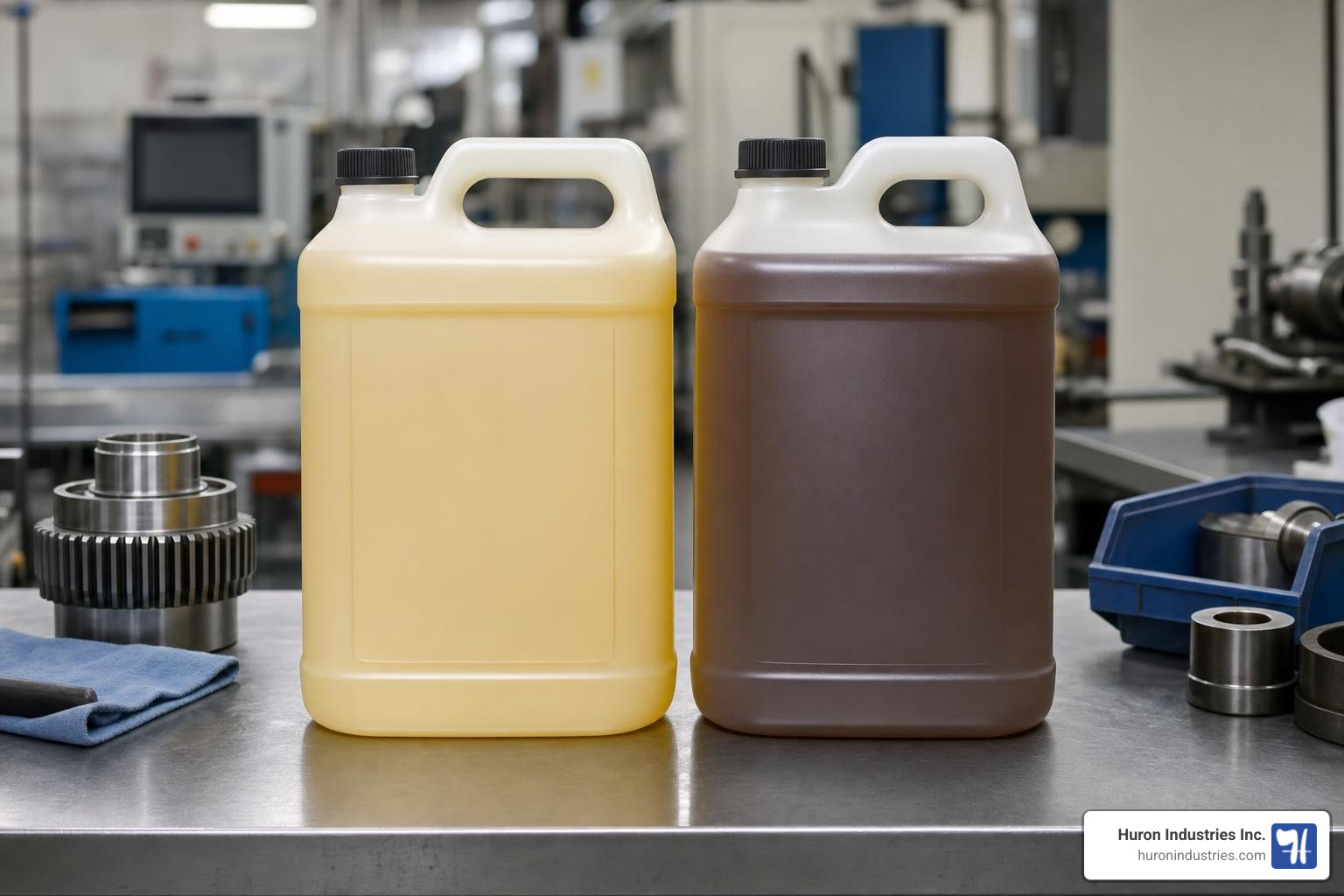
Whether you need a fully qualified military-spec lubricant or an industrial-grade conductive dry film, understanding the differences between Neolube No. 1, No. 1.1, and No. 2 is essential. To assist you in your selection, you can access the Technical specifications for Neolube No. 1 or See nuclear industry applications to find the perfect match for your facility.
Neolube No. 1 and the Transition to Neolube No. 1.1
For decades, Neolube No. 1 was the undisputed gold standard for naval nuclear applications. However, as part of our commitment to modernizing our manufacturing and securing our supply chain, Huron Industries officially discontinued the legacy Neolube No. 1 formula on July 11, 2024.
To replace it, we released Neolube No. 1.1 in February 2025.
Neolube No. 1.1 is the direct successor to No. 1. It is manufactured and tested entirely in the USA, ensuring complete control over the chemical purity of every batch. It maintains full compliance with MIL-L-24131C and is packaged in convenient 2-ounce and 8-ounce non-halogenated plastic bottles with built-in brush-in-cap applicators. If you are currently transitioning your procurement specifications from the legacy formula, you can Download Neolube No. 1.1 TDS to update your technical documentation.
Neolube No. 2 and High-Temperature Limitations
While Neolube No. 1.1 is designed to meet strict military specifications, Neolube No. 2 is our industrial-grade dry film lubricant. It shares many of the same high-purity characteristics—including being manufactured without mercury or low-melting-point metals—but it is formulated with a slightly different binder system.
One of the most unique features of Neolube No. 2 is its electrical properties. It is a conductive dry film lubricant that can be used to reduce electrical chatter and arcing on buss bars, or applied as a resistance coating on non-conductive substrates like plastics.
However, both Neolube No. 1.1 and No. 2 share a critical environmental limitation: temperature. Both products have a continuous service temperature limit of 400°F (204°C) in oxygen environments, with intermittent exposure up to 850°F (454°C). Above 200°F (93°C), the thermoplastic binder in these formulas slowly begins to decompose.
Because of this, neither Neolube No. 1.1 nor No. 2 is recommended for use on threaded parts inside reactor primary containment areas where operating temperatures routinely exceed 400°F. For those high-temperature, critical containment applications, we recommend Neolube No. 1260, which is rated for temperatures up to 1175°F (635°C). To review the physical properties and limits of our conductive formula, you can Download Neolube No. 2 TDS.
Frequently Asked Questions about Neolube in Nuclear Propulsion
Why are halogens strictly restricted in naval nuclear reactors?
Halogens like chlorine and fluorine are highly reactive elements. When stainless steel—which is widely used in naval reactor piping and components—is exposed to even trace amounts of halogens under high temperatures and pressures, it undergoes a destructive phenomenon known as stress corrosion cracking (SCC). This causes microscopic cracks to propagate rapidly through the metal, potentially leading to sudden, catastrophic structural failures in high-pressure reactor loops. By strictly limiting fluorine to less than 20 PPM and chlorine to less than 200 PPM, Neolube eliminates this risk entirely.
Can Neolube No. 1.1 be used in primary reactor containment areas?
Neolube No. 1.1 is rated for a continuous service temperature of 400°F (204°C). In primary reactor containment areas where fitting temperatures routinely exceed this limit in the presence of oxygen, Neolube No. 1.1 is not recommended. For these high-temperature containment areas, Neolube No. 1260 should be used instead, as it is engineered to withstand temperatures up to 1175°F (635°C) without losing its sealing and lubricating properties.
How does Neolube No. 2 differ from Neolube No. 1.1?
The primary difference lies in their target applications and certifications. Neolube No. 1.1 is fully qualified to Military Specification MIL-L-24131C and is specifically approved for the internal and auxiliary equipment mechanisms of marine nuclear reactor systems. Neolube No. 2, while still a high-purity, nuclear-grade lubricant, does not carry the MIL-L-24131C qualification. However, Neolube No. 2 features unique electrical properties, allowing it to function as a conductive dry film lubricant and variable resistance coating on non-conductive surfaces.
Conclusion

In the demanding, zero-failure world of naval nuclear propulsion, every single component must perform exactly as designed. For over 50 years, the U.S. Navy has trusted Neolube to protect its reactors, prevent costly thread galling, and support a flawless safety record across hundreds of millions of miles steamed.
By enforcing strict chemical purity standards, eliminating harmful impurities like halogens and heavy metals, and continuing to innovate with the release of Neolube No. 1.1, Huron Industries remains the premier partner for nuclear and marine engineering professionals worldwide.
If you are ready to secure certified, high-purity dry film lubricants or thread sealants for your next project, my team at Huron Industries is here to help. Please Get a landed price for your Neolube order by providing your shipping details and certification requirements, and we will ensure your facility receives the exact high-performance products it needs.