
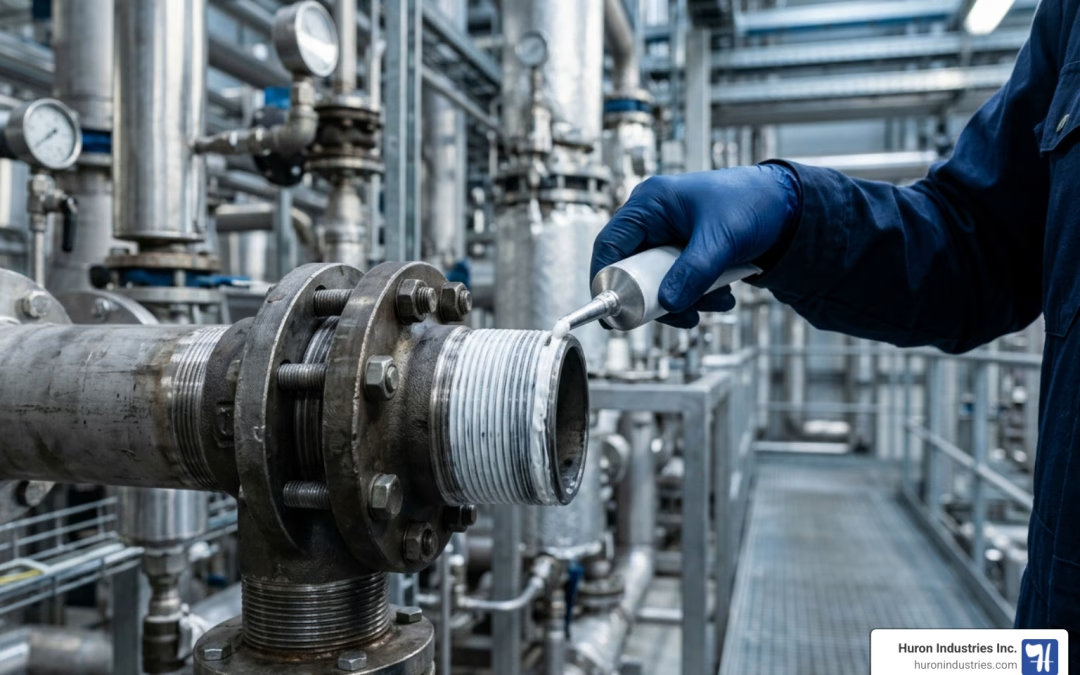
When the Wrong Sealant Can Shut Down a Reactor
Nuclear grade thread sealant is a high-purity sealing compound formulated specifically for use in nuclear power plants, naval propulsion systems, and other radiation-exposed environments where standard sealants would fail — or worse, cause a safety incident.
Here's what separates nuclear grade from standard thread sealants at a glance:
| Requirement | Standard Sealant | Nuclear Grade Sealant |
|---|---|---|
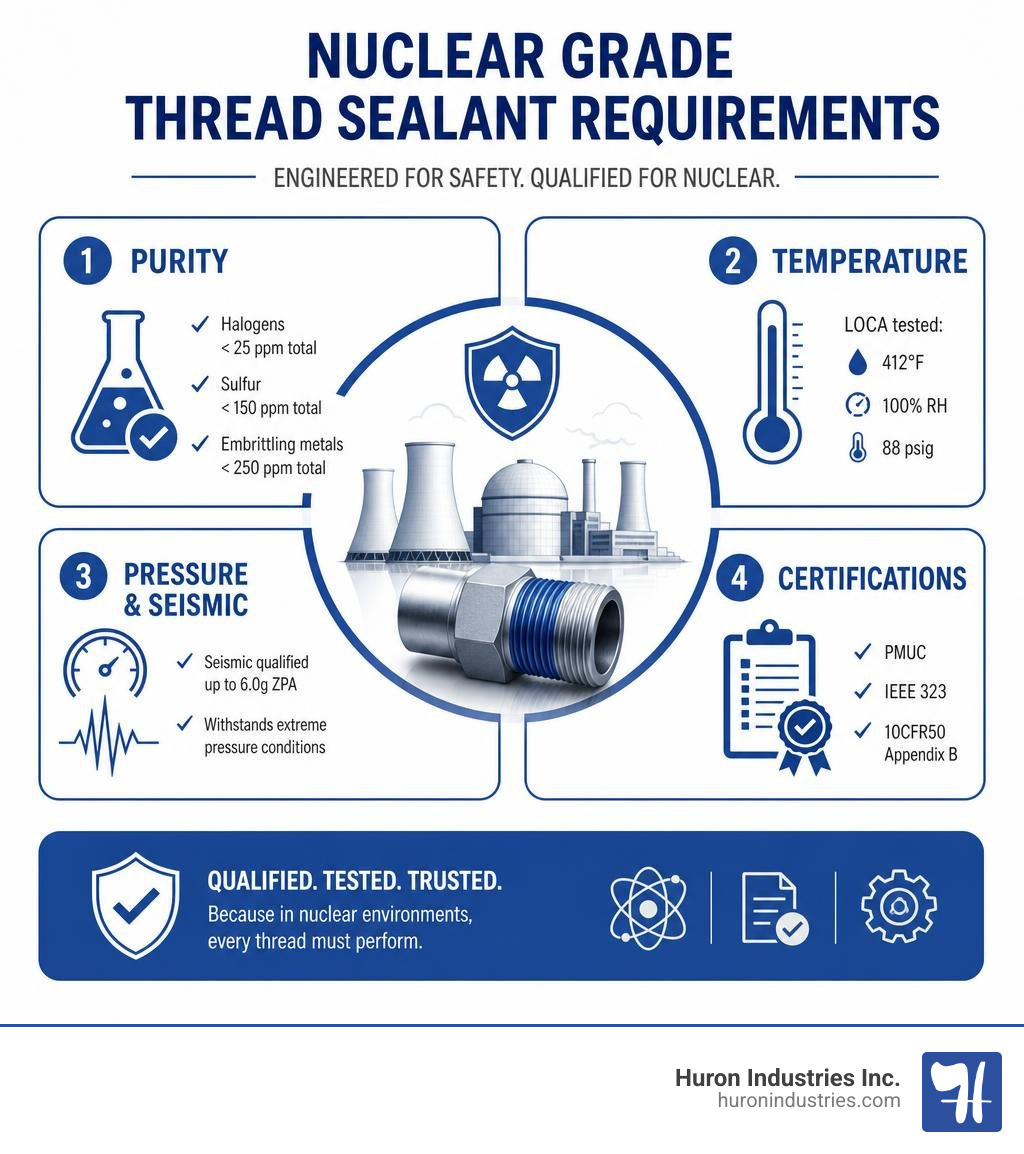
| Halogen content | Unrestricted | < 25 ppm total |
| Sulfur content | Unrestricted | < 150 ppm total |
| Embrittling metals | Not controlled | < 250 ppm total |
| Radiation resistance | Not rated | Tested (e.g., 1.5 × 10⁹ RADS gamma) |
| Seismic qualification | None | Up to 6.0g ZPA |
| LOCA tested | No | Yes (e.g., 412°F, 88 psig, 100% RH) |
| Certifications | General industrial | PMUC, IEEE 323, 10CFR50 Appendix B |
The stakes are real. On November 17, 1983, two control rods at Peach Bottom Unit 3 failed to meet their required scram times. The cause? A tiny amount of excess anaerobic sealant that never cured — because it was left exposed to air outside the joint. It migrated into a solenoid valve and bonded the plunger to the base assembly. The U.S. Nuclear Regulatory Commission issued Information Notice 84-53 to warn the entire industry.
That one drop reshaped how facilities think about sealant selection, application, and qualification.
Choosing the right nuclear grade sealant isn't just a procurement decision — it's a safety-critical one.
I'm Nicholas Cunha, founder of CreatiVertical and the content strategist behind Huron Industries Inc.'s digital program, where I work closely with their engineering team to communicate the technical requirements of nuclear grade thread sealant and specialty lubricant products to procurement and maintenance buyers in regulated industries. In the sections below, I'll walk you through exactly what to look for, what to avoid, and how to match the right sealant to your application.
What Defines a True Nuclear Grade Thread Sealant?
When I talk to maintenance engineers at nuclear facilities, the first question they usually ask is: "What actually makes a thread sealant 'nuclear grade'?"
At its core, a true nuclear grade thread sealant must survive the unique, punishing environment of a reactor system while remaining chemically inert. Standard industrial thread sealants are designed to do one thing: block a leak path. But in a nuclear environment, a sealant must block leaks without introducing chemical impurities that could degrade reactor piping, poison catalyst beds, or migrate into sensitive downstream mechanisms.
To understand where these specialized products are used, you can explore the diverse range of Nuclear Industry Applications. These applications span from primary reactor coolant loops and secondary steam systems to auxiliary water, air, and hydraulic lines.
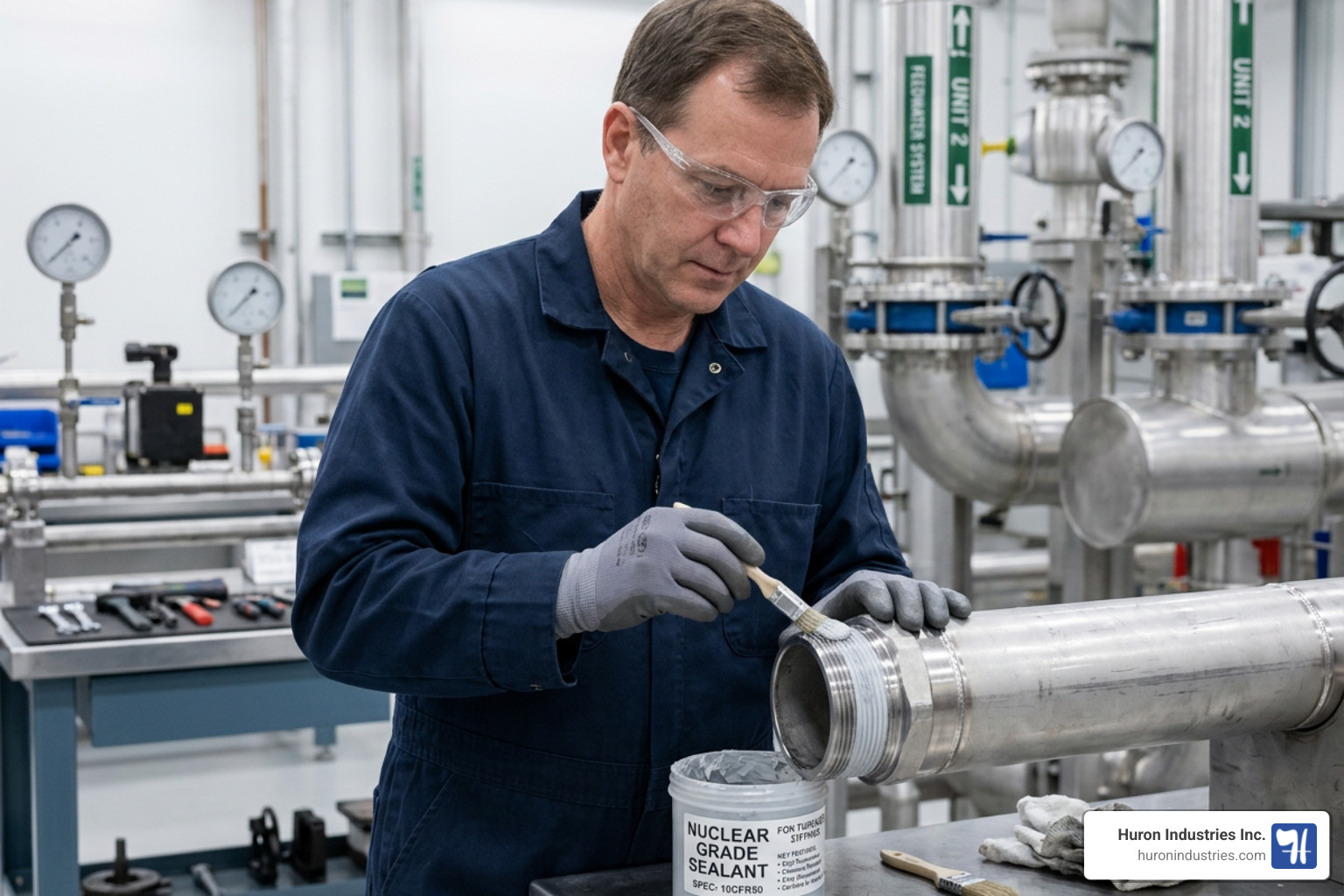
Standard vs. Nuclear Grade Thread Sealant
Standard industrial sealants often contain high levels of halogens (like chlorine and fluorine), sulfur, and heavy metals. In a typical factory, these elements are harmless. In a nuclear facility, they are a recipe for catastrophe.
When standard sealants are exposed to high temperatures, high pressures, and radiation, they can break down and release corrosive byproducts. These byproducts attack the protective oxide layer on stainless steel and titanium piping, leading to Stress Corrosion Cracking (SCC).
To prevent this material degradation, nuclear-grade compounds are manufactured using a highly controlled, Non-Corrosive Formula. This ensures that the sealant remains stable and does not react with the surrounding metal, even under decades of constant exposure to high-temperature steam and radiation.
Chemical Purity Standards for Nuclear Grade Thread Sealant
To qualify as nuclear grade, a sealant must meet strict chemical purity thresholds. Every batch must be analyzed and certified to ensure trace elements are kept below ultra-low limits.
The industry-standard purity requirements for premium thread sealants include:
- Total Halogens (Chlorine, Fluorine, etc.): Less than 25 ppm (parts per million).
- Leachable Chlorides: Less than 10 ppm.
- Total Sulfur: Less than 150 ppm.
- Embrittling Metals (Lead, Copper, Zinc, Mercury, etc.): Less than 250 ppm total, with no single metal exceeding 200 ppm.
These ultra-low limits are crucial for protecting sensitive alloys. For example, high-purity graphite pastes are formulated to meet stringent nonmetallic material specifications, such as General Electric's D50YP12 Rev 2. Additionally, many European and international nuclear plants require PMUC (Produits et Matériaux Utilisables en Centrales Nucléaires) approval, a strict French standard that certifies materials for safe use inside nuclear power stations.
For over 40 years, manufacturers have developed specialized formulations to meet these strict requirements. You can learn more about how these high-purity standards are maintained by visiting the Nuclear Industry Specialty Lubricants and Sealants page. To verify a manufacturer's credentials and history in the field, you can also check out the Huron Industries, Inc. profile on ThomasNet.
Key Performance Metrics in Extreme Environments
Beyond chemical purity, a nuclear grade thread sealant must perform reliably under physical conditions that would destroy standard industrial products.
In safety-related nuclear systems, components are routinely subjected to extreme thermal cycling, high pressures, intense radiation fields, and potential seismic events. If a sealant degrades, hardens, or shrinks under these conditions, the joint will leak.
To ensure long-term survivability, engineers look closely at how these materials behave under intense stress. You can read more about these protective characteristics on the Condition Performance Chemical Radiation Resistance page.
Thermal and Pressure Thresholds
Depending on the chemistry of the sealant, temperature and pressure ratings vary widely.
For instance, high-purity graphite pastes—such as our flagship Neolube® No. 1260—are rated for critical service up to 1175°F (635°C) and pressures up to 2300 psi (16 MPa). At extreme temperatures, the petroleum-based carrier fluid in the paste begins to volatilize (typically starting around 255°F/125°C), but the pure graphite solids remain behind, molding into the thread irregularities to maintain a tight, high-pressure seal.
Other specialized sealants on the market offer different ranges:
- Thermal Reactive Liquids and Pastes: These compounds cure under heat to form a "plastic-like" mechanical seal, withstanding temperatures from 200°F (93°C) up to 1350°F (732°C) and handling extreme pressures up to 11,000 psi (758 bar).
- Anaerobic Methacrylate Sealants: Designed for lower-temperature fluid systems, these typically operate from -55°C to +150°C and are ideal for quick-curing, medium-strength locking on pipes up to 3 inches in diameter.
- Nickel-Based Anti-Seize: Formulated with pure nickel flake and graphite, these prevent metal-to-metal welding and seizure up to 2600°F (1427°C) in non-wetted auxiliary systems.
To dive deeper into how these materials handle extreme heat without losing their sealing properties, visit the Condition Performance Thermal Stability resource.
Radiation and Seismic Survivability
Inside the reactor containment boundary, radiation resistance is non-negotiable. Standard polymers and PTFE tapes quickly degrade under intense radiation, becoming brittle, cracking, and powdering away.
A high-performance graphite sealant like Neolube® No. 1260 has been independently tested and proven to withstand 1.5 × 10⁹ RADS of Gamma Radiation and 5.5 × 10²¹ NVT of integrated neutron flux with no apparent effect on its physical or sealing properties.
Furthermore, safety-related components must be qualified to survive a Loss of Coolant Accident (LOCA) and seismic events. During LOCA testing, sealants are exposed to simulated accident conditions, including temperatures up to 412°F (211°C), pressures of 88 psig, 100% relative humidity, and corrosive chemical sprays.
The timeline below illustrates the typical progression of a LOCA simulation and how a qualified nuclear sealant maintains its integrity throughout the event:

To see how different nuclear sealants perform under these simulated accident conditions, consider the comparison table below:
| Sealant Type | Radiation Limit (Gamma RADS) | Max Temp (Continuous) | LOCA Qualified? | Seismic Rating |
|---|---|---|---|---|
| High-Purity Graphite Paste (e.g., Neolube® No. 1260) | 1.5 × 10⁹ | 1175°F (635°C) | Yes | Highly resistant (non-hardening) |
| Thermal Reactive Liquid | Tested for auxiliary | 1350°F (732°C) | Yes (Auxiliary) | Excellent (flexible plastic cure) |
| Anaerobic Methacrylate | Limited (Auxiliary only) | 300°F (150°C) | No | Moderate (susceptible to embrittlement) |
Comparing Types of Radiation-Resistant Sealants
Choosing the right nuclear grade thread sealant requires matching the chemical base of the product to the specific mechanical and environmental demands of the piping system.
You can browse a wide range of options in our Thread Sealant Category or explore the general Product Category Thread Sealant catalog to find the right fit.
Selecting the Right Nuclear Grade Thread Sealant for Your Application
Different systems require different sealing technologies. To help you select, let's break down the primary types of nuclear-grade sealants and where they shine:
- High-Purity Graphite Pastes: These are the workhorses of high-temperature, high-pressure nuclear piping. Because they do not cure or harden, they allow for easy, non-destructive disassembly even after years of service. However, they are typically limited to close-fitting threaded joints on pipe sizes of 2 inches (50.8 mm OD) or smaller.
- Colloidal Graphite Liquids: Formulations like Neolube® No. 100 act as dry-film lubricants and sealants. They are excellent for preventing galling on stainless steel, titanium, and aluminum threaded parts with limited clearances.
- Thermal Reactive Sealants: Available in liquid or paste form, these compounds cure with heat to form a tough, flexible, "plastic-like" seal. They are ideal for high-pressure steam lines and thermal cycling systems.
- Anaerobic Methacrylate Sealants: These products cure in the absence of air between closely fitting metal surfaces. They lock and seal threaded connections up to 3 inches (80 mm) in diameter. While convenient because they don't require heat to cure, they have lower temperature limits (up to 150°C/300°F) and are susceptible to radiation-induced embrittlement.
When evaluating these options, engineers must also consider joint design and system media. For example, some systems may require comparing a liquid or paste Pipe Thread Sealant vs PTFE Tape, as PTFE tape is generally prohibited in primary nuclear loops due to the risk of shredded tape pieces clogging sensitive reactor nozzles.
For critical, high-temperature lines, you should always specify a High Temperature Thread Sealant Critical Service compound. Depending on your specific plant system, you can find specialized guidance for:
- Thread Sealant Hydraulic Fittings Compressor Lines
- Gas Pipe Thread Sealant Neolube
- Refrigerant AC Thread Sealant Neolube
- Electrical Conduit Thread Sealing Industrial Systems
Non-Hardening vs. Hard-Setting Graphite Pastes
One of the most important decisions is whether to use a non-hardening or a hard-setting compound.
Non-hardening graphite pastes are highly valued in nuclear maintenance because they never cure. They maintain a pliable, plastic-like consistency indefinitely. This provides excellent resistance to thermal shock and vibration, prevents gasket creep relaxation, and ensures that joints can be easily disassembled years later without damaging the threads.
To compare these characteristics in detail, check out our guide on Non-Hardening vs Hard-Setting Thread Sealant Neolube. For a complete overview of our high-purity, non-hardening graphite products, you can explore the Neolube brand page.
Critical Safety Considerations and Historical Lessons
In the nuclear industry, safety rules are written in the aftermath of equipment failures. The strict controls we have today on nuclear grade thread sealant application are a direct result of lessons learned from historical incidents.
The most famous of these is the Peach Bottom Unit 3 scram failure in 1983, which was detailed in the NRC Information Notice 84-53 regulatory notice.
In that incident, maintenance technicians used a standard anaerobic thread locker on the acorn nuts of control rod scram pilot solenoid valves. Because anaerobic compounds only cure in the absence of air (inside the threads), the excess sealant left on the outside of the joint remained liquid.
Over time, this uncured liquid migrated into the solenoid valve housing. When the valve heated up, the fluid bonded the solenoid core plunger to the base assembly. When a scram signal was initiated, the control rods failed to insert within the required safety time limits.
This single event highlighted two critical safety rules for nuclear maintenance:
- Never leave excess anaerobic sealant on a joint. Any excess material must be wiped completely clean immediately after assembly.
- Use non-migrating, thixotropic, or non-hardening compounds in proximity to sensitive mechanical actuators or electrical components.
Proper Application and Surface Preparation
To prevent migration and ensure a reliable seal, proper application procedures must be followed precisely.
Before applying any sealant, the threaded surfaces must be thoroughly cleaned and degreased. Any residual oils, cutting fluids, or old sealant will compromise the new seal and may introduce prohibited chemical impurities into the system.
When using a premium graphite paste like Neolube® No. 1260, follow these step-by-step application instructions:
- Prepare the Surface: Clean the threads with a nuclear-approved solvent to remove all grease, dirt, and moisture.
- Knead the Tube: Because graphite paste consists of solid graphite particles suspended in a petroleum carrier, some separation can occur during storage. Remove the cap, squeeze out any trapped air, recap the tube tightly, and knead the tube thoroughly to re-homogenize the paste.
- Apply the Paste: Apply an even coat of paste to the male threads, ensuring that the thread roots are completely filled.
- Assemble the Joint: Carefully thread the components together and torque to the engineering specification. Wipe away any excess paste that squeezes out of the joint.
- Store Properly: Tighten the cap immediately after use to preserve the shelf life, and store the tube at or below 38°C (100°F).
For detailed technical datasheets, material safety data sheets, and purchasing options for our premier nuclear-grade graphite sealants, explore these resources:
- Neolube® No. 1260:
- Neolube® No. 100:
Frequently Asked Questions about Nuclear Sealants
What makes a thread sealant nuclear grade?
A thread sealant is certified "nuclear grade" when it possesses high chemical purity (typically total halogens < 25 ppm, leachable chlorides < 10 ppm, and total sulfur < 150 ppm) to prevent stress corrosion cracking. It must also be qualified to withstand extreme radiation exposure and remain stable under high-temperature and seismic conditions.
Why are halogens and sulfur restricted in nuclear environments?
Halogens (like chlorine and fluorine) and sulfur can react with stainless steel, titanium, and other high-performance alloys under high temperatures and radiation. This chemical reaction breaks down the metal's protective oxide layer, leading to Stress Corrosion Cracking (SCC) and premature component failure. Sulfur and heavy metals can also poison reactor catalyst beds.
Do graphite-based nuclear sealants require curing time?
Many high-purity graphite-based sealants are non-hardening pastes that do not require any curing or drying time. This allows the system to be pressurized immediately after assembly, reducing maintenance downtime. However, some specialized thermal reactive sealants do require heat to reach a full cure.
Conclusion
When it comes to safety and reliability in a nuclear facility, there is no room for compromise. Choosing the right nuclear grade thread sealant requires a thorough understanding of chemical purity standards, environmental limits, and application safety.
At Huron Industries Inc., we have been manufacturing high-purity, certified graphite lubricants and sealants in Port Huron, Michigan, since 1971. Our flagship Neolube® line is qualified to MIL-L-24131C and is trusted in commercial and naval nuclear reactor systems worldwide.
If you are looking for a high-pressure, radiation-resistant solution that prevents galling and ensures easy joint disassembly even after years of extreme service, I highly recommend exploring our premier High Pressure Thread Sealant 2300 psi Neolube 1260 product page.
Our team is always ready to help you select the exact sealant your facility needs to stay compliant, safe, and leak-free.