
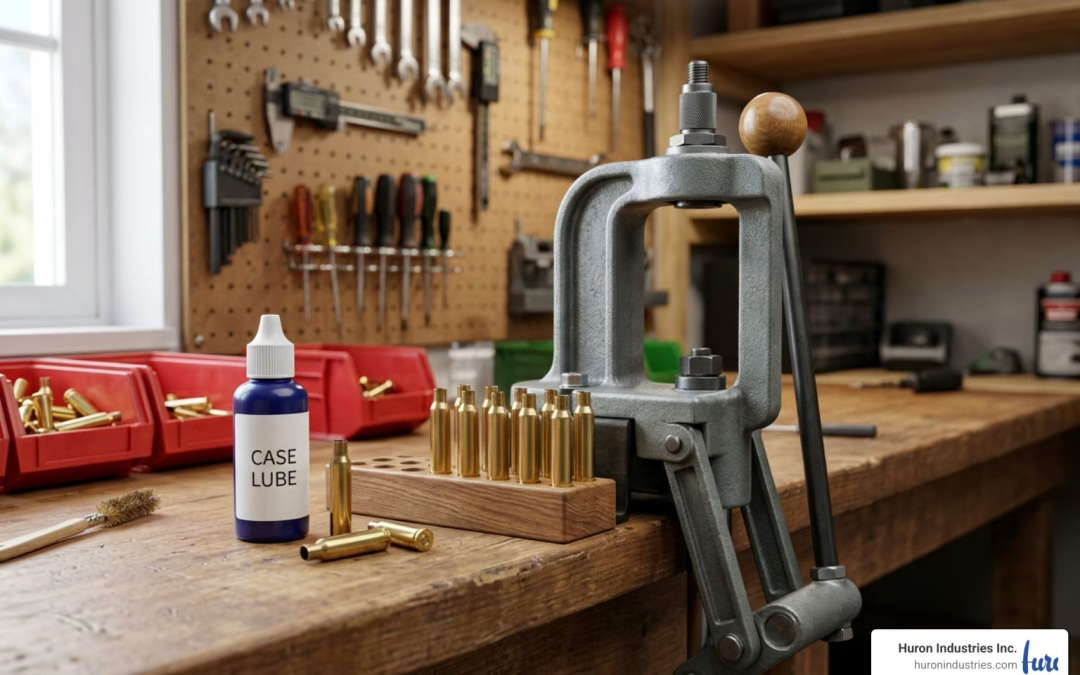
What the CaseLube Datasheet Tells You About Safe, Precise Lubrication
The CaseLube datasheet covers everything you need to know before handling this colloidal graphite case neck lubricant — from friction specs to flammability warnings.
Here are the key technical figures at a glance:
| Property | Value |
|---|---|
| Coefficient of Friction (Static) | 0.19 |
| Dry Film Thickness | 0.2 – 0.5 mil |
| Dries to Touch | ~5 minutes |
| Ready for Use | ~30 minutes |
| Service Temperature (Continuous) | 400°F (204°C) |
| Service Temperature (Intermittent) | 850°F (454°C) |
| Flash Point | 52°F (11.1°C) |
| Operating Temperature Range | -70°F to 400°F |
| Primary Carrier Solvent | Isopropanol |
| VOC Content | 766 g/L |
CaseLube™ is a liquid graphite lubricant made by Huron Industries Inc. It uses processed micro graphite suspended in isopropanol to deposit a thin, dry film inside cartridge case necks. That film reduces friction during sizing — without the sticky residue or powder contamination risks that come with wax or aerosol alternatives.
The catch? The isopropanol carrier is extremely flammable. Handling it safely means understanding the full datasheet — not just the friction numbers.
I'm Nicholas Cunha, the digital marketing specialist behind Huron Industries' content and SEO program, and I've spent considerable time working directly with the technical documentation behind the CaseLube datasheet to make these specs clear and accessible for engineers, procurement teams, and precision reloaders alike. This guide walks you through everything the datasheet covers — so you can use CaseLube confidently and safely.
Understanding the CaseLube Datasheet and Technical Specifications
When you first open up the CaseLube datasheet, you are looking at a document designed to bridge the gap between industrial surface science and your reloading bench. At its core, CaseLube is a thixotropic colloidal graphite suspension. But what does that actually mean when you are sitting at your press trying to resize a batch of expensive brass?

In simple terms, we have taken highly processed micro graphite particles and suspended them in an isopropanol (isopropyl alcohol) carrier solvent. The isopropanol acts as a temporary vehicle. It allows the graphite to flow smoothly into the microscopic pores of your brass case necks. Once applied, the alcohol quickly evaporates, leaving behind an incredibly uniform, dry lubricating film.
To dig deeper into these specifications, you can view the complete CaseLube Technical Data Sheet. This document details the physical chemistry of the liquid and the cured film properties that make it a staple for precision reloaders.
Key Specifications from the CaseLube Datasheet
If you want to understand why this formula works so well, you have to look at the numbers. Let’s break down the key data points from the CaseLube datasheet:
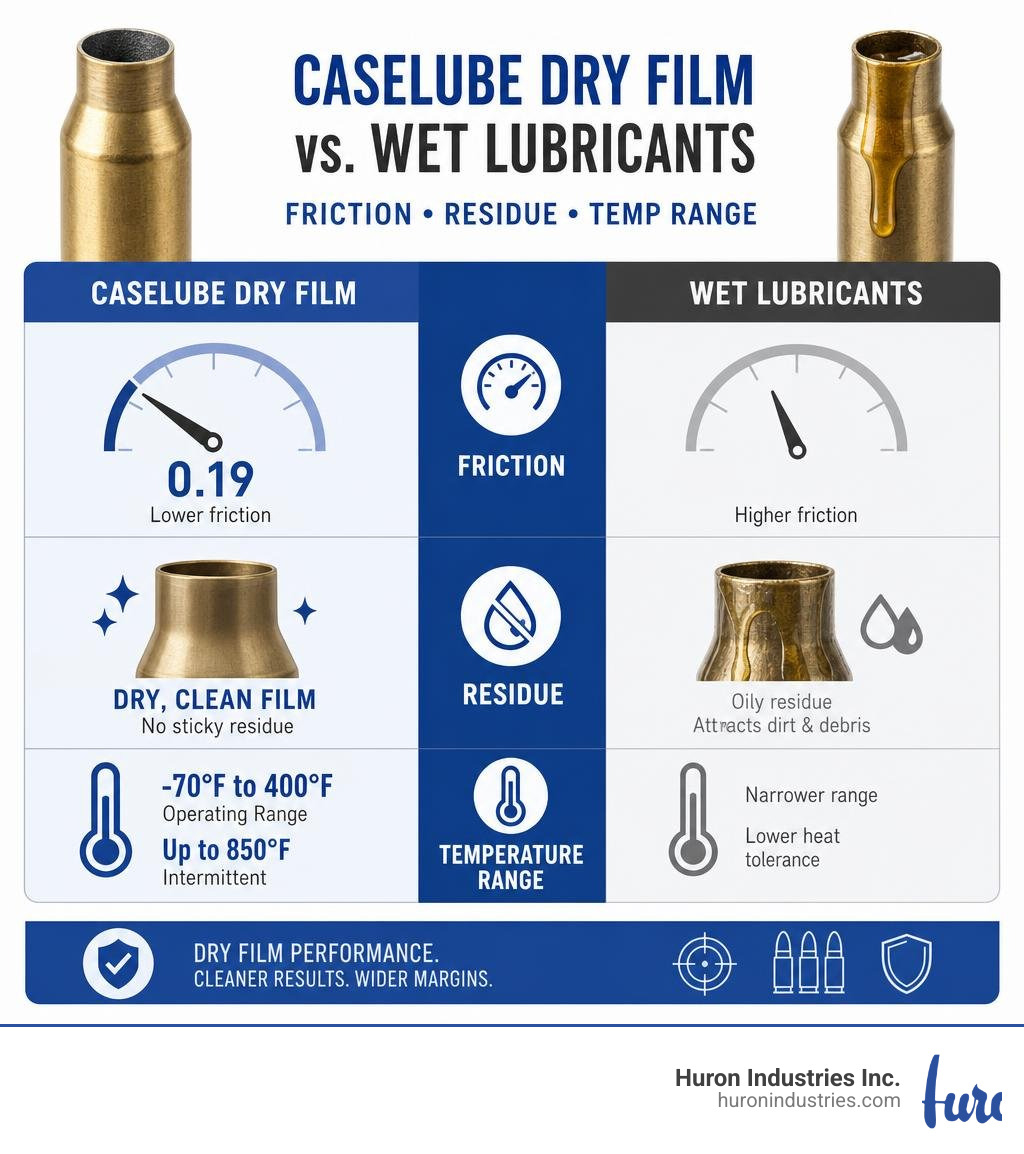
- Static Coefficient of Friction (0.19): Once the film is fully cured, it provides a remarkably low static coefficient of friction of 0.19. This low friction rating is what prevents galling and minimizes the physical effort required to run a case neck over an expander ball or through a sizing die.
- Dry Film Thickness (0.2 – 0.5 mil): One of the biggest headaches in reloading is dimensional consistency. Traditional wax or oil lubricants can build up unevenly, changing the neck tension of your cartridge. CaseLube leaves a dry film that is only 0.2 to 0.5 mil thick (1 mil = 1/1000 of an inch). When applied properly, there is no measurable thickness variation across your brass.
- Drying Times: Time is valuable, and nobody wants to wait all day for lube to dry. CaseLube air dries to the touch in approximately 5 minutes. It is fully cured and ready for heavy-duty sizing or bullet seating in approximately 30 minutes.
- Service Temperature Range: Because it is graphite-based, CaseLube handles extreme thermal environments that would melt or vaporize standard waxes. It remains stable in temperatures ranging from -70°F up to a continuous service temperature of 400°F (204°C). Intermittently, it can withstand temperatures up to 850°F (454°C).
Application Methods for Precision Reloading
Applying a liquid graphite suspension might seem intimidating if you’ve only ever used spray-on waxes, but it is actually incredibly straightforward. The goal is always to apply a thin, even film while keeping the liquid away from the primer pocket and the base of the cartridge.
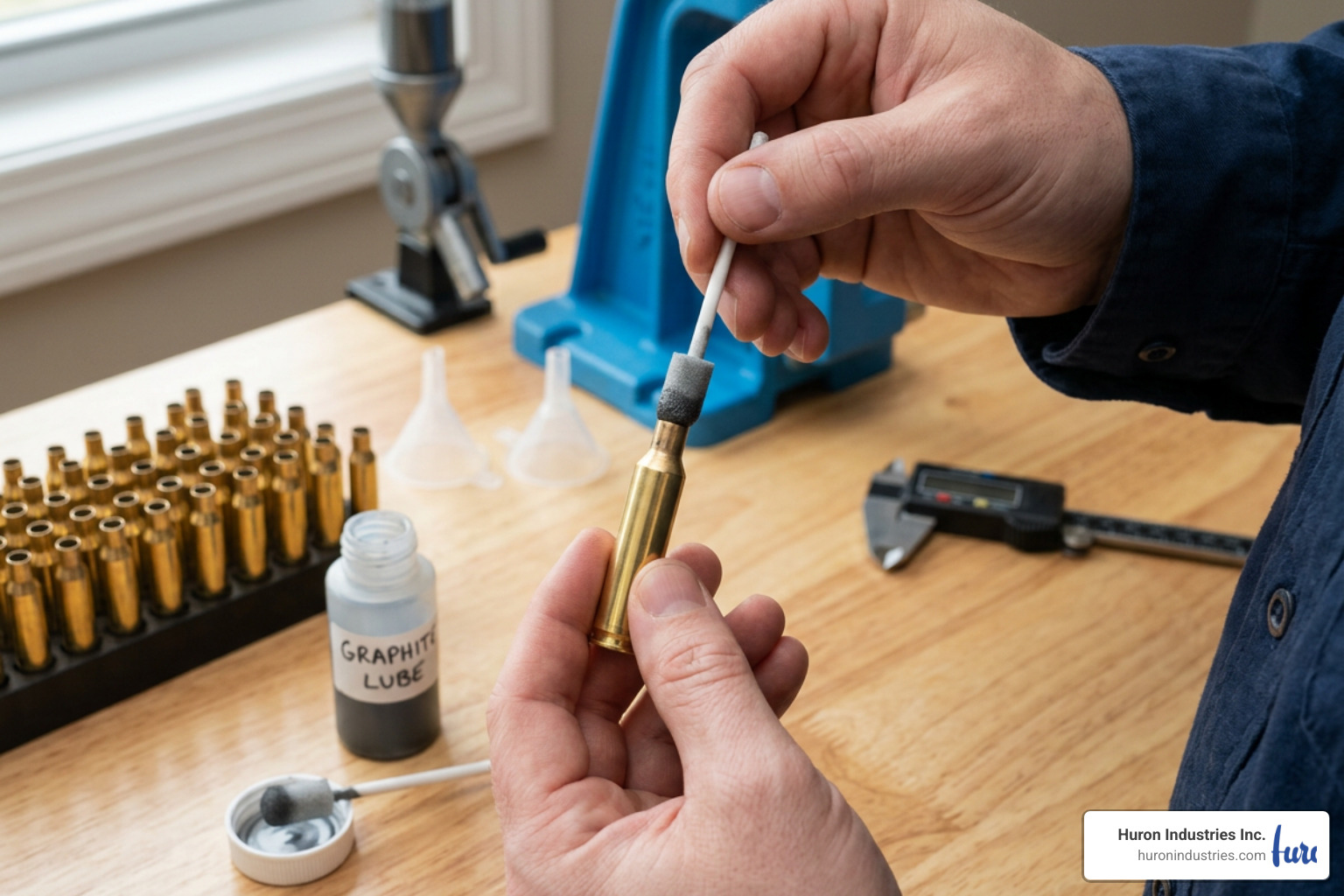
The best way to do this is with a dedicated applicator. A lint-free polyurethane foam pad or a non-abrasive foam swab (such as the C5709C foam swab) works perfectly. Simply shake the bottle thoroughly to ensure the micro graphite is fully suspended in the alcohol, lightly charge your foam swab with the liquid, and gently rotate it inside the case neck.
Alternatively, some reloaders use a light dip method. If you choose to dip, ensure you only make light contact with the very mouth of the case neck. You do not want liquid pooling deep inside the case body. For a step-by-step visual guide on getting this process right, check out our guide on how to Apply Liquid Graphite to Case Necks.
Why Dry Film Lubrication Outperforms Wet Alternatives
To truly appreciate why dry film graphite is the gold standard for precision reloading, we need to compare it to the "wet" alternatives on the market. Whether it is a tallow-based wax, a water-soluble liquid, an aerosol spray, or a DIY homebrew, wet lubricants all share fundamental physical limitations.
Here is a direct comparison of how CaseLube's dry film properties stack up against typical wet reloading lubricants:
| Performance Metric | CaseLube™ Dry Graphite | Traditional Tallow/Wax | Aerosol (Hexane-Based) | DIY Lanolin/Alcohol |
|---|---|---|---|---|
| Residue Type | None (Dry bonded film) | Sticky, heavy wax | Greasy, sticky over time | Sticky, tacky film |
| Powder Contamination Risk | Extremely Low | High (if inside neck) | High (if not fully dry) | Moderate to High |
| Dust/Debris Attraction | Zero | High | High | High |
| Max Temperature Stability | 400°F (Continuous) | ~107°F (Melts) | Low (Degrades quickly) | Low (Melts/runs) |
| Post-Sizing Cleanup | Optional (No tack) | Mandatory (Tumble/wipe) | Mandatory | Mandatory (Wet tumble) |
The Drawbacks of Traditional Wet Lubricants
Let's look at some of the common wet options reloaders use and see how they compare to CaseLube.
Traditional Tallow and Wax Lubricants
Many classic, highly respected paste lubricants on the market rely heavily on tallow, mink oil, glycerol monooleate, or paraffin wax as their primary components.
While tallow and wax are excellent for heavy-duty resizing, they have a very low melting point (often around 107°F / 42°C). If your reloading room gets warm, or if your dies heat up during a high-volume session, these wax-based lubricants will melt, run, and migrate. They are also highly tacky, meaning they will attract dust, carbon, and tumbling media like a magnet.
Water-Soluble Liquid Lubricants
Some non-toxic, water-soluble liquid options are designed to be wiped off easily after sizing. While these are much easier to clean up than tallow-based waxes, they are still wet lubricants. They require manual wiping or washing after the sizing process to prevent sticky residue from building up inside your dies and on your brass.
Aerosol Spray Lubricants
Aerosol sprays are popular for high-volume reloading because they are fast to apply. However, many commercial aerosol case lubes contain high concentrations of hexane, making them highly volatile and extremely flammable, with very low flash points.
Beyond the immediate safety hazards of spraying hexane indoors, these aerosol formulations often present long-term storage issues. Experienced reloaders have noted that cases stored for 10 to 15 years with degraded aerosol residue become highly sticky and develop a brownish coating. This degraded residue can actually cause gunpowder to cake inside the cartridge walls, ruining the ammunition.
DIY Lanolin and Isopropyl Alcohol
A popular cost-saving alternative is the DIY case lube recipe, which typically mixes pure liquid lanolin with isopropyl alcohol in a pump spray bottle. While this homebrew is inexpensive and works reasonably well for bulk resizing of rifle brass, it leaves a very greasy, sticky lanolin film on the brass. To remove it, you almost always have to wet-tumble your brass after sizing. If you leave it on, it will attract dirt and potentially contaminate your powder charge.
The Limitations of Non-Dedicated Lubrication Methods
Using non-dedicated lubricants or leaving wet residues inside your case necks introduces a major variable to your reloading process: inconsistent neck tension.
When you seat a bullet into a case neck coated with a sticky, wet lubricant, the force required to release that bullet during firing changes from shot to shot. This variation directly impacts your chamber pressure, muzzle velocity, and ultimately, your extreme spread (ES) and standard deviation (SD) numbers.
Furthermore, wet lubes can migrate over time, causing powder caking around the base of the bullet. To understand how internal neck friction directly degrades your downrange accuracy, read our technical analysis on Case Neck Friction & Extreme Spread. For an even deeper dive into how dry graphite solves this issue, you can explore the Technical Notes: Neolube 2 for Lubricating Internal Case Necks.
Safety, Handling, and Environmental Considerations
Because CaseLube contains a high concentration of isopropanol, treating it with the same respect you would show to any other volatile, flammable solvent is critical.
Safety and Handling Guidelines from the CaseLube Datasheet
The primary hazard when working with CaseLube is its flash point of 52°F (11.1°C). Because it flashes off at room temperature, the liquid and its vapors are highly flammable.
Here are the essential safety rules to follow at your bench:
- Ventilation is Key: Always use CaseLube in a well-ventilated area. If you are reloading in a small basement or utility room, open a window or use a small fan to keep fresh air moving. Do not inhale the vapors directly.
- Eliminate Ignition Sources: Keep the bottle far away from open flames, sparks, hot reloading dies, or electrical equipment that could spark.
- Wear Basic PPE: While CaseLube is not highly toxic, the isopropanol carrier can dry out your skin with prolonged contact, and graphite will stain your hands black. Wear chemical-resistant gloves (like nitrile) and safety glasses to prevent accidental splashes to the eyes.
- Keep the Bottle Capped: Isopropanol evaporates incredibly fast. If you leave the cap off while reloading, your solvent will flash off, leaving you with a thick, unusable paste. Cap the bottle tightly between applications.
For a complete breakdown of first-aid measures, exposure limits, and chemical stability, you can access the CaseLube Safety Data Sheet.
While some industrial lubricants like silicone-based greases are non-flammable and highly stable, they are completely unsuited for cartridge case necks because they do not dry, meaning they will permanently contaminate gunpowder.
Environmental and Long-Term Storage Effects
One of the greatest environmental benefits of dry graphite is its stability. Unlike petroleum-based oils or animal-derived tallows, graphite does not rot, spoil, or degrade over time.
If you size your brass using CaseLube and store it in a bin for five years, the graphite film will remain completely unchanged. It won't turn into a sticky brown varnish, it won't attract moisture that could corrode your brass, and it won't break down into acidic compounds.
Additionally, because graphite is a natural, inert form of carbon, it does not present the same disposal hazards as chlorinated solvents or heavy aerosols. Any rags or foam swabs used to apply CaseLube can be disposed of safely according to your local solid waste regulations once the alcohol carrier has fully evaporated.
Frequently Asked Questions about CaseLube
To help you get the most out of your reloading sessions, here are answers to some of the most common questions we receive regarding CaseLube.
Does CaseLube contaminate powder or primers?
When applied correctly, CaseLube will not contaminate your powder or primers. Because the colloidal graphite chemically bonds to the brass surface as a dry film, there are no wet oils or liquid carriers left to migrate into the powder charge.
The key is proper application: apply a thin, even film strictly to the interior of the case neck. Avoid getting the liquid near the flash hole or the primer pocket. Once the isopropanol solvent has completely evaporated, the remaining dry graphite is completely inert and will not react with modern smokeless powders.
How long does CaseLube take to dry completely?
CaseLube air dries to the touch in about 5 minutes, but you should wait approximately 30 minutes for the film to fully cure before you begin sizing your brass or seating bullets. This wait time ensures that all of the isopropanol carrier has completely evaporated, leaving behind a tough, dry graphite film that won't rub off inside your dies.
Can I use CaseLube for high-volume progressive reloading?
Absolutely. In fact, this is where CaseLube truly shines compared to wax-based lubricants. Because graphite has an incredibly high service temperature (up to 850°F intermittent), it will not melt or break down when your reloading dies get hot during rapid, high-volume progressive reloading sessions. It keeps your press running smoothly without the sticky buildup that can jam progressive shell plates and dies.
Conclusion
At Huron Industries Inc., we have been manufacturing high-purity, high-performance graphite lubricants right here in Port Huron, Michigan, since 1971. Our industrial heritage includes supplying the flagship Neolube® colloidal graphite line, qualified to MIL-L-24131C, for demanding naval and commercial nuclear reactor systems. You can read more about our company's capabilities and industrial certifications on the Huron Industries, Inc. - Thomasnet profile page.
We took that exact same nuclear-grade engineering and precision and applied it to CaseLube™ to give precision reloaders a cleaner, more consistent, and highly reliable alternative to messy wet waxes and sticky aerosols.
If you are ready to eliminate inconsistent neck tension and messy cleanup from your reloading bench, you can view our full range of products on the CaseLube Product Category page.
Ready to try it for yourself? Grab a CaseLube 2 oz Bottle for your precision bench, or stock up for high-volume loading with our CaseLube 8 oz Bottle.
For all safety and technical documentation, including the official CaseLube datasheet, please visit the Huron Industries Safety & Technical Datasheets portal. Keep your bench clean, your velocity spreads tight, and your reloading safe!