
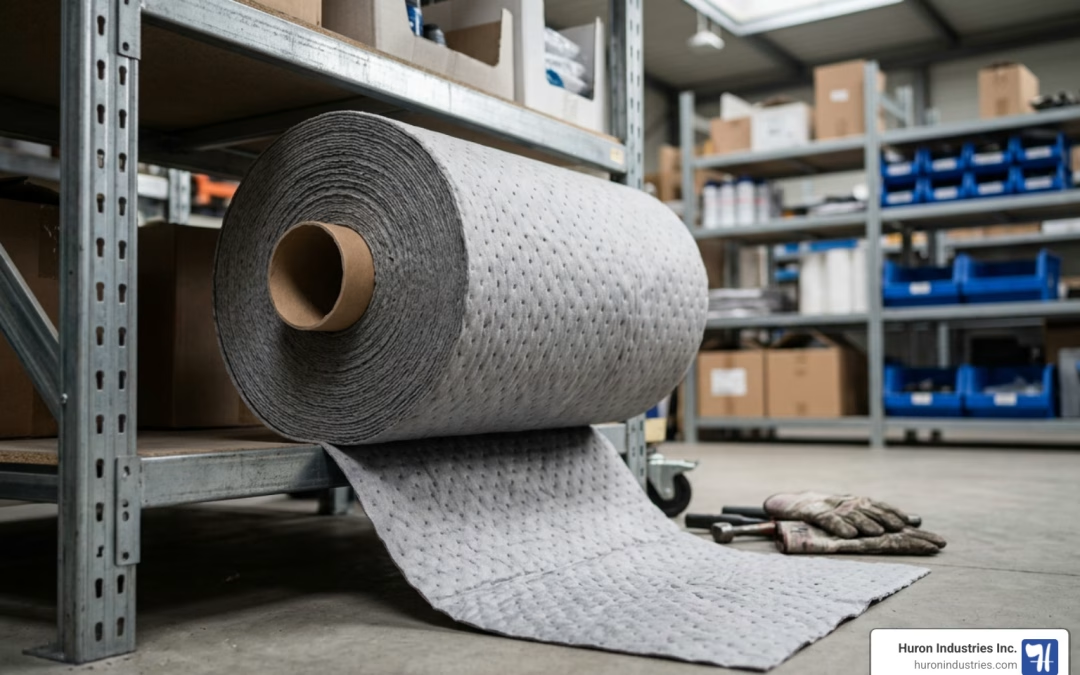
Choose an Absorbent Pad Roll That Matches the Fluid and the Work Area
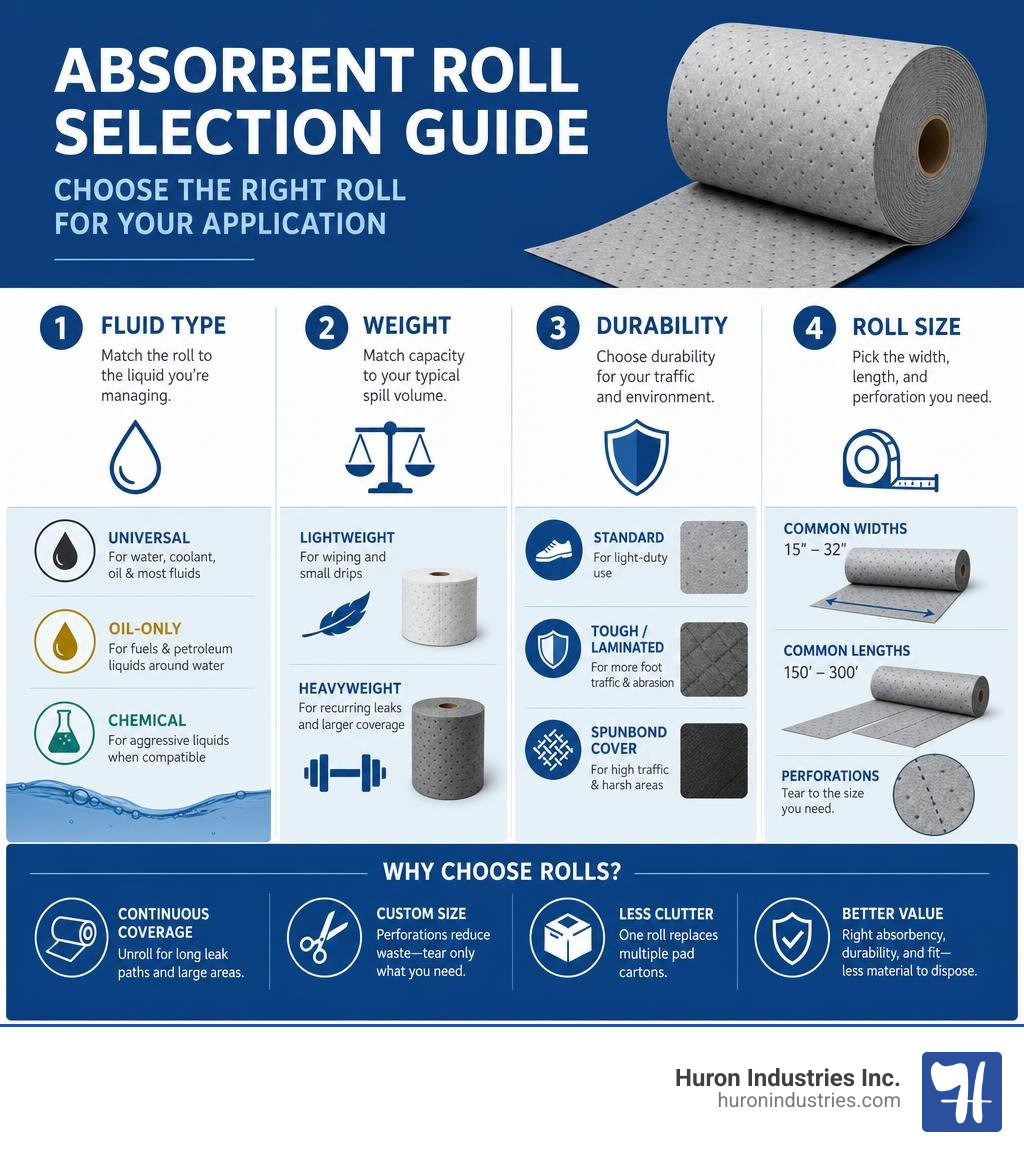
The right absorbent pad roll controls routine drips, leaks, and spill spread while letting your team tear off only the coverage they need. Choose a universal roll for mixed maintenance fluids such as water, coolant, and oil; an oil-only roll for fuels and petroleum liquids around water; or a chemical roll for aggressive liquids when its compatibility guidance confirms it is suitable.
For most facilities, compare these four details before buying:
- Fluid type: Never assume a universal sorbent is safe for every acid, base, or oxidizer.
- Capacity and weight: Light-weight rolls suit wiping and small drips. Heavyweight rolls provide more fluid capacity for recurring leaks and larger coverage areas.
- Durability: Select a tougher, laminated, or spunbond-covered roll for walkways, equipment traffic, or abrasive work areas.
- Size and perforation: Common industrial formats include 15- to 32-inch widths and 150- or 300-foot lengths. Perforations reduce waste by allowing custom pad or runner lengths.
Rolls are often more practical than pre-cut pads for machine lines, benches, and long leak paths because one roll can provide continuous coverage or be divided into smaller sections. The best value is not simply the lowest case price - it is the option that delivers the needed absorbency, durability, and chemical fit with the least unused material to dispose of.
I am Nicholas Cunha, founder of CreatiVertical and a technical industrial content specialist supporting Huron Industries Inc. I help procurement, maintenance, and engineering buyers compare specified products, including absorbent pad roll options, in clear terms that support safer purchasing decisions.
Selecting the Right Absorbent Pad Roll for Your Facility
Choosing the right roll configuration requires balancing tensile strength, fluid capacity, and your typical spill volume. If you manage an active machine shop, an automated packaging facility, or a process plant, fluid release is rarely uniform. It ranges from steady, localized weeping along pipe flanges to broad overspray stretching down an entire assembly bay.
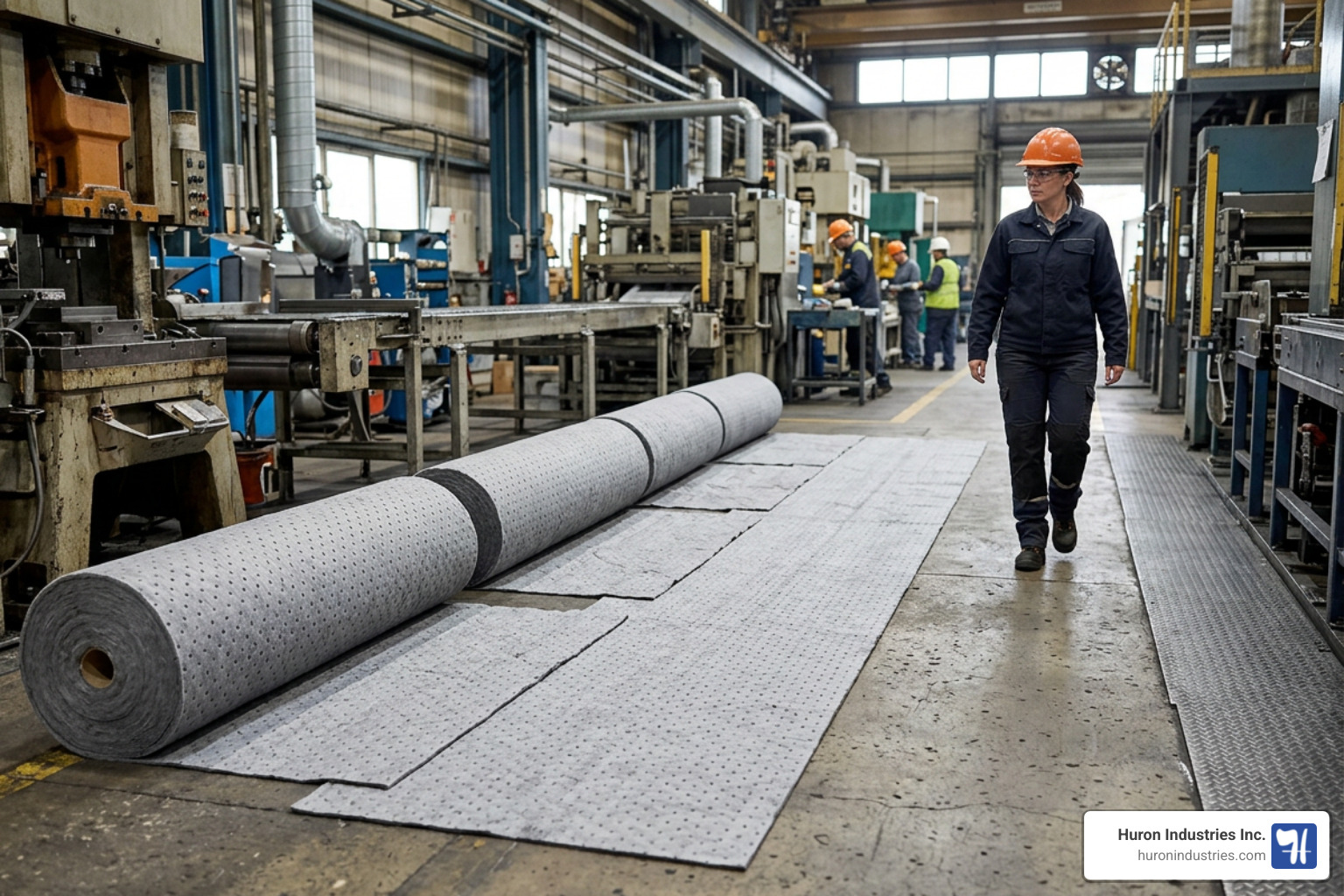
Continuous rolls give your maintenance team the operational freedom to address these variable hazards without cluttering storage closets with dozens of mismatched pre-cut pad cartons. A single roll can be unrolled as a continuous 50-foot runner beneath a leaky conveyor system or torn along precision perforations into compact benchtop wipes.
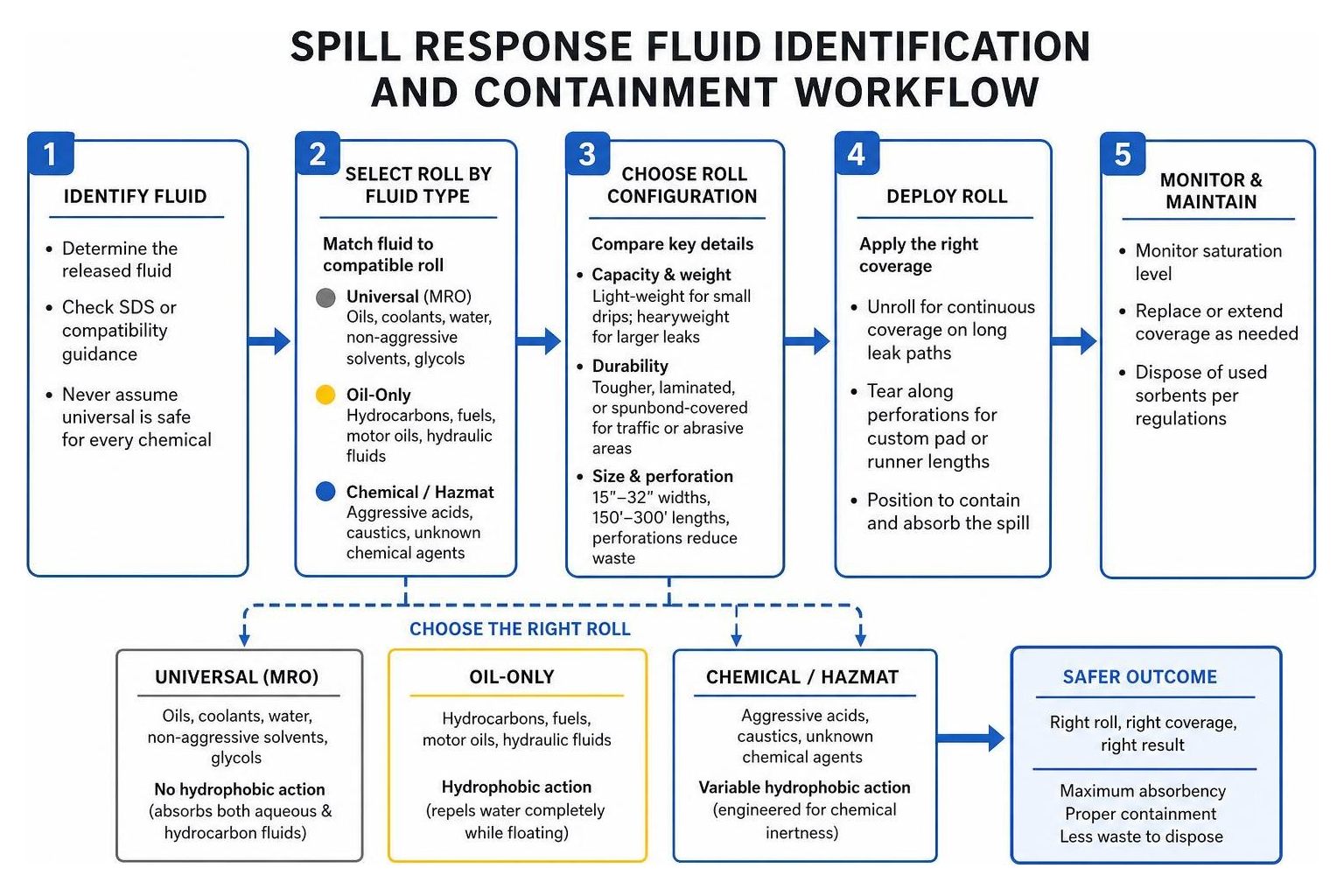
When evaluating your spill containment strategy, fluid chemistry must always dictate your base material selection. Standardizing your facility on the wrong sorbent grade can lead to rapid saturation failure, chemical degradation, or wasted spend.
| Roll Category | Primary Liquid Compatibility | Hydrophobic Action | Common Industry Applications | Typical Fluid Capacity (per 30" x 150' Roll) |
|---|---|---|---|---|
| Universal (MRO) | Oils, coolants, water, non-aggressive solvents, glycols | No (absorbs aqueous & hydrocarbon fluids simultaneously) | General machine maintenance, assembly lines, walkways, tool benches | 40 – 52 Gallons |
| Oil-Only | Hydrocarbons, fuels, motor oils, hydraulic fluids | Yes (repels water completely while floating) | Outdoor fuel transfers, marine docks, wash bays, retention ponds | 42 – 55 Gallons |
| Chemical / Hazmat | Aggressive acids, caustics, unknown chemical agents | Variable (engineered for chemical inertness) | Chemical storage bays, plating lines, laboratories, hazmat response | 38 – 50 Gallons |
Universal Absorbent Pad Roll Formats for Maintenance
Universal absorbent rolls—typically color-coded industrial gray—serve as the workhorse for general maintenance, repair, and operations (MRO). These versatile rolls are engineered to capture both polar and non-polar liquids, meaning they readily absorb water-based coolants, machine cutting fluids, petroleum lubricants, hydraulic oils, and everyday workshop spills without chemical differentiation.
In high-throughput industrial environments, laying down a continuous run of a Sorbent – All Purpose roll alongside active machinery catches routine overspray before it migrates into heavy-traffic aisles. Because these multi-fluid containment rolls incorporate balanced fiber matrices, they absorb mixed shop fluids instantly, preventing slip-and-fall hazards on polished concrete floors.
Oil-Only Hydrophobic Sorbent Rolls
Oil-only sorbent rolls (typically bright white) are manufactured specifically to target petroleum-derived hydrocarbons while repelling aqueous liquids entirely. Utilizing inherently hydrophobic and oleophilic meltblown polypropylene fibers, these rolls selectively draw in motor oils, crude, gasoline, diesel, and synthetic lubricants.
Because oil-only rolls will not absorb a single drop of water, they remain buoyant even when fully saturated with oil. This makes them indispensable for outdoor equipment storage yards, marine loading docks, fuel dispensing stations, and indoor wash-down bays where oils must be stripped from standing water pools or retention basins.
Chemical and Hazardous Liquid Roll Barriers
When dealing with aggressive acids, strong alkalis, caustics, and unidentified chemical reagents, general-purpose absorbents can degrade or react unpredictably. Chemical hazmat rolls are manufactured from 100% chemically inert polypropylene to withstand contact with high-concentration acids and bases without breaking down or releasing hazardous fumes.
These rolls are almost universally colored high-visibility yellow or green. This serves a dual operational purpose: it immediately alerts facility personnel that a hazardous chemical incident is being contained, and it warns personnel to don proper personal protective equipment (PPE) before approaching the perimeter.
Core Considerations: Weight, Material, and Perforation Styles
Deploying the optimal sorbent roll requires evaluating mechanical durability and saturation speed alongside liquid compatibility. Sorbent rolls encounter distinct mechanical stresses depending on where they are placed—whether laid flat beneath heavy foot traffic, run under rolling equipment carts, or draped across rough cast-iron machine casings.
When selecting roll inventory for routine plant maintenance, reviewing product lines like the Sorbent products – Plus line and consulting the NEOSafe Plus Technical Datasheet (TDS) helps procurement teams verify exact weight baselines and tear-perforation specifications before placing facility-wide orders.
Material Ply, Meltblown Polymers, and Durability Ratings
Industrial sorbent rolls are constructed using distinct plies and bonding techniques that define their tensile strength and abrasion resistance:
- Single-Ply Meltblown: Constructed entirely from a loose web of fine meltblown polypropylene microfibers. While highly economical and fast-wicking, single-ply rolls exhibit lower tensile strength (<15 lbs) and tend to lint or tear when subjected to scuffing feet or dragging toolboxes. They are best reserved for passive catch basins and under-machine drip zones.
- 2-Ply and 3-Ply Spunbond-Meltblown (SMS): These composite rolls sandwich a core of high-loft meltblown absorbent fibers between outer protective layers of spunbond polypropylene. The spunbond coverstock adds exceptional abrasion resistance (handling 28+ lbs of mechanical tensile pull), virtually eliminates surface linting, and prevents fibers from catching in turning drive shafts or precision assemblies.
- Ultrasonic and Dimpled Point-Bonding: High-performance rolls feature ultrasonic pin-bonding across their entire surface. This dimpling locks the inner core fibers to the outer layers, preventing ply separation and accelerating fluid wicking across the roll surface.
- Laminated Barrier Backing: For critical containment on cleanroom or high-visibility walking surfaces, laminated rolls incorporate an impermeable polymer bottom film. This ensures that even when the upper absorbent layers reach 100% fluid saturation, no liquid bleeds through onto the subfloor.
High-Capacity Heavyweight Absorbent Pad Roll Options
Absorbent rolls are grouped into three primary basis-weight categories:
- Lightweight (LW): Engineered primarily for light benchtop wiping, minor tool cleaning, and low-volume preventative wraps. Lightweight rolls maximize square footage per roll while minimizing consumable cost per wipe.
- Mediumweight (MW): The ideal multi-purpose balance for general maintenance aisles, capturing moderate equipment drips and daily facility overspray without premature saturation.
- Heavyweight (HW): High-density, high-loft rolls engineered for heavy industrial weeping, continuous hydraulic leakage, and emergency bulk spill response. A standard 30" x 150' heavyweight roll can absorb between 45 and 52 gallons of fluid.
For severe leak points, facilities frequently standardize on industrial heavyweight formats such as the Sorbent products – Max line. Checking the NEOSafe Max Technical Datasheet (TDS) provides engineering teams with precise saturation limits and load-bearing capacities under continuous industrial operating conditions.
Industrial, Healthcare, and Packaging Applications
The continuous format of absorbent rolls lends itself to diverse industrial, clinical, and packaging environments where standard flat pads fall short.
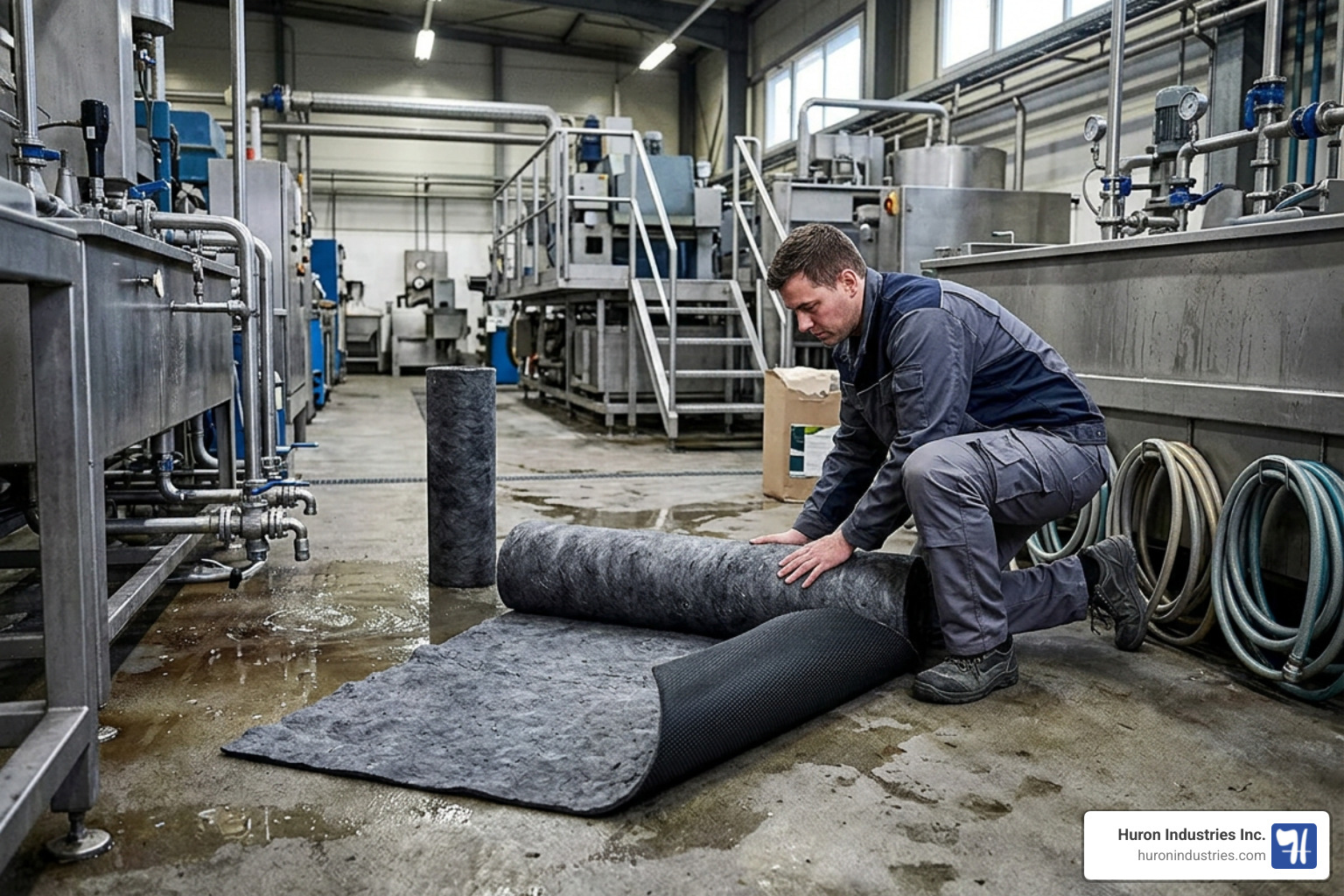
Whether you are managing industrial oil lines, food processing plants, or sterile clinical suites, matching the pad roll backing and composition to the environment is essential. In food manufacturing and temperature-controlled logistics, utilizing cleanroom-compliant materials is equally critical; exploring What is an NSF Certified Sorbent and Why Does Your Cold Chain Need It? offers valuable context on meeting strict purity and regulatory standards.
Operating Suite and Medical Floor Protection
In surgical suites and clinical procedural areas, fluid management presents severe safety and turnover challenges. Arthroscopic, orthopedic, and urological procedures utilize substantial volumes of saline irrigation, which routinely spills onto operating room floors.
Traditional solutions—such as tossing laundered hospital blankets or cotton towels on the floor—create hazardous tripping ridges, bunch under rolling equipment, and become saturated quickly.
Modern surgical absorbent rolls feature an engineered low-profile, adhesive-grip backing that adheres firmly to clean room flooring. These specialized medical rolls:
- Hug floor surfaces securely without shifting or curling under surgeon foot traffic.
- Allow Mayo stands, IV poles, and mobile imaging carts to glide smoothly over the top layer without tearing the fabric.
- Incorporate multi-layer cores capable of absorbing up to 90 liters of saline and bodily fluids per 100-foot roll.
- Reduce room turnover time by allowing rapid, hygienic roll-up and biohazard disposal between procedures.
Automated Packaging Line Integration
In high-speed food processing—specifically fresh meat, poultry, and seafood packaging—fluid purge must be controlled to prevent bacterial spoilage, maintain package seal integrity, and extend shelf life.
Manual placement of individual soaker pads into packaging trays slows cycle times and introduces human contamination risks. To solve this, processing plants utilize continuous roll-fed absorbent pads engineered for automated Modified Atmosphere Packaging (MAP) lines and tray denesters.
These specialized continuous packaging rolls incorporate advanced manufacturing features:
- Diamond-Embossed Cores: Channel patterns disperse fluid evenly across the internal pad core, preventing localized pooling beneath the meat cut.
- Super Absorbent Polymers (SAP): High-purity SAP granules instantly convert absorbed moisture into a locked gel state, ensuring no purge leaks out under packaging pressure.
- Precision Optical Sensor Marks: Rolls feature standardized registration marks and ultrasonic micro-perforations, allowing high-speed automated dispensers (such as those on G. Mondini, Sealpac, or Multivac machinery) to cut and position pads with millimeter precision at hundreds of units per minute.
- Uniform Winding Tension: Consistent machine winding prevents roll telescoping or jamming during high-speed unwinding, maximizing Overall Equipment Effectiveness (OEE).
Frequently Asked Questions about Sorbent Roll Management
How do absorbent pad rolls compare to pre-cut pads in cost efficiency?
While a carton of pre-cut absorbent pads may appear less expensive on an initial purchase order, continuous absorbent pad rolls generally deliver a lower total cost of ownership across active facilities.
When technicians use pre-cut 15" x 19" pads to clean a small 4-inch drip beneath a fitting, the entire pad is consumed and discarded, resulting in significant unused absorbent material entering the waste stream. Perforated absorbent rolls allow workers to tear off exact 7.5-inch or 15-inch squares sized directly to the spill footprint.
Furthermore, when protecting long equipment perimeters, laying down a single continuous roll runner takes a fraction of the labor time required to overlap and tape dozens of individual pads, saving maintenance labor while eliminating seam leakage.
How should saturated absorbent pad rolls be stored and disposed of?
Proper storage and disposal protocols are governed by the specific fluids absorbed rather than the original sorbent material:
- Clean Sorbent Storage: Store unused absorbent rolls on dedicated wall-mounted dispensing racks or enclosed mobile spill carts in clean, dry areas away from direct sunlight, open flames, and extreme humidity.
- Saturated Waste Categorization: Unused polypropylene sorbents are chemically inert and non-hazardous. However, under EPA RCRA regulations, once a roll absorbs a liquid, it inherits the hazardous characteristics and regulatory disposal classifications of that liquid (e.g., flammable solvents, heavy-metal cutting fluids, or toxic chemicals).
- Disposal Protocols: Saturated sorbents containing non-hazardous oils and coolants can typically be incinerated for energy recovery or sent to industrial waste facilities, depending on local municipal regulations. Sorbents saturated with hazardous wastes must be placed in secondary containment drums, clearly labeled, and handled by licensed hazardous waste disposal contractors. Never leave spent, oil-soaked sorbent rolls sitting piled in open shop barrels.
Can universal absorbent rolls handle aggressive chemical spills safely?
Universal absorbent rolls are engineered for non-aggressive chemical spills (such as dilute coolants, glycols, standard lubricants, and mild aqueous cleaners). They should not be used for concentrated, highly reactive, or oxidizing chemical spills.
When dealing with concentrated sulfuric, nitric, or hydrofluoric acids, strong sodium hydroxide caustics, or unknown reactive agents, you must deploy designated chemical hazmat sorbent rolls. Chemical-grade sorbents are specially treated and tested to remain stable under aggressive chemical attacks, preventing polymer melt degradation, exothermic reactions, or toxic gas off-gassing during emergency spill response operations.
Conclusion
Controlling leaks, drips, and surface overspray is essential to maintaining facility safety, ensuring regulatory compliance, and protecting your operational baseline. By selecting an absorbent pad roll tailored to your exact liquid chemistry, traffic load, and operational workflow, you eliminate slip hazards, reduce material waste, and streamline spill cleanup.
Huron Industries Inc. manufactures and supplies high-performance sorbent products engineered to meet demanding industrial and regulated environments. Explore Huron Industries high-performance sorbent solutions to find the right containment products for your facility today.