
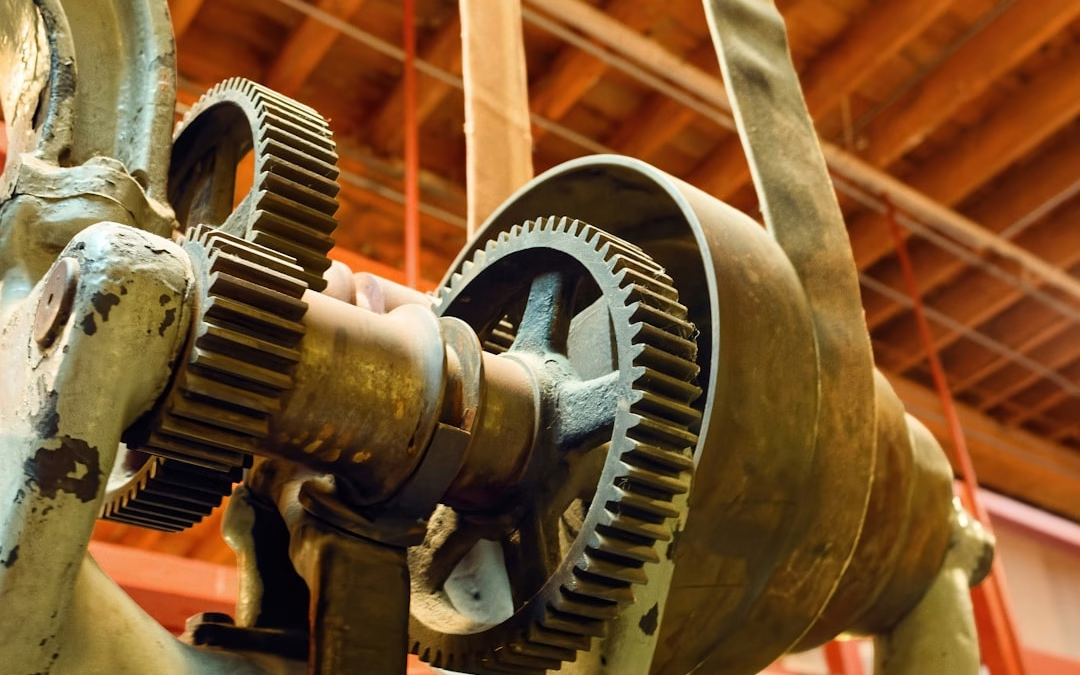
When Machinery Is Under Pressure, the Right Lubricant Makes All the Difference
An extreme pressure lubricant is a specially formulated grease or oil designed to protect metal surfaces when loads are so high that a normal oil film breaks down completely.
Quick answer: Here's what you need to know at a glance:
| Question | Answer |
|---|---|
| What does an EP lubricant do? | Forms a protective chemical film on metal surfaces under high load to prevent wear and welding |
| How is it different from standard grease? | Standard grease relies on an oil film; EP lubricants react chemically with metal when that film fails |
| What are common EP additives? | Sulfur, phosphorus, and molybdenum disulfide (MoS2) compounds |
| Where is it used? | Gearboxes, bearings, mining equipment, steel mills, marine, and more |
| Key specs to look for? | NLGI grade, dropping point, Four-Ball Weld Point, Timken OK load |
Under normal operating conditions, a thin oil film keeps metal parts from touching each other. But when loads spike — think heavily loaded gears, drill pipes, or mining equipment — that film gets squeezed out entirely.
That's the moment extreme pressure conditions begin.
At that point, metal asperities (the microscopic peaks on any surface) start making direct contact. Without the right protection, the result is rapid wear, scoring, or even surface welding.
EP lubricants solve this by doing something standard greases simply cannot: they react chemically with the metal surface at the exact moment the oil film collapses, forming a thin, tough sacrificial layer that takes the punishment instead of your equipment.
The stakes are high in regulated and heavy-industry environments. A failed bearing in a steel mill, a seized gear in a wind turbine, or a scored pin in mining equipment doesn't just cost money — it costs production time, safety compliance, and sometimes far worse.
I'm Nicholas Cunha, founder of CreatiVertical and the content strategist behind Huron Industries Inc.'s digital program, where I work hands-on with specialty lubricant lines — including extreme pressure lubricant formulations — to help procurement and engineering buyers find and qualify the right products. In this guide, I'll break down exactly how EP lubricants work, what separates a good one from a great one, and how to choose the right formulation for your specific application.
What is an Extreme Pressure Lubricant and How Does It Work?
To understand how an extreme pressure lubricant functions, we first have to look at what happens when machinery runs out of its comfort zone.
In a perfectly behaving mechanical system, parts are separated by a continuous hydrodynamic film. Think of this as water-skiing: as long as there is enough speed and fluid, the skier (one metal surface) glides effortlessly on top of the water (the lubricant) without ever touching the lakebed (the opposing metal surface). This hydrodynamic state keeps friction low and wear virtually nonexistent.
However, when loads increase, speeds drop, or shock loads occur, that fluid film is squeezed out. This is where standard grease fails. A standard lubricant relies almost entirely on physical separation via its base oil viscosity. When that physical barrier is gone, the microscopic, jagged peaks on the metal surfaces (known as asperities) collide.
This is where the magic of an EP lubricant comes into play. Instead of relying on a physical cushion, it leverages a chemical defense system. Under high loads and intense friction, localized contact temperatures skyrocket. This heat triggers a tribochemical reaction between the extreme pressure additives in the lubricant and the iron in the metal components. The additives decompose and react with the metal to form a highly resilient, microscopic sacrificial film. This film has a low shear strength, meaning it easily slides over itself, protecting the underlying metal from tearing, scoring, or welding under extreme pressure.
To dive deeper into how these chemical mechanisms protect your equipment over its operational life, explore our detailed breakdown of lubrication wear reduction.
The Chemistry of Extreme Pressure Lubricant Additives
The secret to this chemical defense lies in the specific additives blended into the grease or oil. Historically, early formulations used lead soaps to handle heavy loads, but these were phased out in the 1950s due to toxicity. Modern formulations rely on highly engineered sulfur-phosphorus compounds, zinc compounds, and solid materials.
The activation of these additives is entirely temperature-dependent:
- Zinc Dialkyldithiophosphate (ZDDP): A classic anti-wear and light EP additive, ZDDP begins its thermal decomposition around 130°C to 170°C, forming a protective polyphosphate glass layer.
- Tricresyl Phosphate (TCP): Typically activates at higher temperatures, often exceeding 200°C.
- Sulfur-Phosphorus Additives: These are the workhorses of heavy-duty industrial gear oils and greases. Under heavy loads, localized contact temperatures can briefly flash between 300°C and 1000°C. These extreme temperatures cause the sulfur and phosphorus molecules to break down and bond with the metal, creating iron sulfides and iron phosphates.
Within sulfur chemistry, we distinguish between two primary types:
- Active Sulfur: These compounds have weakly bonded sulfur atoms (often containing five sulfur atoms in their molecular chain) that react readily with metal surfaces at lower temperatures. While highly effective at preventing welding, active sulfur can be corrosive to yellow metals like bronze and copper.
- Inactive Sulfur: These compounds hold their sulfur atoms more tightly (typically three sulfur atoms in the chain). They require much higher temperatures to react, making them safer for systems containing bronze bushings or brass gears.
For safety coordinators and maintenance managers interested in the exact chemical handling, hazard profiles, and safety protocols of specialized industrial EP formulations, reviewing standard safety data sheets (SDS) for heavy-duty extreme pressure lubricants provides a clear picture of how these chemical mixtures are managed safely in the field.
Boundary Lubrication vs. Hydrodynamic Film
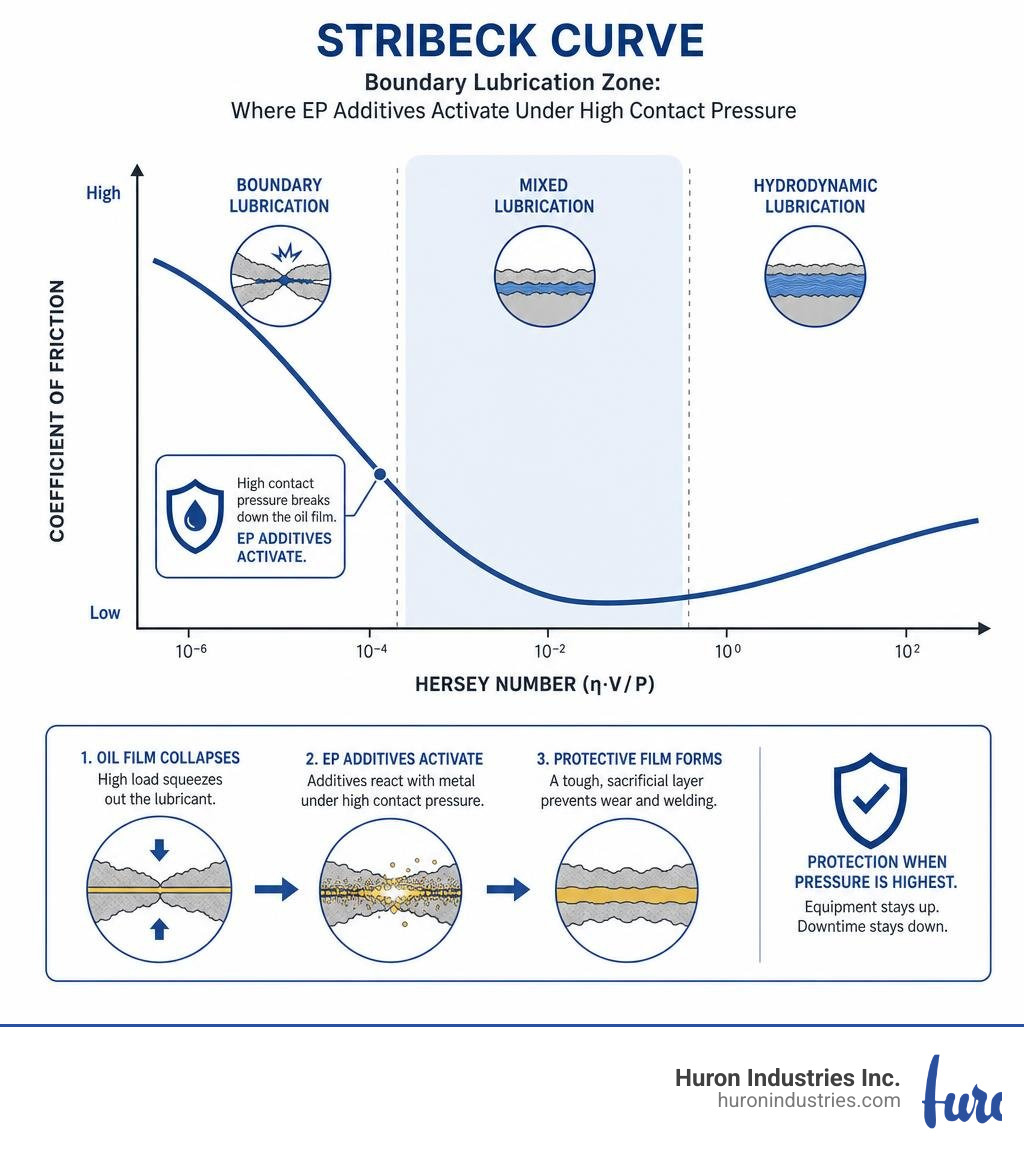
To visualize the transition between lubrication states, engineers refer to the Stribeck Curve.
In the hydrodynamic and elastohydrodynamic regimes, the metal surfaces are completely separated by a liquid film. As the load increases or the speed decreases, the system enters the mixed lubrication regime, where some surface asperities begin to touch.
Finally, under extreme loads, the system enters boundary lubrication. Here, the physical fluid film is entirely absent. Without an extreme pressure lubricant, the shear stress on the surface asperities would cause them to plastically deform, generating intense heat and causing the metal surfaces to cold-weld together. When the machinery continues to force movement, these welded joints tear apart, resulting in catastrophic scoring, pitting, and eventual equipment failure.
The sacrificial film formed by EP additives acts as a low-friction barrier that shears easily, absorbing the friction and protecting the metal underneath from direct tearing.
Key Performance Characteristics of EP Greases
When you are selecting an EP grease for your machinery, you cannot simply grab the first red tube on the shelf. You need to evaluate several critical performance metrics to ensure the lubricant can survive your specific operating environment.
Key performance characteristics to evaluate include:
- Base Oil Viscosity: The viscosity of the oil suspended within the grease thickener. High-load, low-speed applications require a higher base oil viscosity to maintain as much physical film as possible before the EP additives have to take over.
- Dropping Point: The temperature at which the grease structure transitions from a semi-solid to a liquid state. A high dropping point is essential for high-temperature operations.
- Shear Stability: The ability of the grease to maintain its consistency (its NLGI grade) when subjected to mechanical shearing forces. Poor shear stability causes grease to soften and run out of the bearing.
For heavy-duty trucking, construction, and mining operations, premium lithium complex greases are designed to balance high dropping points with exceptional stay-put properties under heavy water wash and high-load conditions.
Standardized Testing: Four-Ball EP and Timken OK Load
To compare the load-carrying capacity of different lubricants, the industry relies on standardized ASTM testing methods. The two most common are the Four-Ball EP test and the Timken OK Load test. For an independent reference on the test method, see ASTM International's ASTM D2596 standard overview.
- Four-Ball Weld Point (ASTM D2596): This test utilizes three steel balls clamped together in a bath of the test lubricant, with a fourth ball rotating against them from above. Load is progressively added until the frictional heat causes the balls to weld together. The weld point is measured in kilograms-force (kgf). High-performance EP greases typically exhibit weld points of 250 kgf to 620 kgf or higher.
- Four-Ball Wear Scar (ASTM D2266 / D2266-modified): Measures the diameter of the wear scar left on the balls under a set load and time. A smaller scar indicates superior anti-wear protection.
- Timken OK Load (ASTM D2509): This test presses a rotating steel cup against a stationary steel block. The "OK Load" is the maximum weight that can be applied to the test lever arm for 10 minutes without causing scoring or scuffing on the test block. A rating of 40 to 80 lbs indicates excellent extreme pressure protection.
NLGI Grades, Temperature Ranges, and Water Resistance
Beyond load-carrying capacity, you must match the physical characteristics of the grease to your operating environment:
- NLGI Grades: Defined by the National Lubricating Grease Institute, this scale measures grease consistency (hardness), ranging from 000 (fluid like cooking oil) to 6 (hard like a block of cheese). NLGI Grade 2 is the most common multipurpose consistency, similar to peanut butter, and is ideal for most industrial bearings.
- Operating Temperature Range: Extreme conditions often involve temperature extremes. High-quality synthetic base oils and advanced thickeners allow some EP greases to operate continuously from sub-zero temperatures up to 4753F (2466C), with intermittent peaks even higher.
- Water Washout and Spray-off Resistance: In wet environments, water can wash grease out of bearings or degrade its structure. Greases with excellent water resistance (often measured by ASTM D1264 water washout tests) maintain their consistency and stay in place even when directly sprayed with water.
For hydraulic systems and heavy machinery operating across massive temperature swings, specialized fluids use highly shear-stable viscosity index (VI) improvers to prevent viscosity loss under high shear rates, protecting hydraulic pumps from wear.
Technical Specification Comparison
To help you visualize how these performance metrics translate to real-world products, let's look at how several popular EP greases on the market compare:
| Product Type / Feature | Thickener Type | Base Oil Viscosity (cSt @ 406C) | Four-Ball Weld Point (kg) | Timken OK Load (lbs) | Temperature Range | Notable Certifications / Features |
|---|---|---|---|---|---|---|
| Super Lube High Temp EP | Silica | 45 | 620 | 50 | -306F to 4756F | NSF H1 (Incidental Food Contact) |
| Mobil Delvac Xtreme | Lithium Complex | 320 | 250 | -206C to 1606C | High stay-put, water washout resistance | |
| Premalube Xtreme Heat Shield | Calcium Sulfonate | 113 | 1000+ | 70 | Up to 10006C (intermittent) | Solid lubricants (Moly & Graphite) |
| SAPPHIRE Extreme | Clay (Bentone) | -106C to 2356C | Non-melting, MoS2 fortified | |||
| Alco-EP Multipurpose | Aluminum Complex | 60 | -256F to 4506F | Highly adhesive, MoS2 & Graphite |
Main Types and Popular Formulations on the Market
The performance of an extreme pressure lubricant is highly dependent on its thickener type. The thickener acts as a sponge that holds the lubricating oil and additives in place.
- Lithium Complex: The classic, reliable workhorse of the industry. Lithium complex greases offer good high-temperature stability, excellent shear stability, and solid water resistance. They are highly compatible with other grease types, making them the default choice for general industrial and automotive applications.
- Calcium Sulfonate: A rapidly growing premium thickener technology. Calcium sulfonate is unique because the thickener itself inherently possesses extreme pressure and anti-rust properties. These greases naturally exhibit incredibly high Four-Ball Weld points (often over 600 kg) and outstanding water resistance without requiring heavy loads of chemical EP additives.
- Aluminum Complex: Known for its exceptional water resistance and excellent adhesion properties. Aluminum complex greases stick tenaciously to metal surfaces, making them highly popular in marine applications, steel mills, and horizontal directional drilling.
To see how these diverse grease formulations are integrated into manufacturing, processing, and heavy machinery, read more about industrial machinery applications.
Solid Lubricants: Molybdenum Disulfide and Graphite
In the most demanding boundary lubrication scenarios, chemical EP additives are paired with solid boundary lubricants. When the liquid film is squeezed out completely, these microscopic solids provide a physical sliding barrier that cannot be squeezed out.

- Molybdenum Disulfide (MoS2): Commonly referred to as "moly," MoS2 has a natural affinity for metal surfaces. Its molecular structure consists of sheets of molybdenum atoms sandwiched between sheets of sulfur atoms. The bond between the sulfur and the metal is incredibly strong, while the bond between the sulfur sheets is weak. This allows the layers to slide over each other with incredibly low friction, providing an outstanding backup defense against shock loads.
- Colloidal Graphite: Graphite is another highly effective solid lubricant, particularly in high-temperature environments. Like moly, graphite has a layered lattice structure that shears easily. At temperatures where synthetic and mineral base oils evaporate or decompose, graphite remains behind as a solid, dry film, preventing metal-on-metal wear.
At Huron Industries Inc., we specialize in high-purity colloidal graphite formulations. Our flagship Neolube product line is a prime example of how precision-engineered colloidal graphite can provide boundary lubrication and prevent seizing in the most critical, highly regulated environments on earth, including commercial and naval nuclear reactor systems.
Selecting the Right Extreme Pressure Lubricant for Your Industry
Different industries face vastly different operational challenges. Matching the lubricant to these specific demands is critical for operational efficiency:
- Steel Mills: Require greases that can withstand extreme radiant heat, constant water spray, and heavy shock loads. Calcium sulfonate greases with solid graphite are highly favored here.
- Mining and Construction: Equipment like bucket pins, open gears, and chassis components operate in dusty, high-load environments. High-viscosity lithium complex or aluminum complex greases fortified with molybdenum disulfide (MoS2) are standard.
- Wind Turbines: Blade bearings undergo constant, slow, high-pressure oscillating movements that can cause fretting corrosion. They require highly specialized synthetic EP greases with excellent low-temperature pumpability and high load-carrying capacity.
- Marine & Offshore: Saltwater exposure requires exceptional rust prevention and water washout resistance. Aluminum complex or calcium sulfonate greases are ideal.
For heavy-duty bearing applications subjected to continuous high temperatures and vibration, specialized industrial greases utilize non-melting clay thickeners combined with molybdenum disulfide to maintain physical integrity where standard greases melt and run.
Best Practices for Application, Maintenance, and Eco-Friendly Alternatives
Even the most advanced extreme pressure lubricant will fail if it is applied incorrectly or contaminated during service. Proper maintenance protocols are just as important as the lubricant selection itself.
Application and Maintenance Protocols
- Grease Gun Calibration: It is easy to over-lubricate or under-lubricate when relying on manual grease guns. Calibrate your grease guns regularly to know exactly how many grams of grease are delivered per stroke.
- Purging Old Grease: When transitioning to a new grease, or during routine maintenance, purge the old grease completely. Mixing incompatible thickener types (such as mixing a clay-based grease with a lithium-based grease) can cause the thickener to de-gel, leading to rapid oil separation and bearing failure.
- Contamination Control: Wipe grease fittings clean before attaching the grease gun. Even microscopic dirt particles pumped into a bearing act as an abrasive paste, accelerating wear and defeating the purpose of your EP grease.
- Torque Accuracy: In assembly applications, using a high-quality EP bolt lubricant reduces friction during tightening, allowing you to achieve highly accurate torque readings and optimal clamping force without damaging fastener threads.
Food-Grade and Environmentally Friendly EP Options
Historically, extreme pressure lubricants were synonymous with heavy chemical additives and environmental toxicity. Today, that is no longer the case.
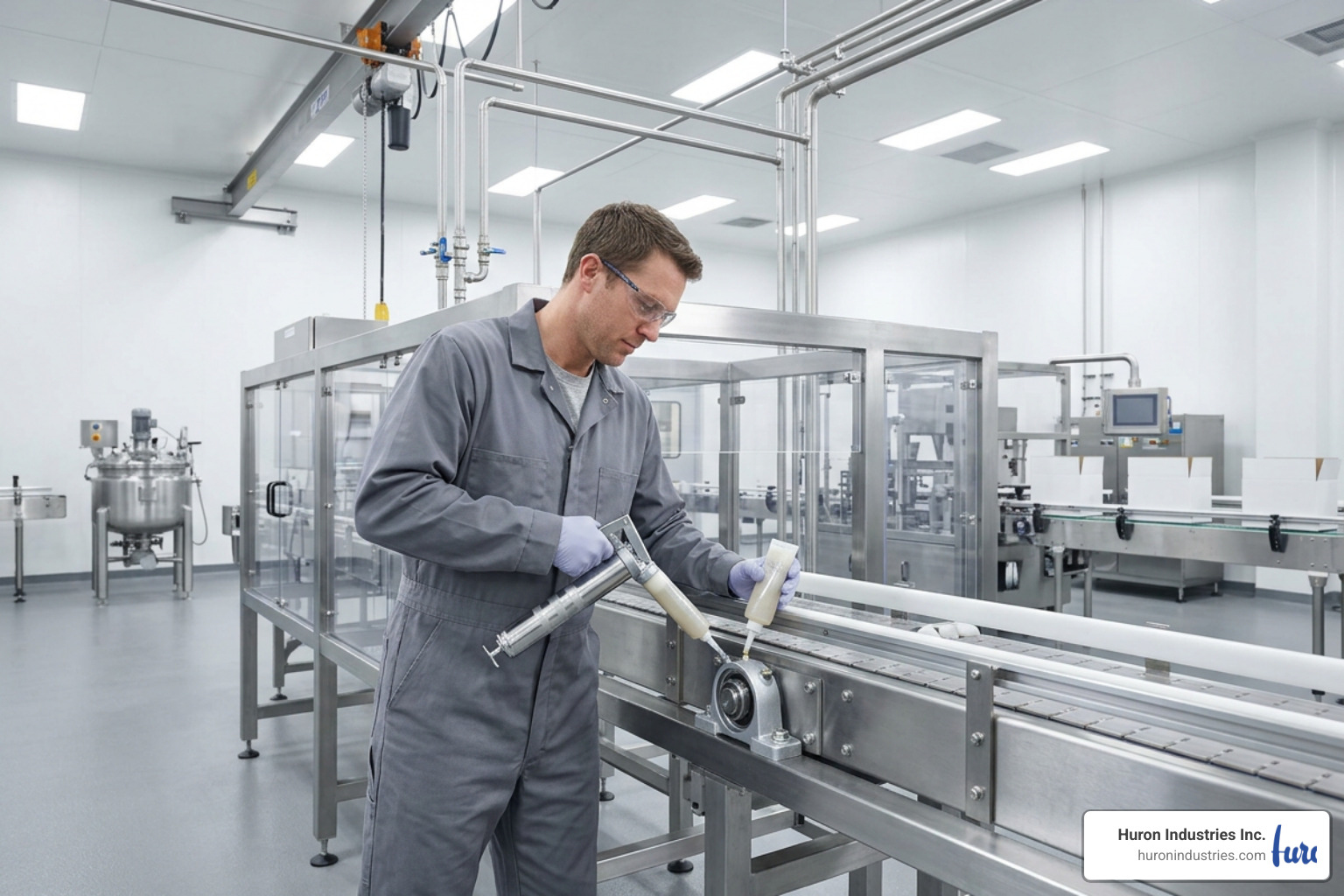
- NSF H1 Registration: In food and beverage processing facilities, machinery still operates under high loads, but any lubricant used must be safe for incidental food contact. Modern food-grade EP greases utilize advanced synthetic base oils and specialized non-toxic additives to achieve high load-carrying performance while meeting strict NSF H1 safety standards.
- Biodegradable Marine Lubricants: For marine and offshore applications, lubricants can easily escape into the environment. Environmentally Acceptable Lubricants (EALs) utilize biodegradable synthetic esters or vegetable base oils that break down naturally in water without bioaccumulating or harming marine life.
For operators looking for a high-performance food-grade option, high-temperature EP greases can utilize a high concentration of polytetrafluoroethylene (PTFE) to achieve a massive 620 kg Four-Ball Weld Point while maintaining full NSF H1 registration for incidental food contact.
Frequently Asked Questions about EP Lubrication
What is the difference between anti-wear (AW) and extreme pressure (EP) lubricants?
While both protect against wear, they operate under different load levels and contact pressures:
- Anti-Wear (AW) Lubricants: Designed for moderate loads and continuous sliding speeds. They typically use polar additives like ZDDP that physically adsorb onto metal surfaces to form a thin protective layer. This layer prevents wear under normal operating conditions but is easily sheared off under extreme loads.
- Extreme Pressure (EP) Lubricants: Designed for high-load, low-speed, or shock-load conditions where boundary lubrication occurs. EP additives require high localized temperatures to chemically react with and bond to the metal surface, creating a highly durable sacrificial film that can withstand extreme contact pressures.
Can extreme pressure lubricants corrode yellow metals like bronze?
Yes, if the formulation contains active sulfur additives. Active sulfur reacts with copper-containing alloys (like bronze and brass) at relatively low temperatures, causing chemical corrosion. This is a major concern in worm gearboxes, which often feature a steel worm gear driving a bronze ring gear. For systems containing yellow metals, always select an EP lubricant formulated with inactive sulfur or non-corrosive solid lubricants like graphite.
Why are chlorinated paraffins being phased out of EP formulations?
Chlorinated paraffins were once highly popular EP additives because they are incredibly effective and cost-efficient. However, they have been heavily phased out due to environmental toxicity. Short-chain chlorinated paraffins are highly persistent in the environment, bioaccumulate in living organisms, and are classified as potential carcinogens. Modern EP formulations replace them with safer sulfur-phosphorus chemistries, calcium sulfonates, or advanced solid lubricants.
Conclusion
When your industrial machinery is running under extreme loads, high temperatures, and harsh environmental conditions, a standard lubricant simply cannot keep up. Investing in a high-quality extreme pressure lubricant is the single most effective way to prevent unplanned downtime, reduce component wear, and extend the service life of your critical assets.
At Huron Industries Inc., we have been manufacturing certified, high-purity, and high-performance lubrication solutions since 1971. From our Port Huron, Michigan facility, we supply specialized colloidal graphite lubricants, thread sealants, and anti-seize compounds trusted in the world's most demanding naval and commercial nuclear reactor systems.
To find the perfect high-temperature, high-pressure solution for your critical applications, learn more about thermal stability performance and let us help you keep your machinery running smoothly—no matter how high the pressure gets.