
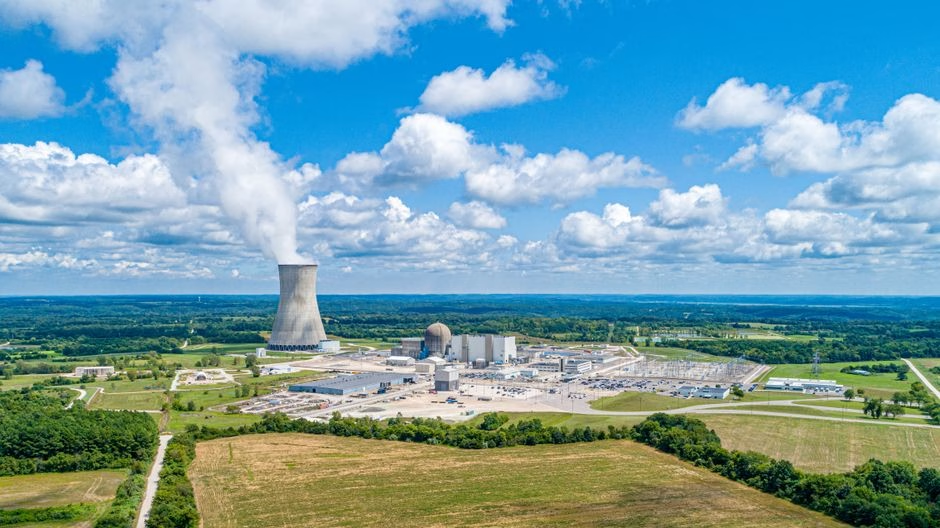
When a Leak Isn't Just a Leak: Why Nuclear Grade Sealant Matters
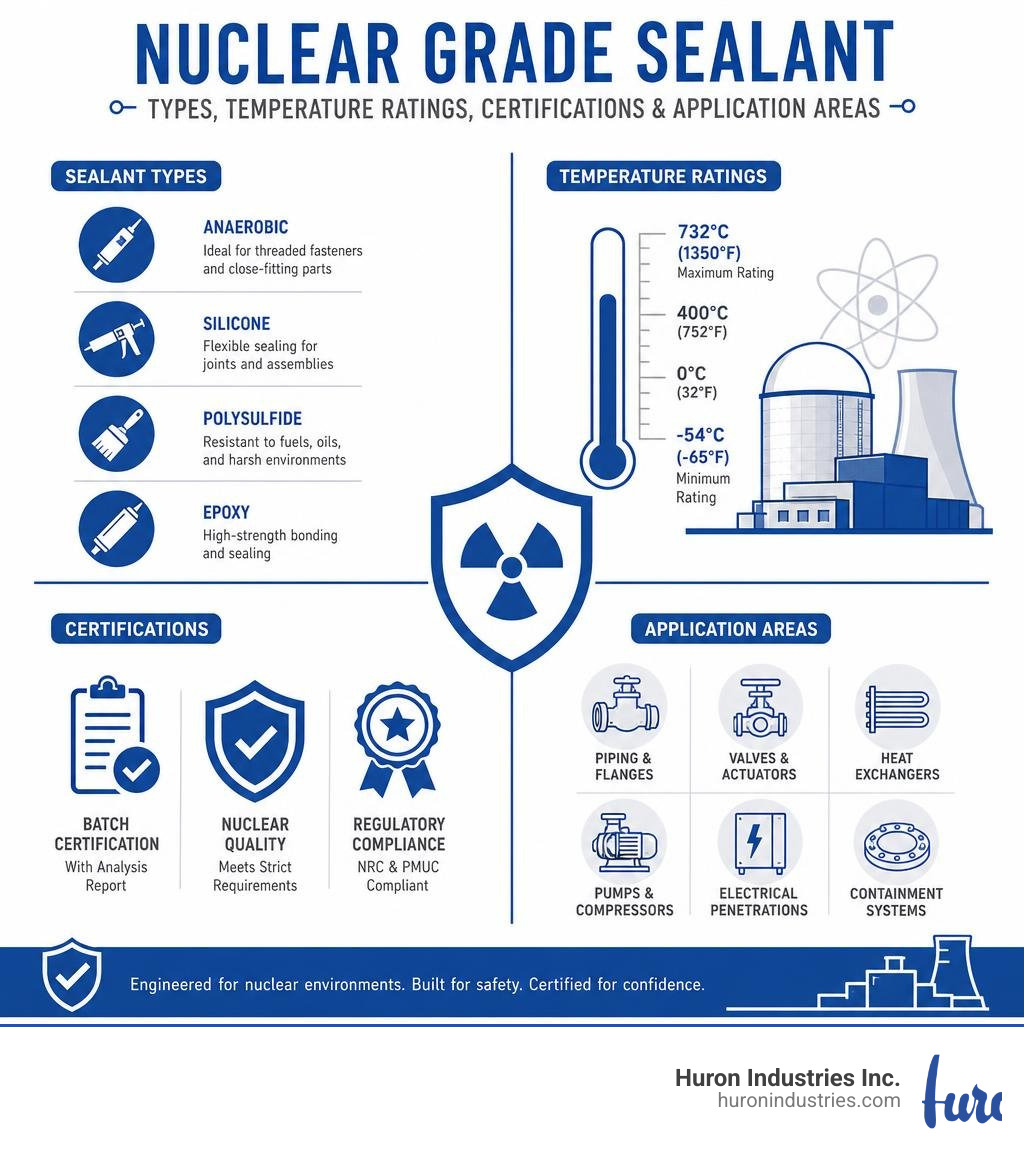
A nuclear grade sealant is a high-purity sealing compound engineered specifically for use in nuclear power plants, defense reactors, and other radiation-critical environments. Unlike standard industrial sealants, nuclear grade products must meet strict limits on halogens, sulfur, and heavy metals — and every batch must be certified before use.
Quick answer: What is a nuclear grade sealant?
| Feature | Nuclear Grade Sealant | Standard Industrial Sealant |
|---|---|---|
| Halogen content | Controlled (e.g., <25 ppm Cl typical) | Not typically controlled |
| Batch certification | Required (with analysis report) | Rarely required |
| Radiation resistance | Tested and rated | Not rated |
| Temperature range | Up to 732°C (1350°F) or higher | Varies widely |
| Sulfur content | Strictly limited | Not typically limited |
| Regulatory compliance | Required (e.g., NRC, PMUC) | Not required |
Inside a nuclear facility, a small leak is never just a maintenance inconvenience. It can mean radiation exposure, contamination of stainless steel systems, or — in serious cases — a safety event. In 1984, the U.S. Nuclear Regulatory Commission issued an information notice after excess anaerobic sealant at Peach Bottom Unit 3 migrated into a solenoid valve and caused two control rods to exceed their allowed scram times. The fix wasn't just a better application technique. It was a switch to properly certified, nuclear grade materials.
That's the difference a certified sealant makes — and why the stakes of getting it wrong are so high.
I'm Nicholas Cunha, founder of CreatiVertical and the content strategist behind Huron Industries Inc.'s digital presence. My work helping Huron bring its colloidal graphite and nuclear grade sealant product lines to the engineers and procurement buyers who source them gives me a close working knowledge of what these products actually need to do in the field. Let's walk through the key types, specifications, and selection criteria so you can source with confidence.
What is a Nuclear Grade Sealant and Why Does It Matter?
When you step into a nuclear power plant, you quickly realize that the laws of standard industrial maintenance no longer apply. In a conventional manufacturing facility, if a pipe joint drips a little steam or a flange weeps a bit of water, you grab whatever standard industrial sealant is sitting on the maintenance cart, slather it on, and call it a day.
In a nuclear reactor system, that casual approach can lead to a catastrophic regulatory and operational nightmare.
The primary reason we must differentiate a nuclear grade sealant from its standard industrial counterparts comes down to chemical compatibility, corrosion prevention, and system integrity. Many standard sealants contain high concentrations of halogens (like chlorine and fluorine) and sulfur. Under normal conditions, these elements seem harmless. However, when exposed to the high temperatures, intense pressures, and extreme radiation of a nuclear primary loop, these elements break down.
When halogens come into contact with stainless steel and nickel-based alloys under stress, they cause a phenomenon known as Stress Corrosion Cracking (SCC). This insidious form of corrosion can cause a high-pressure pipe to rupture without warning. To protect these critical metallic structures, nuclear operators enforce incredibly strict halogen limits and sulfur limits.
The danger of using non-certified compounds is not theoretical. The historical record is clear. As detailed in the NRC Information Concerning the Use of Loctite 242 and Other Anaerobic ... , standard anaerobic adhesive compounds can remain liquid when exposed to air. In safety-critical systems, this uncured liquid can migrate. At Peach Bottom Unit 3, excess sealant migrated directly into solenoid valves, causing critical control rods to fail their scram time requirements.
This is why choosing a certified, high-purity Low Halogen Thread Sealant When It Matters is not just a best practice—it is a regulatory mandate.
Key Performance Requirements and Certifications
Because the consequences of sealant failure are so severe, the nuclear industry does not rely on promises. It relies on rigorous testing, strict certifications, and comprehensive batch tracking.

Every single production batch of a nuclear grade sealant must undergo systematic laboratory testing. This ensures that the chemical composition of the specific tube or can you hold in your hand matches the stringent safety envelope of the plant.
One of the most widely recognized global frameworks is the PMUC certification (Produits et Matériaux Utilisables en Centrales Nucléaires), established by the French utility EDF. PMUC standards require strict control of chlorine, fluorine, and sulfur content to minimize pollution and corrosion in nuclear circuits.
In the United States, individual utilities and reactor designers set their own rigorous specifications. For instance, General Electric’s nonmetallic material specification D50YP12 Rev 2 outlines strict limits for leachable chlorides, total halogens, sulfur, and low-melting-point embrittling metals (such as lead, zinc, and antimony) that could compromise alloy integrity.
Purity Standards for a Nuclear Grade Sealant
To appreciate the precision involved, let’s look at the actual parts-per-million (ppm) limits required for high-purity graphite thread sealants. A certified nuclear-grade compound typically conforms to the following chemical thresholds:
- Total Halogens (as Cl): <25 ppm typical, with an absolute maximum of 450 ppm.
- Leachable Chloride: <10 ppm typical, with a maximum limit of 50 ppm.
- Total Sulfur: <150 ppm typical, with a maximum limit of 630 ppm.
- Embrittling Metals: <250 ppm typical, with a maximum limit of 500 ppm.
Meeting these standards requires specialized manufacturing processes and pristine raw materials. For engineering teams reviewing these products, having access to verifiable Safety Technical Datasheets is essential for verifying compliance before any material enters the containment boundary.
Radiation Resistance and Thermal Cycling
Purity is only half the battle. Once applied, a nuclear grade sealant must survive an environment that would rapidly destroy standard commercial polymers.
First, there is the issue of radiation resistance. High levels of gamma radiation and neutron flux break down the molecular bonds of standard elastomers, causing them to turn brittle, shrink, or crumble into powder. A true nuclear sealant must withstand massive cumulative doses—often exceeding $1.5 times 10^9$ RADS of Gamma radiation—without losing its structural integrity or sealing properties.
Second, the sealant must endure relentless thermal cycling. As a reactor starts up, operates, and shuts down for refueling, piping systems expand and contract. Sealants must maintain their elasticity or structural stability through these massive temperature swings without cracking or losing adhesion. For extreme primary system applications, using a High Temperature Thread Sealant Critical Service ensures that the joint remains completely leak-free under both thermal expansion and high-pressure conditions.
Main Types of High-Temperature Nuclear Sealants
No single sealant can handle every job in a nuclear plant. The product you choose depends entirely on the joint geometry, temperature, pressure, and whether the system needs to be disassembled in the future.
| Sealant Type | Typical Base Material | Max Temperature | Max Pressure | Primary Application |
|---|---|---|---|---|
| High-Purity Paste | Colloidal Graphite / Petroleum Carrier | 635°C (1175°F) | 16 MPa (2300 psi) | Small-diameter threaded pipe joints, instrumentation lines, bolts |
| Thermal Reactive Liquid/Paste | Heat-Curing Resins | 732°C (1350°F) | 758 Bar (11,000 psi) | Large flanges, turbines, steam lines, online leak sealing |
| Silicone Elastomer | Radiological Silicone | 180°C (356°F) | 100 kPa (Air) | Cable penetrations, fire barriers, structural joints |
Colloidal Graphite and High-Purity Thread Sealants
For threaded connections and close-tolerance joints, high-purity colloidal graphite paste is the gold standard. These sealants utilize a high-purity petroleum-based carrier that acts as a lubricant during assembly, allowing installers to achieve precise torque values.
As the system heats up to operating temperature, the petroleum carrier cleanly volatilizes, leaving behind a dense, highly compressed matrix of pure graphite. This graphite matrix remains stable up to 635°C (1175°F) and easily withstands pressures up to 16 MPa (2300 psi).
Because graphite does not cure or harden into a rigid adhesive, it prevents galling on stainless steel threads and acts as an exceptional anti-seize compound. When it comes time for maintenance, the joints can be easily disassembled—even after years of high-temperature, high-radiation service. For critical systems, utilizing a High Pressure Thread Sealant 2300 PSI Neolube 1260 ensures long-term joint integrity without the risk of system contamination.
Selecting the Right Nuclear Grade Sealant for Critical Piping
Selecting a sealant for critical piping networks requires balancing several physical factors:
- Pipe Diameter: High-purity graphite pastes are generally optimized for small-diameter, close-tolerance threaded joints (typically up to 2 inches).
- Flange Configuration: Large, irregular flanges or steam-cut joints often require thermal reactive liquids or heavy pastes. These compounds cure upon exposure to heat, filling microscopic voids and resisting extreme pressures up to 11,000 psi (758 Bar), such as those found in steam turbines and primary coolant pumps. Products like Deacon 770-L SS Nuclear Grade Liquid Sealant - Jet-Lube provide heat-curing properties with high chemical tolerance for these demanding environments.
- Gasket Compatibility: It is critical to ensure your sealant does not react with surrounding gaskets. For example, graphite-based sealants are highly compatible with Nitrile and Viton, but should not be used in direct contact with EPDM, Silicone, or Neoprene unless verified by engineering.
For decades, procurement specialists have relied on verified industrial directories like Huron Industries, Inc. - Thomasnet to source these highly specialized, American-made sealing compounds.
Elastomeric and Penetration Sealing Systems
While graphite and thermal-reactive compounds dominate piping and mechanical systems, structural containment requires a completely different class of materials.
Electrical cable runs, piping penetrations, and structural expansion joints must be sealed to prevent the migration of air, water, fire, and radiation between different zones of the reactor building. These applications use highly specialized elastomeric systems:
- Penetration Caulking: Systems like the Penetration caulking system - NuPLUG 3130 utilize flexible radiological silicone elastomers. These compounds are engineered to provide a gamma and neutron radiation attenuation factor equivalent to solid concrete, while remaining flexible enough to accommodate significant pipe movement and thermal expansion.
- Expansion Joint Sealing: For sealing large structural gaps up to 600mm wide between buildings, systems like the Joint sealing system - NuJOINT 3120 combine mineral wool, refractory glue, and silicone elastomers. These systems provide up to 4 hours of fire resistance and withstand water pressures up to 3 bars, protecting critical safety-related structures during design-basis accidents.
Frequently Asked Questions About Nuclear Sealants
Navigating the technical requirements of nuclear-grade materials can be challenging. Here are answers to some of the most common questions we encounter from field engineers and procurement specialists.

What makes a sealant "nuclear grade"?
A sealant is classified as "nuclear grade" when it is manufactured under strict quality assurance programs (often conforming to 10 CFR 50 Appendix B in the US) and certified to contain exceptionally low levels of halogens (chlorine, fluorine), sulfur, and low-melting-point metals. Every batch must undergo independent laboratory analysis, and the product must be accompanied by a certified batch analysis report to prevent stress corrosion cracking in safety-related alloys.
Can standard thread sealants be used in reactors?
No. Standard commercial thread sealants, including many common anaerobic adhesives and standard PTFE tapes, are not permitted in critical nuclear systems. Standard anaerobic compounds can remain liquid when exposed to air, allowing them to migrate into safety-critical components like control rod drive mechanisms or solenoid valves, leading to equipment failure. Furthermore, their uncontrolled halogen and sulfur levels present a significant risk of cracking in stainless steel systems.
How do graphite sealants perform under extreme radiation?
High-purity graphite is incredibly stable under radiation. Unlike synthetic polymers or rubbers, which degrade, harden, or shrink when exposed to gamma and neutron radiation, graphite maintains its molecular structure. Tested up to cumulative doses of $1.5 times 10^9$ RADS of Gamma radiation, premium graphite sealants show no apparent change in physical properties, ensuring a reliable, long-term seal throughout the operating lifecycle of the reactor.
Conclusion
In the demanding world of nuclear power generation, there is no room for compromise. Every valve, flange, instrument line, and structural penetration must be sealed with absolute certainty. A high-quality nuclear grade sealant is a critical line of defense, ensuring that high-pressure, high-radiation systems remain completely contained.
At Huron Industries Inc., we have spent over five decades manufacturing the high-purity, high-performance compounds that keep reactors operating safely. Based in Port Huron, Michigan, our flagship Neolube® colloidal-graphite line is qualified to MIL-L-24131C and trusted in both commercial and naval nuclear systems worldwide.
In addition to our world-class lubricants and thread sealants, we support plant safety with our Neosafe line of industrial spill sorbents. Designed to manage spills quickly and efficiently, you can access the Neosafe All Purpose Safety Datasheet SDS and Neosafe All Purpose Technical Datasheet TDS to see how they fit into your plant's maintenance protocols. For more demanding environments, we also offer the Neosafe Max Safety Datasheet SDS along with its Neosafe Max Technical Datasheet TDS, as well as the Neosafe Plus Safety Datasheet SDS and Neosafe Plus Technical Datasheet TDS to ensure your team is prepared for any cleanup scenario.
When you need certified performance that stands up to extreme heat, intense pressure, and high-radiation environments, choose the products designed specifically for the job. Explore our complete range of solutions for Nuclear Industry Applications and let us help you maintain the highest standards of safety and regulatory compliance.