
What Is Neolube No. 1.1 — and Why Does It Matter for Critical Applications?
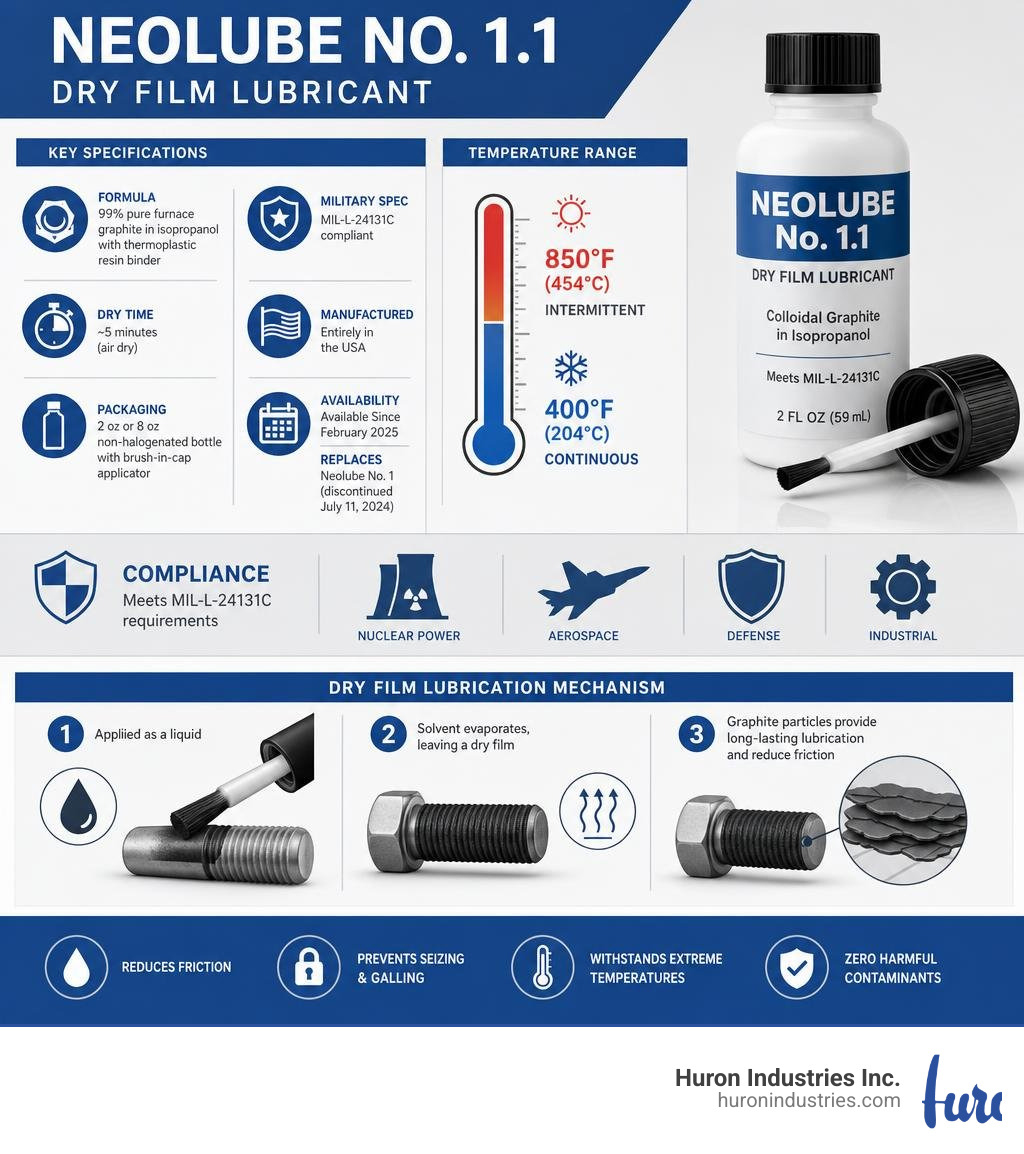
Neolube No. 1.1 is a colloidal graphite dry film lubricant suspended in isopropanol, designed for use in nuclear power plants, aerospace, defense, and high-precision industrial environments where impurity control and regulatory compliance are non-negotiable.
Here's a quick summary of what you need to know:
| Property | Detail |
|---|---|
| Formula | 99% pure furnace graphite in isopropanol with thermoplastic resin binder |
| Military Spec | MIL-L-24131C compliant |
| Service Temp | Up to 400°F (204°C) continuous; 850°F (454°C) intermittent |
| Dry Time | ~5 minutes (air dry) |
| Packaging | 2 oz or 8 oz non-halogenated bottle with brush-in-cap applicator |
| Manufactured | Entirely in the USA |
| Replaced | Neolube No. 1 (discontinued July 11, 2024) |
| Available Since | February 2025 |
Dry film lubricants like Neolube No. 1.1 have been used in the construction and maintenance of every nuclear power plant in the United States. That's not a marketing claim — it's a reflection of how critical clean, low-impurity lubrication is in environments where contamination can have serious consequences.
When a lubricant goes on a threaded fastener inside a nuclear reactor system, it needs to do several things at once: reduce friction, prevent seizing and galling, survive extreme temperatures, and introduce zero harmful contaminants into the environment around it. That's a tall order. Neolube No. 1.1 was built specifically to meet it.
I'm Nicholas Cunha, the digital marketing and SEO strategist behind Huron Industries Inc.'s content program — I've worked closely with the Huron team to document and communicate the technical details of Neolube No. 1.1 for the engineers, procurement specialists, and maintenance professionals who need accurate, specification-level information to make qualified sourcing decisions. In the sections below, we'll walk through everything from compliance specs to application procedures so you have exactly what you need.
Technical Specifications and Compliance of Neolube No 1.1

When working in nuclear and aerospace engineering, "close enough" is a phrase that can keep you up at night. That is why the technical specifications of neolube no 1.1 are tracked down to the single parts-per-million (PPM) level.
To start, the material is a suspension of 99% pure furnace graphite particles in high-purity isopropanol (isopropyl alcohol), held together by a specialized thermoplastic resin binder. The total solids content of the mixture is held to a strict window of 3.30% ± 0.50%. Of those total solids, graphite makes up 75% ± 5%.
The primary standard governing this product is MIL-L-24131C, a military specification that dictates the performance and chemical boundaries of dry film colloidal graphite lubricants. Meeting this standard means every batch must undergo rigorous laboratory testing to verify that it does not introduce corrosive elements or heavy metals into delicate machinery.
To understand how the new formulation stacks up against the legacy version, let's look at the direct specifications side-by-side:
Specifications Comparison Table
| Parameter | Legacy Neolube No. 1 (Discontinued) | Neolube No. 1.1 (Current) |
|---|---|---|
| Solids Content | 3.30% ± 0.50% | 3.30% ± 0.50% |
| Graphite Purity | 99% pure furnace graphite | 99% pure furnace graphite |
| Carrier Solvent | Isopropanol | Isopropanol |
| Binder Type | Thermoplastic Resin | Enhanced Thermoplastic Resin |
| Max Particle Size | 10 microns (90% < 4 microns) | 10 microns (90% < 4 microns) |
| Ash Limit (on solids) | Max 0.75% | Max 0.75% |
| Fluorine Limit | Max 20 PPM | Max 20 PPM |
| Chlorine Limit | Max 200 PPM | Max 200 PPM |
| Sulfur Limit | Max 200 PPM | Max 200 PPM |
| Lead Limit | Max 150 PPM | Max 150 PPM |
| Mercury Content | Mercury-Free | Mercury-Free |
| Density | 6.6 lb./gal (0.791 kg/l) | 6.8 lb./gal (0.82 kg/l) |
| Flash Point | 52°F (11°C) | 52°F (11°C) |
For complete documentation on these properties, you can download the official Neolube No. 1.1 Technical Data Sheet or review the safety protocols in the Neolube No. 1.1 Safety Data Sheet.
The Evolution from Neolube No 1 to Neolube No 1.1
Change is inevitable, even for products that have performed flawlessly for half a century. The legacy Neolube No. 1 was a staple of the Qualified Products List (QPL) since 1974. However, as raw material supply chains evolved and manufacturing technologies advanced, the legacy formula had to be retired. Huron Industries officially discontinued Neolube No. 1 on July 11, 2024.
To fill this critical gap without disrupting naval and commercial nuclear operations, Huron developed and launched the next-generation replacement. In February 2025, the company officially introduced the updated formulation. You can read the full launch details in the news release: Huron Industries Launches Neolube No 1.1.
What changed? The core differences lie in the updated thermoplastic resin binder. This modernized binder system improves the adhesion of the graphite particles to metal substrates, reducing flaking and providing a more durable dry film. Despite the update, the product maintains full compliance with the MIL-L-24131C standard. Best of all, it is manufactured and tested entirely at our facility in Port Huron, Michigan, ensuring complete control over the supply chain and quality testing.
Physical and Chemical Properties
The magic of neolube no 1.1 lies in its microscopic structure. Let's break down the physical and chemical properties that make this lubricant so reliable:
- Microscopic Particle Size: The graphite particles are incredibly fine. At least 90% of the particles have a maximum dimension of 4 microns, and absolutely no particle exceeds 10 microns. This ultra-fine particle size allows the lubricant to penetrate tight clearances and coat threaded parts smoothly without clumping.
- Extreme Purity (Low Halogens and Metals): In nuclear environments, halogens (like fluorine and chlorine) and heavy metals (like lead and mercury) are highly restricted because they can cause stress corrosion cracking in stainless steel. Neolube No. 1.1 enforces strict limits: Fluorine is kept under 20 PPM, Chlorine under 200 PPM, Sulfur under 200 PPM, and Lead under 150 PPM.
- Mercury-Free Manufacturing: No mercury or low-melting-point metals are ever intentionally added during the manufacturing process.
- Coefficient of Friction: The static coefficient of friction of the cured coating is 0.15, providing excellent slip and preventing seizing under high loads.
- Density & Flash Point: The product has a density of 6.8 lb/gal (0.82 kg/l) and a flash point of 52°F (11°C), reflecting its high isopropanol content.
Industrial and Nuclear Applications of Neolube No 1.1
Thanks to its unique combination of lubrication, chemical purity, and electrical conductivity, Neolube No. 1.1 is used across several high-performance sectors:
- Nuclear Power Generation: It is used as an anti-seize compound and thread lubricant on internal and auxiliary equipment mechanisms in commercial and naval nuclear reactor systems. It allows for tight assemblies that can be disassembled years later without destructive drilling.
- Electrical Contacts and Switchgear: Because graphite is naturally conductive, Neolube No. 1.1 is applied to electrical contacts, sliding switches, and switchgear to reduce physical wear while maintaining electrical path integrity.
- Aerospace and Defense: It serves as a dry lubricant on precision aerospace components where wet greases would attract dust or evaporate in low-pressure environments.
- High-Vacuum Systems: Standard liquid lubricants outgas in a vacuum, ruining the vacuum seal and contaminating sensitive instruments. Neolube No. 1.1 cures to a solid, non-outgassing graphite film, making it perfect for high-vacuum chambers.
For a deeper look into its historical role in energy generation, check out the background resource: Dry Film Lubricant Used In US Nuclear Power Plants.
Application Guidelines and Best Practices

Applying Neolube no 1.1 is simple, but getting a long-lasting, high-performance film requires following a few basic steps. Here is how I recommend preparing, applying, and curing the lubricant for professional results.
Step 1: Substrate Preparation
A dry film lubricant is only as good as its bond to the metal. If there is oil, grease, or cutting fluid on the surface, the thermoplastic resin cannot adhere properly.
- Thoroughly clean the metal substrate using a solvent wipe (such as high-purity isopropanol or acetone).
- Ensure the surface is completely dry before applying the lubricant.
- For critical industrial applications, a light mechanical abrasion or chemical etching can further improve the mechanical bond of the graphite film.
Step 2: Mixing and Dilution
Because Neolube No. 1.1 is a colloidal suspension, the graphite particles will naturally settle to the bottom of the bottle over time.
- Always shake or stir the container thoroughly before use to ensure the graphite is uniformly distributed.
- If the product has thickened due to solvent evaporation, or if you require an exceptionally thin coating, you can dilute it by adding pure, technical-grade isopropanol while mixing uniformly.
Step 3: Application Methods
You can apply Neolube No. 1.1 using several common industrial methods:
- Brush-in-Cap / Manual Brushing: Ideal for small parts, threaded fasteners, and localized touch-ups.
- Spraying: For large surface areas or ultra-thin, highly uniform coatings. When spraying, ensure you use adequate local exhaust ventilation to manage the isopropanol vapors.
- Dipping: Perfect for batch-processing small components. Simply dip the clean parts into the agitated suspension, remove them, and let the excess liquid drain off.
Step 4: Curing and Drying Time
The carrier solvent (isopropanol) evaporates quickly. Under normal room temperature and humidity conditions, the film will air dry in approximately 5 minutes. Once dry, the parts can be handled and assembled. No high-temperature baking is required to cure the thermoplastic binder.
Ready to secure a bottle for your next project? You can purchase individual containers directly through our online store:
- Neolube No. 1.1 2oz Product Page (includes a convenient brush-in-cap applicator)
- Neolube No. 1.1 8oz Product Page (ideal for larger maintenance and assembly jobs)
Safety, Handling, and Storage Precautions
Because Neolube No. 1.1 relies on an isopropanol carrier, it must be treated as a Category 1 Flammable Liquid. Working safely with it is straightforward if you keep a few standard industrial safety protocols in mind.
- Keep Away from Ignition Sources: Store and apply the lubricant far away from heat, sparks, open flames, and hot surfaces. Smoking should be strictly prohibited in application areas.
- Ventilation is Key: Use only outdoors or in a well-ventilated area. If you are spraying the product indoors, local exhaust ventilation is highly recommended to keep vapor concentrations below permissible exposure limits.
- Wear Protective Gear: Isopropanol can dry out skin and irritate eyes. Wear protective nitrile gloves and safety glasses during application.
- Use Non-Sparking Tools: When opening or handling bulk containers in flammable environments, use non-sparking tools and explosion-proof electrical equipment.
- Storage Temperature Limits: Store the product in a cool, well-ventilated space. Keep the storage temperature at or below 90°F (32.2°C). Always keep the container tightly closed when not in use to prevent the solvent from evaporating and leaving behind a dried-out block of graphite.
If your application requires a different dry film conductive lubricant formula, you may also want to review the safety protocols for our other popular products, such as the Neolube No. 2 Safety Data Sheet.
Frequently Asked Questions
What is the service temperature limit for Neolube No 1.1?
Neolube no 1.1 is highly effective at temperatures up to 400°F (204°C) under continuous service, and can withstand intermittent exposures up to 850°F (454°C).
However, there is an important limitation to keep in mind: it is not recommended for use on threaded fasteners located inside the reactor primary containment area if those fasteners will experience continuous temperatures exceeding 400°F. For those extreme, ultra-high-temperature primary containment environments, specialized lubricants like Neolube No. 1260 are typically recommended instead. You can read more about these application limits on the Dry Film Lubricant Used In US Nuclear Power Plants information page.
Can Neolube No 1.1 be used in oxygen systems?
No, Neolube No. 1.1 is not recommended for use in pure oxygen systems. The combination of an organic thermoplastic resin binder, carbon-based graphite, and any potential residual isopropanol solvent can present a combustion hazard in high-pressure, pure oxygen environments. Always consult with a materials engineer to select specialized oxygen-compatible lubricants for gaseous or liquid oxygen systems.
What packaging sizes and NSNs are available?
Neolube No. 1.1 is available in two convenient, non-halogenated plastic bottle sizes designed to protect the purity of the lubricant:
- 2-Ounce Bottle: Features a handy brush-in-cap applicator for easy precision brushing.
- 8-Ounce Bottle: Perfect for larger assemblies, dipping, or pouring into spray equipment.
For military and defense procurement, the 2-ounce package is assigned National Stock Number (NSN) 1H 9150 01-725-0368 X3. For additional procurement details and international shipping options, you can view the Neolube No.1.1 Newman Tools Product Page.
Conclusion
Since Huron Industries Inc. was established in 1971 in Port Huron, Michigan, we have committed ourselves to manufacturing the highest-purity, highest-performance specialty graphite lubricants on the market. Neolube No. 1.1 represents the next generation of this legacy, providing commercial and naval nuclear reactor systems, aerospace manufacturers, and industrial facilities with a reliable, MIL-L-24131C compliant solution.
Whether you need to prevent galling on threaded stainless steel bolts, coat sliding electrical contacts, or prepare components for high-vacuum environments, Neolube No. 1.1 delivers consistent, clean performance.
Ready to explore our full lineup of specialty industrial lubricants, sealants, and anti-seize compounds? Explore the NEOLUBE Product Category to find the perfect solution for your most demanding applications.