
Why Choosing the Right CaseLube Matters for Precision Reloading
Quick Answer: What is CaseLube?
| Question | Answer |
|---|---|
| What is it? | A colloidal graphite dry-film lubricant for cartridge case necks |
| What does it do? | Reduces sizing friction and promotes consistent neck tension |
| Who makes it? | Huron Industries Inc. |
| How is it applied? | Foam pad, brush, or dip method inside case neck |
| How long to dry? | Touch-dry in ~5 minutes, ready to use in ~30 minutes |
| Available sizes | 2 oz and 8 oz bottles |
CaseLube is one of the most important — and most overlooked — variables in precision ammunition reloading. Most reloaders focus on powder charges, bullet selection, and seating depth. But the lubricant you use on your case necks directly affects neck tension consistency, sizing force, and ultimately, how tight your shot groups are.
A stuck case in a sizing die is the obvious failure. But there's a subtler problem: inconsistent lubrication that causes uneven neck tension from case to case — and that shows up as velocity spread and flyers downrange.
Choosing the wrong lube, or applying it wrong, costs you precision. This guide covers everything you need to know to get it right.
I'm Nicholas Cunha, founder of CreatiVertical and the content strategist behind Huron Industries Inc.'s digital presence — including their CaseLube colloidal graphite lubricant line. My work involves translating complex, highly specified industrial and specialty products into clear guidance for the buyers and end users who rely on them.
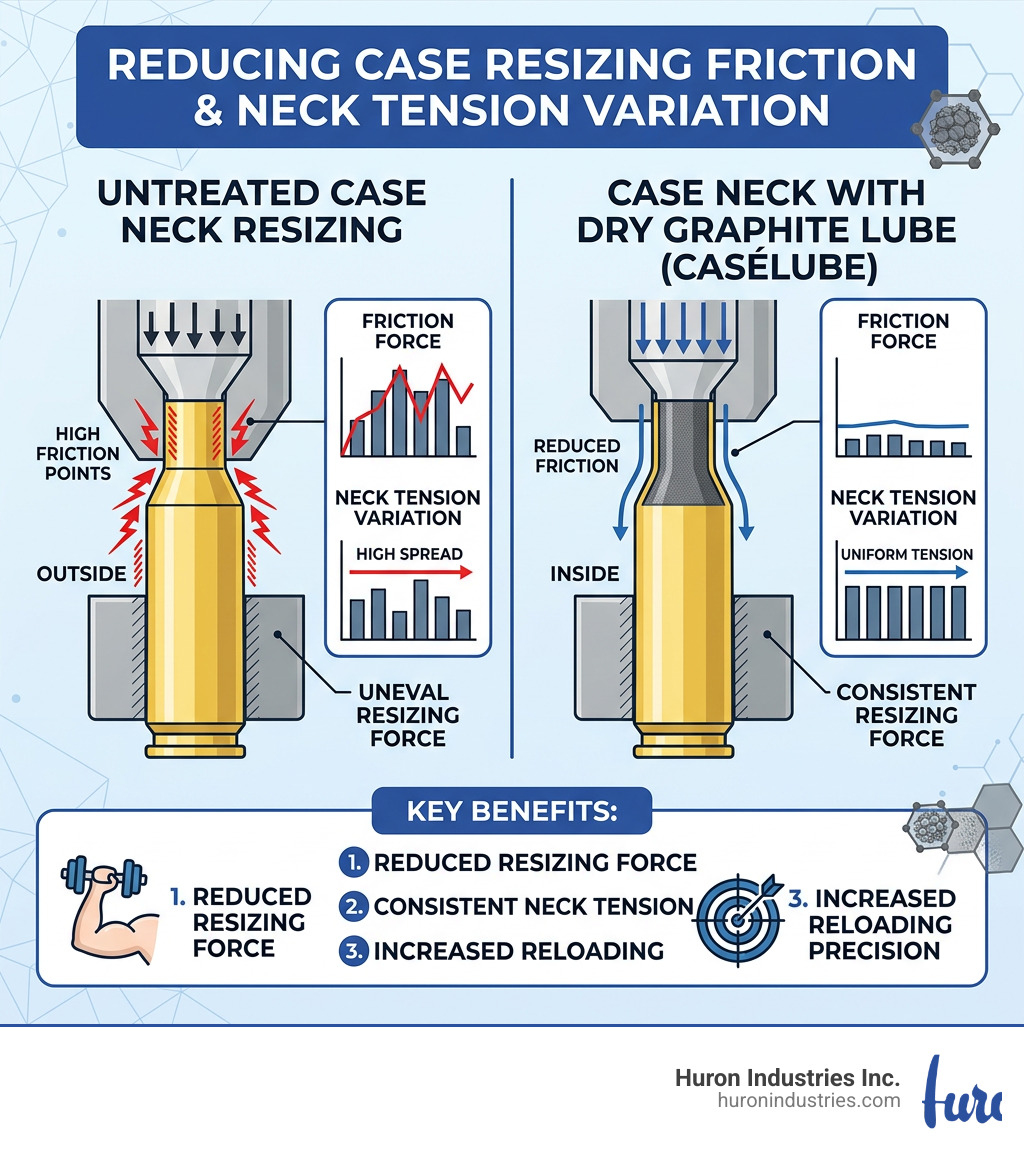
What is CaseLube and How Does It Work?
If you have spent any time hanging out in reloading circles, you have probably heard people debating the merits of different lubricants. But what exactly is CaseLube, and how does it differ from the typical sticky goop you find on a traditional reloading bench?
At its core, CaseLube is a highly specialized colloidal graphite dry-film lubricant. Unlike traditional wet lubricants that rely on oils, waxes, or silicones to create a slippery barrier, our formula harnesses the natural lubricating properties of microscopically fine graphite particles. These particles are suspended in an ultra-pure isopropanol carrier.
When you apply it to your brass, the isopropanol carrier quickly evaporates, leaving behind a micro-thin, chemically bonded dry graphite film. This film is incredibly thin—typically between 0.2 and 0.5 mils thick—meaning it does not alter the physical dimensions of your brass in any measurable way. Yet, it provides an exceptionally slick surface with a static coefficient of friction of just 0.19.
This dry film is where the magic happens. Because the graphite is colloidal, it bonds directly to the brass surface on a molecular level. It does not run, migrate, or wear off easily during handling. When you run your brass into a sizing die, this micro-thin barrier acts as a shield, dramatically reducing the force required to resize the case and pull the expander ball back out through the case neck.
To dive deeper into the science of how this dry film interacts with your brass, you can read our Technical Notes Neolube 2 for Lubricating Internal Case Necks and explore the history of our specialized formulas on our Brand Neolube Caselube Neolube page.
The Benefits of Dry Graphite vs. Traditional Case Lubricants
To truly appreciate dry graphite, we have to look at what reloaders have been dealing with for decades. Traditional wet lubricants - including gels, waxes, and oil-based case lubricants - can help prevent stuck cases. But they come with a host of annoying side effects.
First, there is the sticky residue. Wet lubes act like dust magnets on your reloading bench. If you do not clean every single drop off your brass after sizing, that sticky film will attract dirt, powder flakes, and pocket lint.
Even worse is the risk of powder and primer contamination. If a wet lubricant migrates inside the case neck or down into the primer pocket, it can deaden your gunpowder or ruin a primer. That means a click instead of a bang when you pull the trigger.
Aerosol-style lubricants offer convenience, but they often lead to overspray. You end up lubricating your loading blocks, your reloading press, and your hands. And if you get too much wet lube on the shoulder of a bottleneck rifle case, the hydraulic pressure inside the die will actually dent the brass.
Dry graphite eliminates these headaches entirely. Because it dries to a completely static, solid film, there is nothing to migrate, nothing to attract dust, and absolutely zero risk of contaminating your powder or primers.
Let's look at how the different options stack up on the reloading bench:
| Lubricant Type | Residue Level | Powder/Primer Safe? | Ease of Cleanup | Application Target |
|---|---|---|---|---|
| CaseLube (Dry Graphite) | None (Dry Film) | Yes (Non-migrating) | No cleanup required | Case neck interior & exterior |
| Traditional Gel or Wax Lubricant | High (Sticky/Tacky) | No (Must be cleaned) | Requires washing/wiping | Case body or lube pad use |
| Oil-Based or Lanolin-Style Spray | Medium-High | No (Must be cleaned) | Requires wiping or media tumbling | Case body or bulk spray use |
| Aerosol Dry-Film Lubricant | Low-Medium | Yes (If fully dry) | Light wiping | Case body & neck |
| Household Oil, Grease, or Cosmetic Product | Extremely High | No (Not recommended) | Very difficult | Not recommended for reloading |
When you look at discussions on popular reloading forums, you will see reloaders constantly searching for a cleaner, more reliable solution. Some folks even experiment with household oils, greases, or cosmetic products. Those materials are not engineered for brass sizing, case neck lubrication, powder compatibility, or precision ammunition workflows, so they are a poor substitute for a purpose-built dry-film lubricant.
Using the wrong lube can also lead to massive inconsistencies in case neck friction. For a detailed breakdown of how this friction affects your reloading, check out our analysis on Case Neck Friction Extreme Spread.
Why Precision Reloaders Choose CaseLube
For the competitive shooter or the long-range hunter, consistency is everything. You want every single round of ammunition to perform exactly like the last one. This is where CaseLube truly shines.
When you seat a bullet into a cartridge case, the force required to push that bullet into place is directly determined by the friction between the bullet's copper jacket and the inside of the brass case neck. If that friction varies from round to round, your bullet pull (the force required for the powder pressure to release the bullet upon firing) will also vary.
This variation leads to a wider Extreme Spread (ES) and Standard Deviation (SD) in your muzzle velocities. A variation of just 15 to 20 feet per second can be the difference between a bullseye and a complete miss at 600 yards.
Because CaseLube deposits an incredibly uniform, ultra-slick layer of colloidal graphite inside the case neck, it standardizes this friction. Bullet seating becomes incredibly smooth, and your neck tension remains perfectly consistent across your entire batch of ammo.
Compatibility with Rifle and Pistol Brass
Is dry graphite only for high-end precision rifle shooters? Absolutely not. While it is a favorite for bottleneck rifle cartridges like the .223 Remington, 6.5 Creedmoor, and .308 Winchester, it is equally beneficial for handgun reloaders.

When reloading straight-wall pistol cases on a progressive press, many reloaders rely on carbide sizing dies, which technically do not require lubrication. However, even with carbide dies, running completely dry brass creates a lot of physical resistance. It makes the press handle hard to pull and causes the machine to shake, which can spill powder from charged cases.
Applying a light coating of CaseLube makes progressive pistol reloading incredibly smooth. It reduces the wear and tear on your reloading press, saves your arm from fatigue during high-volume sessions, and extends the life of your expensive sizing dies.
Application Techniques for Precision Sizing
Applying CaseLube is incredibly simple, and you do not need any fancy, expensive equipment to do it. The goal is to apply a micro-thin, even layer of the liquid graphite to the inside of the case necks (and the exterior of the cases if you are sizing without a secondary body lube).
You can use a lint-free foam pad, a nylon bore brush, or a simple cotton swab. Some reloaders prefer the "dip" method, where they lightly dip the case neck into the liquid. The key is to remember that with colloidal graphite, less is always more. You want a thin, dark, uniform coating—not a thick, runny puddle.
Once applied, the isopropanol carrier needs a few minutes to "flash off" (evaporate). This leaves the dry, bonded graphite film ready to go. You can find visual guides and specialized tips on how to do this quickly on our page about how to Apply Liquid Graphite to Case Necks.
Step-by-Step Guide to Applying CaseLube
To get the absolute best results from your dry graphite lubricant, follow this simple four-step process:
- Clean Your Brass: Start with clean, dry brass. Any leftover carbon, dirt, or oily residue from previous lubes can prevent the colloidal graphite from bonding properly to the metal.
- Deprime (Optional but Recommended): Depriming your cases before lubrication ensures that the graphite can coat the entire interior of the neck uniformly without pooling around an old primer.
- Apply a Thin Film: Lightly saturate your foam applicator or brush with CaseLube. Insert the applicator into the case neck and rotate it slightly to apply a thin, even coat. If you are sizing bottleneck rifle cases, you can also wipe a tiny amount onto the outer body of the case.
- Allow to Dry: Give the cases about 5 minutes to become dry to the touch, and about 30 minutes to fully cure. Once dry, your brass is ready to run through the sizing die.
For exact physical properties, viscosity ratings, and drying times under different environmental conditions, you can refer directly to the Datasheet Caselube Technical Data Sheet.
Cleaning and Residue Management
One of the best things about dry graphite is how little work it requires after you are done sizing.
With traditional wet lubricants like water-soluble gels or lanolin-based sprays, you must clean the brass after sizing. This usually involves throwing your sized brass back into a vibratory tumbler with corn cob media, running them through a wet rotary tumbler with stainless steel pins, or using an ultrasonic cleaner. It adds an entire extra step (and hours of drying time) to your reloading workflow.
With CaseLube, you can completely skip the post-sizing wash. Because the cured graphite film is dry, non-migrating, and completely chemically inert, it will not affect your gunpowder or primers. You can go straight from the sizing press to the powder dropper and bullet seating station. The tiny amount of graphite left inside the neck actually acts as a beneficial lubricant when the bullet is fired, reducing throat wear in your rifle barrel!
Frequently Asked Questions about Case Lubrication
Is dry graphite safe for reloading dies and brass?
Yes, absolutely. Colloidal graphite is completely non-corrosive and chemically inert. It will not react with brass alloys, steel, or carbide dies. In fact, by creating an incredibly slick, high-pressure barrier, it reduces friction-induced heat and die wear, significantly extending the life of your reloading equipment.
General-purpose oils, greases, and maintenance fluids are not designed for precision ammunition reloading and should be kept away from case necks, powder, and primers. CaseLube is formulated specifically for controlled metal-to-metal contact in reloading applications without leaving gummy deposits.
What sizes of liquid graphite are available?
We manufacture and package our dry graphite lubricant right here in Port Huron, Michigan. To suit different reloading volumes, we offer it in two convenient sizes:
- Our Shop Caselube Liquid Graphite Case Neck Lubricant 2 oz Bottle is perfect for low-to-medium volume reloaders and precision hunters. A little goes a very long way!
- For high-volume competitive shooters and commercial reloaders, we offer the Shop Caselube Liquid Graphite Case Neck Lubricant 8 oz Bottle.
You can browse all of our available formulas and sizes on our Product Category Lubricant Caselube page.
What are the safety and handling instructions?
Because our formula uses an isopropanol (isopropyl alcohol) carrier to ensure fast drying times, it is highly flammable in its liquid state. You should always use it in a well-ventilated area, away from open flames, sparks, or heat sources. Keep the bottle tightly capped when not in use to prevent the alcohol from evaporating.
Once the lubricant has dried on your brass, the flammability risk is completely gone, leaving only the safe, inert graphite film. For detailed safety guidelines, first-aid measures, and storage requirements, please review the Datasheet Caselube Safety Data Sheet.
Conclusion
At Huron Industries Inc., we have been manufacturing high-purity, high-performance graphite lubricants in Port Huron, Michigan, since 1971. Our industrial and nuclear-grade lubricants are trusted in some of the most demanding, highly regulated environments in the world. We bring that same level of engineering, purity, and quality control to the reloading bench with CaseLube.

If you are tired of dealing with sticky cases, dented shoulders, messy sprays, and inconsistent muzzle velocities, it is time to upgrade your reloading workflow. By switching to a high-purity colloidal graphite dry film, you will protect your dies, make your reloading sessions smoother, and—most importantly—achieve the consistent neck tension required for true match-grade precision.
Ready to experience the difference for yourself? Visit our main CaseLube page to learn more or order your bottle today!