
Why Choosing the Right Lubricant for Neolube Reactor Applications Can Make or Break a Maintenance Cycle
Neolube reactor applications cover a wide range of critical uses inside commercial and naval nuclear power systems — from thread lubrication on stainless steel fasteners to anti-seize coatings on primary coolant valve assemblies.
Here is a quick breakdown of where each Neolube formulation fits:
| Application | Recommended Product | Key Reason |
|---|---|---|
| Secondary section thread lubrication | Neolube No. 1.1 | MIL-L-24131C compliant, low halogen |
| General nuclear anti-seize and moving parts | Neolube No. 2 | Conductive dry film, low halogen |
| Primary containment / temps above 400°F | Neolube No. 1260 | Rated to 1,175°F (635°C), 2,300 psi |
| Specialty threaded fasteners, high-purity environments | Molybdenum Disulfide (MIL-L-24478) | Certified high-purity formulation |
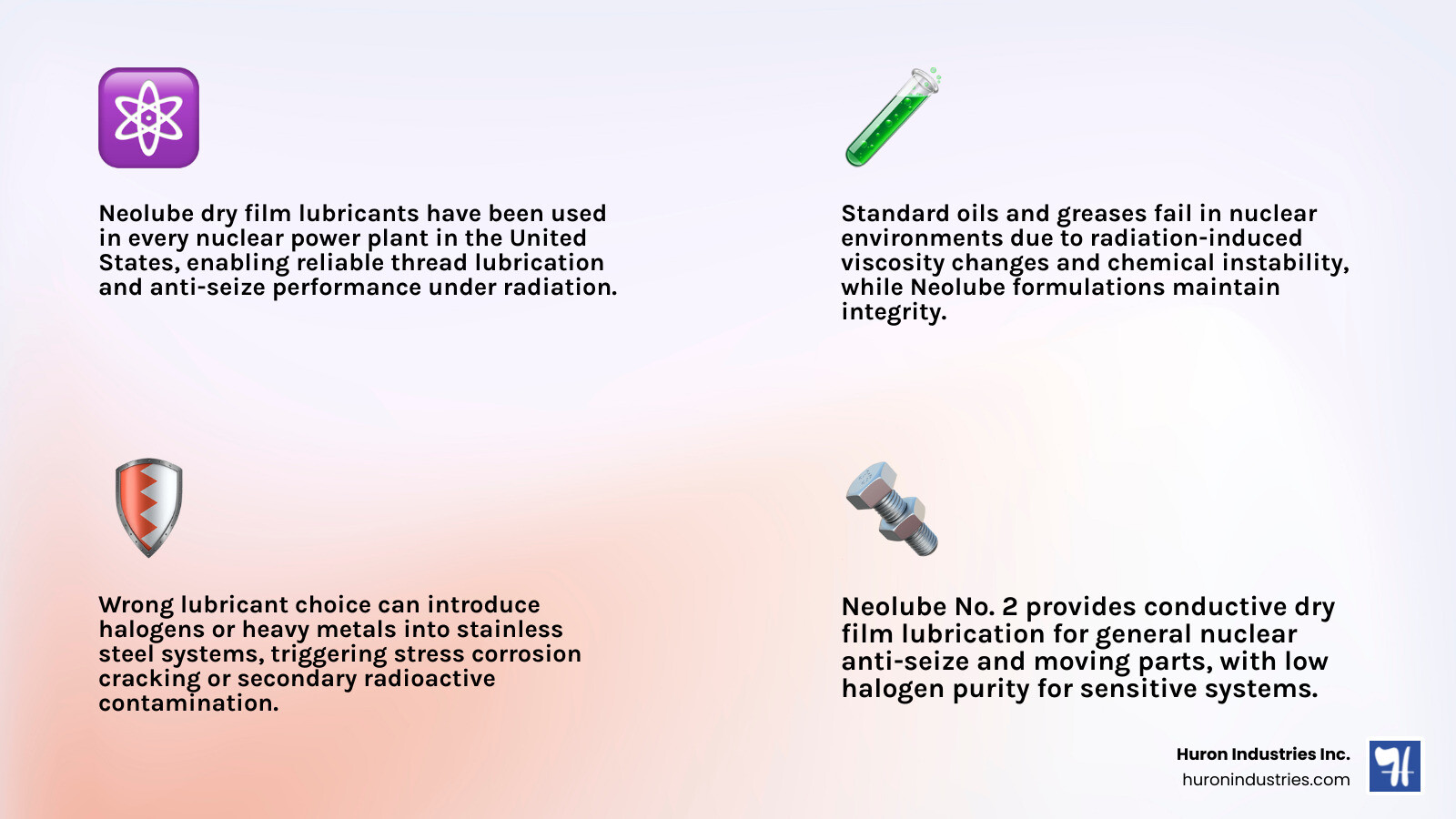
Dry film lubricants have been used in the components and construction of every nuclear power plant in the United States. The reason is straightforward: standard oils and greases fail under radiation, extreme heat, and the strict chemical purity requirements that nuclear environments demand.
Getting the formulation wrong is not just a performance issue. The wrong lubricant can introduce halogens or heavy metals into a stainless steel system — triggering stress corrosion cracking, or worse, becoming a source of secondary radioactive contamination.
This guide compares the Neolube product line so you can match the right formulation to the right reactor environment.
I'm Nicholas Cunha, founder of CreatiVertical and the content and SEO strategist behind Huron Industries Inc.'s digital program — I work directly with their technical team to translate complex Neolube reactor applications specifications into clear, accurate guidance for procurement and engineering buyers. The sections below draw on Huron's product datasheets, military specification records, and over 48 years of documented Navy nuclear program performance data.
The Tribology of Nuclear Systems and Neolube Reactor Applications
When I talk to nuclear engineers about tribology—the science of friction, wear, and lubrication—I always emphasize that selecting a lubricant is not a routine maintenance decision. It is an active machine design decision. Inside a nuclear reactor, components operate under immense pressures, high speeds, heavy loads, and intense radiation fields. Standard petroleum-based greases or synthetic oils simply cannot survive here. They undergo severe viscosity changes, lose chemical stability, and can even become highly corrosive.
This is where dry film lubricants come into play. By utilizing a solid lubricating medium like high-purity colloidal graphite suspended in an evaporating carrier, we can establish a microscopic, highly adherent barrier. This barrier prevents metal-to-metal contact without migrating, running, or attracting airborne debris. For a deeper look at how these systems are engineered, explore our guide on Nuclear Industry Applications.
The primary threat to stainless steel reactor piping and structural components is stress corrosion cracking (SCC). When traditional lubricants break down under thermal stress, they often release halogens (like chlorine and fluorine) or sulfur. In the presence of high-temperature water and tensile stress, these impurities rapidly attack the grain boundaries of stainless steel.
By utilizing exceptionally stable compounds of colloidal micrographite and thermoplastic resin, Neolube dry films provide robust wear protection while maintaining remarkable radiation tolerance. In fact, Neolube coatings have been proven to withstand cumulative radiation levels up to 1 x 10^9 rads without structural degradation or loss of lubricity. You can read more about these extreme testing parameters in our resource on Chemical Radiation Resistance.
Historical Performance of Neolube Reactor Applications in the US Navy
If you want the ultimate proving ground for nuclear-grade reliability, look no further than the US Navy Nuclear Propulsion Program. The Navy has operated nuclear-powered vessels since the historic authorization of the USS Nautilus in 1951. Since then, the program has maintained a superb safety record, steaming over 157 million miles on nuclear power without a single reactor accident. Today, there are 96 reactors operating under this program, accumulating a total of over 6,700 reactor-years of safe operation.
Huron Industries Inc. has been a proud part of this legacy. Our flagship product, Neolube No. 1, was first approved by the Naval Ship Engineering Center in June 1974 under Test Report Number QPL 10744. We have maintained an uninterrupted presence on the Qualified Products List (QPL) for military specification MIL-L-24131C for over 48 years.
During the early days of the naval nuclear program, technicians faced a severe problem: primary coolant valve caps on submarines were consistently seizing and galling due to the extreme heat and pressure. Removing them for routine maintenance often required physically cutting the valves away, keeping strategically vital submarines offline for extended periods.
Applying a thin coat of Neolube solved this issue overnight. It became a trusted tool in the Navy's maintenance arsenal, enabling rapid, non-destructive disassembly of critical components. To learn more about this remarkable history, read how Neolube’s Anti-Galling Performance Is Proven in Over 48 Years of Successful US Navy Nuclear Power Plant Operations - NEOLUBE® Industrial Dry Lubricants .
Preventing Galling and Seizing on Threaded Fasteners
Galling is a form of severe adhesive wear that occurs when two metal surfaces slide against each other under heavy load. The high pressure tears protective oxide films from the metal, causing the microscopic high points (asperities) on the surfaces to weld together. When the joint is forced, these welds tear, transferring metal from one surface to another and effectively locking the threads. Stainless steel is notorious for galling because of its ductile nature and self-passivating chromium oxide layer, which easily rubs off under friction.
When applied to threaded fasteners, Neolube leaves an ultra-thin, highly adhesive dry film of pure furnace graphite. This film shears easily under sliding forces, acting as a sacrificial barrier that prevents the metal surfaces from ever making direct contact.
Because the carrier fluid evaporates entirely, there is no wet residue to attract dirt, dust, or abrasive particles that could accelerate thread wear. This ensures that threaded joints can be tightened to precise torque specifications without erratic friction coefficients, and later disassembled without damaging the threads. Discover more about minimizing component wear in our overview on Lubrication Wear Reduction.
Comparing Neolube Formulations: No. 1.1, No. 1, and No. 2
To choose the right product for your facility, it helps to understand the exact physical and chemical differences between our primary formulations. Below is a comparison table outlining their core specifications:
| Specification / Property | Neolube No. 1.1 | Neolube No. 1 (Legacy) | Neolube No. 2 |
|---|---|---|---|
| Active Lubricant | 99% Pure Furnace Graphite | 99% Pure Furnace Graphite | 99% Pure Furnace Graphite |
| Carrier Fluid | Isopropanol | Isopropanol | Isopropanol |
| Binder | Thermoplastic Resin | Thermoplastic Resin | Thermoplastic Resin |
| MIL-Spec Compliance | MIL-L-24131C | MIL-L-24131C | N/A (Industrial/Commercial) |
| Status | Active (Released Feb 2025) | Discontinued (July 11, 2024) | Active |
| Max Chlorine Content | 200 PPM | 200 PPM | 200 PPM |
| Max Fluorine Content | 20 PPM | 20 PPM | 75 PPM |
| Max Sulfur Content | 200 PPM | 200 PPM | 900 PPM |
| Max Lead Content | 150 PPM | 150 PPM | Excluded (Low-melting-point metal) |
| Continuous Temp Limit | 400°F (204°C) | 400°F (204°C) | 400°F (204°C) |
| Intermittent Temp Limit | 850°F (454°C) | 850°F (454°C) | 850°F (454°C) |
| Static Friction Coeff. | ~0.15 | 0.15 | 0.19 |
For a complete overview of our product family, you can visit the main Neolube page.
Selecting the Right Formulation for Neolube Reactor Applications
The most significant recent update to our product line is the transition from our legacy Neolube No. 1 to the newly formulated Neolube No. 1.1. Due to raw material supply shifts, the original Neolube No. 1 was officially discontinued on July 11, 2024. To ensure that our naval and commercial nuclear customers experienced no lapse in compliance, we developed and released Neolube No. 1.1 in February 2025.
Neolube No. 1.1 is manufactured and tested entirely in the USA. It maintains full compliance with MIL-L-24131C, ensuring it can seamlessly replace the legacy No. 1 formula in all existing procurement specifications and National Stock Numbers (NSNs). It features the same ultra-low halogen limits, high-purity furnace graphite, and reliable anti-seize performance. For full technical details and certification records, refer to the Datasheet Neolube No 1 Lubricant Technical Datasheet.
Neolube No. 2, while sharing the same continuous and intermittent temperature limits, is formulated with slightly different chemical thresholds. It is designed for general nuclear and demanding industrial applications where strict MIL-spec certification is not required, but high-purity dry lubrication is still essential. You can review its physical parameters in the Datasheet Neolube No 2 Lubricant Technical Datasheet.
Electrical Conductivity and Static Dissipation with Neolube No. 2
While both formulations utilize conductive graphite, Neolube No. 2 is specifically optimized for applications requiring controlled electrical conductivity and static dissipation. When cured, it forms a dry film with a sheet resistance of less than 2400 ohms/square at a 25µm dry film thickness.
This unique property makes Neolube No. 2 highly effective for:
- Coating non-conductive substrates (like plastics or composites) to provide static-bleeding and ground paths.
- Preventing electrical chatter, arcing, and pitting on high-tension switch contacts, buss bars, and electrode contact shoes.
- Serving as a conductive release coating in specialized manufacturing and assembly processes.
If your facility requires a combination of dry-film lubrication and electrical conductivity, you can Shop Neolube No. 2 online in various sizes, ranging from 2-ounce bottles to 1-gallon containers.
Critical Limitations and High-Temperature Alternatives
While Neolube No. 1.1 and No. 2 are exceptionally versatile, they do have hard physical boundaries. The most critical limitation is temperature. Both products have a continuous service temperature limit of 400°F (204°C) and an intermittent limit of 850°F (454°C).
The thermoplastic resin binder used in these formulations begins to slowly decompose when exposed to temperatures above 200°F (93°C). While this decomposition does not destroy the lubricating properties of the graphite particles themselves, it does weaken the film's physical adhesion to the substrate. Furthermore, in oxygen-rich environments, graphite will begin to oxidize at temperatures exceeding 400°F, turning into carbon dioxide and leaving the metal surfaces unprotected.
For these reasons, Neolube No. 1.1 and No. 2 are strictly not recommended for use in primary containment areas or on threads where continuous operating temperatures exceed 400°F. Additionally, they must never be used in pure oxygen systems. To learn more about how thermal limits affect material choices, read our guide on Thermal Stability.
High-Temperature and High-Pressure Alternatives
For applications on the containment side or secondary steam lines where temperatures regularly exceed the 400°F threshold, we engineered Neolube No. 1260. Unlike our standard graphite dry films, Neolube No. 1260 is a high-temperature lubricant and sealant designed to withstand continuous operating temperatures up to 1,175°F (635°C) and pressures up to 2,300 psi (16 MPa).
Neolube No. 1260 is a non-hardening compound. It does not cure or bake onto the metal over time, which ensures that high-temperature joints, instrumentation fittings, and valve packing glands remain easy to disassemble even after years of continuous, high-heat service. For detailed pressure ratings and application parameters, see our page on High Pressure Thread Sealant 2300 PSI Neolube 1260 and discover Why Neolube 1260 is the thread sealant you need.
Molybdenum Disulfide in Isopropanol
In certain high-purity industrial environments or specific reactor auxiliary systems, military specifications may call for a molybdenum disulfide-based lubricant rather than graphite. For these applications, we supply a specialized Molybdenum Disulfide in Isopropanol kit that complies with military specification MIL-L-24478.
Molybdenum disulfide (MoS2) offers excellent extreme-pressure (EP) performance and is highly resistant to chemical attack. Our certified kit contains 1,500 grams of high-purity molybdenum disulfide powder and 1,000 milliliters of pure isopropanol, allowing technicians to mix a fresh, highly effective anti-seize coating on-site. For guidance on when to choose molybdenum disulfide over graphite, consult our technical breakdown on How to Choose the Best Anti Seize Thread Lubricant for Any Job.
Application Process, Surface Preparation, and Quality Standards
To achieve maximum adhesion and performance from any dry film lubricant, proper surface preparation is absolutely critical. The presence of residual grease, cutting oils, rust, or moisture will prevent the thermoplastic binder from bonding to the metal substrate, leading to premature flaking or rub-off.
I always advise technicians to follow this step-by-step application sequence:
- Pretreatment & Cleaning: Thoroughly clean the substrate. A simple solvent wipe using a fast-evaporating, non-residue solvent is usually sufficient for smooth metal surfaces. For porous metals, pre-heat the part to drive off entrapped moisture or oils before solvent wiping.
- Mechanical Prep (Optional): For critical applications requiring maximum film adhesion, use mechanical or chemical pretreatment such as light grit-blasting, phosphating, anodizing, or etching to create a microscopic anchor pattern on the metal.
- Mixing: Thoroughly agitate or stir the Neolube container before use. Because graphite is a solid pigment, it will naturally settle over time. Uniform mixing ensures the correct graphite-to-binder ratio is applied.
- Application: Apply a thin, uniform coat. You can use the convenient brush-in-cap applicator, a conventional spray gun, a standard paint brush, or a dipping process. Aim for a dry film thickness of 0.2 to 0.5 mils per coat. If a thicker film (up to 1.0 mil) is required, apply multiple thin coats rather than one heavy, wet coat.
- Curing: Allow the coating to air dry. Neolube No. 1.1 and No. 2 will air dry to the touch in approximately 5 minutes and are ready for full service in 30 minutes. To accelerate the curing process, you can bake the coated component at 167°F (75°C) for 5 minutes after the initial 5-minute air dry.
For more practical tips on applying anti-seize compounds cleanly and efficiently, read How to Use Anti Seize for Threads Without Making a Total Mess.
Impurity Control and Nuclear Safety Compliance
In nuclear power generation, the chemical composition of every material entering the containment boundary must be strictly controlled. The presence of trace impurities can have catastrophic consequences for reactor safety and component longevity.
Our manufacturing facility in Port Huron, MI, USA, operates under rigid quality control standards to ensure that Neolube products maintain the highest levels of chemical purity. We strictly limit key elemental impurities to prevent material degradation:
- Halogens (Chlorine & Fluorine): Chlorine is limited to a maximum of 200 PPM, and fluorine is limited to 20 PPM (for No. 1.1). This prevents halogen-induced stress corrosion cracking in stainless steel.
- Sulfur: Limited to a maximum of 200 PPM in Neolube No. 1.1 to prevent high-temperature sulfidation and embrittlement of nickel-base alloys.
- Lead & Low-Melting-Point Metals: Lead is restricted to a maximum of 150 PPM. Metals like zinc, tin, mercury, and antimony are strictly excluded to prevent liquid metal embrittlement of structural alloys.
- Mercury-Free Manufacturing: Neolube products are manufactured without any contact with mercury or mercury-containing compounds, eliminating the risk of mercury-induced cracking.
Furthermore, maintaining high purity prevents the lubricant itself from becoming a source of secondary radioactivity. If a lubricant contains heavy metals or elements with high neutron absorption cross-sections, exposure to the reactor's neutron flux can activate these impurities, turning the lubricating film into a highly radioactive hazard during maintenance outages.
To understand why these strict limits are non-negotiable for sensitive piping systems, read our detailed article explaining Why Sensitive Metal Pipes Need Low Halogen and Low Sulfur Sealants.
Frequently Asked Questions About Nuclear Dry Film Lubricants
What is the difference between Neolube No. 1 and Neolube No. 1.1?
Neolube No. 1 was our legacy formulation that served the nuclear industry for 50 years. It was officially discontinued on July 11, 2024. Neolube No. 1.1, released in February 2025, is its direct replacement. It is 100% manufactured and tested in the USA, maintains full compliance with military specification MIL-L-24131C, and features the same high-purity colloidal graphite and ultra-low halogen chemistry.
Can Neolube No. 1.1 or No. 2 be used in primary containment areas?
Generally, no. Both formulations have a continuous service temperature limit of 400°F (204°C). Because temperatures in primary containment often exceed this threshold, and because graphite can oxidize in high-temperature oxygen environments, we do not recommend them for primary containment threads. Instead, Neolube No. 1260, which is rated to 1,175°F (635°C), should be used.
Why are halogens and heavy metals strictly restricted in nuclear lubricants?
Halogens (like chlorine and fluorine) react with stainless steel under high temperatures and pressures, causing rapid stress corrosion cracking. Heavy metals with low melting points (like lead, zinc, tin, and mercury) can cause liquid metal embrittlement, structurally weakening critical alloys. Additionally, keeping these impurities out prevents the lubricant from becoming radioactively activated under neutron exposure.
Conclusion
Since our establishment in 1971, Huron Industries Inc. has been dedicated to manufacturing high-purity, high-performance specialty graphite lubricants, thread sealants, and anti-seize compounds. From our facility in Port Huron, Michigan, USA, we continue to supply the commercial and naval nuclear industries with certified formulations that meet the most demanding regulatory and environmental standards.
Whether you are performing routine maintenance on secondary steam systems, upgrading electrical contacts, or sealing high-temperature reactor joints, there is a certified Neolube product engineered for the task. Explore our high-performance lubricants and sealants to secure the exact certifications and formulations your facility requires.