
Material Formulations for High Temperature Valve Packing
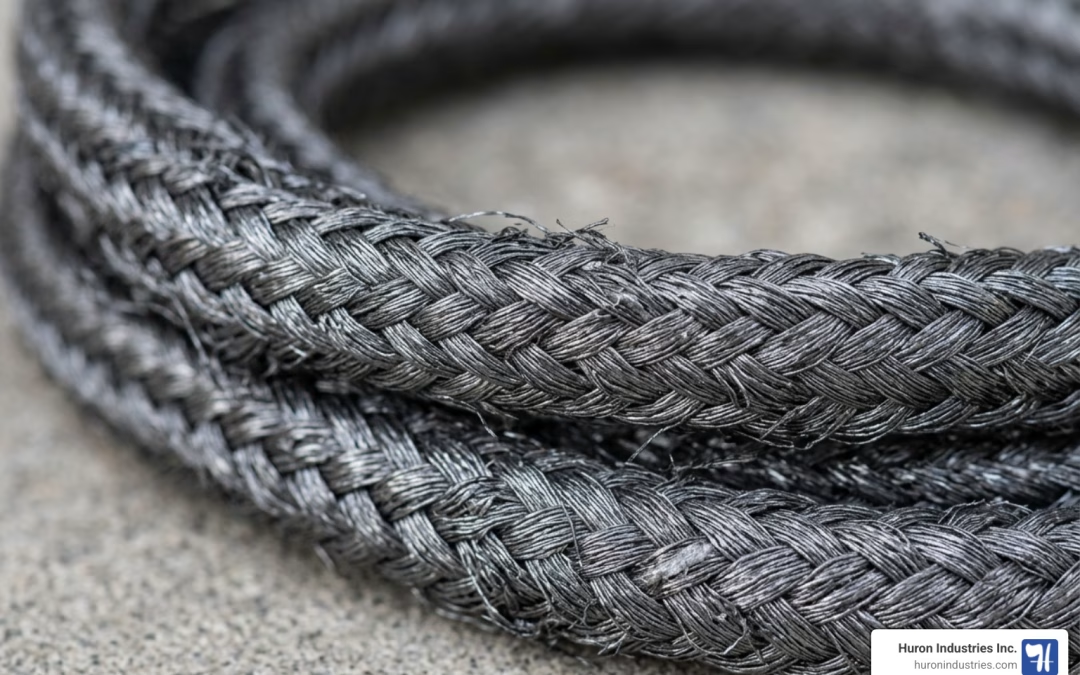
When I evaluate materials for extreme thermal environments, flexible expanded graphite remains the primary choice for critical valve stems. Expanded graphite is manufactured by taking natural crystalline graphite flakes, treating them with intercalating acids, and exposing them to rapid heating. This process causes the flakes to expand significantly, creating a cohesive, pliable material that can be compressed into ribbons, yarn, or solid die-formed sealing rings.
The true differentiator among high-temperature packings lies in carbon purity and structural integrity under stress. Standard commercial graphite often contains natural ash, silicates, and trace elements that accelerate degradation at elevated temperatures. In contrast, high-purity industrial formulations preserve their elasticity and volume over long periods. When assessing a material's capability to withstand long-term operational stress without shrinking or degrading, analyzing its thermal stability helps predict how well it will maintain its seal over extended cycles.
Flexible graphite provides universal chemical resistance across almost the entire pH spectrum (0 to 14), with exceptions limited to powerful oxidizing agents like hot fuming nitric acid or concentrated sulfuric acid. It also features natural self-lubricating qualities that minimize stem friction during actuation. However, high-temperature service introduces severe mechanical and chemical stresses that require specialized reinforcement, controlled purity standards, and active metallurgy protection.
Wire Reinforcement and Mechanical Extrusion Resistance
In high-temperature, high-pressure (HTHP) valve service—such as ASME Class 1500 and Class 2500 steam isolation—pure flexible graphite alone lacks the tensile strength to resist the mechanical forces exerted by high differential pressures. Under extreme system pressure, pure expanded graphite behaves like a dense fluid, attempting to migrate into the narrow clearances between the valve stem, the gland follower, and the stuffing box floor. This extrusion, often called "nibbling," destroys the packing volume and causes rapid gland load loss.
To counter this mechanism, manufacturers braid individual graphite yarns around high-strength metallic alloy cores or encapsulate the yarns in an external metal mesh.
- Inconel Wire (e.g., Inconel 600 or 625): The industry benchmark for extreme temperature and supercritical steam. Inconel maintains its tensile strength, yield resistance, and oxidation resistance well above 500°C (932°F), forming a structural cage that prevents packing extrusion under differential pressures up to 450 bar (approx. 6,500 psi).
- 316L Stainless Steel Filaments: Highly effective for moderate-to-high pressure classes at temperatures up to 400°C (752°F). While 316L provides structural stability, it exhibits lower oxidation resistance and reduced creep strength compared to nickel-chromium superalloys when exposed to supercritical steam environments.
Incorporating wire reinforcement allows engineers to bridge wider mechanical clearances while retaining the compressibility and recovery necessary for dynamic stem sealing.
Standard vs Nuclear-Grade High Temperature Valve Packing
The distinction between standard industrial-grade graphite packing and nuclear-grade configurations centers on elemental purity, chemical contamination thresholds, and microstructural consistency. Standard industrial packings typically exhibit carbon purities between 95% and 98%, with the remaining percentage composed of ash, sulfur compounds, and trace halides.
For nuclear power generation, aerospace, and high-reliability industrial infrastructure, standard grades present unacceptable risks of stress corrosion cracking and rapid material decay. Nuclear-grade packing mandates a minimum carbon purity of 99.5%, with strict limits on leachable halides (chlorides, fluorides) and low-melting metals (such as lead, zinc, and bismuth) that could compromise structural alloys.
| Property / Specification | Standard Industrial Packing | High-Purity Nuclear-Grade Packing |
|---|---|---|
| Carbon Content | 95.0% – 98.0% | ≥ 99.5% Minimum |
| Ash Content | 2.0% – 5.0% | < 0.5% Maximum |
| Leachable Chlorides | Typically < 100 ppm | < 50 ppm (often < 20 ppm) |
| Total Halides (Cl + F) | Uncontrolled / Variable | Strictly regulated (< 100 ppm combined) |
| Primary Industry Standards | General Industrial / ASME | MIL-L-24131C, Nuclear Regulatory Specs |
| Microstructure Technology | Standard Expanded Flake | Nano-Graphite Dispersion / Void-Free Matrix |
Meeting strict nuclear reactor specifications requires materials with low leachable contaminant profiles to prevent chemical degradation of critical valve stuffing box components. Advanced formulations also utilize nano-graphite dispersion techniques. By incorporating nanoscale graphite particles into the yarn matrix, manufacturers can eliminate microscopic interstitial voids. This uniform density blocks fluid wicking along the stem interface and lowers operational friction, preventing shaft scoring during rapid cycling.
Corrosion Inhibitors and Stem Metallurgy Protection
One paradox of using pure graphite in metallic valves is galvanic corrosion. Graphite occupies a noble (cathodic) position on the galvanic scale. When an electrolyte (such as condensed steam, ambient moisture, or hydrostatic test water) enters the stuffing box while the valve is idle, an electrochemical cell forms between the cathodic graphite packing and the anodic metal stem.
This reaction frequently causes severe pitting and etching on 13% chromium steel (410/416 stainless), 304 stainless, and 316 stainless steel valve stems. A pitted stem acts like a serrated file across the packing set during stroke movements, rapidly destroying the sealing face and generating fugitive emissions.
To prevent galvanic attack, premium high-temperature packing incorporates dual-action corrosion inhibition:
- Active (Sacrificial) Inhibitors: Finely dispersed sacrificial metals (such as high-purity zinc or inorganic phosphorus compounds) are blended directly into the graphite matrix. These particles possess a lower electrochemical potential than the stem alloy, intentionally corroding in the presence of an electrolyte to shield the base metal.
- Passive Inhibitors: Chemical passivating agents react with the stem surface to produce an ultra-thin, stable oxide barrier film. This passive barrier blocks electron transfer between the carbon matrix and the metallic substrate, keeping the stem smooth over extended outages.
Thermal Limits, Oxidation, and Sealing Failure Modes
Graphite does not melt under conventional industrial conditions; instead, its primary thermal vulnerability is oxidation. At elevated temperatures in the presence of an oxidizing atmosphere, solid carbon reacts with atmospheric oxygen:
$$text{C (solid)} + text{O}_2 text{ (gas)} rightarrow text{CO}_2 text{ (gas)}$$
This reaction begins slowly around 400°C (752°F) and accelerates significantly above 850°F (454°C). As solid carbon converts into carbon dioxide gas, the packing physically loses mass and volume.
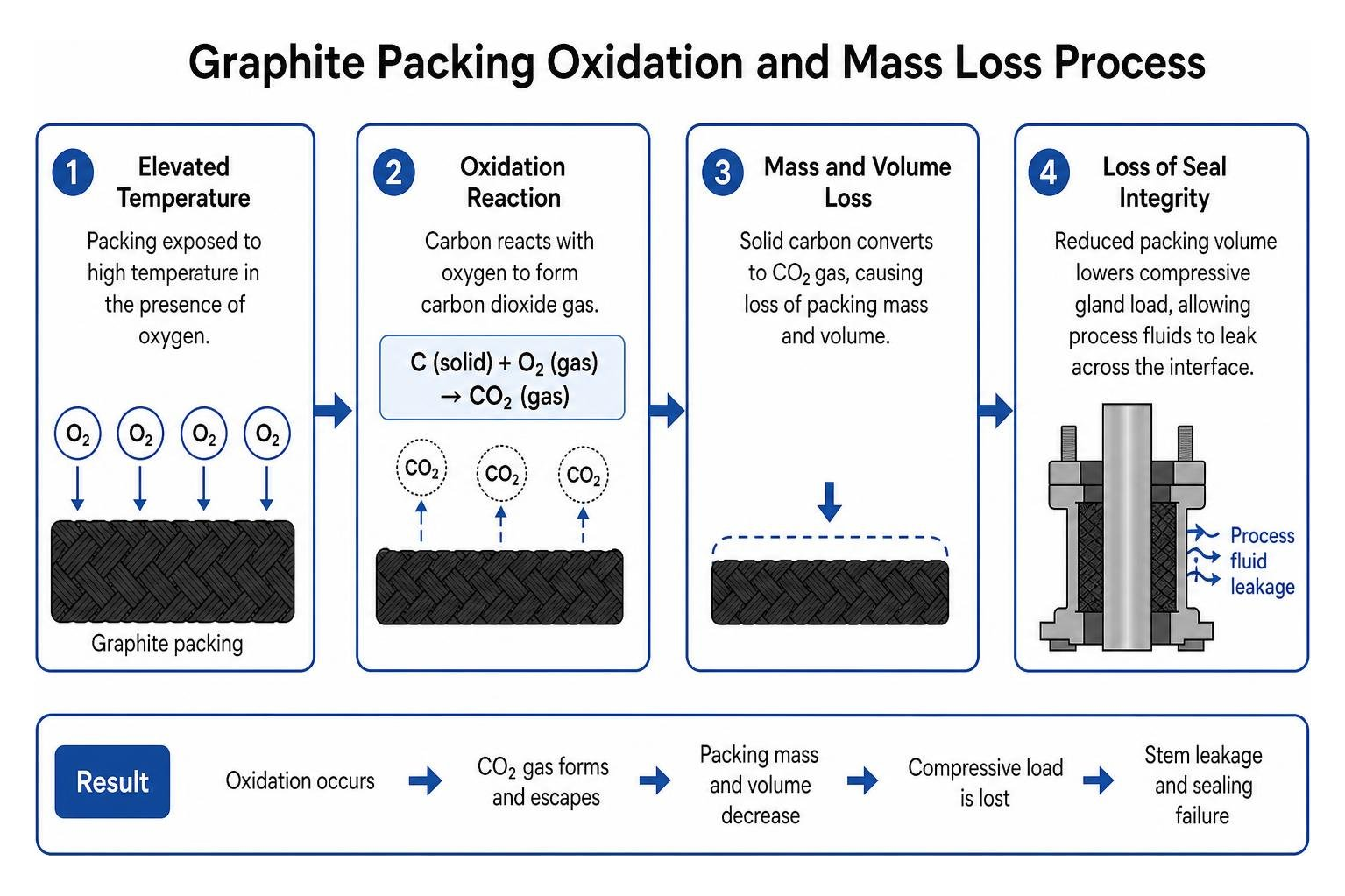
This oxidation leads directly to a loss of compressive gland load. Once the Belleville spring stack or gland studs can no longer compensate for the vanished packing volume, internal system pressure pushes process fluids across the relaxed sealing interface, resulting in sudden, catastrophic stem leakage. Deploying an effective high temperature sealant helps provide an extra layer of defense when maintaining tight stem and bonnet boundaries across extreme thermal transitions.
Selecting High Temperature Valve Packing for Steam vs Oxidizing Environments
Selecting the correct packing requires evaluating both the nominal system operating temperature and the chemical nature of the surrounding atmosphere. In steam and non-oxidizing environments, graphite resists thermal degradation far beyond its open-air limits.
| Atmosphere / Environment | Continuous Service Ceiling | Peak / Intermittent Limit | Primary Limiting Mechanism |
|---|---|---|---|
| Superheated Steam | +550°C to +650°C (1022°F to 1200°F) | Up to +950°C (1742°F) | Mechanical erosion; wire oxidation |
| Inert / Reducing (N2, H2, Ar) | +650°C to +850°C (1200°F to 1562°F) | Up to +1400°C (2552°F) | Sublimation / Microstructural stability |
| Oxidizing Air / Flue Gas | +400°C to +450°C (752°F to 842°F) | +500°C (932°F) | Rapid carbon oxidation ($text{CO}_2$ mass loss) |
In superheated steam lines, flexible graphite tape and braided high-purity packings operate reliably up to 650°C because the oxygen concentration in the process steam is low. In high-temperature air or oxidizing flue gases, engineers must cap pure graphite ratings at 450°C unless thermal mitigation strategies are incorporated into the stuffing box design.
Thermal Management and Insulating Ring Technology
When process media temperatures exceed the oxidation threshold of flexible graphite in environments where oxygen ingress cannot be eliminated, thermal management techniques help extend packing life.
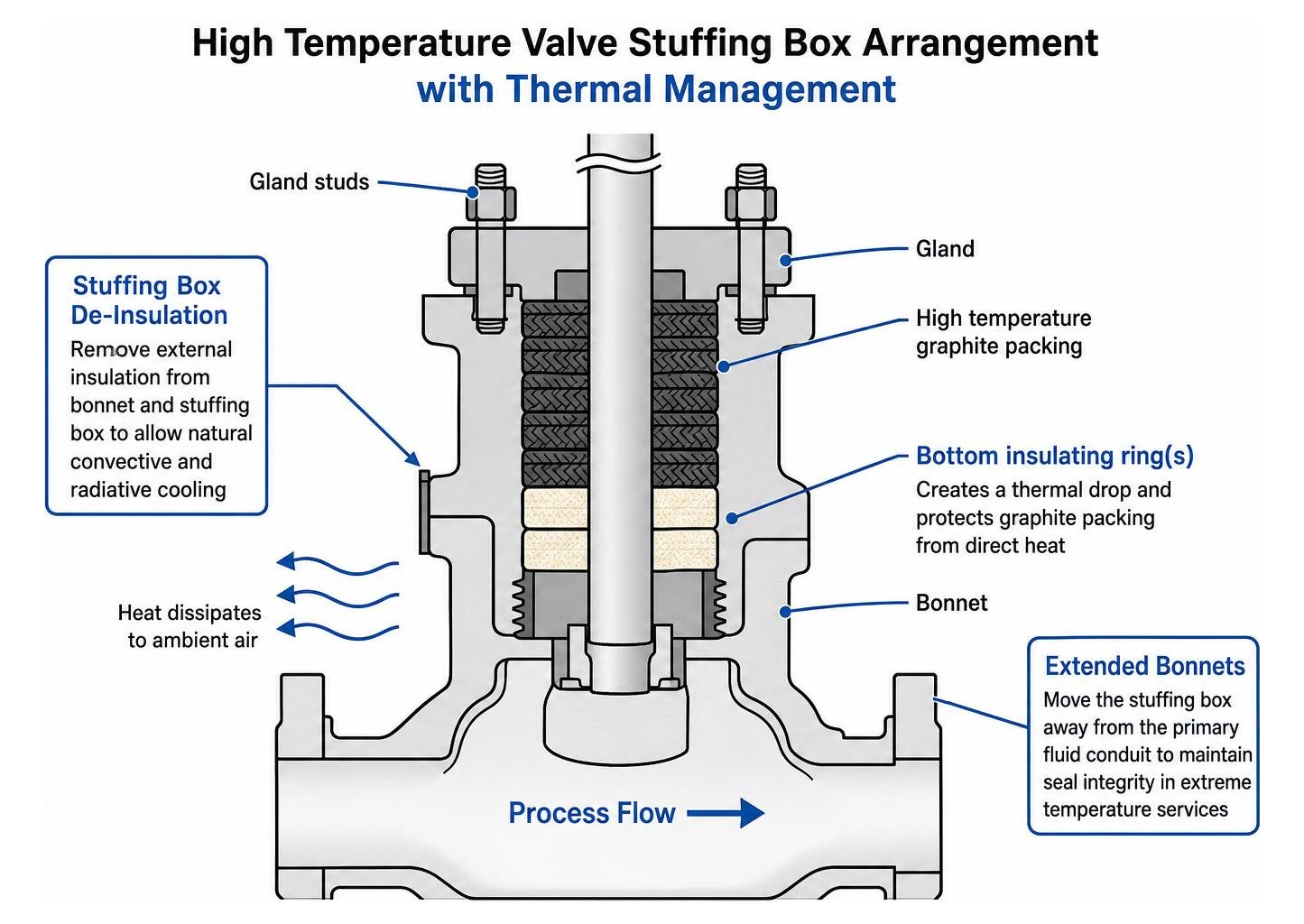
- Bottom Insulating Rings: Installing one or two sacrificial insulating rings made from dense ceramic fiber rope, woven alumina-silica fiber, or specialized high-temperature spacer materials at the bottom of the stuffing box creates a localized thermal drop. These rings insulate the primary graphite sealing set from direct conductive and radiant heat emitted by the process stream.
- Stuffing Box De-Insulation: While piping engineers often insulate entire valves to conserve energy, removing external thermal insulation from the valve bonnet and stuffing box exterior allows natural convective and radiative cooling to the ambient air. This simple design adjustment can lower the packing operating temperature by 50°C to 120°C, bringing the graphite back below its rapid-oxidation threshold.
- Extended Bonnets: In extreme services such as molten-salt heat transfer loops and high-temperature petrochemical reactors, using extended bonnets moves the stuffing box away from the primary fluid conduit, maintaining seal integrity over long production cycles.
Packing Configurations and Installation Best Practices
Achieving a durable seal in high-temperature, high-pressure valves requires more than just high-grade materials; it requires proper packing set architecture and controlled installation.
A standard industrial stuffing box should not simply be filled with identical braided rings. Under compressive load, the top and bottom rings encounter the highest mechanical shear and clear extrusion gaps.
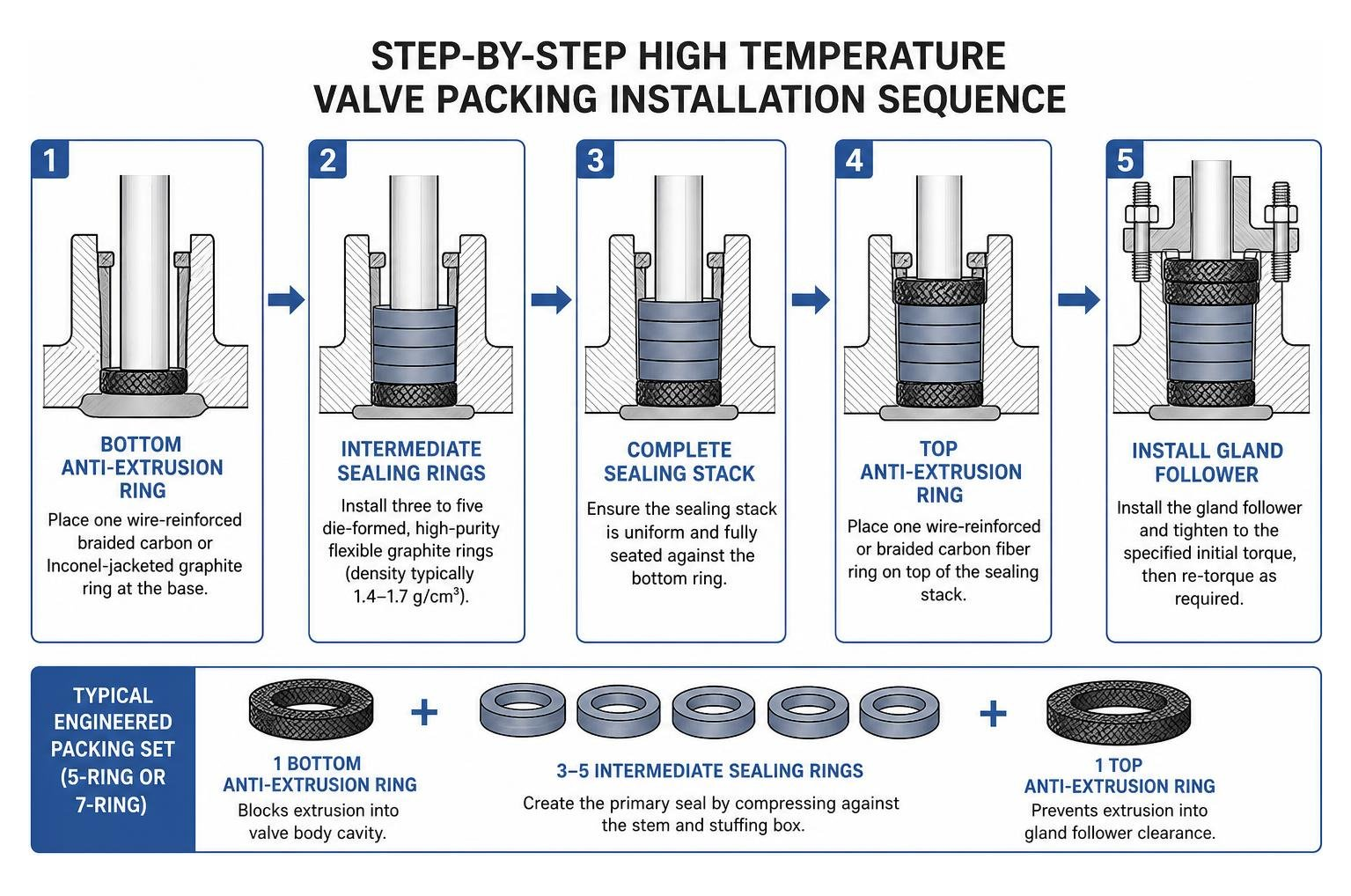
A proven arrangement for ASME Class 1500 to 2500 valves operating above 450°C is the 5-ring or 7-ring engineered set:
- Bottom Anti-Extrusion Ring: One dense, wire-reinforced braided carbon or Inconel-jacketed flexible graphite ring placed at the base of the stuffing box to block extrusion into the valve body cavity.
- Intermediate Sealing Rings: Three to five die-formed, high-purity flexible graphite rings (density typically between 1.4 and 1.7 g/cm³). These rings compress radially against both the valve stem and stuffing box bore, creating a tight seal.
- Top Anti-Extrusion Ring: A final wire-reinforced or braided carbon fiber ring placed beneath the gland follower to eliminate extrusion upward into the follower clearance gap.
When installing rings, stagger all split joints by 90° to 120°, seat each ring individually using a split tamping tool, and verify that the gland follower enters the stuffing box square to maintain uniform radial loading.
Live Loading Systems and Bolt Torque Control
High-temperature valves undergo significant thermal expansion and contraction during operational cycles. Because graphite packing exhibits natural stress relaxation (creep) under load, rigid gland bolting often loses tension after initial thermal cycles, leading to leakage.
A Live Loading System uses stacks of precision-engineered Belleville disc springs installed on the gland studs. These springs act as an energy storage bank, maintaining continuous compressive force on the gland follower regardless of packing volume loss, stem stroke movement, or thermal expansion differences between the exotic stem alloy and the carbon steel bonnet.
To set gland torque correctly:
- Calculate target gland stress based on process pressure and standard compliance requirements (typically 3,500 to 5,500 psi gland stress for high-pressure steam).
- Clean and lubricate gland stud threads with a certified high-temperature thread paste to ensure accurate torque-to-tension conversion.
- Tighten nuts incrementally in alternating passes, measuring Belleville spring stack compression with calipers until the manufacturer's specified deflection (typically 80% to 85% of flat) is reached.
Injectable Compounds vs Braided Valve Packing Sets
Injectable packing compounds and semi-solid valve sealants are frequently used alongside or in place of traditional braided packing sets.
- Injectable Sealants: Formulated from micronized graphite, synthetic polymers, and carrier lubricants, these pastes can be pumped directly into an active stuffing box via a high-pressure injection gun (up to 10,000 psi) through a button-head fitting. They are well-suited for emergency online leak sealing, repairing scored stems, and filling irregular stuffing box geometries without shutting down the facility.
- Braided & Die-Formed Sets: Structured packing sets provide superior mechanical stability and defined load retention over years of continuous cycling. Injectables can experience carrier oil volatilization at sustained temperatures above 400°C, requiring periodic re-injection, whereas engineered braided graphite sets maintain their sealing structure when properly live loaded.
Selecting the appropriate fastener lubricants and anti-seize pastes is essential during packing replacement, as highlighted in this guide on high temp anti-seize paste selection for critical industrial assemblies.
Regulatory Compliance and Testing Standards
Modern industrial plants must comply with strict environmental and safety mandates regarding fugitive volatile organic compound (VOC) emissions, hazardous air pollutants, and operational fire safety.
- API Standard 622 (Fugitive Emissions Testing): Evaluates packing materials across 1,500 mechanical stroke cycles and multiple thermal cycles from ambient to 260°C (500°F) using methane gas at 600 psig. Acceptable packing must maintain leakage below 100 ppmv without gland adjustments.
- ISO 15848-1: An international standard classifying valve stem leakage into tight performance classes (Class AH, BH, CH) through helium leak detection or methane sniffing across extensive thermal cycling up to 400°C+.
- API 589 / API 607 (Fire Safety): Validates that after direct burn exposure to flame temperatures between 750°C and 1000°C (1382°F to 1832°F) for 30 minutes, the packing set retains mechanical integrity and restricts stem leakage within defined limits during cool-down and repressurization.
- TA Luft (VDI 2440): The primary European clean air standard, enforcing strict stem leakage thresholds ($le 10^{-4}text{ mbar}cdottext{l}/(text{s}cdottext{m})$ for temperatures $ge 250^circtext{C}$).
Frequently Asked Questions About High-Temperature Stem Sealing
What causes graphite packing to lose sealing load at high temperatures?
Graphite packing loses sealing load through a combination of thermal oxidation and mechanical stress relaxation. When exposed to oxygen at temperatures above 454°C (850°F), the carbon reacts to form carbon dioxide gas, reducing physical packing volume. Simultaneously, under high continuous gland pressure, the graphite flakes slowly consolidate and creep into micro-voids. This loss of volume relieves the compressive strain on standard gland bolts, lowering radial sealing forces and permitting leakage.
When should wire-reinforced packing rings be used in valve stuffing boxes?
Wire-reinforced packing rings should be installed whenever operating pressures exceed ASME Class 600 ratings (or differential pressures exceed 1,000 psi), in supercritical steam services above 500°C, and in any valve subject to wide mechanical clearances between the stem and gland follower. They should always be used as top and bottom end rings in high-temperature stuffing boxes to prevent the extrusion of intermediate flexible graphite rings.
How do live loading spring sets maintain seal integrity during thermal cycling?
Live loading systems use disc spring washers that maintain a high spring rate across a small deflection envelope. When the valve heats up and cools down, the stem, bonnet, and packing expand and contract at different rates. The Belleville spring stack dynamically absorbs this dimensional change, expanding as the packing volume relaxes to apply a near-constant axial compressive stress to the gland follower.
Conclusion
Successfully sealing severe-service valves requires balancing operating conditions, material purity, mechanical reinforcement, and proper installation. By matching high-purity graphite matrices with Inconel structural cages, sacrificial corrosion inhibitors, and live-loaded Belleville hardware, industrial facilities can eliminate fugitive emissions and avoid unscheduled shutdowns.
At Huron Industries Inc., we manufacture and distribute specialty graphite lubricants, high-temperature thread sealants, and anti-seize materials engineered to support demanding industrial operations. For operations requiring nuclear-grade graphite purity, certified MIL-L-24131C compliance, or advanced material solutions, explore our specialized nuclear industry sealing solutions to protect your critical infrastructure. (Note: The coefficient of friction for Neolube No. 1.1 of 0.15 has not been tested or approved for this.)