Why Getting Anti-Seize for Threads Right Matters More Than You Think
Quick answer: anti seize for threads is a lubricating compound applied to fastener threads before assembly to prevent seizing, galling, and corrosion — especially under heat, pressure, or dissimilar metals. Here's what you need to know at a glance:
- What it does: Creates a protective barrier between metal surfaces so fasteners don't fuse together over time
- When to use it: High-heat applications (exhaust manifolds, turbocharger bolts, spark plugs), dissimilar metal joints, and fasteners in corrosive environments
- Key types: Copper-based, nickel-based, aluminum/graphite, and non-metallic — each suited to different temperatures and materials
- Torque note: Anti-seize reduces friction, so torque values typically need to be reduced (often ~10–15%) to avoid over-tightening
- When not to use it: Oxygen systems, chlorine environments, or anywhere a threadlocker is required
Who hasn't had to fight a stubborn fastener that simply will not break free? Whether it's a seized spark plug in an aluminum head or a frozen exhaust manifold bolt snapping off mid-removal, stuck threads cost time, money, and patience. In critical industrial settings — nuclear facilities, offshore platforms, refineries — a broken stud isn't just an inconvenience. It can mean unplanned downtime or a safety incident.
The good news is that most of these failures are preventable. Applied correctly at assembly, anti-seize compounds protect threads from the heat, moisture, and galvanic reactions that cause fasteners to lock up over time. Applied incorrectly, though, they can cause just as many problems — over-torqued joints, contaminated assemblies, or the wrong formula reacting with a sensitive alloy.
This guide walks you through everything you need to know: how anti-seize works, how to pick the right formula, and how to apply it without making a mess or a mistake.
I'm Nicholas Cunha, founder of CreatiVertical and the content strategist behind Huron Industries Inc.'s digital presence — including their line of specialty lubricants, colloidal graphite products, and anti seize for threads used in some of the most demanding regulated environments in the world. In building that content program, I've gone deep into the technical and compliance considerations that separate a good anti-seize choice from a costly one.
What is Anti Seize for Threads and How Does It Work?
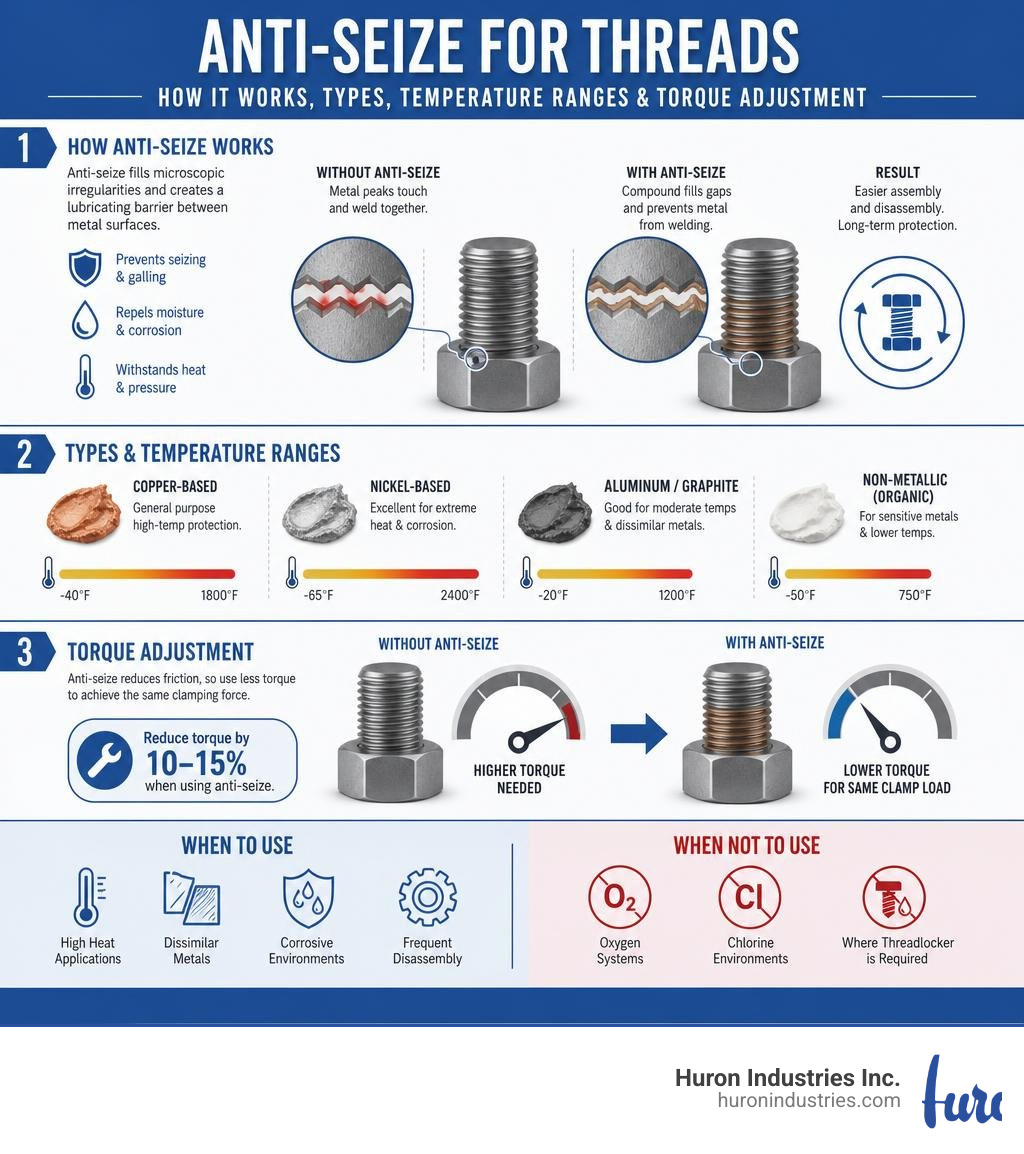
To understand how anti seize for threads works, we have to zoom in—way in. Under a microscope, even the most beautifully machined metal threads look like jagged mountain ranges. When you tighten a nut onto a bolt, these microscopic peaks (called asperities) rub against each other under immense pressure.

Without lubrication, this intense metal-to-metal contact can cause the asperities to cold-weld together. This destructive phenomenon is known as galling. When you try to back the fastener out later, those welded points tear apart, destroying the threads. If you add high temperatures, corrosive salt air, or moisture to the mix, oxidation accelerates, and the assembly essentially fuses into a single piece of rust.
This is where anti-seize comes to the rescue. An anti-seize compound is a highly specialized formulation consisting of two main parts:
- The Carrier Grease: A synthetic or petroleum-based grease that acts as a transport vehicle. It makes the compound easy to apply and provides initial lubrication during assembly.
- Solid Lubricant Particles: Micro-fine flakes of metals (like copper, aluminum, or nickel) or non-metallic solids (like graphite, calcium oxide, or PTFE) suspended in the grease.
When you assemble a joint coated in anti-seize, the carrier grease fills the microscopic valleys between the threads. Under heavy pressure, the grease gets squeezed, but the solid lubricant particles remain trapped between the metal surfaces. These solids act like microscopic plates or ball bearings. They slide over one another easily, preventing the metal threads from ever touching directly.
Even if the operating temperature becomes so hot that the carrier grease bakes out completely, the solid particles stay behind. They remain stable and form a physical barrier that prevents cold welding, rust, and galvanic corrosion.
For a deeper dive into the science behind this, you can learn more about the mechanism of action of anti-seize compounds.
Choosing the Right Anti-Seize Formula
Using the wrong anti-seize formula can sometimes be worse than using none at all. For example, applying a copper-based formula to a stainless steel bolt in a highly corrosive environment can actually accelerate galvanic corrosion.
To help you navigate your options, I’ve put together a breakdown of the most common formulas you will encounter. You can also explore our comprehensive guide on How to Choose the Best Anti-Seize Thread Lubricant for Any Job for a deeper look at selection criteria.
| Formula Type | Temperature Range | Best Material Compatibility | Common Applications | Key Limitations |
|---|---|---|---|---|
| Copper-Based | Up to 2000°F (1095°C) | Steel, iron, brass, copper | Exhaust manifolds, spark plugs, brake assemblies | Do not use on stainless steel in highly corrosive environments; avoid on aluminum where galvanic action is a risk |
| Nickel-Based | Up to 2400°F (1315°C) | Stainless steel, titanium, nimonic alloys, cast iron | Nuclear reactors, chemical processing, aerospace fasteners | Highly expensive; should not be used on soft metals like copper or brass |
| Aluminum/Graphite | Up to 1000°F to 2000°F | Carbon steel, alloy steels | General-purpose industrial maintenance, machinery | Graphite can cause galvanic corrosion in aluminum if moisture is present |
| Non-Metallic | Up to 2600°F (1427°C) | Chrome, Inconel, sensitive alloys | Marine environments, offshore drilling, petrochemical | Lower extreme-pressure (EP) protection than heavy metallic formulas |
When shopping for standard maintenance supplies, you'll find plenty of retail options such as 8-Ounce Anti-Seize Thread Lubricant - Steelman Tools or the massive variety of commercial brands listed on Anti-seize - Amazon.com. For specialized industrial designs, pre-applied thread coatings like ND Anti-Seize - ND Industries or Anti-Seize - Tectorius (en-US) are often utilized during manufacturing.
Copper-Based Anti Seize for Threads
Copper-based anti seize for threads is the classic, bright-bronze paste that most DIYers and mechanics keep in their toolboxes. Because copper is an excellent conductor of heat and electricity, this formula is highly favored for electrical grounding connections and automotive components.
It easily resists temperatures up to 2000°F, making it perfect for exhaust manifolds, turbocharger installation, EGR valves, and cylinder heads. The copper flakes act as a sacrificial wear surface, absorbing the friction and preventing the underlying steel threads from galling.
Nickel and Graphite Anti Seize for Threads
When you are working with stainless steel, titanium, or exotic alloys like Nimonic, copper is off the table. Under high temperatures, copper can cause "metal embrittlement" or stress corrosion cracking in stainless steel. For these demanding materials, a nickel-based formula is the industry gold standard.
Nickel-based anti-seize can withstand extreme temperatures up to 2400°F. It is highly resistant to chemical attack, acids, and ammonia, making it the preferred choice for petrochemical plants and refineries.
Furthermore, in high-purity environments like nuclear power generation, sulfur, chlorine, and heavy metals must be kept to an absolute minimum to prevent catastrophic stress corrosion. High-purity nickel and graphite formulas (with sulfur and chlorine levels controlled below 200ppm) are strictly required here.
At Huron Industries Inc., based in Port Huron, MI, we have spent decades manufacturing highly certified graphite lubricants, such as our flagship Neolube® colloidal-graphite line. This product line is qualified to MIL-L-24131C and is trusted in commercial and naval nuclear reactor systems. You can read more about our industrial capabilities on our Huron Industries, Inc. - Thomasnet Profile.
How to Apply Anti-Seize Lubricant Properly
We have all seen it: a bolt so caked in silver or copper paste that it looks like a frosted cupcake. Not only is this a waste of product, but it also creates a massive mess that gets on your hands, your clothes, and nearby components.
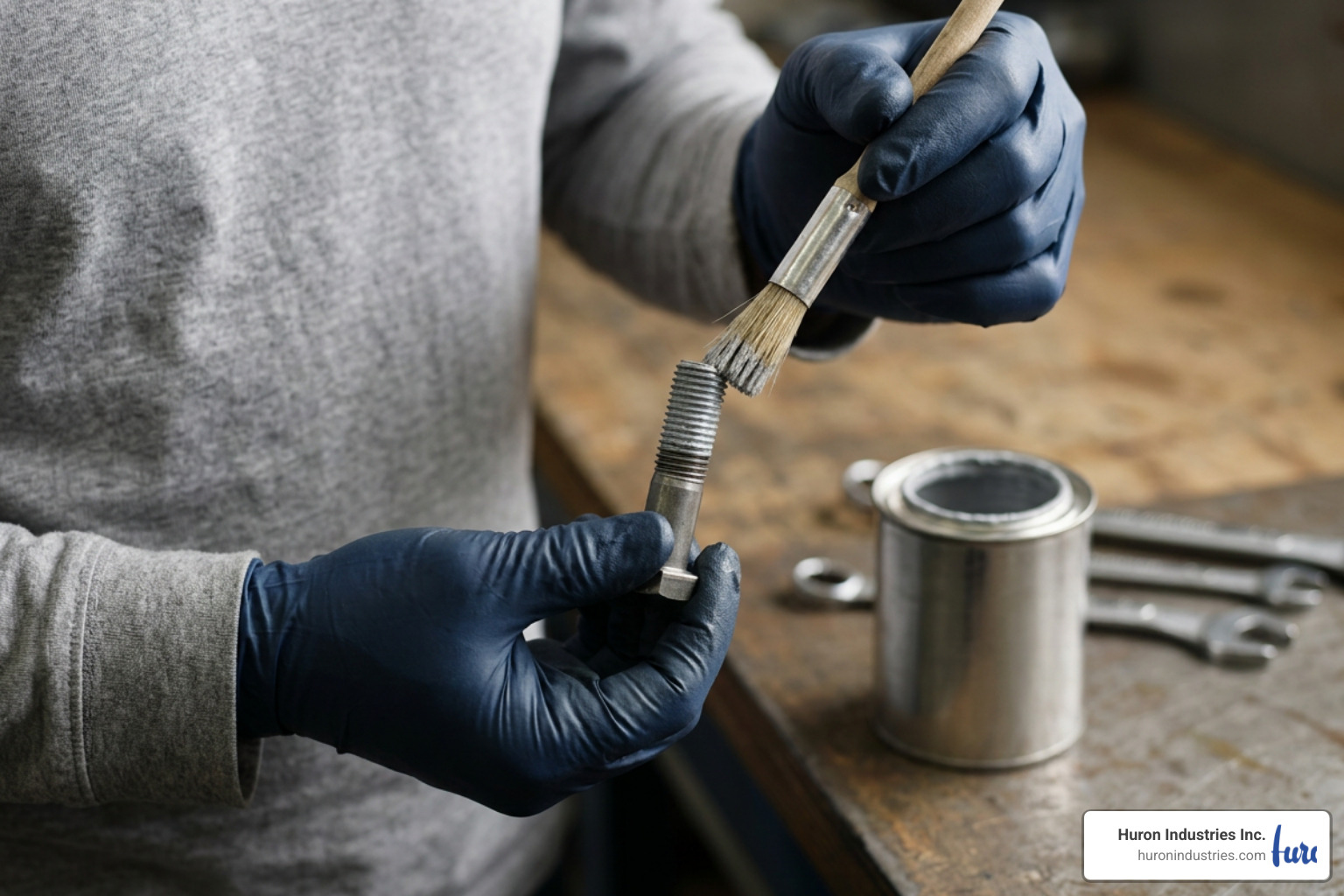
Here is my step-by-step method for applying anti-seize cleanly and effectively:
- Clean the Threads Thoroughly: Before you apply anything, you must remove old grease, rust, dirt, and metal shavings. Use a wire brush and a quick-evaporating solvent (like brake cleaner) to get the male and female threads down to bare metal.
- Stir the Product: If your bottle of anti-seize has been sitting on a shelf in your garage or shop, some oil separation is normal. Give it a good stir with the brush applicator to redistribute the solid metallic flakes back into the carrier grease.
- Apply a Thin, Even Film: Dip your brush into the paste, wiping off any excess on the rim of the container. Apply the compound to the male threads, starting a couple of threads back from the tip (to prevent the paste from being pushed into the assembly interior). Run the brush along the length of the threads, ensuring you coat the valleys.
- Do Not Overdo It: You do not need to pack the threads. A thin, visible film is all it takes. As you thread the bolt into the matching nut or hole, the tightening action will naturally spread the compound evenly across the remaining thread surface.
- Coat the Washer Face (If Needed): In high-load industrial applications, applying a tiny smear of anti-seize to the underside of the bolt head or the washer face can help prevent friction binding during torquing.
- Wipe Away Excess: Once the fastener is fully torqued down, use a clean rag to wipe away any excess paste that squeezed out of the joint.
Torque Adjustments and When NOT to Use Anti-Seize
One of the most critical—and frequently overlooked—aspects of using anti seize for threads is its impact on torque values.
Most manufacturer torque specifications are calculated for "dry" or lightly oiled threads. When you apply a highly slick anti-seize compound, you dramatically reduce the friction in the thread assembly.
If you use a torque wrench to tighten a lubricated bolt to its dry torque specification, you will actually over-tighten it. Because there is less friction resisting your wrench, you will stretch the bolt far beyond its yield point before the wrench clicks. This can strip the threads, crack aluminum castings, or snap the bolt head clean off.
As a general rule of thumb:
- When using a standard metallic anti-seize, reduce the torque specification by 10% to 15% (sometimes up to 20% depending on the fastener size and material).
- Refer to the manufacturer's "K-factor" or torque coefficient. For example, a standard dry steel bolt might have a K-factor around 0.20, whereas an anti-seize-lubricated bolt might drop to 0.15.
- Always consult the equipment manufacturer's guidelines for critical fasteners, like cylinder head bolts or wheel lug nuts.
When You Should NOT Use Anti-Seize
While anti-seize is an incredible tool, there are several scenarios where it should stay in your toolbox:
- Where Threadlockers Are Needed: Threadlockers (liquid anaerobic adhesives) require direct metal-to-metal contact to cure into a hard thermoset plastic. If you apply anti-seize, the adhesive cannot bond, and your fast-moving or vibrating machinery could shake loose.
- Oxygen and Chlorine Systems: Standard petroleum-based carrier greases can react violently (even explosively) when exposed to pure oxygen or highly oxidative chemicals like chlorine.
- As a Bearing Lubricant: Anti-seize is designed for static or slow-moving threaded joints. The high concentration of solid particles will quickly destroy high-speed rolling bearings.
- On Exposed Threads Near Sensitive Sensors: Excess grease can migrate and contaminate oxygen sensors, mass airflow sensors, or delicate electronics.
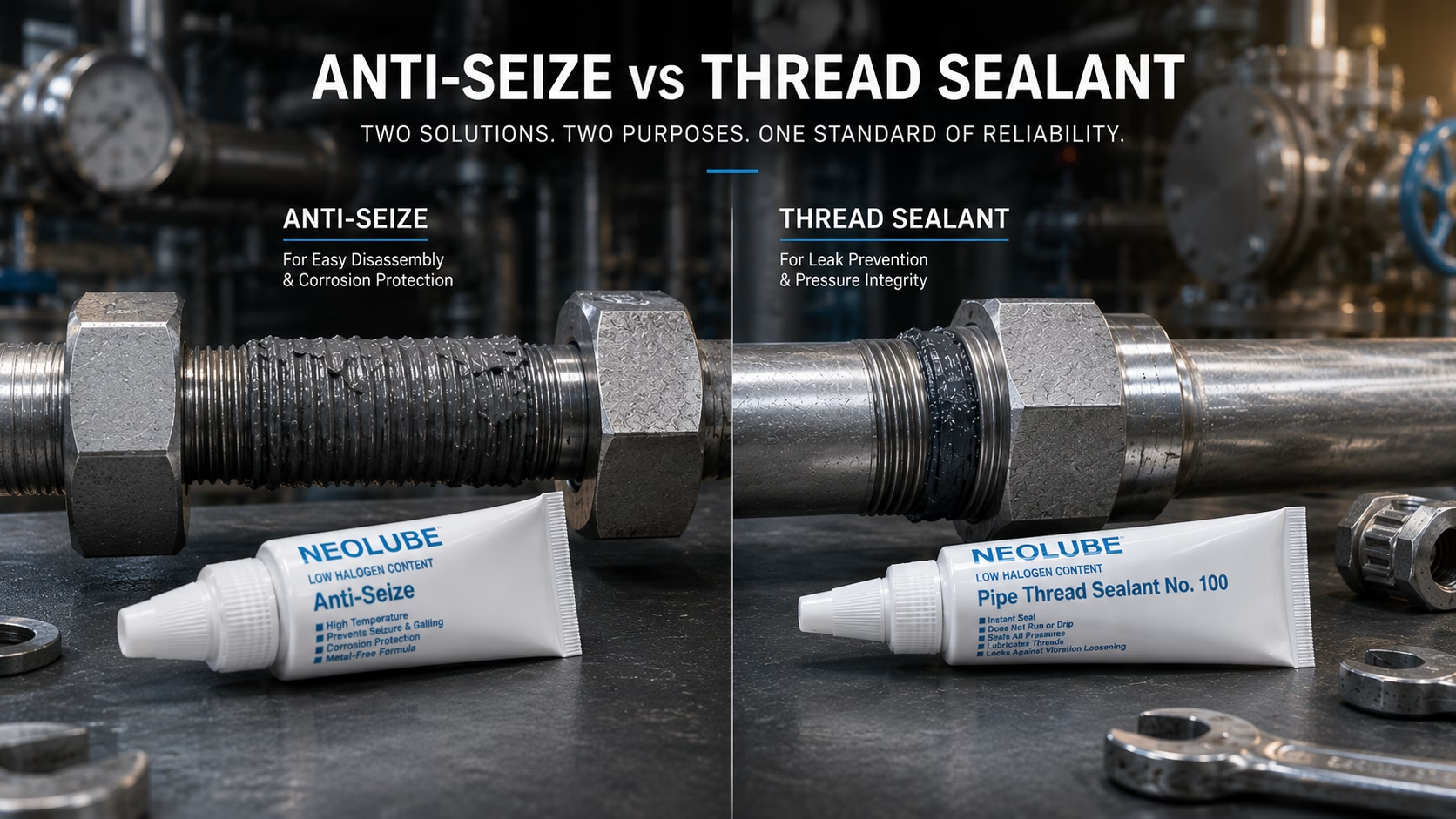
If you are unsure whether your high-temperature application requires an anti-seize or a thread sealant to prevent fluid leaks, read our breakdown on High Temperature Anti-Seize vs Thread Sealant.
Frequently Asked Questions About Thread Lubrication
Can you use anti seize for threads on spark plugs?
This is a highly debated topic in automotive circles. Traditionally, mechanics applied a dab of copper anti-seize to spark plug threads to prevent them from seizing in aluminum cylinder heads.
However, most modern spark plug manufacturers apply a special zinc- or nickel-plated metal shell coating to their plugs right out of the factory. This plating is designed to prevent seizing on its own.
If you apply anti-seize to a plated plug, you risk over-torquing the plug (which can distort the metal shell and cause internal electrical failure) or insulating the spark plug, which relies on clean thread contact with the cylinder head for electrical grounding. If you do choose to use anti-seize on older, unplated spark plugs, apply a very sparse amount of copper- or nickel-based paste, and reduce your torque specification by about 10%.
How does anti-seize compare to thread locker or regular grease?
These three products serve completely different purposes:
- Anti-Seize: Designed to prevent static fasteners from seizing under extreme heat, pressure, and corrosive environments. It does not lock the fastener in place; it simply ensures you can get it apart later.
- Thread Locker: An anaerobic adhesive designed to cure into a solid plastic bond between threads. It prevents fasteners from backing out due to vibration.
- Regular Grease: Designed for moving parts (gears, bearings, linkages). It lacks the high concentration of solid metal/graphite flakes found in anti-seize, meaning it will wash out or burn off under high heat, leaving no protective dry barrier behind.
What is the shelf life and storage requirement for anti-seize?
When stored properly in a cool, dry place with the container tightly sealed, a high-quality anti-seize compound has a shelf life of five years or more.
Over time, you may notice a thin layer of oil separating and sitting on top of the paste. This is completely normal and does not mean the product has gone bad. Simply use a clean stir stick or the built-in brush applicator to thoroughly mix the oil back into the solids before your next application.
Conclusion
At the end of the day, using anti seize for threads is one of the easiest ways to protect your equipment, prevent costly downtime, and save yourself from the headache of sheared bolts and stripped threads. By matching the right formula (copper, nickel, or graphite) to your operating temperatures and metals, and adjusting your torque values accordingly, you ensure that your assemblies remain secure during operation—and easy to disassemble when maintenance day rolls around.
Since 1971, Huron Industries Inc. has been manufacturing high-purity, high-performance lubricants and thread compounds in Port Huron, Michigan. From our military-grade Neolube® graphite lines to our environmentally friendly marine lubricants, we specialize in solutions for the most demanding environments on earth.
If you are preparing for your next industrial maintenance turn or automotive project and want to make sure you have the absolute best thread compound for the job, check out our comparative guide to Choose the Right High-Temperature Thread Lubricant for Your Next Job.