
The Solid Lubricant That Works Where Others Fail
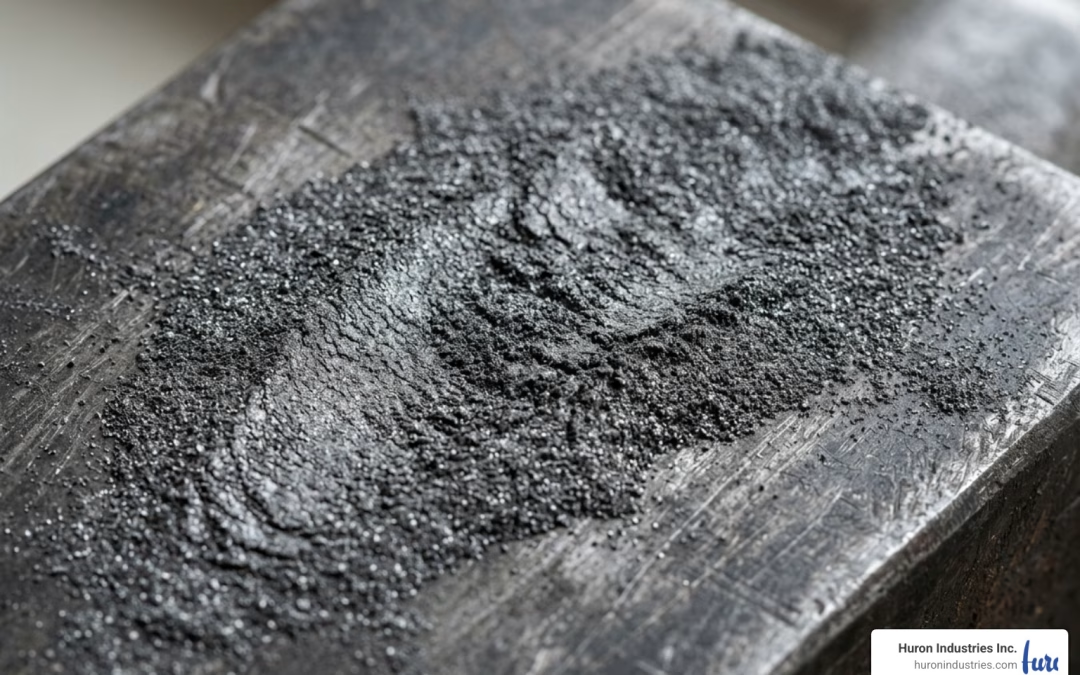
Molybdenum disulfide powder is a dry, solid lubricant made from the naturally occurring mineral molybdenite (MoS₂). It forms a slippery film on metal surfaces that holds up under extreme pressure, high temperatures, and even in vacuum environments where conventional oils and greases break down completely.
Here's a quick summary of what you need to know:
| Property | Value |
|---|---|
| Chemical formula | MoS₂ |
| Coefficient of friction | 0.03 – 0.09 (typical) |
| Max pressure resistance | Up to 250,000 psi |
| Temperature range (atmosphere) | -375°F to 750°F |
| Particle sizes available | 90 nm to 30+ µm |
| Purity levels available | 98% to 99.9% |
| Key advantage | Lubricates in vacuum, radiation, and oxygen environments |
It looks and feels similar to graphite — dark gray, slippery to the touch — but its layered molecular structure gives it performance characteristics that set it apart in demanding industrial, aerospace, and defense applications.
I'm Nicholas Cunha, founder of CreatiVertical and the content strategist behind Huron Industries Inc.'s technical content program, where I work directly with their specialty lubricant lines — including molybdenum disulfide powder formulations — to make complex product specifications clear and accessible for engineering and procurement buyers. This guide covers everything you need to evaluate MoS₂ for your application.
What is Molybdenum Disulfide Powder?
At its core, molybdenum disulfide powder (often abbreviated as MoS₂ or simply "moly") is an inorganic transition metal dichalcogenide. It is a compound composed of one molybdenum atom chemically bonded to two sulfur atoms.
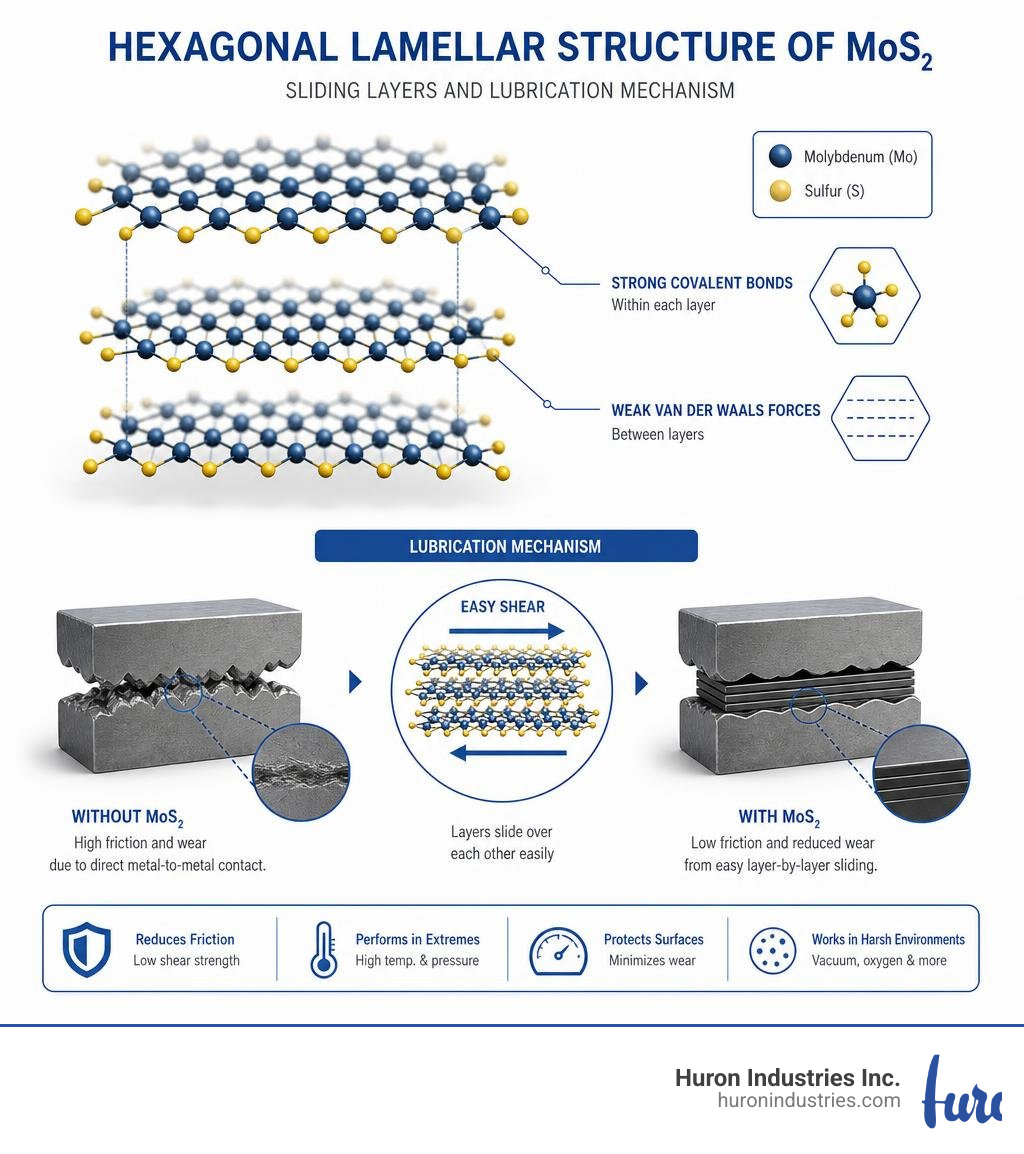
To understand why it is such an incredibly effective dry lubricant, we have to look at how it behaves on a microscopic scale. MoS₂ crystallizes in a hexagonal lamellar (layered) structure, which is highly analogous to graphite, boron nitride, and tungsten disulfide.
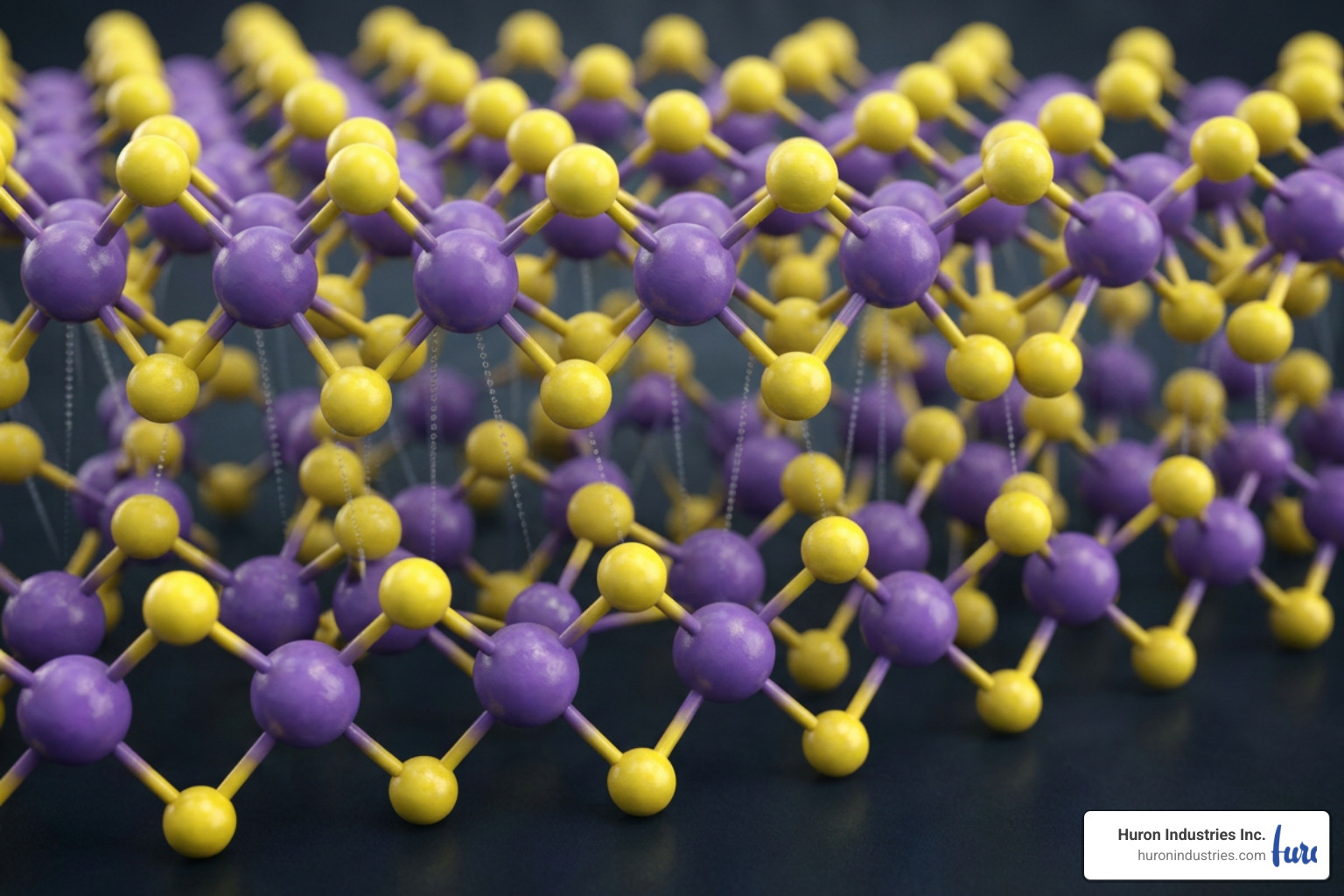
In this structure, a sheet of molybdenum atoms is sandwiched tightly between two sheets of sulfur atoms. The covalent bonds within each MoS₂ layer are incredibly strong, meaning the sheets themselves are highly durable and resistant to tearing. However, the forces holding these triple-atom layers together (called Van der Waals forces) are extremely weak.
When a lateral force is applied to the powder, these microscopic layers easily slide over one another with minimal resistance. This weak inter-planar shear is what gives the powder its signature low coefficient of friction and phenomenal lubricity.
How Molybdenum Disulfide Powder is Produced
The vast majority of commercial MoS₂ powder originates from the natural mineral molybdenite, which is the primary geological ore for molybdenum. The mining and refining process is highly specialized:
- Extraction & Flotation: The raw ore is mined, crushed, and processed using froth flotation to separate the molybdenite from the host rock and other minerals. This concentrates the MoS₂ content.
- Purification: The concentrated material is chemically treated and refined to remove impurities like silica, iron, and other heavy metals.
- Sizing: The purified material is then milled and classified into distinct particle size distributions, ranging from large technical-grade particles down to sub-micron and nanopowders.
For highly specialized or experimental applications, chemical synthesis (such as thermal treatment of molybdenum precursors with hydrogen sulfide) can be used to produce high-purity synthetic MoS₂.
One critical chemical metric to watch during production and storage is the "acid number." Over time, exposure to atmospheric oxygen and humidity can cause the surface of the powder to oxidize, forming molybdenum trioxide ($MoO_3$) and trace amounts of acidic byproducts. This surface oxidation increases the acid number, particularly in finer powder grades where the surface-area-to-volume ratio is much higher. High-purity sourcing and climate-controlled storage are essential to keeping this oxidation in check.
Key Physical and Chemical Properties
MoS₂ is physically robust and chemically inert under the right conditions. Here are the key technical parameters that define its performance:
- Load-Carrying Capacity: MoS₂ is legendary for its extreme pressure performance. Because the molecular layers slide so easily, it can withstand extreme compressive forces up to 250,000 psi (and in some burnished dry-film applications, even exceeding 500,000 psi) without squeezing out of the contact zone.
- Thermal Stability: In normal atmospheric conditions, MoS₂ is stable and effective from -375°F up to 750°F (-226°C to 399°C).
- Vacuum Performance: Unlike graphite, which requires ambient moisture to lubricate, MoS₂ operates exceptionally well in high-vacuum environments. In a vacuum or inert atmosphere, its thermal stability climbs even higher, remaining effective up to approximately 1,200°C (2,192°F).
- Oxidation Limits: When exposed to oxygen at temperatures above 350°C (662°F), MoS₂ begins to oxidize into molybdenum trioxide ($MoO3$). While $MoO3$ still has some mild lubricating properties, it is significantly more abrasive than pure MoS₂ and can increase wear if allowed to accumulate in precision machinery.
- Chemical Resistance: MoS₂ is highly stable, insoluble in water, and unaffected by dilute acids, alkalis, or common organic solvents. However, it will react with strong oxidizing agents, hot concentrated sulfuric or nitric acids, and chlorine gas.
How MoS₂ Compares to Graphite and PTFE
When engineers design systems requiring solid lubrication, they typically evaluate three primary candidates: molybdenum disulfide, graphite, and polytetrafluoroethylene (PTFE). Each has unique strengths and physical limitations.
| Lubricant Property | Molybdenum Disulfide (MoS₂) | Graphite | PTFE (Teflon) |
|---|---|---|---|
| Typical Coefficient of Friction | 0.03 – 0.09 | 0.10 – 0.15 | 0.04 – 0.10 |
| Max Operating Temp (Air) | 750°F (399°C) | 850°F (454°C) | 500°F (260°C) |
| Max Operating Temp (Vacuum) | 2,200°F (1,200°C) | Fails (requires moisture) | 500°F (260°C) |
| Load Capacity (psi) | Up to 250,000+ | Moderate | Low (prone to cold flow) |
| Moisture Sensitivity | Lubricates dry; degrades in high humidity | Requires moisture to lubricate | Hydrophobic; unaffected |
| Corrosion Risk | Potential for galvanic corrosion in wet systems | Low (except in specific nuclear alloys) | Chemically inert |

MoS₂ vs. Graphite
The primary difference between MoS₂ and graphite lies in their relationship with moisture. Graphite relies on adsorbed water vapor or oxygen molecules to weaken its interlayer bonds and achieve its low friction coefficient. In high-vacuum or extremely dry environments (like high-altitude aviation or space applications), graphite loses its lubricity and becomes highly abrasive. MoS₂ requires no moisture to lubricate. In fact, its coefficient of friction actually decreases as moisture is removed, making it the premier choice for vacuum systems.
However, graphite has a major advantage in high-temperature oxidizing environments, surviving up to 850°F in air. More importantly, in the nuclear industry where my company, Huron Industries Inc., specializes, high-purity colloidal graphite (such as our Neolube® line qualified to MIL-L-24131C) remains the absolute gold standard.
Why? Because molybdenum disulfide contains sulfur. At high temperatures and pressures, sulfur can react with stainless steel and nickel-based alloys to cause sulfur-induced stress corrosion cracking (SCC). For commercial and naval nuclear reactor systems, avoiding sulfur is non-negotiable, which is why graphite is used instead of moly in those specific environments.
MoS₂ vs. PTFE
PTFE is highly valued for its extreme chemical inertness, excellent dielectric properties, and low friction at light loads. However, under heavy compressive loads, PTFE suffers from "cold flow" or creep—it physically deforms and squeezes out of the joint. MoS₂ does not suffer from cold flow and can handle loads orders of magnitude higher than PTFE.
Additionally, PTFE is thermally limited to about 500°F (260°C), whereas MoS₂ can easily handle 750°F in open air. Often, these materials are blended; adding MoS₂ powder to PTFE-based plastic composites or nylon gears drastically improves their load capacity, wear resistance, and structural stability.
Industrial, Automotive, and Specialized Applications
Because of its unique physical characteristics, MoS₂ powder is incredibly versatile. It is deployed as a pure dry-film powder, blended into liquid carriers, or used as an extreme-pressure additive in heavy-duty greases and anti-seize compounds.
Automotive and Heavy Machinery Uses
In the automotive world, moly is synonymous with heavy-duty protection. It is a staple additive in constant velocity (CV) joints, where high-angle sliding friction and extreme pressures would quickly destroy a standard grease.
- Engine Run-In: Engine builders often apply a dry film of MoS₂ powder or a moly-rich paste to camshaft lobes, lifters, and piston skirts during assembly. This provides critical boundary lubrication during the first few seconds of engine startup before oil pressure is fully established, preventing scuffing and galling.
- Chassis and Suspension: Heavy-duty chassis greases formulated with 3% to 5% MoS₂ are standard for construction equipment, mining machinery, and agricultural vehicles. The solid moly particles stay lodged in the metal pores of kingpins, ball joints, and fifth wheels, providing backup protection even if the grease carrier is washed away by water or dirt.
Aerospace, Vacuum, and High-Tech Applications
MoS₂ is a critical material in outer space and advanced electronics. Because space is a vacuum, liquid lubricants would instantly vaporize (outgas) and contaminate optical sensors or solar panels. Dry-burnished MoS₂ powder is used to lubricate hinges, gears, and release mechanisms on satellites and spacecraft.
- Liquid Oxygen Valves: Because MoS₂ is chemically resistant to liquid and gaseous oxygen, it is used to lubricate valves and regulators in aerospace propulsion systems where hydrocarbon oils would pose a catastrophic fire or explosion hazard.
- Advanced Electronics and Semiconductors: In recent years, MoS₂ has transitioned from a mechanical lubricant to a star player in solid-state physics. When exfoliated down to a single molecular monolayer, MoS₂ transitions from an indirect bandgap semiconductor (1.23 eV in bulk) to a direct bandgap semiconductor (1.8 eV). This unique property has made MoS₂ nanopowders highly sought after for research into next-generation field-effect transistors (FETs), valleytronics, photovoltaics, and flexible microelectronics.
Technical Specifications: Particle Sizes and Purity Levels
When purchasing or specifying Molybdenum disulfide (MoS2) powder, you must match the particle size and purity to your exact process requirements.
Generally, commercial moly powder is categorized into three primary grades:
- Technical Grade: Typically features a median particle size (D50) of 16.0 to 30.0 µm. It is ideal for heavy industrial greases, metalworking dies, and general mechanical applications where tolerances are relatively loose.
- Technical Fine Grade: Features a median particle size (D50) of 4.0 to 6.0 µm. This is the workhorse grade for dry-film coatings, bullet coating for precision shooting, and finer mechanical assemblies.
- Super Fine Grade: Features a median particle size (D50) of 0.9 to 1.6 µm. This micro-fine powder is preferred when blending into thin oils, aerosol dry-film sprays, or high-precision plastic composites.
For advanced scientific research, manufacturers also offer ultra-pure Molybdenum Disulfide Nanopowder with particle sizes around 90 nm to 100 nm and purities up to 99.9%. These nanopowders provide an incredibly high surface area, which is highly beneficial for catalytic applications (like hydrogen evolution reactions) and microelectronic fabrication.
Understanding Particle Size Distributions
When reading a technical data sheet (like the standard Molysulfide ® (Tech, Tech Fine, Super Fine) sheets), you will encounter terms like D50 and Fisher number.
- D50 (Median Particle Size): This indicates that 50% of the particles in the powder sample are smaller than the specified value, and 50% are larger.
- Fisher Number (F.S.S.S.): Measured via a Fisher Sub-Sieve Sizer, this represents the average particle diameter based on air permeability. A lower Fisher number indicates a finer average particle size.
Understanding these metrics is vital if you are trying to keep MoS₂ suspended in a liquid carrier. In a raw oil blend, larger particles (Technical Grade) will settle out of suspension almost immediately due to gravity. To achieve a stable colloidal suspension, you must use a sub-micron or nanopowder grade (like a Molybdenum Disulfide Nanopowder Lubricant Grade) where Brownian motion — the random movement of microscopic particles suspended in a fluid — can overcome gravitational settling.
Safety and Handling of Molybdenum Disulfide Powder
While MoS₂ is chemically stable and generally non-toxic, handling any fine powder requires proper safety protocols to protect workers and equipment:
- Dust Inhalation: Fine powders can easily become airborne. Inhaling MoS₂ dust can cause mechanical irritation to the respiratory tract. Always wear a properly fitted particulate mask (N95 or better) and work in a well-ventilated area or under a fume hood.
- Skin and Eye Protection: Wear safety glasses and gloves. MoS₂ is incredibly slippery and messy; if it gets on your skin, it can be difficult to wash out of pores and clothing.
- Spill Containment: Because of its low friction coefficient, spilled moly powder on a workshop floor creates an extreme slip hazard. Clean up spills immediately using dry sweeping compounds or specialized industrial sorbents (like our NEOSafe® line).
Before working with these materials, always review the official safety documentation:
Frequently Asked Questions about MoS₂
Can I mix raw MoS₂ powder directly into my engine oil?
I strongly advise against dumping raw, dry MoS₂ powder directly into your engine oil fill cap. While the idea of adding "moly protection" to your engine sounds great, raw powder lacks the necessary chemical dispersants to stay suspended in motor oil.
Within days, the heavy moly particles will settle to the bottom of your oil pan or, worse, get trapped in your oil filter. This can clog the filter element or create a sludge-like buildup in the oil galleries. If you want the benefits of moly in your engine, use a high-quality, commercially formulated engine oil that already contains dissolved, oil-soluble organo-moly compounds, or use a pre-formulated colloidal moly additive designed to stay suspended.
What is the maximum operating temperature for MoS₂?
In a standard oxygen-rich atmosphere, the maximum reliable operating temperature for MoS₂ is 750°F (399°C). Beyond this temperature, the sulfur atoms will begin to oxidize, converting the lubricant into molybdenum trioxide ($MoO_3$) and sulfur dioxide gas. However, if you are operating in a vacuum or a sealed, moisture-free inert environment (like nitrogen or argon), MoS₂ remains highly stable and lubricates effectively up to 2,200°F (1,200°C).
How do you apply dry MoS₂ powder to a metal surface?
There are three primary ways to apply dry MoS₂ powder:
- Burnishing: Clean the metal surface thoroughly with a solvent (like isopropanol) to remove all grease and oil. Pour a small amount of fine MoS₂ powder onto the surface and vigorously rub it into the metal using a clean, lint-free cloth or a polishing wheel. The powder will burnish into the microscopic pores of the metal, creating a thin, highly tenacious lubricating film.
- Tumbling: Precision bullet reloaders often place their cleaned brass or projectiles in a rotary tumbler along with a small amount of Technical Fine MoS₂ powder. The tumbling action mechanically bonds a micro-thin, uniform layer of moly to the metal surfaces.
- Solvent Carrier: You can disperse the powder in a fast-evaporating solvent carrier like isopropyl alcohol. Spray or brush the mixture onto the component. Once the alcohol evaporates, it leaves behind a uniform, dry film of MoS₂ without requiring any baking or thermal curing. For detailed application instructions, see the Molybdenum Disulfide Isopropanol TDS Technical Datasheet.
Conclusion
Molybdenum disulfide powder remains one of the most reliable, high-performance solid lubricants ever discovered. Whether you are dealing with extreme pressures in heavy industrial machinery, managing precision tolerances in aerospace vacuum chambers, or formulating high-performance composite plastics, MoS₂ provides a level of boundary protection that liquid lubricants simply cannot match.
At Huron Industries Inc., we have spent over five decades manufacturing and supplying the highest-quality specialty lubricants from our facility in Port Huron, Michigan. While our Neolube® colloidal-graphite products remain the industry benchmark for ultra-pure nuclear applications, we understand that different engineering challenges require different chemical solutions.
If you are looking for high-purity solid lubricants, dry-film coatings, or custom dispersions tailored to your specific industrial process, we are here to help.