
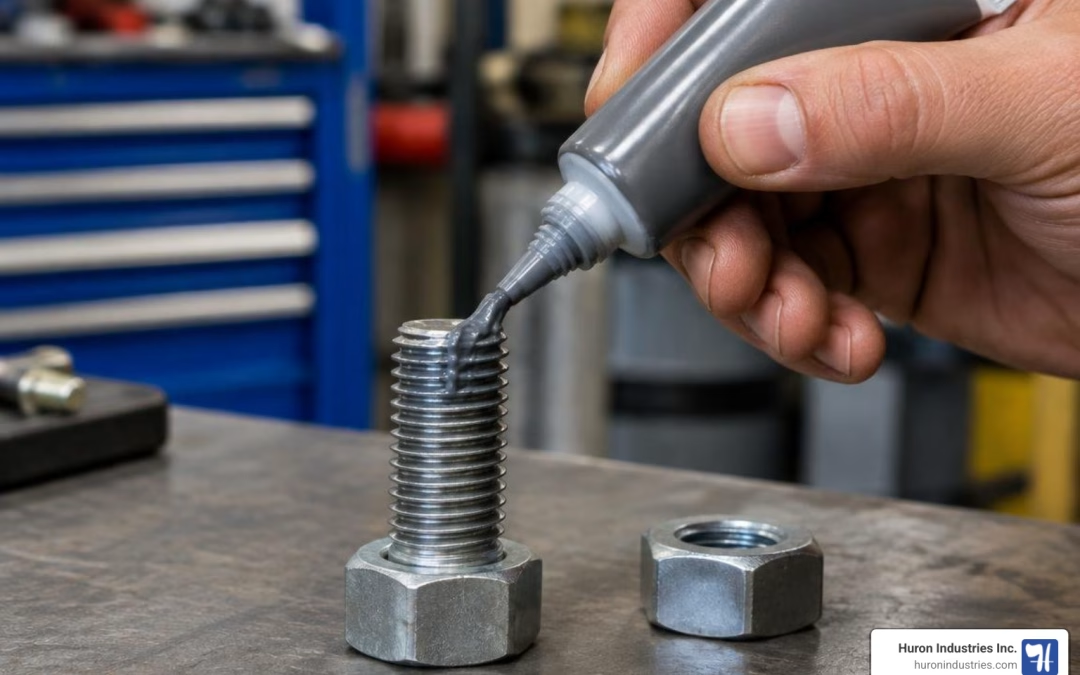
Choose MoS2 Anti-Seize for High Load, Heat, and Reliable Breakout
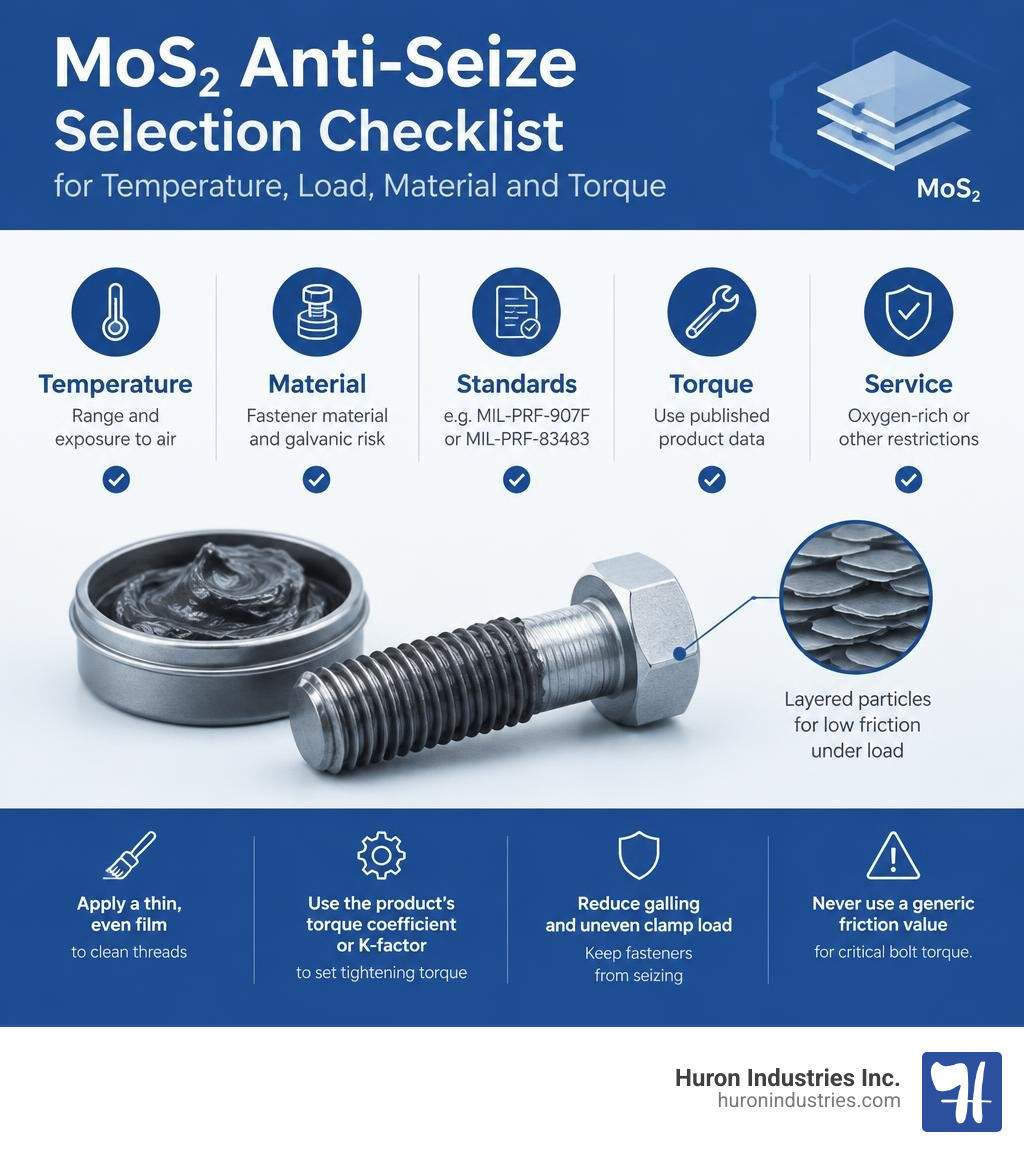
A molybdenum disulfide anti-seize lubricant is a strong choice for threaded parts that face extreme torque, high contact pressure, heat, or corrosion. Apply a thin, even film to clean threads before assembly, then use the product's stated torque coefficient or K-factor to adjust tightening torque. This helps reduce galling, uneven clamp load, and the risk that fasteners will seize during later removal.
MoS2 works as a solid boundary lubricant. Its layered particles slide over one another under load, leaving a low-friction protective film even when the carrier grease is pushed aside. For demanding work, choose a product based on:
- Required temperature range and exposure to air
- Fastener material and risk of galvanic corrosion
- Applicable standards, such as MIL-PRF-907F or MIL-PRF-83483
- Published torque data for the exact product and joint condition
- Restrictions for oxygen-rich or other sensitive service
Some nonmetallic MoS2 and graphite compounds are rated as high as 2,400 F for anti-seize protection, while paste-style products often have lower working limits for moving or exposed applications. Never use a generic friction value to set critical bolt torque. The coefficient of friction for Neolube No. 1.1 of 0.15 has not been tested or approved for this.
I am Nicholas Cunha, founder of CreatiVertical and a technical content specialist who helps Huron Industries Inc. make complex industrial products, including molybdenum disulfide anti-seize lubricant options, easier for engineering and procurement teams to evaluate. This guide compares the performance factors that matter before you specify a product for critical assembly work.
Easy molybdenum disulfide anti-seize lubricant word list:
- molybdenum disulfide powder
- molybdenum disulfide powder under 2 microns
- molybdenum disulfide spray lubricant
Why Choose a Molybdenum Disulfide Anti-Seize Lubricant for Extreme Applications
When you tighten a large fastener, microscopic high points on the mating threads (called asperities) smash into each other under massive contact pressure. In heavy industrial assemblies, this pressure routinely exceeds 10,000 psi and can easily surpass 100,000 psi. Under these severe conditions, standard fluid lubricants get squeezed completely out of the contact zone.
Without a solid lubricant barrier, bare metal rubs against bare metal, causing localized frictional heat, microscopic welding, fret corrosion, and severe thread galling. Once galling occurs, threads seize permanently, turning routine maintenance into a costly nightmare of torch cutting and drilling out ruined studs.
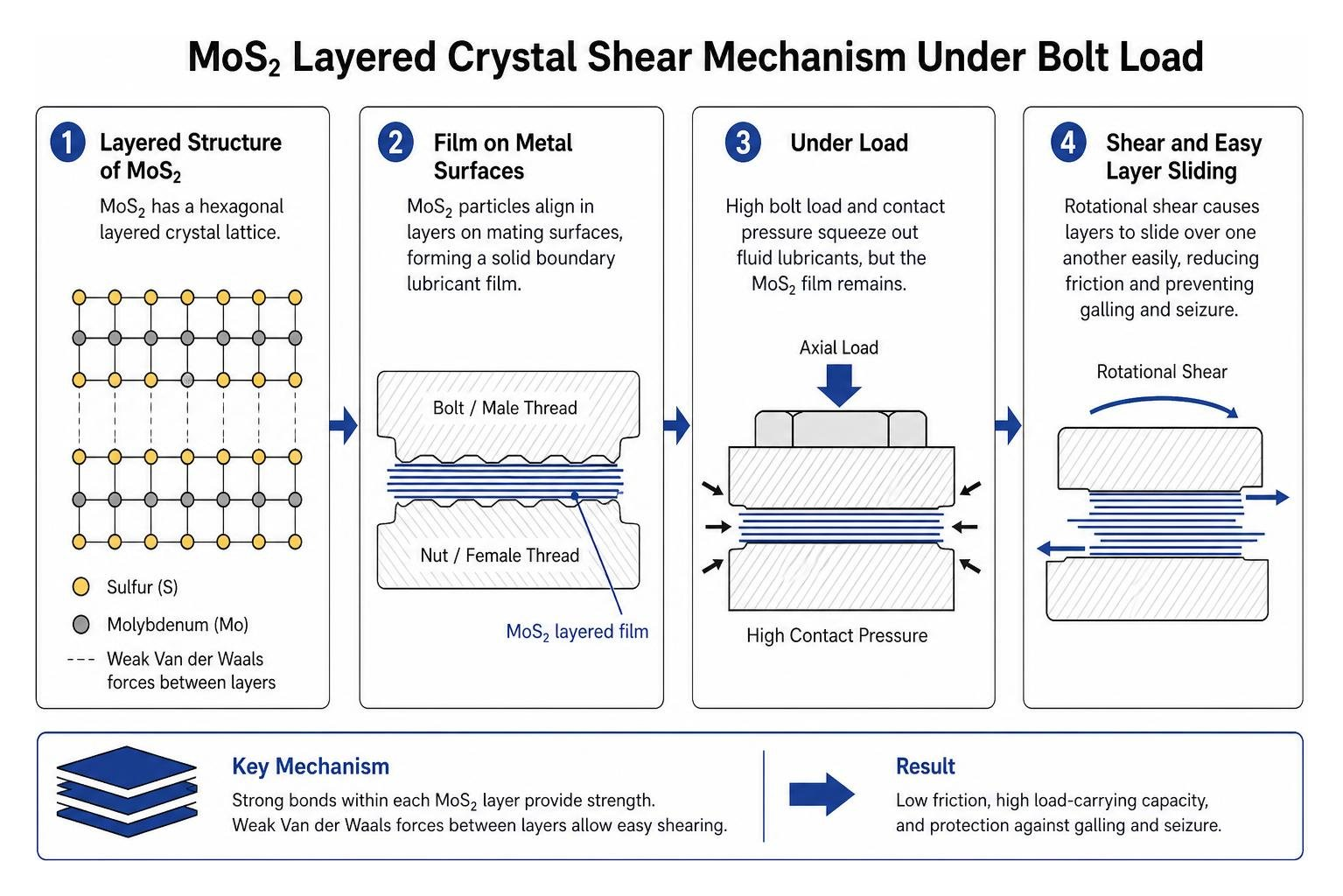
Molybdenum disulfide ($text{MoS}_2$) prevents this disaster through its unique hexagonal crystal lattice. You can visualize the molecular structure of $text{MoS}_2$ as a microscopic sandwich: a single sheet of molybdenum atoms bonded between two layers of sulfur atoms. The covalent bonds within each sandwich layer are exceptionally strong, but the bonds between the adjacent sulfur layers are weak Van der Waals forces.
When your torque wrench applies heavy rotational shear, these molecular layers slide effortlessly past one another like a slick deck of playing cards. This mechanical property gives $text{MoS}_2$ a very low friction coefficient (often between 0.08 and 0.15 depending on formulation) and extreme load-carrying capabilities exceeding 500,000 psi (over 7,000 kg/cm²).
Many technicians ask: Is Molybdenum Disulfide (MoS2) lubricant the same as Anti-Seize? While pure $text{MoS}_2$ is a raw solid lubricant material, an anti-seize compound is an engineered blend that pairs $text{MoS}_2$ solids (often 40% to 50% by weight) with carrier bases, corrosion inhibitors, and complementary solids like synthetic graphite. $text{MoS}_2$ possesses a natural chemical affinity for ferrous metals, mechanically plating onto steel surfaces to create an armor-like boundary film that ensures smooth assembly and non-destructive breakout years later.
Solid Lubricant Carrier Systems: Pastes, Greases, and Dry Films
The performance of an $text{MoS}_2$ anti-seize compound depends heavily on its carrier vehicle. The carrier's job is to keep the solid particles evenly dispersed, enable smooth brush application, and provide baseline corrosion protection until operating temperatures rise.
- Petrolatum and Mineral Oil Pastes: Traditional formulations blend high concentrations of pure $text{MoS}_2$ with refined petrolatum or petroleum oil thickened with organo-clays. These provide excellent brushability and moisture barrier properties. At temperatures above their flash points (typically 400°F to 450°F / 204°C to 232°C), the organic vehicle gradually volatilizes without leaving abrasive carbon residue, leaving pure $text{MoS}_2$ plating the metal roots.
- Synthetic Base Pastes (PAO and Silicone): High-performance synthetic carriers like polyalphaolefin (PAO) or polyphenylmethyl siloxane (silicone) offer exceptional thermal stability and wide operating windows (from -50°C to +230°C in paste form). Silicone-based $text{MoS}_2$ pastes volatilize cleanly under extreme heat, leaving a dry boundary film that continues protecting up to 750°F (400°C) in open air.
- Calcium Sulfonate Complex Greases: Used in premium all-weather anti-seize formulations, calcium sulfonate thickeners provide rust and saltwater corrosion resistance while remaining brushable down to -40°F (-40°C).
- Resin-Bonded Dry Films: Aerosol sprays and liquid dispersions use fast-evaporating solvent carriers (like isopropanol) and specialized resin binders. Once applied, the carrier evaporates completely within minutes, leaving a clean, bonded dry film of $text{MoS}_2$ that does not attract airborne dust, grit, or lint.
Nonmetallic Formulations vs Metallic Anti-Seize Compounds
For decades, maintenance shops relied on metallic anti-seize compounds loaded with copper, aluminum, or nickel flakes. While effective in basic plumbing, metallic compounds carry severe operational risks in critical industrial, petrochemical, and aerospace environments.
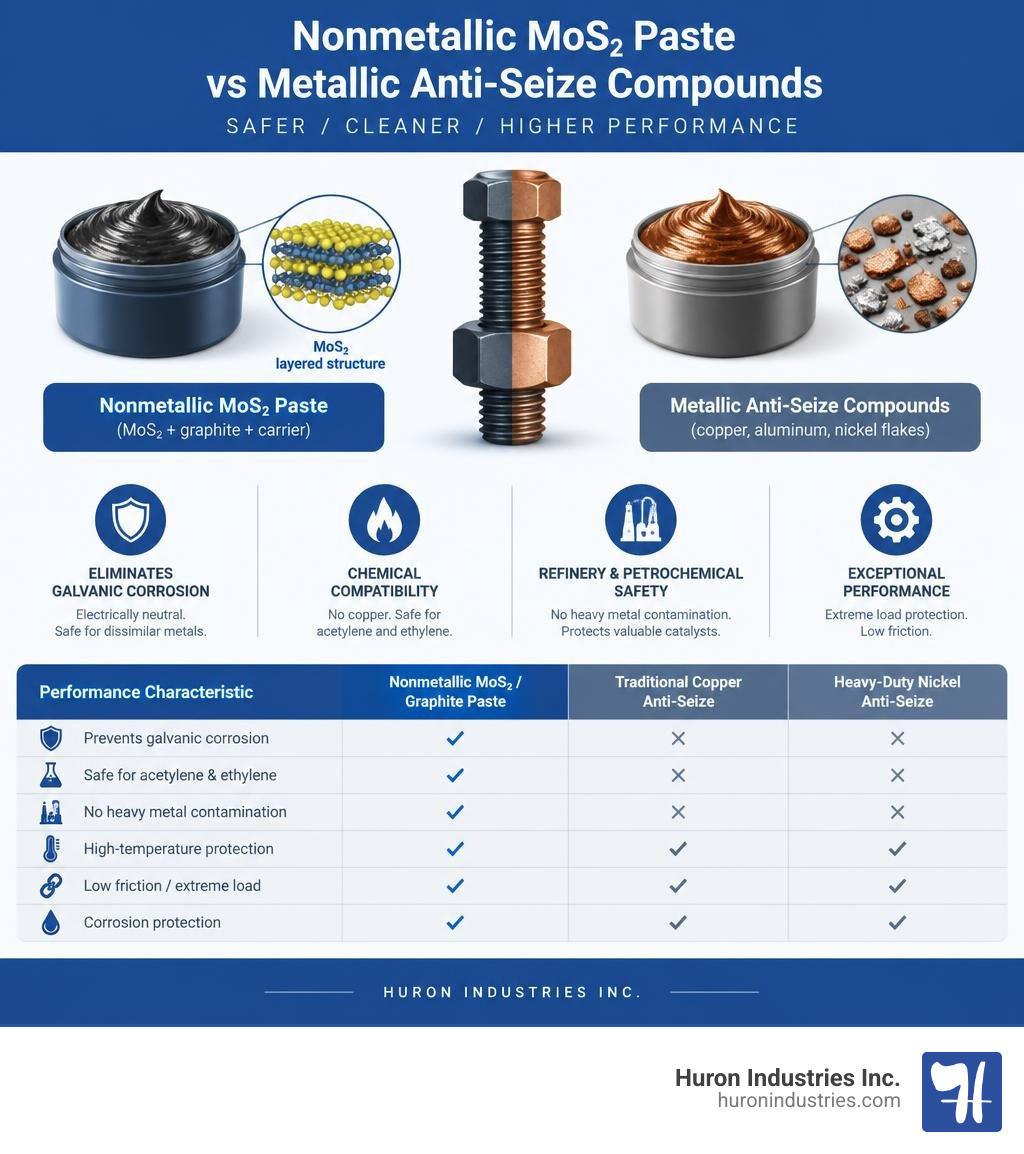
- Elimination of Galvanic Corrosion: When you place copper anti-seize on stainless steel, aluminum, or titanium fasteners exposed to moisture or saltwater, you create an active galvanic cell. The copper acts as a noble cathode, accelerating the severe corrosion of the surrounding fastener metal. Nonmetallic $text{MoS}_2$ and graphite formulations are electrically neutral and completely eliminate galvanic coupling.
- Chemical Compatibility: Copper compounds cannot be used in acetylene or ethylene environments because copper reacts with acetylene gas to form explosive copper acetylides. Nonmetallic $text{MoS}_2$ compounds are copper-free and safe for gas processing equipment.
- Refinery and Petrochemical Safety: In high-temperature refinery units, trace heavy metals like copper, lead, and nickel can poison expensive downstream cracking catalysts or cause liquid metal embrittlement on austenitic stainless steel piping. Pure $text{MoS}_2$ formulations provide extreme load protection without risk of metal contamination.
| Performance Characteristic | Nonmetallic $text{MoS}_2$ / Graphite Paste | Traditional Copper Anti-Seize | Heavy-Duty Nickel Anti-Seize |
|---|---|---|---|
| Primary Solid Lubricant | Molybdenum Disulfide ($text{MoS}_2$) & Graphite | Copper Flake & Graphite | Nickel Flake & Graphite |
| Galvanic Corrosion Risk | Zero (Nonmetallic) | High (when paired with stainless/aluminum) | Moderate |
| Extreme Pressure Resistance | Outstanding (>100,000 psi to 500,000 psi) | Moderate | High |
| Friction Coefficient ($mu$) | Low and consistent (0.085 – 0.16) | Moderate (0.15 – 0.20) | Higher / variable (0.15 – 0.22) |
| Acetylene / Chemical Safety | Safe (Copper-Free) | Unsafe (Explosion hazard) | Safe |
| Environmental & Worker Safety | Lead-free, Nickel-free | Contains heavy metals | Contains carcinogenic nickel |
Top Formulations and Performance Standards for Heavy-Duty Assembly
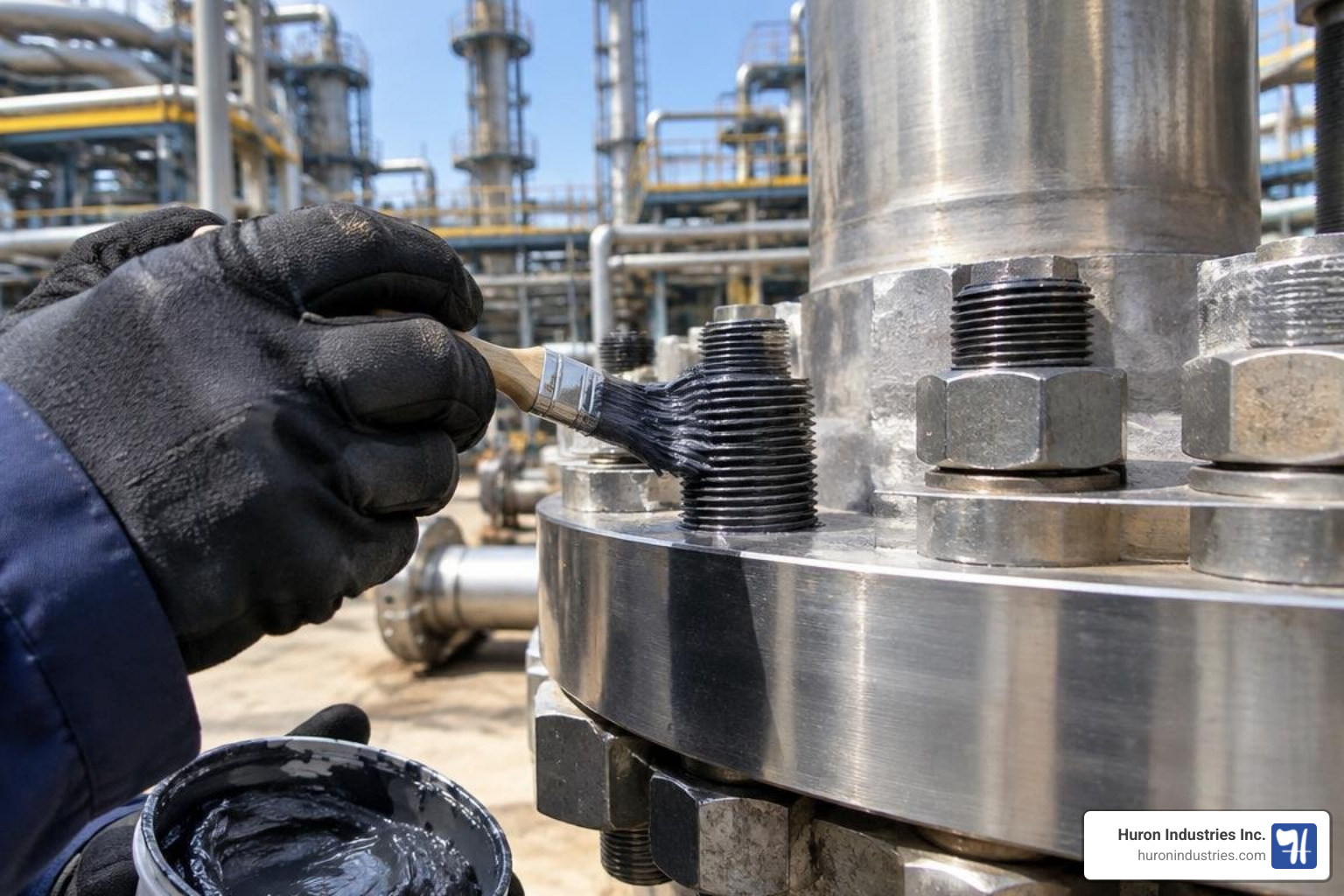
When selecting a heavy-duty anti-seize lubricant, maintenance managers must rely on standardized military and industrial testing protocols rather than vague marketing claims.
Key performance standards include:
- MIL-PRF-907F (formerly MIL-PRF-907E): The benchmark United States Department of Defense performance specification for high-temperature, extreme-pressure anti-seize compounds. Products meeting this standard are tested rigorously to prevent seizure and galling on threaded studs, pipe joints, and boiler fittings subjected to prolonged high-heat soak.
- MIL-PRF-83483 (and MIL-PRF-83483D): Specifically governs military-grade anti-seize compounds formulated with pure molybdenum disulfide and petrolatum bases. Originally developed for aircraft spark plug threads, threaded engine fasteners, and fittings operating between -54°C and 427°C (-65°F to 800°F).
- ASTM D2596 (Four-Ball EP Test): Measures extreme pressure load-carrying capability. Premium $text{MoS}_2$ anti-seize pastes achieve weld loads of 500 kg or higher, demonstrating that the solid film prevents welding under massive mechanical forces.
- ISO 16047 Fastener Testing: Standardizes the determination of torque-tension relationships and friction coefficients ($mu$) under controlled tightening conditions.
High-Temperature MoS2 Formulations for Extreme Thermal Cycling
Understanding how molybdenum disulfide behaves at elevated temperatures is essential for specifying the right product.
In normal ambient air containing oxygen, $text{MoS}_2$ remains chemically stable and inert up to roughly 600°F to 750°F (315°C to 400°C). Above this temperature threshold in open atmosphere, $text{MoS}_2$ slowly begins to oxidize into molybdenum trioxide ($text{MoO}_3$). While $text{MoO}_3$ is not abrasive to hard steels, it loses the low-friction sliding mechanics of pure $text{MoS}_2$.
However, threaded fasteners are naturally sealed mechanical joints. Deep inside the mated roots of a tightened bolt and nut, atmospheric oxygen is excluded. In non-air-exposed or inert environments, $text{MoS}_2$ maintains its solid film lubrication up to 2,000°F (1,090°C). Furthermore, when $text{MoS}_2$ is synergistically blended with high-purity synthetic graphite in heavy-duty compounds, the solid anti-seize barrier protects equipment up to 2,400°F (1,316°C), ensuring clean, non-destructive breakout even after years of continuous furnace operation.
At the opposite end of the spectrum, $text{MoS}_2$ solid lubricants excel in cryogenic applications down to -300°F (-184°C), where liquid oils freeze solid and fail completely.
Selecting the Right Molybdenum Disulfide Anti-Seize Lubricant for Industrial Fasteners
Matching the correct product formulation to your specific operating environment prevents costly mechanical downtime:

- Refineries and Petrochemical Processing: Choose copper-free, nonmetallic $text{MoS}_2$ and synthetic graphite pastes qualified to MIL-PRF-907F. These provide superior resistance to sulfur gases, steam, dilute acids, and thermal cycling on pipe flanges and heat exchangers.
- Offshore Marine Rigging and Subsea Equipment: Select water-resistant formulations blended with calcium sulfonate thickeners or heavy petrolatum bases that meet MIL-PRF-83483. These resist salt spray wash-off while protecting marine engine spark plugs and heavy deck winches.
- Mining, Earthmoving, and Heavy Equipment: For slow-moving, high-load pins, bushings, splines, and track bolts, choose heavy pastes containing 40% to 50% $text{MoS}_2$ with a 4-Ball EP weld load rating of 500 kg or higher to absorb severe shock loading.
- Cleanroom, Aerospace, and Regulated Maintenance: When wet lubricants could migrate, collect abrasive airborne grit, or contaminate vacuum chambers, specify resin-bonded dry-film $text{MoS}_2$ coatings qualified to MIL-L-23398C.
Application Best Practices and Torque Calculation
Applying an anti-seize compound changes how a threaded fastener responds to wrench torque. Understanding this mechanical relationship is critical to avoid catastrophic bolt stretching or stripping.
The Torque-Tension Relationship and Nut Factors
When you tighten a bolt, the torque applied by your wrench ($T$) is converted into clamping tension ($F$) according to the standard short-form formula:
$$T = K cdot D cdot F$$
Where:
- $T$ = Tightening torque (inch-pounds or foot-pounds)
- $K$ = Torque coefficient (also known as the "Nut Factor")
- $D$ = Nominal bolt diameter (inches)
- $F$ = Target bolt preload tension (pounds)
In an unlubricated, dry steel fastener assembly, approximately 85% to 90% of the wrench torque is lost overcoming friction under the bolt head and between the mating thread flanks; only 10% to 15% is actually converted into useful bolt stretch and clamping tension. Dry steel fasteners typically have a $K$-factor between 0.20 and 0.30.
Because a molybdenum disulfide anti-seize lubricant dramatically lowers thread friction—dropping the $K$-factor to a range of 0.13 to 0.17 (with pure $text{MoS}_2$ friction coefficients as low as 0.085)—significantly more torque is converted directly into clamping force.
If you tighten an anti-seize-lubricated bolt using the published dry torque specification, you will severely over-tension the fastener. This can yield the bolt steel, strip the internal nut threads, or crush joint gaskets. As a general industry rule of thumb, applying a high-performance $text{MoS}_2$ anti-seize requires reducing your tightening torque setting by 20% to 40% compared to dry torque values. Always verify the manufacturer's published $K$-factor for your specific bolt diameter and grade.
Step-by-Step Application Instructions
- Thorough Surface Cleaning: Never apply fresh anti-seize over old, grit-contaminated grease or corroded threads. Clean the male and female threads thoroughly using a wire brush and a fast-evaporating degreasing solvent. Allow surfaces to dry completely.
- Proper Mixing: If you are using a paste or grease container that has been stored for an extended period, stir the compound with a clean spatula if any slight carrier separation is visible. (Quality formulations with complex bases maintain solid suspension and have a shelf life of 5 years or more).
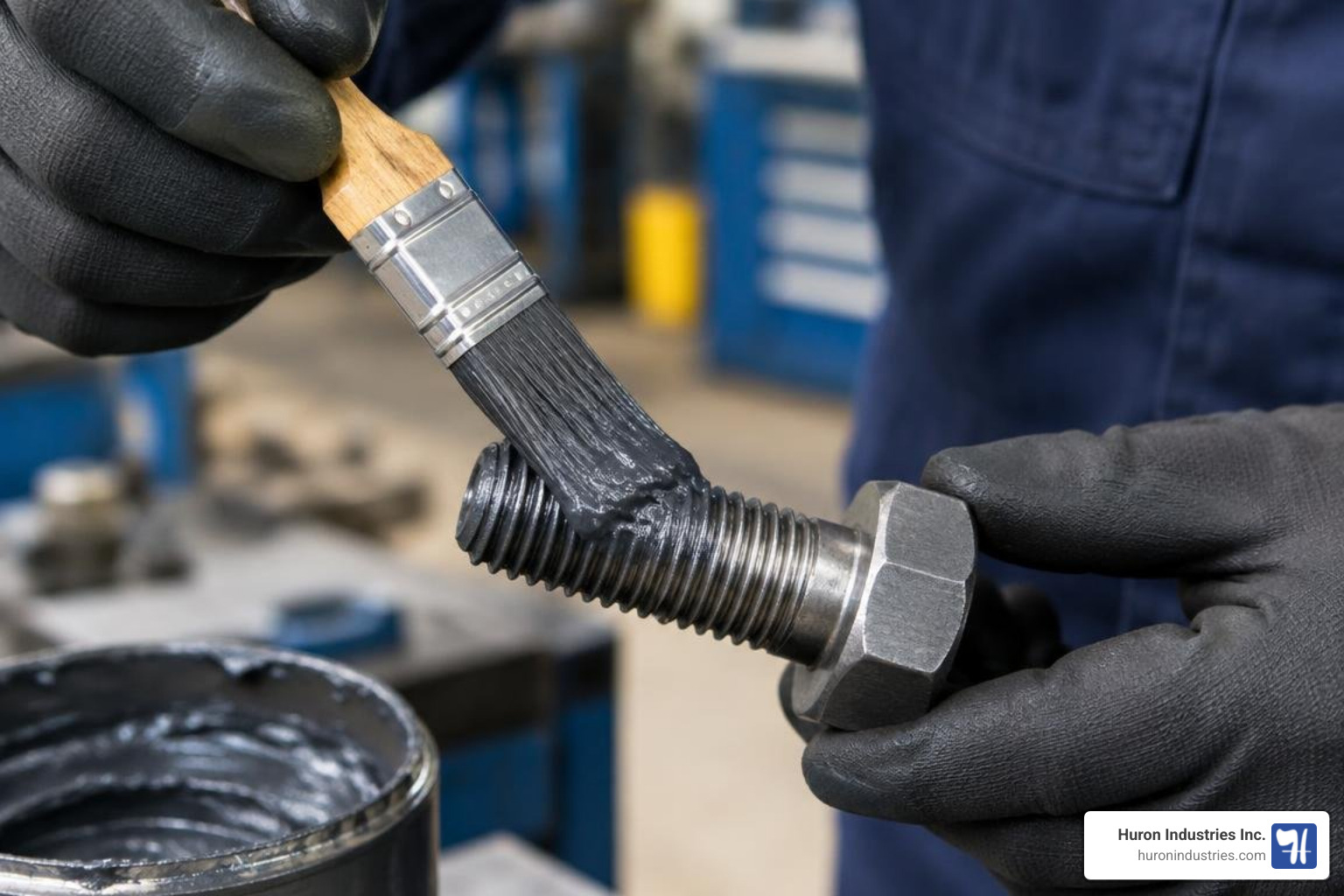
- Targeted, Thin Application: Use a brush-top applicator or stiff bristle brush to apply a light, uniform coat of compound directly onto the engaged male threads. Ensure the paste is forced down into the roots of the threads.
- Lubricate the Bearing Face: Apply a light film under the bolt head or washer face where the rotating nut makes contact. 30% to 40% of rotational friction occurs under this bearing surface.
- Avoid Excess Buildup: Do not pack the threads like cake frosting. Excess compound does not increase boundary lubrication; it simply gets displaced upon makeup and creates unwanted cleanup work. Wipe away any excess squeezed-out paste with a clean rag.
- No Thinning: Use anti-seize compounds at full strength directly from the container. Never dilute the product with motor oil, mineral spirits, or penetrating fluids, as this disrupts the solid-to-carrier ratio and ruins boundary performance.
Frequently Asked Questions About MoS2 Anti-Seize
How does a molybdenum disulfide anti-seize lubricant prevent galling under extreme torque?
Galling is a severe form of mechanical adhesive wear caused by cold welding between microscopic high points (asperities) on contacting thread surfaces under high load. A molybdenum disulfide anti-seize compound prevents galling by placing an impenetrable, lamellar solid barrier between the mating metal faces.
Under extreme pressure, the $text{MoS}_2$ particles fill microscopic metal voids and plate onto the steel. When shear force is applied, the weak molecular bonds between the sulfur layers shear smoothly, preventing metal-to-metal contact, lowering the coefficient of friction down to 0.085, and completely halting the heat buildup that causes cold welding.
What is the maximum operating temperature for MoS2 anti-seize compounds?
The operating temperature limit depends on whether the compound is exposed to open air:
- Continuous Open Air: MoS2 pastes and greases typically operate from -65°F up to 750°F (-54°C to 400°C). Above 750°F in open oxygen, the solid begins oxidizing into molybdenum trioxide.
- Sealed Fasteners and Inert Environments: Deep inside tightened threaded roots where atmospheric oxygen is excluded, MoS2 maintains protective boundary lubrication up to 2,000°F (1,090°C).
- Synergistic Formulations: Compounds blending MoS2 with synthetic graphite provide anti-seize and non-destructive breakout protection up to 2,400°F (1,316°C).
- Cryogenic Service: MoS2 remains fully functional in extreme cold down to -300°F (-184°C).
Can MoS2 anti-seize be safely used in oxygen-rich systems?
No. Petroleum-based, synthetic-oil, or organic-thickened molybdenum disulfide anti-seize pastes must never be used in pure gaseous oxygen systems, liquid oxygen (LOX) lines, or high-concentration oxidizer piping.
Under elevated pressure, hydrocarbons and organic carriers in standard anti-seize compounds can undergo rapid, violent auto-ignition and combustion in the presence of concentrated oxygen. For pure oxygen systems, specify only fluorinated, chemically inert lubricants (such as pure perfluoropolyether / PFPE compounds) that are formally certified for oxygen service.
Conclusion
Reliable equipment operation and fast turnaround during scheduled plant outages depend on the integrity of your threaded fasteners. Specifying a tested, high-performance molybdenum disulfide anti-seize lubricant protects critical machinery against the destructive forces of extreme contact pressure, high temperatures, fret corrosion, and galling.
By selecting copper-free, nonmetallic $text{MoS}_2$ formulations that conform to rigorous standards like MIL-PRF-907F and MIL-PRF-83483, maintenance teams eliminate galvanic corrosion risks, ensure uniform bolt clamp loads, and guarantee non-destructive breakout when it is time to dismantle equipment.
At Huron Industries Inc. (headquartered in Port Huron, Michigan), we have manufactured certified, high-purity solid lubricants, thread sealants, and anti-seize products since 1971. When you need extreme-performance solid boundary lubrication for demanding aerospace, nuclear, or heavy industrial assemblies, explore our high-purity molybdenum disulfide dispersion or contact our technical team for application-specific guidance.