
Key Properties of Molybdenum Disulfide Powder Under 2 Microns
Molybdenum disulfide powder under 2 microns is an ultra-fine solid lubricant engineered for severe-duty applications, delivering extreme pressure resistance up to 250,000 psi, friction coefficients below 0.1 under heavy loads, and thermal stability reaching 1,100°C in vacuum or inert atmospheres. Its sub-micron particle profile allows it to penetrate micro-machined clearances, prevent galling, and provide durable boundary lubrication where conventional liquid oils break down.
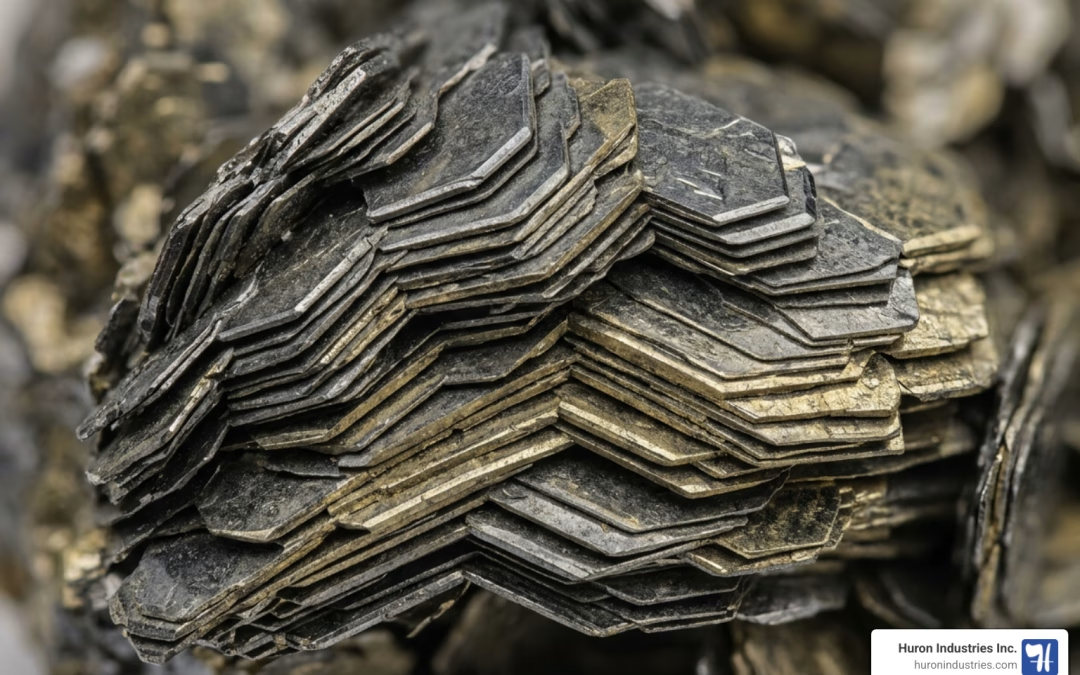
When you look at molybdenum disulfide (MoS₂) on a molecular level, its dry lubricating power comes directly from its hexagonal crystal lattice. In this layered structure, a central sheet of molybdenum atoms is sandwiched between two sheets of sulfur atoms. The covalent bonds holding the molybdenum and sulfur together within each layer are exceptionally strong, but the bonds holding adjacent layers to one another are weak van der Waals forces.
Under mechanical shear, these atomic layers slide over each other with very little resistance. This dynamic gives fine MoS₂ its characteristic slipperiness and low coefficient of friction (often dropping below 0.1 under elevated loads). At the same time, the material demonstrates immense compressive strength, tolerating contact pressures up to 250,000 psi without shearing destructively or cold-welding mating metal surfaces.
MoS₂ also offers impressive thermal resilience. In inert environments or a complete vacuum, it remains stable up to 1,100°C. In open atmosphere, it provides continuous dry lubrication up to approximately 350°C to 400°C before the surface begins oxidizing into molybdenum trioxide (MoO₃).
Particle Size Distribution and Sub-Micron Lubrication Dynamics
A common misconception among buyers is that an average particle size (APS) of 1.5 microns means every single particle in the container is tiny. In particle sizing, understanding the full curve is crucial. High-grade superfine MoS₂ typically features a median diameter ($D_{50}$) between 0.9 and 1.6 microns, with a top-cut ($D_{99}$) strictly controlled below 7 microns. Specialized nano-grades can push these boundaries even further down to around 90 nm.
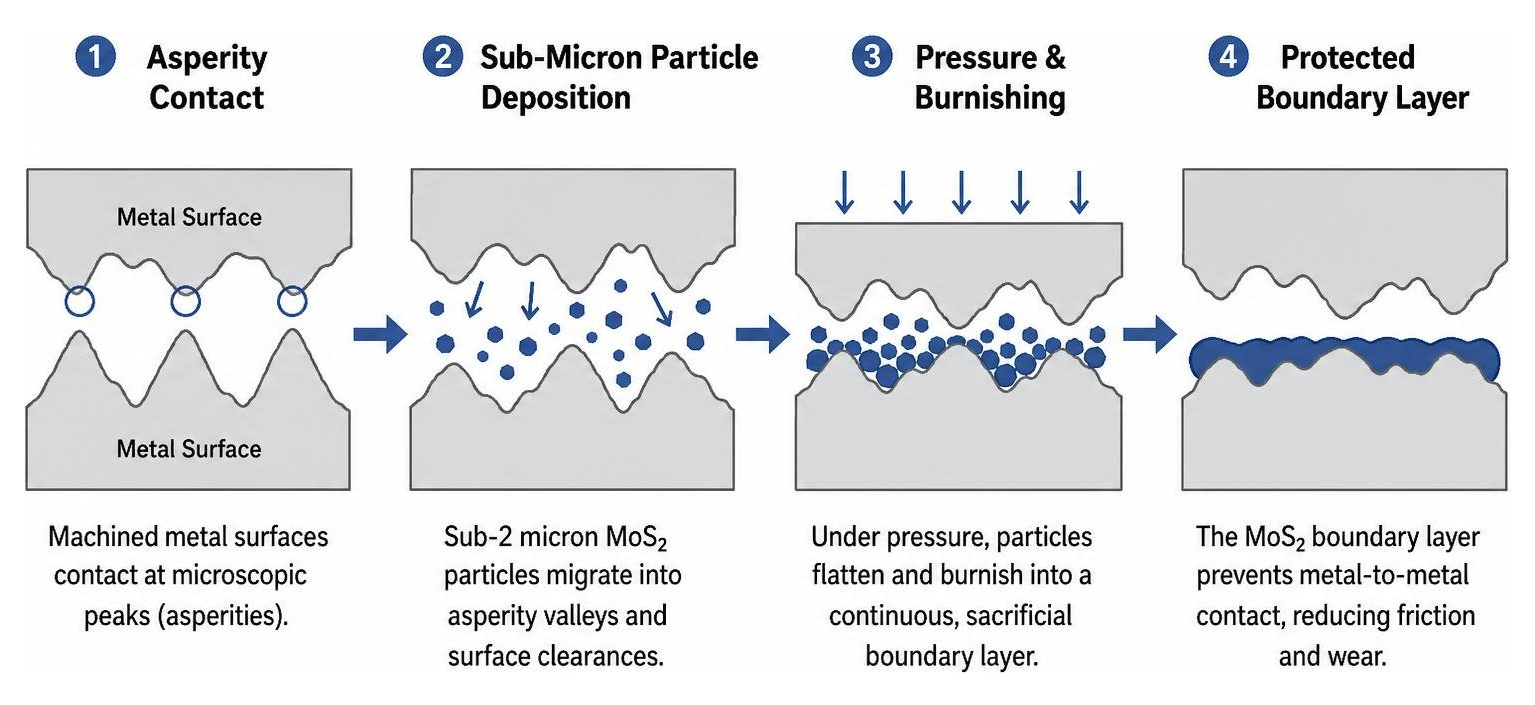
When two machined metal surfaces rub together, contact actually occurs across microscopic peaks and valleys called asperities. Coarse particles cannot always enter the tight clearances of precision assemblies. Sub-2 micron particles easily migrate directly into these tiny valleys. As pressure builds, the fine powder burnishes into a continuous, sacrificial boundary layer that prevents raw metal-to-metal contact. Controlling particle dimensions at this scale is just as critical when working with other solid lubricants, as detailed in Getting Down to the Micron: Everything You Need to Know About 5 Micron Graphite.
Purity Grades and Chemical Specifications for Molybdenum Disulfide Powder Under 2 Microns
Industrial MoS₂ (CAS 1317-33-5) is categorized into several primary purity grades:
- Technical Grade: Typically ~98.0% to 98.5% purity. Suitable for general extreme-pressure greases, open gear lubricants, and heavy industrial compounds where minor non-abrasive mineral traces are acceptable.
- Technical Fine / Superfine Grade: Ranging from 98.5% to 99.0% purity with tight milling controls to eliminate oversized grit.
- High-Purity / Ultrafine Grade: Refined to 99.0%–99.9% purity (and up to 99.9999% for specialized thin films). These grades place rigid maximum limits on contaminants: iron (Fe ≤ 0.5 wt%), silica (SiO₂ ≤ 0.5 wt%), moisture (H₂O ≤ 0.7 wt%), and minimal acid numbers.
Because fine powders present a massive specific surface area (reaching ~35 m²/g in sub-micron varieties), they are inherently more vulnerable to atmospheric moisture and surface oxidation over extended storage. High acid numbers indicate surface oxidation, which can degrade lubricant performance or promote corrosion in sensitive assemblies. Always verify these elemental thresholds on the manufacturer's Certificate of Analysis (CoA).
Industrial Applications and Dispersion Methods
Sub-2 micron MoS₂ powder is widely used across severe-duty sectors, including aerospace actuators, defense hardware, precision manufacturing, metal-forming dies, and automotive drivetrains. Its fine particle dimensions allow it to serve either as an additive suspended in liquid carriers or as a standalone dry-film burnishing compound.
Integrating Molybdenum Disulfide Powder Under 2 Microns into Oils, Polymers, and Greases
Adding sub-micron MoS₂ to a liquid or semi-solid matrix requires careful attention to treat rates and dispersion techniques:
- Treat Rates: For industrial lubricating oils and greases, recommended treat rates generally range from 1 wt% to 5 wt%. For polymer masterbatches (such as self-lubricating nylon, PTFE, or polyimide bushings), concentrations often range from 2 wt% to 10 wt%.
- Dispersion Methods: Simply stirring fine powder into oil with a spatula will cause rapid agglomeration and settling. To create a stable suspension, use high-shear mechanical mixing or ultrasonic bath sonication for 20 to 30 minutes.
- Carrier Compatibility: Fine MoS₂ disperses readily into mineral oils, synthetic polyalphaolefins (PAO), polyol esters, and volatile solvent carriers like isopropanol. When selecting carrier chemistries for extreme boundary conditions, pairing the correct binder or grease thickener is essential; see How to Choose the Best Anti-Seize Thread Lubricant for Any Job for matching solid lubricants with functional carriers.
Dry Film and Anti-Seize Performance Under Extreme Loads
In high-vacuum environments—such as space mechanisms or semiconductor vacuum chambers—conventional liquid lubricants boil off or contaminate optical sensors. Dry MoS₂ powder solves this problem. It can be tumble-coated, burnished directly onto clean metal substrates with a lint-free pad, or combined with resin binders to form bonded dry-film coatings.
These sacrificial films cushion contact surfaces during component break-in, prevent galling during heavy press-fits, and ensure non-destructive breakout torque on high-temperature fasteners. For precision anti-friction dry coatings, exploring The Ultimate Guide to Neolube No. 1 1 Dry Film Lubricant offers useful technical perspective on how bonded lamellar solids behave under severe mechanical stress.
Solid Lubricant Comparison: MoS2 vs. Alternative Fine Powders
Selecting the ideal solid lubricant depends on operating temperature, environmental atmosphere, load, and chemical exposure.
| Property / Material | Molybdenum Disulfide ($text{MoS}_2$) | Synthetic Graphite ($text{C}$) | Tungsten Disulfide ($text{WS}_2$) | Hexagonal Boron Nitride ($text{hBN}$) |
|---|---|---|---|---|
| Crystal Structure | Hexagonal Lamellar | Hexagonal Planar | Hexagonal Lamellar | Hexagonal Planar ("White Graphite") |
| Coefficient of Friction | 0.05 – 0.15 (decreases with load) | 0.10 – 0.20 (requires humidity) | 0.03 – 0.07 | 0.15 – 0.25 |
| Max Temp (Air) | ~350°C to 400°C | ~450°C to 550°C | ~450°C to 500°C | ~900°C to 1000°C |
| Max Temp (Vacuum/Inert) | ~1,100°C | ~2,500°C | ~1,250°C | ~1,800°C |
| Load Bearing Capacity | Up to 250,000 psi | Moderate (~50,000 psi) | Up to 300,000+ psi | Moderate (~40,000 psi) |
| Moisture Dependency | Operates best in dry/vacuum conditions; moisture slightly increases COF | Requires adsorbed water vapor (moisture) to lubricate | Operates well in dry, vacuum, and ambient conditions | Electrically insulating; works well across humid and dry states |
| Primary Advantage | Extreme pressure load carrying, superior vacuum performance | High-temperature oxidation resistance in air, cost-effective | Ultra-low friction, very high thermal limits | Non-conductive, clean white appearance, extreme thermal stability |
While MoS₂ excels in high-load and vacuum applications, graphite remains the premier choice for broad atmospheric high-temperature lubrication and electrical conductivity. You can evaluate the broader chemistry of fluid-suspended carbon in The Many Uses of Colloidal Graphite in Water and Beyond.
Buyer's Guide: Sourcing, Pricing, and Safe Handling Standards
Procurement Benchmarks, Packaging Options, and Cost Factors
Pricing for fine MoS₂ powder varies based on purity level, particle sizing strictness, and container volume:
- Small Pack Quantities (R&D / Bench Scale): 0.5 oz (14 g) to 2 oz bottles typically range from $10.00 to $15.00 ($5.00–$20.00/oz) for 1.0–1.5 micron powders at 98.5%–99.0% purity.
- Medium Pack Sizes (4 oz to 1 lb): Standard 4 oz bottles of superfine technical grades range between $85.00 and $120.00, while 100-gram analytical bottles average $16.00 to $25.00.
- Bulk Quantities (Pails, Drums, Sacks): Industrial volumes (25 lb pails to 50 kg drums) substantially reduce the unit cost per pound, though pricing remains subject to global molybdenum metal commodity markets.
When qualifying a supplier, ensure they operate under a documented ISO 9001 quality management system. Request lot-traceable Certificates of Analysis confirming laser diffraction particle sizing (such as Malvern Mastersizer data) and check for relevant military standard compliance (such as MIL-L-24131C for specialized dry lubricants). For critical installations, pairing vetted solid powders with proven thread compounds helps maintain assembly integrity; see Why Nuclear and Industrial Pros Trust Neolube 100 Thread Sealant for examples of rigorous quality documentation in mission-critical applications.
Storage Protocols, SDS Requirements, and Safety Regulations
Fine chemical powders require structured handling to maintain quality and protect personnel:
- Safety & PPE: MoS₂ powder is classified under GHS as an Inhalation Hazard Category 4 (H332) and can cause mild skin and eye irritation (H315, H319). Handlers must wear a well-fitted particulate respirator (such as N95 or HEPA), chemical splash goggles, and nitrile gloves. Always handle loose powder under a dedicated fume hood or local exhaust ventilation to prevent airborne dust clouds.
- Static Mitigation: Finely divided dry powders can generate static electrical charges during pouring or pneumatic transfer. Use grounded stainless steel vessels and antistatic grounding straps when transferring large quantities.
- Storage Environment: Store in tightly sealed, moisture-barrier containers in a cool, dry room (ideally between 20°C and 30°C). Exposure to humid air leads to moisture uptake, clumping, and accelerated acid formation.
- Regulatory Codes: For trade and shipping documentation, note that MoS₂ carries CAS # 1317-33-5, Harmonized Tariff Schedule (HTS) Code 2830.90, and standard commercial Export Control Classification Number (ECCN) designations (typically EAR99 unless modified for restricted defense systems).
Frequently Asked Questions About Fine MoS2 Powders
How does sub-2 micron MoS2 compare to coarse powder grades in fluid suspensions?
Sub-2 micron MoS₂ particles have a much slower gravitational sedimentation rate than coarse grades (e.g., 10–30 micron powders), enabling longer suspension stability in oils and liquid carriers. Their fine physical profile also allows them to pass cleanly through standard full-flow industrial oil filters (typically rated around 10 to 20 microns) without clogging the filter media.
What is the maximum operating temperature for fine molybdenum disulfide powder?
In normal atmospheric air, sub-2 micron MoS₂ remains thermally stable up to roughly 350°C (662°F). Above this threshold, it reacts with oxygen to form molybdenum trioxide ($text{MoO}_3$) and sulfur dioxide ($text{SO}_2$). In an inert atmosphere or hard vacuum, it remains stable up to 1,100°C (2,012°F).
Can ultra-fine MoS2 powder be mixed directly with engine oil or gear lubricants?
Yes, ultra-fine MoS₂ can be blended into engine and gear oils at concentrations between 1% and 3% by weight. However, mechanical agitation alone will eventually allow particles to settle. For long-term shelf stability, industrial formulators use chemical dispersants or choose specialized formulations such as Green Point Biodegradable Lubricants to maintain fluid film integrity under rigorous environmental standards.
Conclusion
Sourcing high-performance sub-2 micron molybdenum disulfide powder requires looking beyond basic product labels. By demanding comprehensive particle size distribution data ($D_{50}$ and $D_{99}$), verifying chemical purity thresholds on the Certificate of Analysis, and following proper dispersion and storage protocols, you ensure reliable, long-lasting boundary lubrication in your most demanding applications.
If your process requires clean, ready-to-use liquid application without the safety hazards and agglomeration challenges of handling loose dry dust, explore pre-dispersed molybdenum disulfide in isopropanol solutions from Huron Industries Inc. to achieve uniform, bonded solid lubricant coatings with consistent quality.