
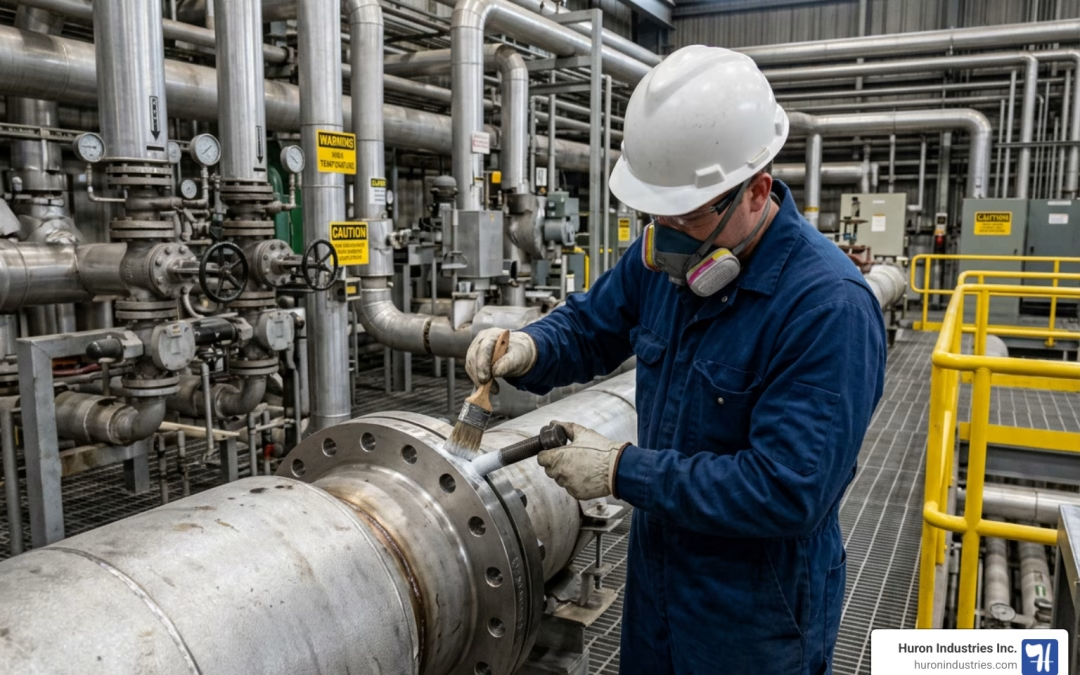
When You Need a Grafoil GTS Alternative for Critical High-Temp Piping
Finding a reliable grafoil gts alternative means matching a very specific set of chemical purity and thermal performance requirements — especially in nuclear, defense, and high-pressure industrial systems where the wrong sealant can cause stress corrosion cracking or catastrophic joint failure.
Here are the top alternatives to Grafoil GTS:
| Product | Type | Max Temp | Max Pressure | Nuclear-Grade |
|---|---|---|---|---|
| Neolube No. 1260 | Colloidal graphite (isopropanol carrier) | 635°C (1175°F) | 16 MPa (2300 psi) | Yes |
| Grafoil GTL | Graphite paste (petroleum carrier) | 635°C (1200°F) | 52 MPa (7500 psi) | Yes (99.5% C) |
| Grafoil GTH | Self-adhesive graphite tape | 635°C (1175°F) | High pressure | Yes |
What makes a true Grafoil GTS equivalent? It must meet all of these thresholds:
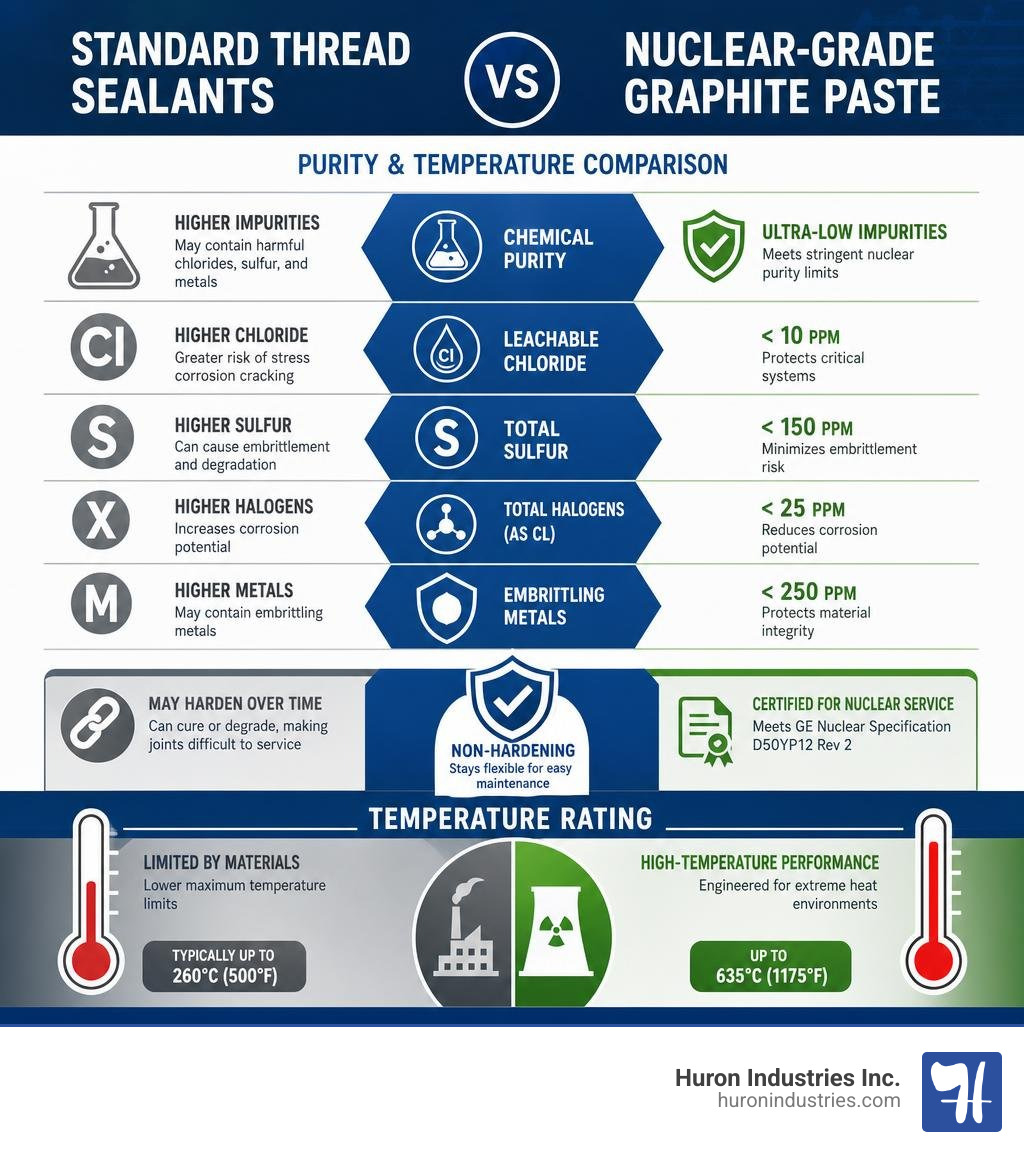
- Leachable chloride < 10 ppm
- Total sulfur < 150 ppm
- Total halogens (as Cl) < 25 ppm
- Embrittling metals < 250 ppm
- Certified to GE Nuclear Specification D50YP12 Rev 2 (for nuclear service)
- Non-hardening — must not cure over time so joints stay serviceable
Grafoil GTS is a nuclear-grade graphite thread sealant paste rated to 635°C (1175°F) and 16 MPa (2300 psi). It combines nuclear-grade graphite with a petroleum-based carrier that never hardens, keeping threaded joints easy to disassemble even after years of extreme service. It is commonly used in nuclear power generation, high-pressure steam lines, and critical industrial piping — and it replaced Teflon tape in these environments because PTFE simply cannot survive the heat.
When Grafoil GTS is unavailable, hard to source, or you need a different carrier chemistry, the alternatives above are worth evaluating closely.
I'm Nicholas Cunha, and through my work building the content and SEO program for Huron Industries Inc., I've spent significant time researching the exact purity thresholds and certification requirements that define a true grafoil gts alternative — particularly for nuclear and defense-grade applications. That research directly informs what follows, so you can qualify the right product with confidence.
Understanding High-Temperature Graphite Thread Sealants: Specifications and Limitations
To find a suitable grafoil gts alternative, we first have to understand the physical and thermal limits of the baseline product. Grafoil GTS is designed for extreme duty, but it operates under a unique physical compromise.
The paste is rated to maintain a seal at temperatures up to 635°C (1175°F) and pressures up to 16 MPa (2300 psi). However, it is limited to close-fitting threaded joints with pipe sizes of 2 inches (50.8 mm OD) or less.
The most interesting technical aspect of standard graphite pastes is how they handle heat. Thermogravimetric Analysis (TGA) reveals that weight loss in the paste actually begins at a relatively low temperature of 125°C (255°F). By the time the joint reaches 200°C (390°F), the sealant has experienced a 6% weight loss.
This weight loss represents the slow volatilization of the petroleum-based carrier. The carrier is there to make the graphite spreadable during installation, but it eventually burns off under high heat, leaving behind a dense, pure graphite dry-film seal. While this works beautifully for sealing, the outgassing of a petroleum carrier can be a major drawback in closed-loop systems, vacuum chambers, or cleanroom environments where airborne hydrocarbons are strictly forbidden. In these scenarios, a dry-film or alcohol-carrier High Temperature Sealant is much more desirable.
Critical Purity Standards for Nuclear-Grade Sealants
In commercial and naval nuclear applications, the chemical composition of a thread sealant is scrutinized down to the parts per million. The reason is simple: stainless steel piping under high pressure and temperature is highly susceptible to Stress Corrosion Cracking (SCC). Impurities like halogens, sulfur, and low-melting-point metals act as catalysts for this destructive process.
To prevent this, nuclear-grade graphite sealants must comply with strict purity standards, such as General Electric’s Nuclear Nonmetallic Material Specification D50YP12 (Rev 2). If you are looking for an equivalent, it must match or exceed these purity limits:
- Leachable Chlorides: Must be strictly less than 10 ppm.
- Total Halogens (as Cl): Less than 25 ppm.
- Total Sulfur: Less than 150 ppm.
- Total Fluorine: Less than 25 ppm.
- Total Nitrite: Less than 1 ppm.
- Total Nitrate: Less than 10 ppm.
- Embrittling Metals: Less than 250 ppm total (with no single metal exceeding 200 ppm).
These strict limits are why industrial-grade graphite products cannot be substituted in nuclear systems. For instance, standard industrial flexible graphite sheets like Grafoil GTB can contain up to 550 ppm of sulfur and higher ash content, which would quickly disqualify them from critical reactor coolant loop service. When safety is on the line, you need to understand Why Neolube 1260 is the D50YP12 Thread Sealant You Actually Need to ensure your piping remains structurally sound.
Selecting the Best High-Purity Graphite Sealant for Critical Piping
When choosing a grafoil gts alternative, the application method, clean-up requirements, and carrier chemistry should guide your decision.
Standard petroleum-based pastes require careful handling. Before application, the user must thoroughly clean all threaded surfaces. If using a tube, you have to remove the cap, squeeze out any trapped air, recap it, and knead the tube thoroughly to ensure the graphite and petroleum carrier are fully mixed.
Additionally, storage is highly sensitive: petroleum-based pastes must be stored at or below 38°C (100°F) to prevent phase separation, and they carry a maximum shelf life of 2 years.
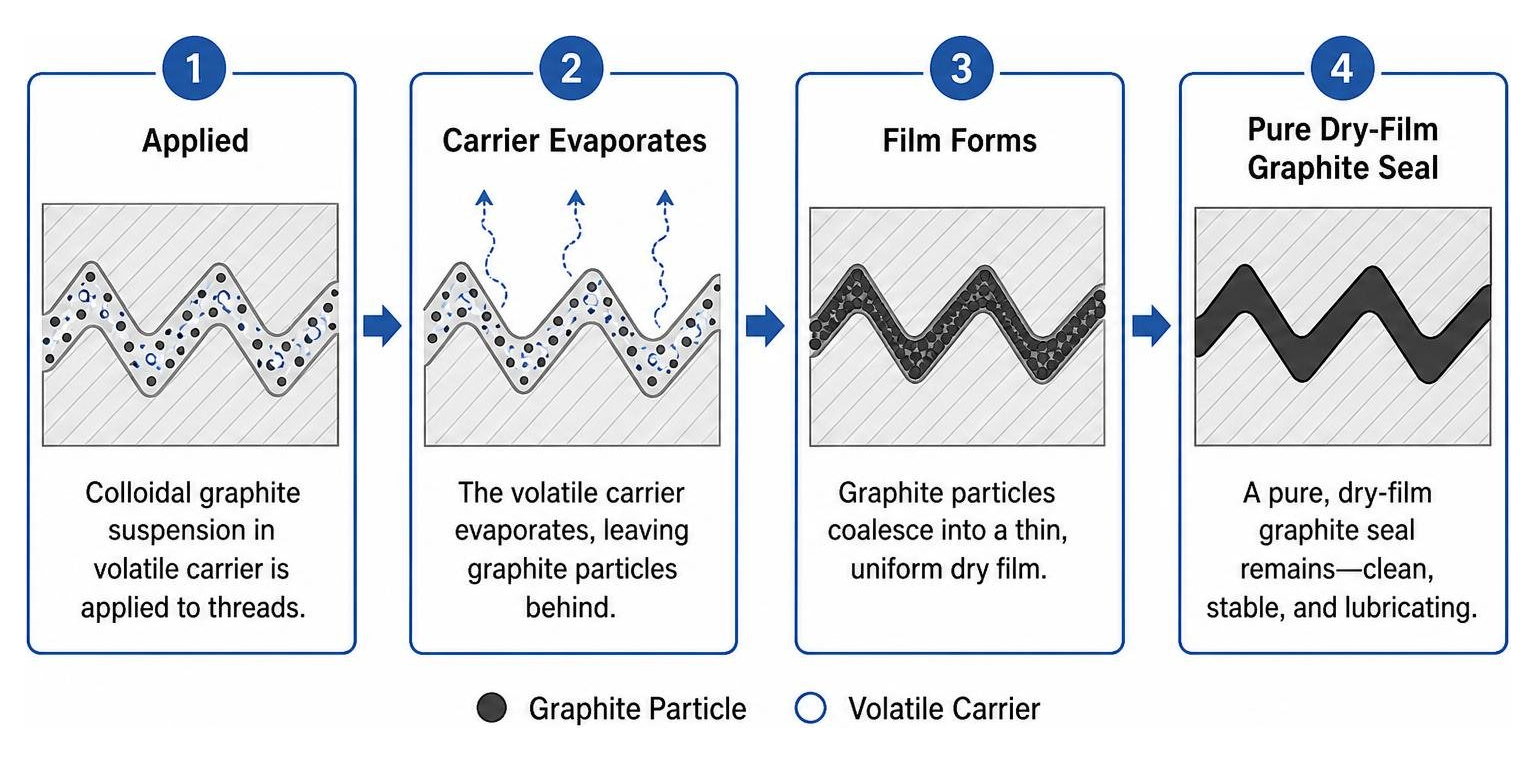
By contrast, colloidal graphite suspensions in volatile carriers offer a cleaner, more stable application process. They dry quickly to a clean, highly lubricated dry film that does not attract dust or outgas heavy hydrocarbons.
Here is a direct comparison of standard petroleum-based graphite pastes versus a high-purity colloidal graphite suspension like Neolube No. 1260:
| Technical Feature | Petroleum-Based Paste (e.g., Grafoil GTS) | Neolube No. 1260 |
|---|---|---|
| Carrier Base | Petroleum / Hydrocarbon | Isopropanol (Isopropyl Alcohol) |
| Curing / Drying | Non-hardening paste, remains wet | Evaporates quickly to leave a dry, pure graphite film |
| Outgassing Risk | High (carrier volatilizes starting at 125°C) | Zero after initial solvent evaporation |
| Cleanliness | Messy to apply, can attract contaminants | Clean dry-film, does not attract dust or grit |
| Disassembly | Excellent (non-hardening) | Excellent (dry-film lubrication prevents seizing) |
| Anti-Seize Properties | Yes | Yes (exceptional bolt lubricant performance) |
Evaluating a Non Hardening vs Hard Setting Thread Sealant Neolube highlights the clear operational advantages of dry-film alternatives in sensitive environments.
Neolube No. 1260: The Premier High-Purity Graphite Sealant
If you are seeking a clean, high-performance grafoil gts alternative that eliminates the mess and outgassing of petroleum carriers while maintaining nuclear-grade certification, Neolube No. 1260 is the industry standard.
Manufactured by Huron Industries Inc. in Port Huron, Michigan, Neolube is a high-purity colloidal graphite suspension in an isopropanol carrier. Upon application, the isopropanol carrier evaporates rapidly, leaving behind a thin, ultra-pure, non-hardening dry film of pure graphite.
Because it dries completely, it does not migrate, attract dirt, or outgas heavy organic vapors under extreme heat. It is rated for high-pressure sealing up to 16 MPa (2300 psi) and easily withstands temperatures up to 635°C (1175°F). Neolube No. 1260 is fully qualified to nuclear purity standards, making it the perfect choice for instrumentation lines, high-pressure steam pipes, and reactor components.
You can find it in convenient packaging, such as the Neolube No 1260 1 69 oz Tube, which is ideal for precise, waste-free application on small-diameter threaded joints. Learn more about its extreme-pressure capabilities by exploring our technical overview of this High Pressure Thread Sealant 2300 PSI Neolube 1260.
Limitations of Alternative High-Temperature Sealing Methods
It is tempting to look at other common thread sealants when Grafoil GTS is out of stock, but critical systems do not tolerate compromises.
For instance, Teflon (PTFE) tape is highly popular in general plumbing, but it is entirely unsuitable for high-temperature service. PTFE begins to soften and degrade at temperatures above 260°C (500°F), releasing highly corrosive fluorine gas as it breaks down.
Standard metallic anti-seize pastes (such as those containing copper, nickel, or zinc) can cause catastrophic galvanic corrosion when paired with stainless steel in high-humidity or high-radiation environments. Furthermore, many standard industrial thread sealants contain binders or resins that cure and harden over time. Once these sealants cure under extreme heat, disassembling the joint without damaging the threads becomes nearly impossible.
Using a dedicated high-purity, non-hardening Pipe Thread Sealant ensures your piping can be easily serviced and disassembled even after decades of continuous high-temperature operation.
Frequently Asked Questions about High-Temperature Thread Sealants

What is the maximum temperature limit for graphite thread sealants?
In ambient air, high-purity graphite thread sealants can safely operate up to 525°C to 635°C (975°F to 1175°F). Beyond these temperatures in an oxidizing atmosphere (air), graphite will slowly oxidize and turn into carbon dioxide. However, in a vacuum or reducing (non-oxidizing) environment, high-purity flexible graphite can withstand extreme temperatures from -240°C up to 3000°C (-400°F to 5400°F).
Why are low halogen and sulfur levels mandatory in nuclear applications?
Halogens (like chlorine and fluorine) and sulfur can cause stress corrosion cracking (SCC) in stainless steel and nickel alloys at high temperatures. Under high-pressure reactor conditions, even trace amounts of these impurities can cause micro-cracks to form along the grain boundaries of the metal, leading to sudden, catastrophic pipe failures. Nuclear-certified sealants keep leachable chlorides below 10 ppm and sulfur below 150 ppm to eliminate this risk.
Does graphite thread sealant paste harden over time?
High-quality graphite thread sealants like Grafoil GTS and Neolube No. 1260 are formulated specifically to be non-hardening. They do not contain curing resins or binders. While the carrier liquid (such as petroleum or isopropanol) may volatilize or evaporate under heat, the remaining pure graphite film never cures or hardens. This preserves the lubricating properties of the joint, ensuring easy, damage-free disassembly even after years of service.
Conclusion
When sourcing a grafoil gts alternative for critical, high-temperature, or nuclear-grade piping systems, matching the strict purity and thermal limits of the original specification is non-negotiable. While products like Grafoil GTL or GTH tape can serve as direct, petroleum-based substitutes, they share the same outgassing and messy application profiles as standard pastes.
For a cleaner, more stable, and highly reliable alternative, Neolube No. 1260 stands out as the premier dry-film option. By utilizing a volatile isopropanol carrier that evaporates to leave a pure, non-hardening graphite barrier, it delivers exceptional sealing and anti-seize performance up to 2300 psi and 1175°F without the risk of hydrocarbon contamination.
Ready to upgrade your critical sealing systems with a certified, nuclear-grade lubricant? Secure your system's integrity and explore the High Pressure Thread Sealant 2300 PSI Neolube 1260 today.