
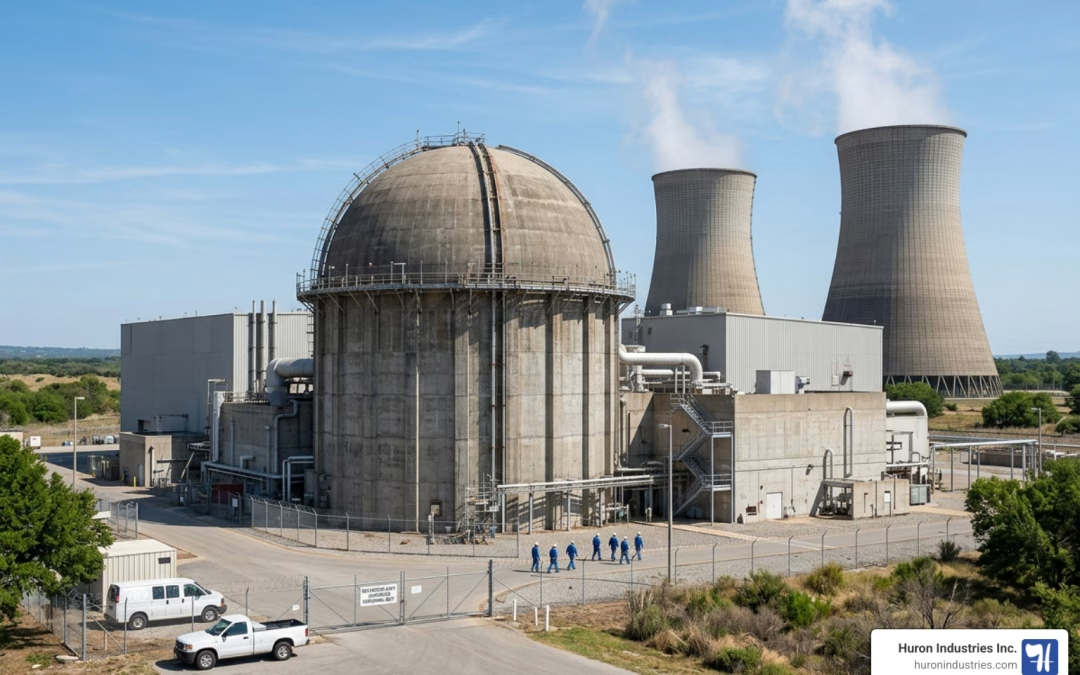
Why Engineering Nuclear Sealant Matters for Containment
Engineering nuclear sealant is the design and selection of materials that stop gases, liquids, radioactive particles, fire, and pressure from passing through critical nuclear boundaries. It includes metal seals, high-purity graphite thread compounds, elastomer barriers, gaskets, and liquid sealing materials chosen for a specific service condition.
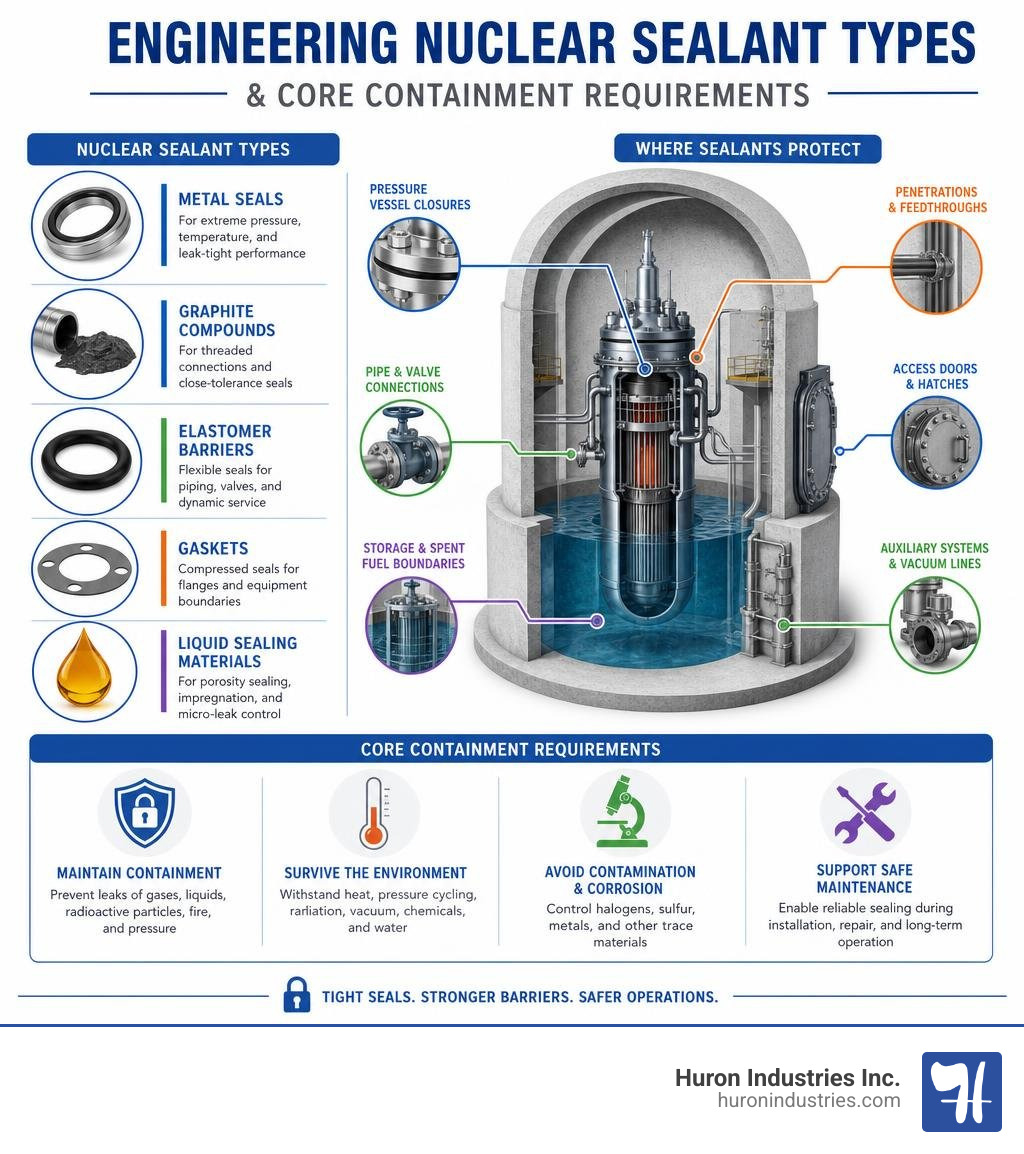
At a basic level, nuclear sealing must do four jobs:
- Maintain containment across pressure vessels, pipes, valves, penetrations, and storage systems.
- Survive the environment - including heat, pressure cycling, radiation, vacuum, chemicals, and water.
- Avoid contamination and corrosion through tight control of halogens, sulfur, metals, and other trace materials.
- Support safe maintenance by providing reliable sealing during installation, repair, and long-term operation.
Unlike a standard industrial joint, a nuclear boundary may have no safe margin for a small leak. A seal can be part of the barrier that protects workers, equipment, the public, and plant availability. The right choice depends on where it is used: a high-pressure coolant joint, a close-tolerance threaded connection, a fire-rated wall penetration, a vacuum system, or a spent-fuel storage boundary.
I am Nicholas Cunha, founder of CreatiVertical and a technical content specialist working with Huron Industries Inc. to make high-purity lubricants, colloidal graphite compounds, and engineering nuclear sealant information easier for procurement and engineering teams to evaluate. This guide explains the seal types, performance limits, quality controls, and maintenance practices that shape reliable nuclear containment.
Engineering nuclear sealant word guide:
Primary Classification and Engineering Nuclear Sealant Types
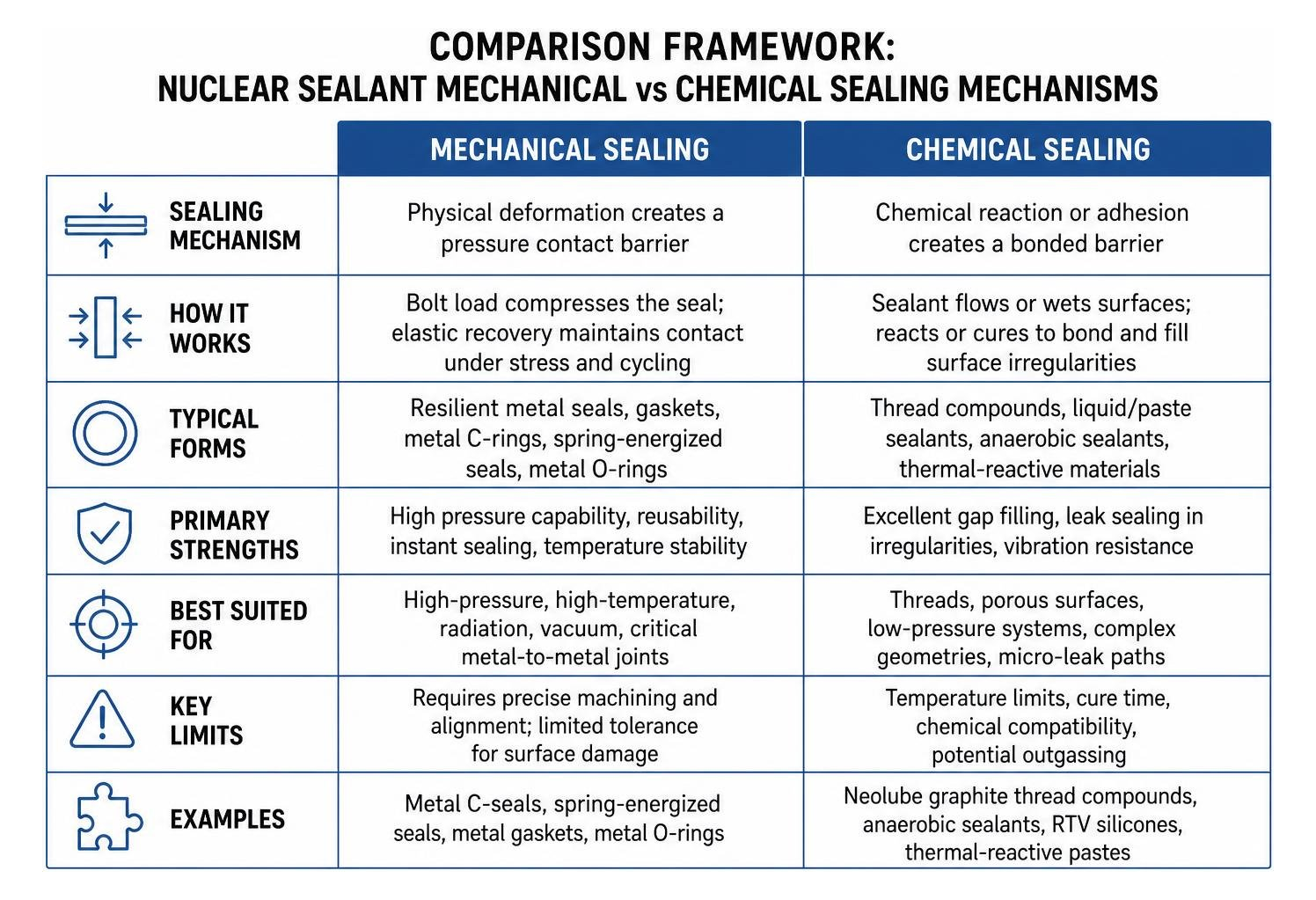
When I talk with nuclear plant technicians and design specialists, I usually break nuclear sealing into four primary technology families: pre-formed resilient metal seals, engineered polymer and elastomer barriers, high-purity colloidal graphite thread compounds, and thermal-reactive liquid or paste sealants.
Each family handles a distinct mechanical geometry and chemical environment. In fact, research published through High Temperature Sealants and Gaskets in Nuclear Applications highlights how choosing between solid metallic seals, flexible polymers, or dry-film thread sealants comes down to balancing spring-back capability against temperature limits and radiation exposure.
Metallic and Resilient Seal Geometries
Resilient metal seals are the frontline heavyweights for primary reactor coolant loops, reactor pressure vessel lids, and ultra-high vacuum boundaries. Unlike a standard flat metal washer that relies purely on brute bolt clamping force, resilient metallic seals are precision-engineered spring structures.
These designs—such as internal and external C-seals, spring-energized metal rings, and specialized U-shaped metallic seals—utilize thin-walled high-strength alloys like Alloy 718, Alloy X-750, or Waspaloy. When tightened between heavy steel flanges, the metallic profile undergoes controlled elastic-plastic deflection. This stored spring energy allows the seal lip to maintain contact pressure even when severe thermal cycling or pressure surges cause the flange mating surfaces to flex apart slightly.
For ultra-demanding reactor boundaries, specialized U-shaped metal seal geometries turn their inner sealing lips inward. This design trick achieves the high elastic recovery of traditional wave seals while eliminating the need for complex, costly edge-lapping or specialized flange machining during installation.
Polymer and Elastomer Barrier Engineering Nuclear Sealant
While metals dominate the hottest primary loops, engineered polymers and silicone elastomers perform vital work in secondary loops, gloveboxes, containment building penetrations, and inter-building expansion joints.
In nuclear applications, standard commercial rubbers like EPDM, Neoprene, or standard silicone are carefully evaluated before deployment. Elastomer formulations used in nuclear spaces are specifically qualified under standards like the French PMUC (Produits et Matériaux Utilisables en Centrale nucléaire) specification to guarantee strict chemical purity. Chlorine, fluorine, and sulfur content are held to minimal levels to eliminate stress corrosion cracking risks on adjacent stainless steel piping.
High-density silicone foams and self-leveling silicone elastomers are frequently applied in cable trays and wall penetrations. By compounding high-purity silicones with dense mineral additives, these materials achieve a specific density up to 2.5. This allows a flexible caulking joint to provide gamma and neutron radiation shielding performance equal to solid concrete, while tolerating pipe movement up to 28% to 40 mm without tearing.
Graphite and Threaded Joint Engineering Nuclear Sealant Solutions
Threaded connections present a unique sealing challenge. Pipe threads, instrument fittings, and threaded fasteners create microscopic helical leak paths that standard gaskets cannot fill. In high-radiation zones, traditional PTFE tape is a liability; gamma radiation breaks down fluoropolymers, converting them into corrosive hydrofluoric acid gas and causing early joint failure.
This is where nuclear-grade colloidal graphite compounds shine. A pure graphite matrix suspended in a nuclear-pure volatile carrier provides both thread lubrication during makeup and permanent sealing during service. When heated, the carrier fluid safely volatilizes around 255°F (124°C), leaving behind a pure, dense graphite seal (>99.5% elemental carbon) packed into the root of the threads.
Nuclear graphite thread sealants, such as Huron Industries' flagship Neolube® formulations, are engineered to handle continuous temperatures up to 1175°F (635°C) and operating pressures reaching 2300 psi (16 MPa). Because pure carbon does not undergo thermal aging, stress relaxation, or polymerization, the joint remains completely leak-tight yet effortlessly disassembles years later without thread galling. You can explore more about these performance metrics in our guide on Why Nuclear and Industrial Pros Trust Neolube 100 Thread Sealant and learn how to avoid radiation degradation by reading No Meltdowns Here: Choosing Radiation Resistant Thread Sealant.
Extreme Service Requirements Across Advanced Nuclear Systems
To appreciate how an engineering nuclear sealant is developed, we must look at the brutal physical environments inside modern reactors. The operational baseline for standard Pressurized Water Reactors (PWRs) already demands performance at 280°C to 330°C (536°F to 626°F) under primary circuit pressures near 155 bar (2250 psi). However, Next-Generation (Gen IV) systems and advanced research reactors push these demands much further.
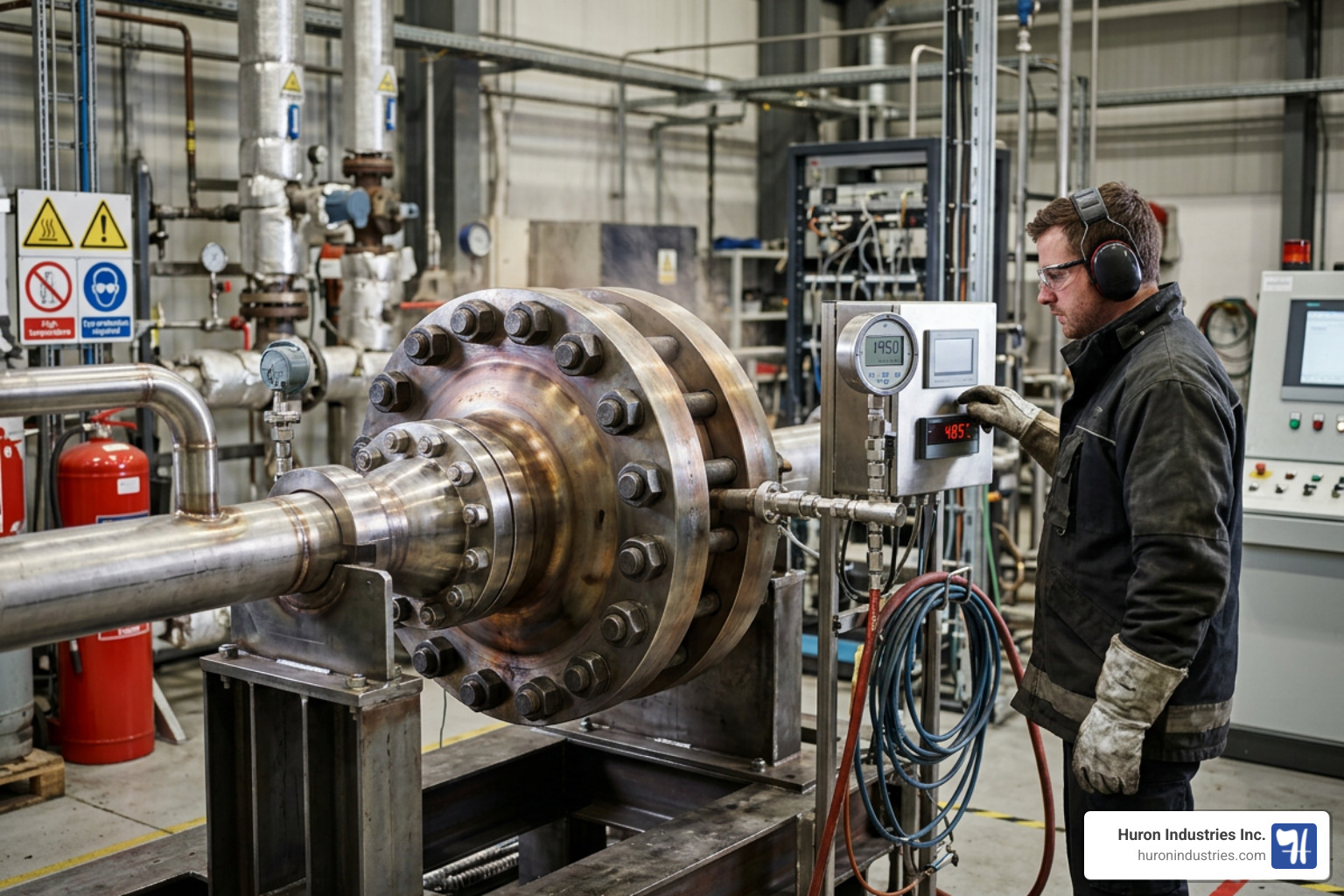
Metallic and graphite seals engineered for advanced primary loops routinely withstand pressures ranging from ultra-high vacuums of 1 × 10⁻¹⁰ torr up to extreme positive pressures exceeding 36,000 psi (and up to 60,000 psi in specialized static C-seal configurations). Continuous service temperatures span from cryogenic conditions (below -160°C) all the way up to 1350°F (732°C) or higher.
Radiological endurance is equally unforgiving. In core-adjacent primary systems, sealing materials endure intense long-term irradiation. Nuclear-grade graphite compounds have demonstrated zero structural degradation or cracking after exposure to an integrated neutron flux of 5.5 × 10²¹ NVT at 1000°C alongside total accumulated gamma radiation doses reaching 1.5 × 10⁹ RADS.
Molten Salt, Sodium Fast, and Lead-Cooled Reactors
Advanced reactor architectures introduce chemical challenges that make traditional gasket material selection impossible:
- Molten Salt Reactors (MSRs): Operating with fluoride or chloride liquid salts above 600°C to 700°C, these systems are violently corrosive to conventional gasket metals and organic binders. Seals must combine specialized nickel-base alloys with high-purity graphite to prevent chemical leaching and fluoride salt attack.
- Sodium Fast Reactors (SFRs): Liquid sodium coolant presents severe chemical fire risks if exposed to air or moisture. Sealing systems must withstand high thermal transients without losing clamping load while resisting liquid sodium erosion.
- Lead-Cooled Fast Reactors (LFRs): Heavy liquid lead or lead-bismuth eutectic (LBE) coolants operate at high temperatures with significant hydrodynamic density. Seals must resist liquid metal corrosion and erosion, often requiring specialized aluminum-alloyed steel surface treatments or metallic plating to survive.
Fusion Tokamaks and Small Modular Reactors (SMRs)
In magnetic confinement fusion systems like Tokamak reactors, sealing boundaries serve two extreme masters: ultra-high vacuum (UHV) and tritium containment. Plasma vacuum vessels require helium leakage rates lower than 1 × 10⁻⁹ mbar·L/s to maintain plasma stability, all while accommodating intense pulsed electromagnetic loads and severe cryogenic-to-high-temperature thermal gradients. Furthermore, seals inside fusion systems must be designed for fully automated remote handling, as intense activation prevents human workers from entering the containment vault.
Small Modular Reactors (SMRs) and Micro Modular Reactors (MMRs) prioritize multi-decade reliability inside compact containment footprints. Because many SMR designs target 10 to 40 years of continuous operation between major overhauls, their primary seals, threaded pipe joints, and wall penetrations must offer exceptional resistance to creep relaxation, vibration fatigue, and thermal cycling.
Single-Use Protocol, Regulatory Standards, and Material Coatings
In commercial nuclear operations, every component in a critical pressure boundary must possess absolute material traceability and certified quality credentials. Standard Quality Assurance frameworks governing nuclear seal manufacturing include:
- ASME NQA-1: Quality Assurance Requirements for Nuclear Facility Applications.
- 10 CFR 50 Appendix B: Quality Assurance Criteria for Nuclear Power Plants and Fuel Reprocessing Plants.
- PMUC Certification: Standardized chemical purity testing verifying low halogens (leachable chlorides typically <10 ppm, total halogens <25 ppm) and sulfur content to protect reactor stainless steel from stress corrosion.
To prevent metal-to-metal galling and optimize gas tightness, solid metallic nuclear seals feature specialized soft electroplated finishes. When the seal is compressed, this soft surface coating deforms plastically, flowing smoothly into the microscopic machining grooves (surface roughness) of the hard steel flange.
| Coating Material | Typical Thickness | Thermal Limit (°F / °C) | Key Application Envelope |
|---|---|---|---|
| Silver Plating | 0.001 - 0.002 in. | 1200°F / 649°C | Standard primary coolant loops, high-pressure steam, and gas boundaries. Excellent plastic flow. |
| Nickel Coating | 0.0005 - 0.0015 in. | 1400°F / 760°C | Highly corrosive atmospheres, sodium fast reactor lines, and extreme thermal environments. |
| Gold Finishing | 0.0005 - 0.001 in. | 900°F / 482°C | Ultra-high vacuum (UHV) systems, cryogenic feedthroughs, and non-oxidizing scientific research loops. |
| PTFE Coatings | Thin film | 500°F / 260°C | Low-temperature fluid lines, water treatment, and non-radiation secondary containment applications. |
For a deeper look into maintaining rigid material lineage across manufacturing batches, read our guide on How to Ensure Nuclear Grade Material Traceability in Your Supply Chain.

The Critical Imperative Against Seal Reuse
I am frequently asked by maintenance crews if a resilient metallic seal or metal C-ring can be reused if it "looks fine" after reactor vessel disassembly. My answer is always an emphatic no.
Reusing a resilient metal seal in a nuclear boundary introduces unacceptable risks of catastrophic joint failure due to three fundamental physical changes:
- Permanent Plastic Deformation: During initial bolt-up, the metallic ring and its soft plating undergo permanent structural deformation to conform to flange imperfections. Once uncompressed, the seal never returns to its original geometry.
- Strain Hardening and Fatigue: Compression work-hardens the metal structure, drastically reducing its ductility and spring-back elasticity.
- Stress Relaxation and Irradiation: Long-term exposure to high operating temperatures and neutron flux causes atomic-level stress relaxation.
When a used metal seal is reinstalled and re-torqued, it cannot deform properly to re-establish a gas-tight interface. The tiny financial savings of reusing a metal ring are completely dwarfed by the massive financial, operational, and safety costs of an un-planned outage triggered by a primary loop leak.
Liquid Sealants, Injectables, and Online Leak Mitigation
While pre-formed metal gaskets and thread sealants are installed during planned maintenance, operational nuclear plants occasionally face unexpected online steam or liquid leaks. Shutting down an active nuclear reactor to replace a leaking valve gland or flange gasket can cost millions of dollars per day in lost power generation.
To resolve these active emergencies safely, nuclear technicians turn to online leak sealing using specialized high-pressure injection equipment and thermal-reactive compounds.
Nuclear-grade thermal-reactive liquid and paste sealants are engineered with a hot-fudge consistency. Using hydraulic injection guns operating at pressures up to 10,000 to 11,000 psi (758 bar), technicians inject the compound directly into a localized retention clamp placed around the leaking joint.
When the compound contacts the hot pipe surface (typically operating between 200°F and 1350°F / 93°C to 732°C), it undergoes a controlled thermal cure. The compound transforms into a resilient, high-pressure, heat-resistant solid barrier that stops the leak instantly without requiring plant shutdown.
Every batch of nuclear-grade liquid or paste sealant must be shipped with verified batch analysis reports detailing trace elements. Strict caps are placed on low-melting-point metals (such as lead, tin, zinc, and bismuth), total halogens, and sulfur compounds to prevent micro-cracking in high-stress stainless steel valve bodies and flange bolts. For detailed guidelines on high-temperature thread sealing applications, consult our technical resource on High Temperature Thread Sealant Critical Service.
Role of Sealing Systems Across the Nuclear Fuel Cycle
Nuclear sealing technology extends far beyond the central reactor building. The complete nuclear fuel cycle—from fuel element fabrication to long-term geological waste storage—relies on specialized sealing barriers to ensure total containment.
Upstream in fuel fabrication and enrichment facilities, sealing systems contend with severe chemical aggression. Processing uranium hexafluoride (UF₆), hydrofluoric acid (HF), and concentrated nitric acid requires seal materials with absolute chemical inertness. Gloveboxes and hot cell manipulators use custom PMUC-approved EPDM and radiation-resistant elastomer bellows to allow workers or robotic arms to handle radioactive materials safely under negative pressure.
Downstream in spent fuel storage and transportation, containment requirements shift from short-term thermal resilience to multi-decade structural survival. Spent fuel dry storage casks are engineered for design lifespans ranging from 40 to 100 years.
Under international standards like IAEA SSR-6, spent fuel transport cask seals must maintain strict containment under continuous outdoor exposure and survive extreme accident scenarios, including:
- A 9-meter (30-foot) drop test onto an unyielding concrete surface.
- A fully engulfing 800°C (1472°F) thermal fire test for 30 minutes.
- Puncture tests and deep-water immersion tests.
To survive these demands, spent fuel cask lids feature dual metallic or high-purity graphite sealing rings equipped with inter-seal monitoring ports, allowing facility operators to verify leak-tightness continuously over decades of storage. You can read more about chemical and radiation stability in our guide on Condition Performance: Chemical Radiation Resistance.
Frequently Asked Questions about Nuclear Seal Engineering
Why are resilient metal seals strictly single-use components?
Resilient metal seals undergo permanent plastic deformation and strain hardening when initially tightened between flanges. During service, high temperatures and radiation cause stress relaxation within the metal alloy. Once uncompressed during maintenance, the seal loses its elastic spring-back capability and soft plating conformability, making reliable re-sealing impossible and risking dangerous primary containment leaks.
How do liquid and thread sealants complement solid metal gaskets?
While pre-formed solid metal gaskets seal large mating flanges, liquid compounds and colloidal graphite thread sealants protect close-tolerance threaded joints, instrument fittings, and valve packing glands. High-purity graphite thread sealants fill microscopic helical thread voids to block gas paths, prevent metal-to-metal galling, survive severe thermal cycling up to 1175°F (635°C), and ensure easy disassembly without destroying expensive nuclear components.
What certifications govern nuclear seal manufacturing?
Nuclear seal manufacturing is governed by strict quality programs including ASME NQA-1 and 10 CFR 50 Appendix B, which mandate complete material traceability from raw melt to finished product. In addition, chemical purity certifications such as PMUC enforce strict upper limits on total halogens (chlorine, fluorine) and sulfur (typically <25 ppm) to prevent stress corrosion cracking on reactor stainless steel components.
Conclusion
From the inner core of a high-temperature primary reactor loop to the long-term containment of spent nuclear fuel, an engineering nuclear sealant is much more than a simple piece of maintenance hardware—it is a critical, high-performance safety barrier. Achieving absolute containment across decades of operation requires balancing mechanical seal geometries, electroplated surface coatings, high-purity graphite matrices, and strict quality control standards.
At Huron Industries Inc., we have spent decades manufacturing high-purity, certified colloidal graphite thread sealants and precision lubricants trusted across commercial power plants and naval nuclear propulsion systems. By eliminating halogenated contaminants and delivering proven thermal and radiation stability, our Neolube® family gives nuclear engineers and maintenance teams absolute confidence in their critical threaded connections.
To explore our full lineup of certified nuclear-grade thread sealants, anti-seize compounds, and high-purity industrial lubricants, visit Huron Industries Inc. and Learn more about precision sealing and lubrication.