
Why High Temp Anti Seize Is Critical for Extreme-Heat Fastener Protection
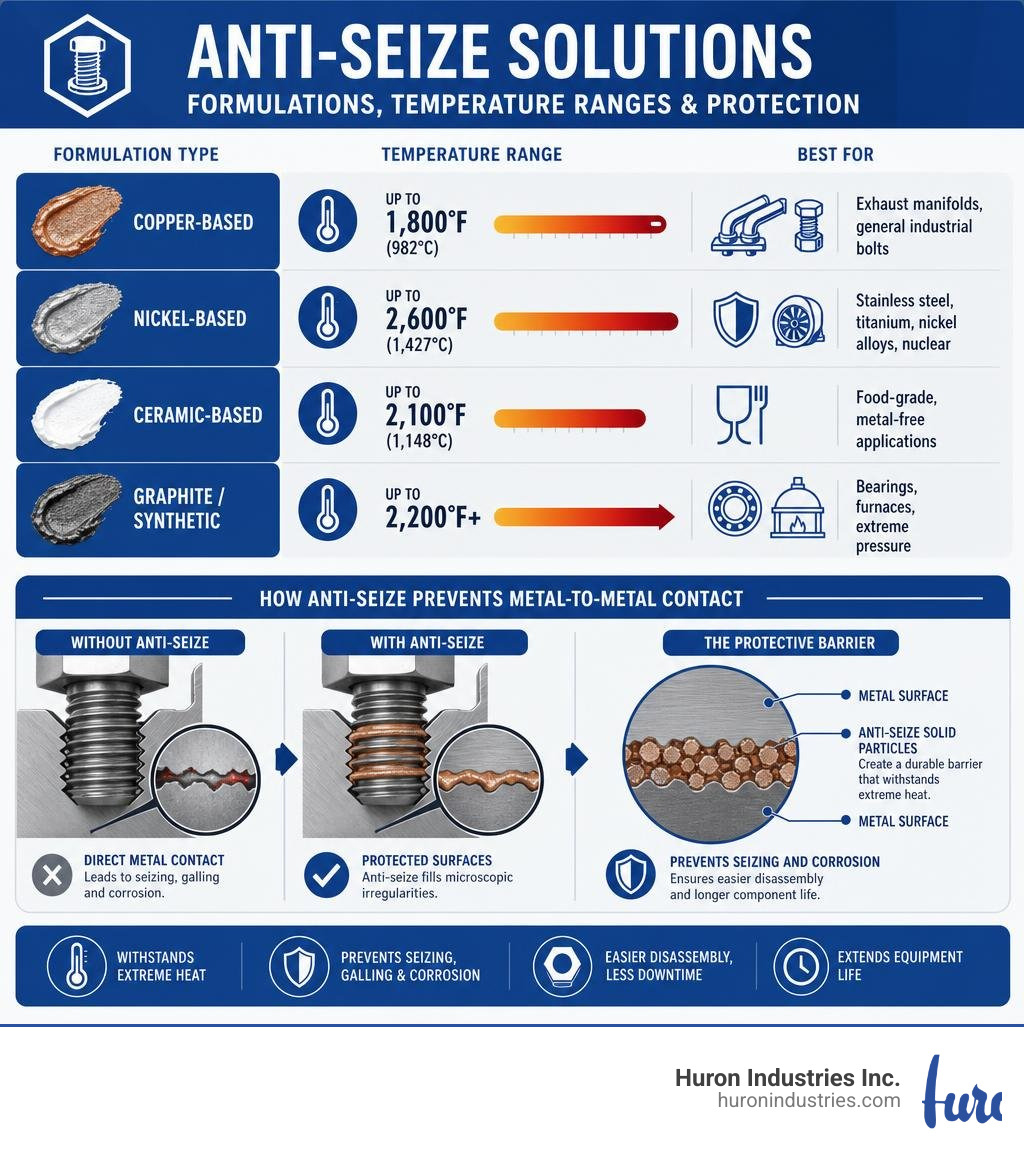
If you need a quick answer on the best high temp anti seize options, here is a fast reference by formulation type:
| Formulation | Max Temp | Best For |
|---|---|---|
| Copper-based | up to 1,800°F (982°C) | Exhaust manifolds, general industrial bolts |
| Nickel-based | up to 2,600°F (1,427°C) | Stainless steel, titanium, nickel alloys, nuclear |
| Ceramic-based | up to 2,100°F (1,148°C) | Food-grade, metal-free applications |
| Graphite/Synthetic | up to 2,200°F+ | Bearings, furnaces, extreme pressure |
Heat destroys fasteners quietly. A bolt that goes on fine can seize completely after one heat cycle — fused by corrosion, galling, or metal-to-metal adhesion. Getting it out can mean broken studs, damaged threads, and hours of unplanned downtime.
That is exactly what high-temperature anti-seize is built to prevent.
These compounds place a protective barrier of metallic or ceramic solids between mating surfaces. When heat drives off the carrier fluid, those solids stay behind — still coating, still protecting, still letting you take the joint apart without a fight.
For procurement, maintenance, and engineering teams working in demanding environments — power generation, refining, aerospace, or heavy industrial — choosing the wrong formulation is just as costly as using none at all. Temperature limits, base metal compatibility, and regulatory certifications all matter.
I'm Nicholas Cunha, founder of CreatiVertical and the content strategist behind Huron Industries Inc.'s digital presence, where I've spent considerable time helping industrial buyers navigate the technical nuances of high temp anti seize compounds, thread sealants, and specialty lubricants. The sections below break down every major formulation, application, and best practice you need to make a confident sourcing decision.
What is High Temp Anti Seize and How Does It Work?
At its core, a high temp anti seize compound is a specialized lubricant designed to prevent metal parts from seizing, galling, and corroding under extreme operational temperatures and heavy loads. While standard greases and lubricants melt, run off, or carbonize when exposed to extreme heat, an anti-seize compound is engineered to survive.
But how does it pull off this magic trick? It comes down to its dual-component anatomy:
- The Carrier (The Vehicle): This is typically a high-quality synthetic or petroleum-based oil or grease. Its job is to hold the solid lubricating particles in suspension and make the compound easy to apply. During initial assembly and low-temperature operation, the carrier provides standard lubrication.
- The Solid Lubricants (The Shield): These are microscopic flakes or particles of metals (like copper, nickel, or aluminum) or non-metallic materials (like ceramic, graphite, or calcium fluoride).
As your machinery heats up to extreme temperatures, the carrier fluid eventually volatilizes (burns off or evaporates). However, instead of leaving behind a dry, abrasive ash that locks the threads, it leaves behind a highly concentrated, interlocking matrix of solid lubricating plates. This dry, metallic, or ceramic plating remains wedged between the microscopic peaks and valleys (asperities) of the mating metal surfaces.

This physical barrier prevents direct metal-to-metal contact, which is the root cause of thread galling (a form of cold-welding caused by friction and pressure) and high-temperature oxidation.
Additionally, using an anti-seize compound significantly stabilizes the torque coefficient (often called the K-factor). When you tighten a dry bolt, a massive portion of your torque is wasted just trying to overcome friction. By applying a high-quality lubricant, you lower friction, ensuring that your torque readings translate into accurate, uniform clamping force.
When it comes to selecting a product, it is vital to match the formulation to the environmental demands. To explore how to navigate these decisions, you can read my guide on How to Choose the Best Anti-Seize Thread Lubricant for Any Job. For everyday, low-stress applications that do not see extreme heat or chemical exposure, standard standard anti-seize lubricants are widely available and highly effective, boasting tens of thousands of positive user reviews across the automotive and maintenance industries. However, when the heat turns up, you must look to specialized formulations.
Choosing the Right High-Temperature Formulation
Using the wrong anti-seize is often worse than using none at all. For instance, putting a copper-based compound on a stainless steel bolt in a highly corrosive environment can trigger galvanic corrosion, effectively welding the bolt in place.
To help you make the right choice, I have compiled a comparison of the primary high-temperature anti-seize formulations:
| Formulation Type | Max Temperature | Compatible Metals | Key Advantages | Disadvantages / Limitations |
|---|---|---|---|---|
| Copper | 1,800°F (982°C) | Carbon steel, iron, brass, bronze | Excellent electrical conductivity, highly cost-effective | Can cause galvanic corrosion on stainless steel; restricted in nuclear and oxygen services |
| Nickel | 2,600°F (1,427°C) | Stainless steel, titanium, nickel alloys, cast iron | Extreme temperature resistance, chemical inertness, prevents intergranular corrosion | Highly expensive; nickel is a regulated allergen in some close-contact applications |
| Ceramic | 2,100°F (1,148°C) | All metals, stainless steel, aluminum, plastics | Metal-free, excellent for food-grade, completely inert, prevents galvanic corrosion | Lower thermal conductivity than copper |
| Synthetic / Graphite | 2,200°F+ (1,204°C+) | Stainless steel, superalloys, Inconel | High-purity, low sulphur/chlorine, excellent for nuclear and turbines | Graphite can cause carburization of stainless steel above 550°F if not formulated correctly |
When to Use Nickel-Based High Temp Anti Seize
Nickel-based high temp anti seize is the undisputed heavy-weight champion for extreme-temperature industrial applications, particularly those reaching up to 2,600°F (1,427°C).
You should specifically opt for a nickel formulation when working with stainless steel, titanium, and nickel-based superalloys (like Inconel or Waspaloy). Stainless steel is highly prone to galling because its protective chromium oxide layer easily rubs off under pressure, allowing the raw metals to weld together. Nickel flakes act as an incredibly tough, sacrificial barrier that prevents this cold-welding.
Furthermore, nickel-based compounds are chemically inert and highly resistant to acidic and caustic solutions. They are the standard choice in chemical processing plants, refineries, and power generation facilities where copper contamination must be strictly avoided. If you are regularly dealing with high-performance alloys under intense thermal stress, sourcing specialized high-temperature alloy lubricants is essential to protect your capital equipment from catastrophic thread failure.
Specialty and Food-Grade High Temp Anti Seize Options
In industries like food processing, pharmaceuticals, and cosmetics, standard metallic anti-seize compounds are off the table due to strict safety regulations. Here, you must use a certified food-grade option.
Modern food-grade anti-seize compounds utilize a ceramic base. These white, non-staining pastes are formulated to be completely metal-free, utilizing highly refined synthetic carriers and ceramic solids. They carry an NSF H-1 registration, meaning they are approved for incidental food contact under FDA regulation 21CFR 178.3570.
Despite containing zero metal, these ceramic compounds are incredibly robust, often protecting fasteners up to 2,100°F (1,148°C). They are completely impervious to water washout, steam cleaning, and the harsh food acids (like citric or lactic acid) commonly found in processing plants. If your facility requires clean, non-toxic assembly lubrication, choosing a certified food-grade anti-seize compound ensures regulatory compliance without sacrificing high-temperature protection.
Key Applications: Where to Apply High-Temperature Lubricants
High-temperature anti-seize compounds find their home anywhere heat and pressure threaten to lock metal parts together.

- Automotive Exhaust Systems: Exhaust manifold bolts, V-band clamps, muffler connections, and turbocharger mounting hardware regularly cycle from ambient temperatures to over 1,200°F. Applying a copper or nickel compound prevents studs from snapping during future exhaust service.
- Spark Plugs and Oxygen Sensors: Spark plugs installed in aluminum cylinder heads are prime candidates for thread damage. A tiny dab of anti-seize prevents the steel threads of the plug from seizing in the soft aluminum head. (Note: Always keep the lubricant clear of the first two threads and the electrode to avoid electrical fouling).
- Brake Components: High-performance ceramic-based anti-seize is used on the backside of disc brake pads, caliper slide pins, and pad contact points to prevent squealing and ensure smooth caliper operation under intense thermal loads.
- Industrial Ovens and Furnaces: Slow-moving bearings (under 100 RPM), kiln car wheel bearings, conveyor chains, and furnace door hinges rely on synthetic metallic compounds to remain operational inside high-heat environments.
- Petrochemical and Marine Flanges: Large flange bolts exposed to salt spray, steam, and corrosive chemicals are coated to guarantee they can be tensioned accurately and disassembled easily during maintenance shutdowns.
It is important to note that anti-seize is strictly a lubricant and release agent. It does not seal fluid pressure. If your goal is to prevent fluid or gas leaks in high-temperature threaded pipe connections, you must understand the operational differences. You can read my detailed breakdown on High Temperature Anti-Seize vs Thread Sealant to ensure you are using the correct product for the job.
How to Properly Apply High-Temperature Anti-Seize
Applying anti-seize seems simple, but doing it incorrectly can lead to loose bolts, over-torqued fasteners, or contaminated systems. Follow these professional best practices:
- Prep the Surface: Before applying a single drop of compound, clean the threads thoroughly. Use a wire brush to remove old rust, scale, and dirt. Degrease the parts with a fast-evaporating solvent cleaner. Applying anti-seize over existing debris prevents the solid particles from adhering properly to the metal.
- Apply Moderately: Less is more. You do not need to bury the bolt in paste. Apply a thin, even film of anti-seize along the entire length of the threads that will be engaged. Use the integrated brush top cap to work the compound into the root of the threads.
- Adjust Your Torque: This is the most critical step. Because anti-seize is highly lubricious, it reduces friction. If you tighten a lubricated bolt to the "dry" torque specification, you will over-stretch the bolt, potentially stripping the threads or snapping the fastener. As a rule of thumb, reduce your torque values by 15% to 25% when using a lubricated fastener, or refer to the manufacturer's specific K-Factor (torque coefficient) calculations.
- Wipe the Excess: Once the fastener is torqued down, wipe away any excess paste that squeezes out of the joint. This prevents dirt and abrasive grit from sticking to the exposed threads.
- Consider the Format: For large-scale industrial projects or hard-to-reach areas, a standard brush-top can can be tedious. In these scenarios, utilizing a high-quality high-temp anti-seize spray allows for incredibly fast, uniform coverage across large arrays of studs and fasteners.
Frequently Asked Questions about High-Temperature Lubricants
What is the difference between anti-seize and thread sealant?
While both are applied to threaded connections, they serve entirely different purposes.
An anti-seize compound is designed strictly as an extreme-pressure lubricant to prevent galling, seizing, and corrosion, allowing for easy disassembly. It contains a high concentration of solid particles (like copper or nickel) and does not cure or seal fluid pressure.
A thread sealant, on the other hand, is engineered to fill the physical gaps between mating threads to create a pressure-tight seal against liquids and gases. Many thread sealants contain Teflon (PTFE) or anaerobic resins that cure into a solid barrier. For critical, high-pressure, high-heat plumbing and process piping, you should read my guide on High Temperature Thread Sealant for Critical Service to select a compound designed to hold pressure under thermal stress.
Can you use copper anti-seize on stainless steel?
Generally, no—especially not at high temperatures or in corrosive environments.
Stainless steel contains chromium, which gives it its corrosion resistance. If you apply a copper-based anti-seize to stainless steel, the copper and stainless steel act as dissimilar metals. In the presence of moisture or electrolytes (like road salt or coastal air), galvanic corrosion occurs, causing the stainless steel to corrode rapidly.
Furthermore, at temperatures exceeding 550°F (288°C), copper can diffuse into the grain boundaries of stainless steel, leading to a phenomenon known as liquid metal embrittlement, which causes the fastener to crack and fail under load. For stainless steel, always use a nickel-based or ceramic-based anti-seize.
How should high-temperature anti-seize be stored?
High-temperature anti-seize compounds have an exceptionally long shelf life—often 5 years or more—if stored correctly.
- Temperature: Store containers in a cool, dry place between 40°F and 90°F (4°C to 32°C). Exposure to extreme heat in storage can accelerate oil separation.
- Sealing: Always keep the container tightly sealed when not in use. This prevents volatile solvents from evaporating and stops dirt, dust, and moisture from contaminating the paste.
- Separation: It is completely normal for a thin layer of oil to separate and pool at the top of the can over time. Simply use a clean stir stick or the applicator brush to thoroughly mix the compound back to a smooth, creamy consistency before use.
Conclusion
When the heat is on, standard lubricants simply cannot stand the pressure. Investing in the correct high temp anti seize formulation is a simple, highly cost-effective way to protect expensive machinery, prevent catastrophic galling, and eliminate hours of maintenance headaches during teardowns.
At Huron Industries Inc., established in 1971 in Port Huron, Michigan, we have spent over five decades manufacturing high-purity, high-performance specialty lubricants and sealants designed for the world's most demanding environments. From our military-qualified Neolube® colloidal-graphite line—trusted in commercial and naval nuclear reactor systems—to our advanced industrial sealing compounds, we build products that deliver absolute thermal stability.
To learn more about our company and certifications, you can view our Huron Industries, Inc. profile. If you are facing complex sealing challenges alongside extreme heat, check out our specialized High Temperature Sealant options, or Learn more about thermal stability solutions to find the perfect match for your next project.