
How Absorbent Socks Function and Differ from Marine Booms
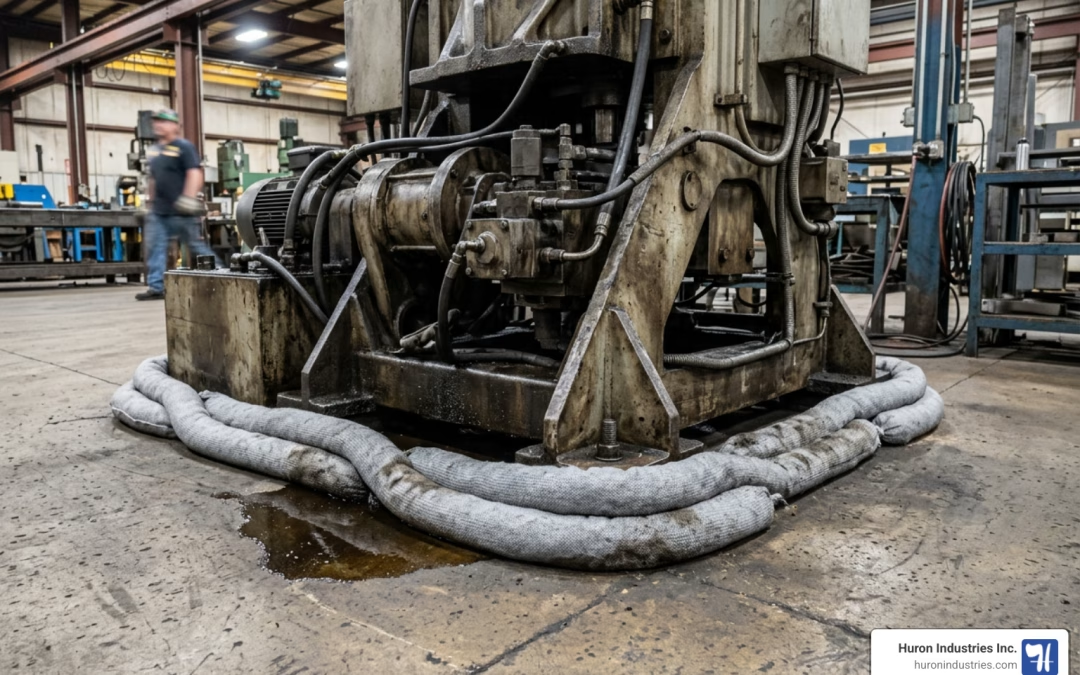
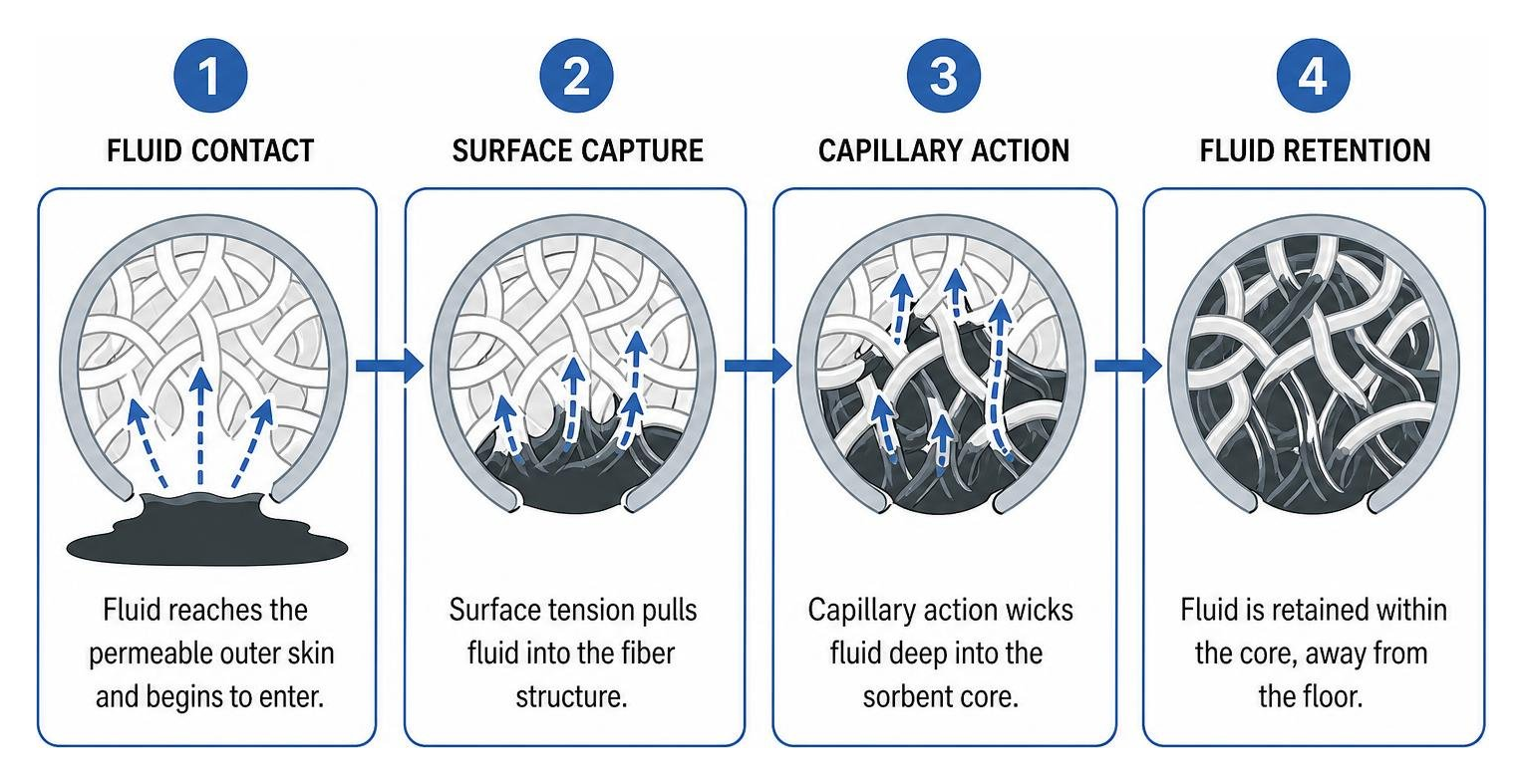
When an industrial fluid line bursts or a gearbox seal fails, liquid spreads rapidly along the path of least resistance. Absorbent socks work through a combination of fluid diking, surface tension capture, and internal capillary action.
The outer casing functions as a permeable skin, allowing liquids to pass through while keeping the internal sorbent matrix secure. Inside, oleophilic fibers or open-cell structures draw the fluid deep into the core, trapping it away from the shop floor. Because these tubular barriers are flexible and moldable, you can contour them directly against equipment castings, baseplates, concrete expansion joints, and uneven masonry. This tight physical seal forms a dependable secondary containment boundary that stops fluids from migrating into pedestrian walkways or drainage networks.
Sorbent Tubes vs. Marine Containment Booms
While sorbent tubes and marine booms share a tubular profile, their engineering and intended environments are quite different. Sorbent tubes (standard socks) are designed primarily for land-based diking around indoor machinery, shop floors, and tight outdoor pads. Containment booms are rugged, large-diameter barriers built to withstand open water skimming, wind currents, and hydrodynamic drag.
Marine booms feature heavy-duty ballast hardware, internal high-tensile netting, end-to-end load lines, and steel connection clips. These features allow response teams to link multiple sections together and tow them across open water without tearing. Sorbent socks, by contrast, focus on perimeter flexibility and surface molding. To handle broad surface spills within a contained area, facility managers often pair these socks with absorbent pad rolls for fast, high-surface-area cleanup.
| Feature | Industrial Absorbent Socks | Marine Absorbent Booms |
|---|---|---|
| Primary Environment | Plant floors, machine bases, shop sumps | Harbors, rivers, retention ponds, open water |
| Standard Diameters | 3 in. (8 cm) to 5 in. (12.7 cm) | 5 in. (12.7 cm) to 8 in. (20 cm) |
| Standard Lengths | 4 ft (1.2 m), 8 ft, 10 ft, 12 ft | 10 ft (3 m) to 20 ft (6.1 m) |
| Internal Reinforcement | Lightweight scrim or stitch-bonded skin | High-tensile center rope and heavy netting |
| Connecting Hardware | Overlapping ends, integrated ties, or magnets | Steel carabiners, heavy grommets, and rings |
| Primary Function | Precision perimeter diking and leak containment | Large-scale hydrocarbon containment and deflection |
Types and Materials of Industrial Oil Absorbent Socks
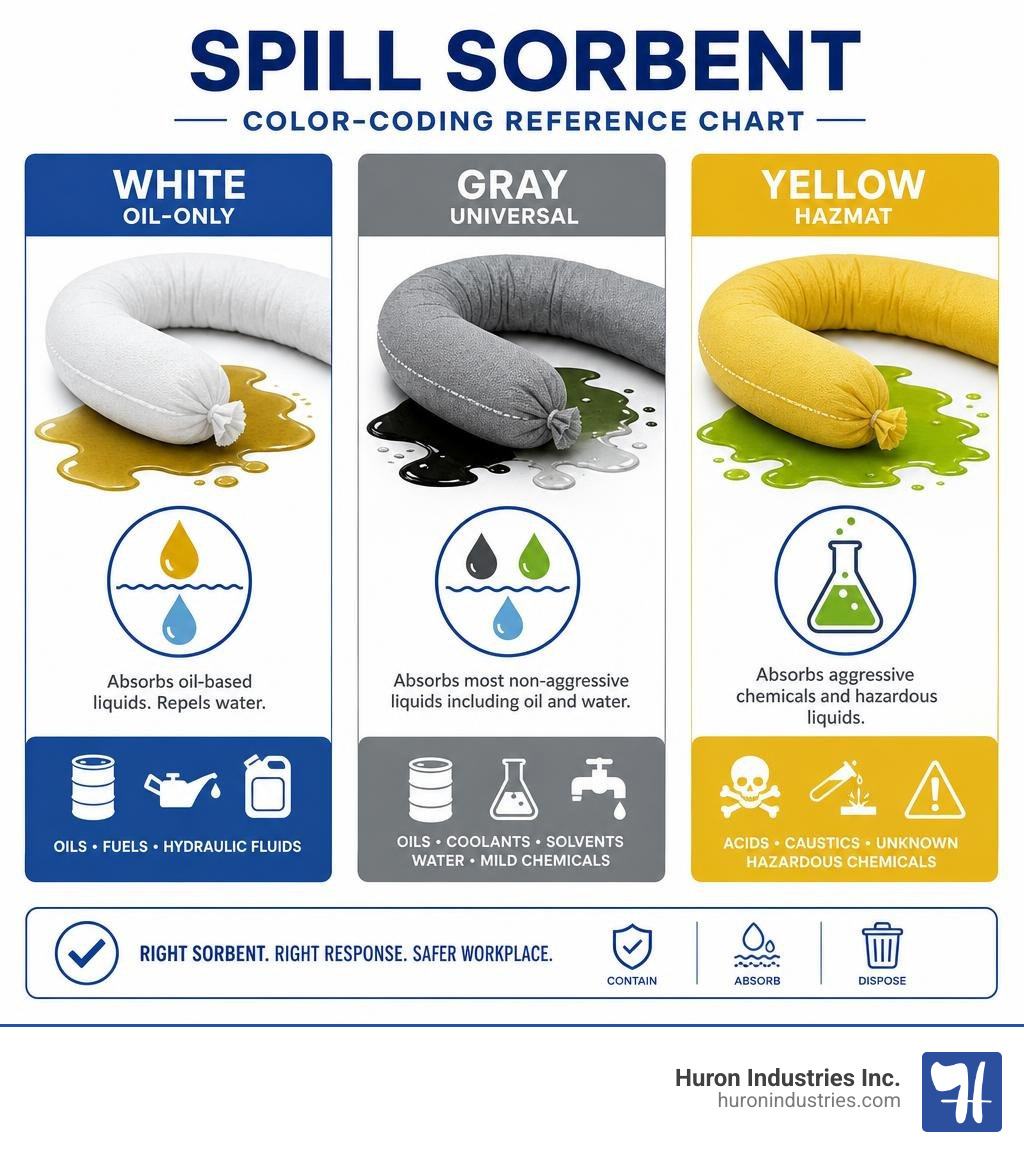
Using the wrong sorbent type can lead to poor cleanup performance, higher disposal costs, or dangerous chemical reactions. Sorbents follow a standard industrial color-coding system to help operators quickly select the right tool during an incident.
White Oil-Only vs. Gray Universal vs. Yellow Hazmat Sorbents
Industrial sorbent tubes fall into three main fluid classifications:
- White (Oil-Only): These socks are naturally hydrophobic (water-repelling) and oleophilic (oil-attracting). They selectively absorb petroleum hydrocarbons, motor oils, hydraulic fluids, diesel fuel, and non-polar organic solvents while rejecting water. This makes them ideal for rainy outdoor yards, wet machine sumps, settling basins, and aquatic surfaces.
- Gray (Universal): These hydrophilic sorbents absorb both water-based liquids and petroleum products. They are best suited for routine indoor facility maintenance, capturing machine coolants, glycols, aqueous cutting fluids, and general shop leaks. For broad plant upkeep, deploying an all purpose sorbent around multi-fluid machining centers ensures consistent, reliable containment.
- Yellow (Hazmat / Aggressive Chemical): Made from chemically inert synthetic polymers, hazmat socks are built to withstand corrosive acids, strong bases, and unknown aggressive liquids without breaking down. They are standard equipment for chemical processing plants, battery charging areas, and hazardous chemical staging zones.
Core Materials: Meltblown Polypropylene, Cellulose, and Synthetic Foam
The internal filler and outer sleeve material determine a sock's absorption speed, liquid retention, UV stability, and durability:
- Meltblown Polypropylene: The industrial standard for hydrocarbon management. Meltblown microfibers create a dense, fine network that locks in low-viscosity oils. Heavyweight polypropylene outer skins with sonic bonding resist tearing and minimize linting around sensitive machine parts.
- Recycled Hydrophobic Cellulose: A cost-effective, sustainable core option made from treated cellulose fibers. Premium blends reject ambient water while absorbing up to one gallon of oil per standard 4-foot sock. When enclosed in a UV-stabilized polypropylene skin, these socks can remain outdoors in direct sunlight for up to 12 months without the outer casing breaking down. For heavy industrial leak zones, an advanced blend like Max Sorbent provides the density needed to keep large fluid volumes in check.
- Open-Cell Polyurethane Foam: High-performance synthetic foam cores can absorb up to 30 times their dry weight in oil. These advanced open-cell matrices can be mechanically wrung out and reused multiple times, helping reduce total hazardous waste volume in high-demand settings.
Critical Applications and Spill Response Strategies
Having absorbent socks on hand is only half the battle; knowing how to position them quickly is what keeps small leaks from turning into serious plant disruptions.
Deploying Oil Absorbent Socks for Perimeter Diking and Spill Containment
To establish an effective barrier during an active leak or spill, follow this deployment sequence:
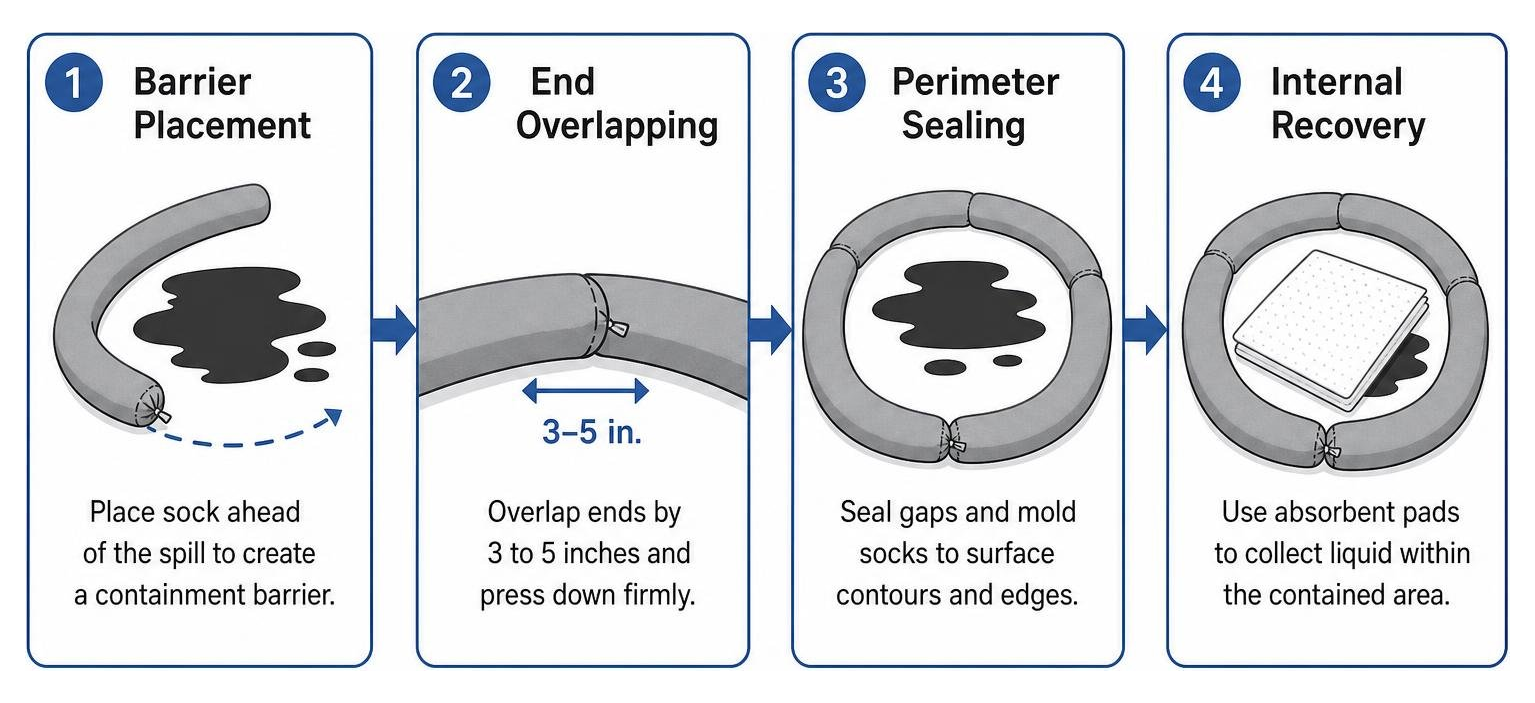
- Identify and Approach Safely: Confirm the spilled fluid type, check its compatibility, and put on the appropriate personal protective equipment (PPE).
- Form the Perimeter Dike: Lay the socks directly on the dry surface ahead of the advancing liquid front. Rather than placing them right at the edge of the puddle, leave a small margin of clean floor so you can secure the barrier before fluid reaches it.
- Overlap All Connection Points: Never place socks butt-end to butt-end. Liquid will easily seep through the seam. Always overlap the ends by at least 3 to 5 inches, pressing the connection down firmly against the floor to eliminate gaps.
- Mold to Surface Contours: Press the tubular casing firmly against machine footings, concrete expansion joints, masonry seams, or floor drains to prevent underflow.
- Protect Vulnerable Inlets: If a spill occurs near floor drains or exit doors, build an offset U-shaped or fully enclosed ring around the inlet to keep hydrocarbons out of the municipal sewer or stormwater system.
- Recover the Pooled Center: Once the outer perimeter is contained, place high-capacity pads or loose granular media in the center pool to soak up the standing fluid.
High-Risk Industrial Environments and Marine Outfalls
Different industrial settings face unique fluid management challenges:
- CNC Machining & Manufacturing: High-speed metal cutting operations constantly produce mist, coolant overspray, and hydraulic seepage. Wrapping flexible socks around machine perimeters prevents oily slicks from reaching walkways, supporting OSHA floor cleanliness standards.
- Electrical Substation Rooms: High-voltage transformers can develop slow leaks of dielectric insulating fluids. Sorbent socks placed inside containment basins catch drips before they reach gravel beds or drainage sumps.
- Loading Docks & Fuel Bunkering: Outdoor fluid transfers are vulnerable to sudden rain. Using hydrophobic, oil-only socks ensures that passing stormwater flows freely while spilled fuels and lubricants are captured.
- Food & Cold Chain Facilities: Facilities handling refrigeration equipment or food packaging must meet strict purity and safety requirements. Learning what is an NSF certified sorbent helps EHS professionals select clean, certified sorbents that prevent cross-contamination in temperature-controlled spaces.
Absorption Performance, Reusability, and Regulatory Compliance
Selecting the right sorbent inventory means matching sock capacity to your facility's realistic spill volumes and understanding your regulatory obligations.
Absorption Capacity and Sizing of Oil Absorbent Socks
Absorbent socks come in several standardized configurations to suit different leak rates and space constraints:
- Standard 3 in. x 4 ft (8 cm x 1.2 m): The classic shop workhorse. Each 4-foot sock typically holds between 0.7 and 1.0 gallon (2.6 to 3.8 liters) of petroleum fluid. A standard carton of 30 to 40 units provides between 25 and 44 gallons of total containment capacity.
- Continuous 3 in. x 8 ft to 12 ft: Longer single-piece socks minimize the number of overlap points around large machining centers, hydraulic presses, and multi-sided fluid reservoirs.
- High-Volume 5 in. x 10 ft Sorbent Booms: Used for high-output industrial sumps, retention ponds, and marine dock perimeters. These larger barriers can absorb 8 to 17.5 gallons of hydrocarbon fluid per unit.
- Fast-Action Formulations: High-efficiency universal socks can draw in fluid at rates up to 1.5 liters per second, quickly halting fast-moving leaks.

Reusability, Incineration, and Hazardous Waste Disposal
Managing saturated sorbents responsibly is just as important as the initial cleanup:
- Reusability and Fluid Recovery: Traditional meltblown polypropylene and cellulose socks are designed for single-use applications; squeezing them damages their internal fiber structure and drops their retention capacity. However, advanced open-cell polyurethane foam socks can be mechanically wrung out and returned to service for up to 5 to 10 cycles with minimal loss in performance.
- Waste-to-Energy and Incineration: Because petroleum-saturated polypropylene and cellulose carry high BTU ratings, many industrial operations route spent socks to certified waste-to-energy facilities for incineration or fuel blending, significantly reducing solid waste volume.
- Regulatory Compliance Framework: Under OSHA 29 CFR 1910.22(a)(2), workplace floors must be maintained in a clean, dry condition to prevent slips, trips, and falls. Furthermore, EPA SPCC (40 CFR 112.7) and EPA NPDES (40 CFR 122.26) regulations require industrial facilities to maintain appropriate spill response materials to prevent oil discharges from reaching navigable waterways. For daily operational needs, using a proven, versatile product like Neosafe All Purpose Sorbent Solution helps your team stay compliant with both workplace safety and environmental rules.
Frequently Asked Questions About Spill Containment Socks
Can oil-only absorbent socks be used on water surfaces?
Yes. Oil-only socks are made with hydrophobic materials that actively repel water while attracting hydrocarbons. They remain buoyant even when fully saturated with oil, making them easy to retrieve from retention basins, sumps, cooling towers, and open water outfalls.
How do you properly link and overlap absorbent socks?
To build an unbroken barrier, overlap adjacent sock ends by 3 to 5 inches. Press the overlapping joint firmly against the ground to eliminate gaps. For outdoor setups or high-flow areas, choose socks with integrated tie strings, metal clips, or magnetic fasteners to keep the barrier securely anchored.
Can industrial absorbent socks be cleaned and reused?
Standard polypropylene and cellulose socks are designed for single use. Squeezing or wringing them breaks down the internal fiber matrix and compromises their liquid retention. Only socks specifically made with open-cell polyurethane foam or elastomeric cores should be mechanically wrung out and reused.
Conclusion
A well-planned spill response strategy relies on having the right containment tools ready before an incident happens. Industrial absorbent socks provide a moldable, reliable first line of defense—preventing expensive fluid losses, protecting workers from slip hazards, and keeping facilities aligned with OSHA and EPA environmental standards.
At Huron Industries Inc., we build reliable, field-tested containment solutions designed to withstand the demands of modern manufacturing plants, utility systems, and marine environments. Explore our complete sorbent product category to find the right oil-only, universal, and high-capacity sorbents to protect your facility.