
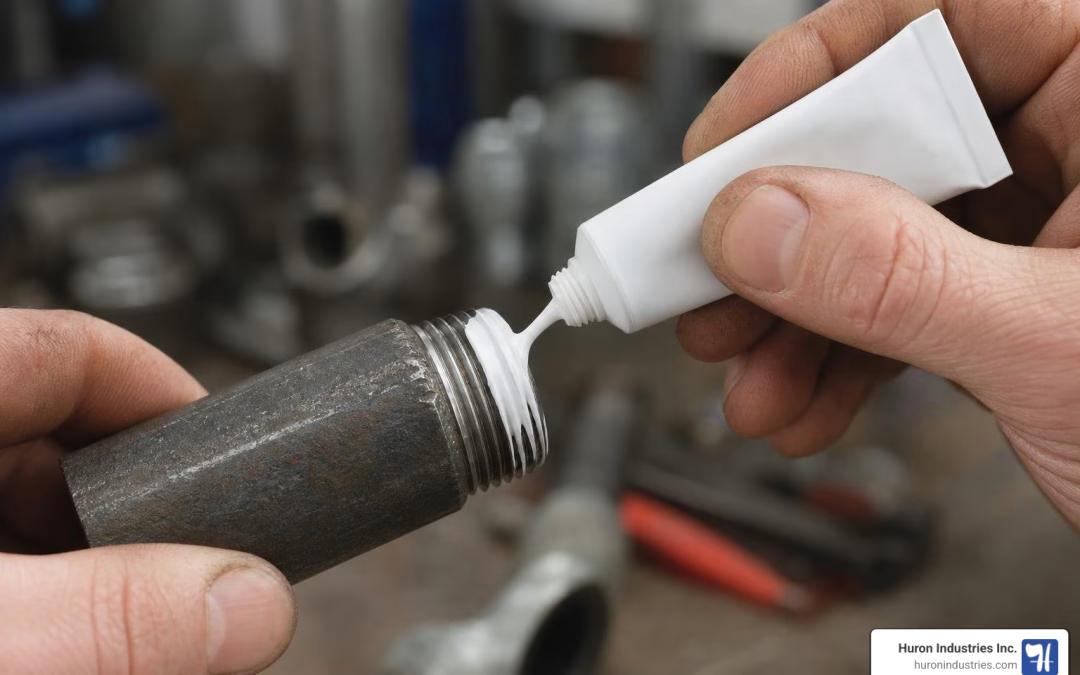
What Is Formula 8 Thread Sealant — and Why Does It Matter?
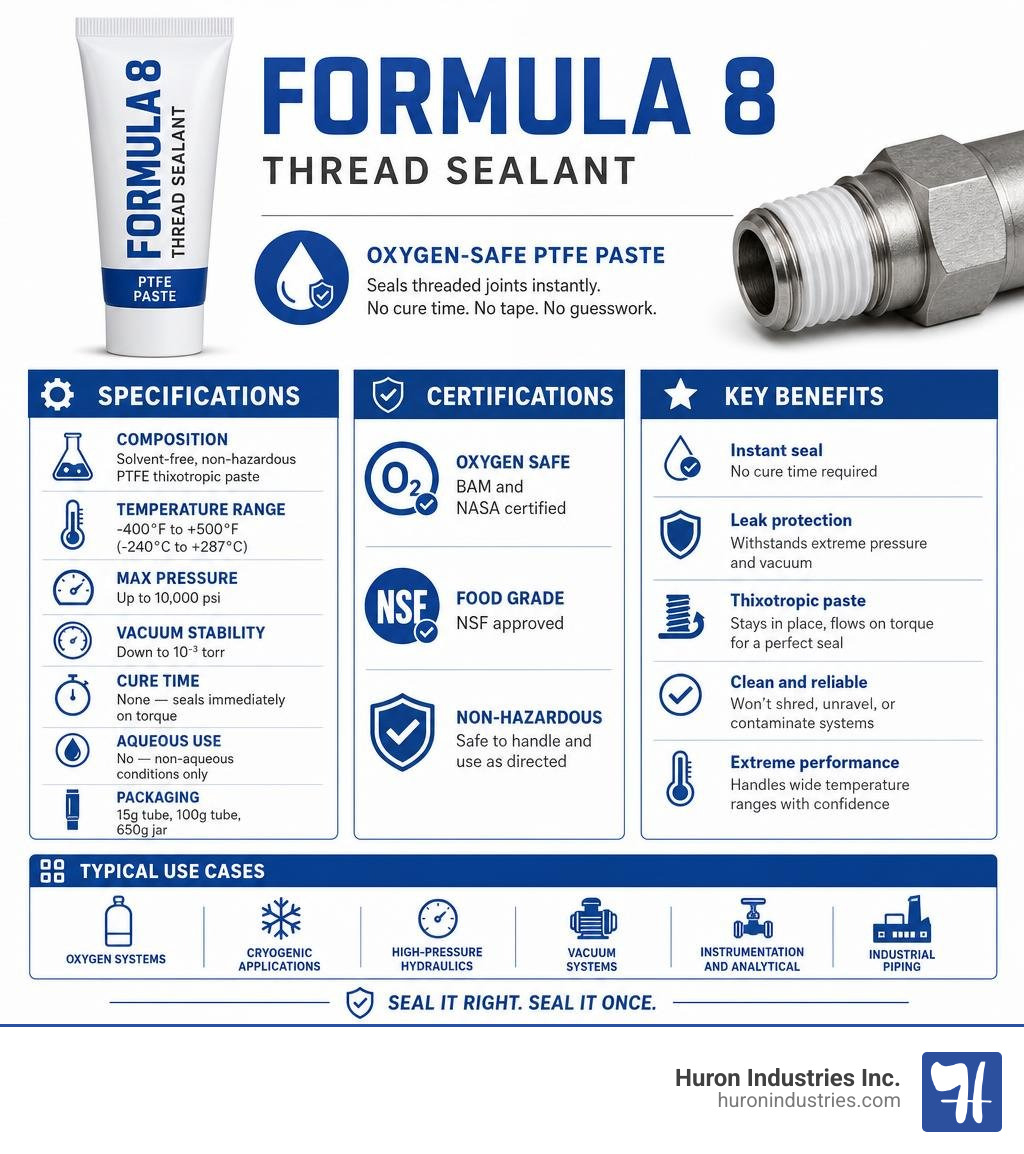
Formula 8 thread sealant is a high-performance, oxygen-safe PTFE paste engineered to seal threaded joints across a wide range of gases, liquids, and vacuum systems — with no cure time required.
Here is a quick-reference summary:
| Property | Formula 8 Specification |
|---|---|
| Composition | Solvent-free, non-hazardous PTFE thixotropic paste |
| Temperature Range | -400°F to +500°F (-240°C to +287°C) |
| Max Pressure | Up to 10,000 psi |
| Vacuum Stability | Down to 10⁻³ torr |
| Cure Time | None — seals immediately on torque |
| Oxygen Safe | Yes — BAM and NASA certified |
| Food Grade | Yes — NSF approved |
| Aqueous Use | No — non-aqueous conditions only |
| Packaging | 15g tube, 100g tube, 650g jar |
If you have ever dealt with thread seal tape bunching up, cold-flowing into a check valve, or simply refusing to cooperate on a fine instrument thread in a tight space, you already know the problem Formula 8 was built to solve.
Traditional PTFE tape works well enough in straightforward plumbing. But in oxygen systems, cryogenic lines, hydraulic circuits running at thousands of psi, or any application where a contaminated valve means a shutdown — tape starts to show its limits fast.
Formula 8 takes a different approach. It is a shear-sensitive thixotropic paste, meaning it stays thick and stable at rest, then flows and wets aggressively into threads the moment you apply torque. No wrapping. No guessing how many layers. No fragments breaking off into your system.
I'm Nicholas Cunha, founder of CreatiVertical and the digital marketing strategist behind Huron Industries Inc.'s content program — I work closely with the Huron team to translate the technical depth of products like Formula 8 thread sealant into clear, useful guidance for engineers and procurement buyers. In this guide, we will walk through exactly how Formula 8 works, where it excels, and how to determine whether it is the right sealant for your application.
What is Formula 8 Thread Sealant and How Does It Work?
To understand why this thixotropic paste is such a lifesaver in critical systems, we have to look closely at its physical state and behavior. Unlike standard liquid sealants that rely on solvents evaporating or anaerobic resins curing, Formula 8 is a solvent-free, non-hazardous PTFE paste.
It does not dry out, shrink, or crack. Instead, it remains pliable indefinitely. This means that once you apply it, it stays exactly where you put it, filling the microscopic gaps in your threaded fittings without changing its physical volume over time.
The Science Behind the formula 8 thread sealant
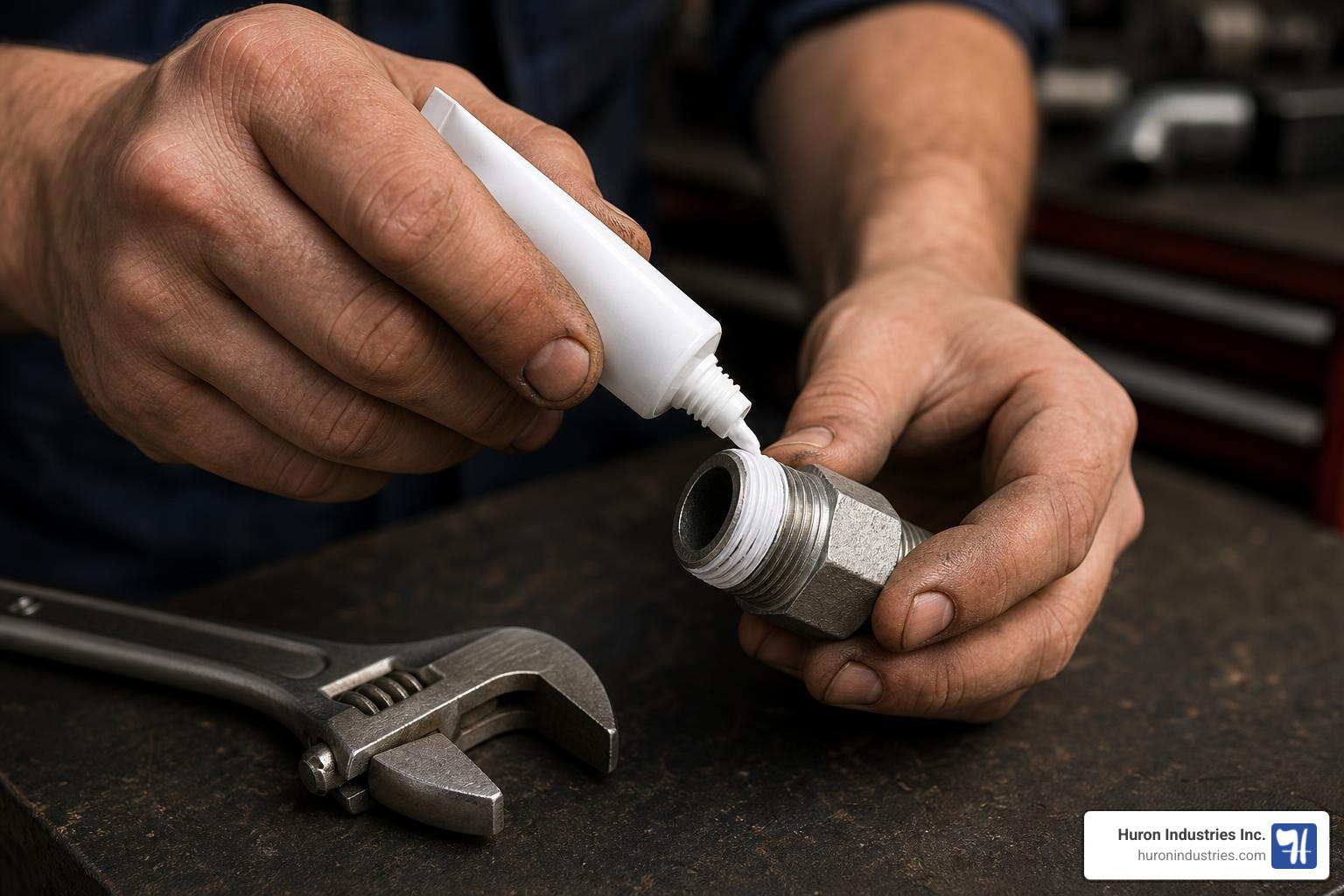
The magic of formula 8 thread sealant lies in its thixotropic, shear-sensitive nature. In simple terms, a thixotropic material is thick and viscous under normal conditions, but it thins out and flows when physical force (shear stress) is applied.
When you torque a threaded joint together, the immense mechanical pressure acts as the shear force. The paste instantly thins, wetting the metal or plastic surfaces aggressively. As it flows, it physically sheets out into microscopic PTFE strings that pack tightly into the thread roots and crests. The moment the torquing stops, the sealant returns to its highly viscous, non-flowing state.
This creates a highly reliable physical barrier. Because it relies on this physical transformation rather than a chemical reaction, it is highly valued in high-vibration and high-stress environments. In fact, major transit authorities use it in critical underground and high-speed rail systems, as detailed by Formula-8 - Railway Technology .
Key Technical Specifications: Temperature, Pressure, and Vacuum Limits
If you are operating in extreme environments, you need to know exactly what your materials can handle before they fail. Formula 8 is built to withstand environments that would make standard hardware-store sealants turn to dust or liquid.
- Temperature Stability: Formula 8 remains stable from cryogenic temperatures of -400°F (-240°C) all the way up to +500°F (+287°C or +260°C depending on the system configuration). Whether you are sealing liquid nitrogen lines or high-temperature steam fittings, the PTFE backbone ensures the compound will not melt, freeze, or degrade. For more details on choosing compounds for these hot environments, check out our guide on High Temperature Thread Sealant for Critical Service Applications.
- Pressure Resistance: In general applications, Formula 8 is rated up to 3,500 psi. However, in fuel and hydraulic systems where aggressive wetting is fully supported by the substrate, it can withstand pressures up to an astonishing 10,000 psi.
- Vacuum Performance: If you are sealing fine instrument lines or vacuum chambers, leaks are your absolute worst enemy. Formula 8 is stable in vacuum systems down to $10^{-3}$ torr, preventing outside air from contaminating high-purity processes.
Key Benefits of Formula-8 Over Traditional Thread Seal Tape
Let’s be honest: thread seal tape (often called Teflon™ tape) is the default choice for most quick plumbing fixes. But in a high-consequence industrial setting, relying on tape can be a high-stakes gamble.
The biggest issue with PTFE tape is "cold flow." Over time, under constant pressure, tape has a tendency to physically squeeze out of the threads. When it does, it can shred. These tiny loose fragments of tape travel down your piping system, eventually ending up exactly where you don't want them: jamming check valves, clogging fine filters, or seizing expensive pumps.

Using a thixotropic paste like Formula 8 eliminates this risk entirely. It cannot shred, cold-flow, or break off into the line.
Additionally, applying tape to fine instrumentation threads or in incredibly tight, hard-to-reach places is a physical nightmare. You have to wrap it in the correct direction, ensure it doesn't overlap the end of the pipe, and hope it doesn't bunch up as you thread the joint. Formula 8 simply brushes on, wetting the entire thread length instantly.
To see how these two methods stack up side-by-side, let's look at this comparison:
| Feature | Formula 8 PTFE Paste | Traditional PTFE Tape |
|---|---|---|
| Application Ease | Easy brush/tip application; works in tight spaces | Difficult in tight spaces; requires precise wrapping |
| Risk of System Clogging | Zero — will not shred or produce loose fragments | High — cold flows and shreds, clogging valves |
| Fine Thread Performance | Excellent; wets into microscopic gaps | Poor; tape adds too much bulk to fine threads |
| Cure Time | None; immediate pressurization | None |
| Pliability over Time | Remains permanently pliable; easy disassembly | Can degrade, shred, or harden under high heat |
For a deeper dive into how these two sealing methods compare across various industrial applications, you can read our detailed analysis on Pipe Thread Sealant vs PTFE Tape.
Why Non-Hardening Pastes Outperform Tape in Critical Systems
When you assemble a piping system, it is rarely static. Pumps vibrate, thermal expansion causes pipes to grow and shrink, and physical impacts happen. Hard-setting sealants can crack under these dynamic stresses, leading to slow, weeping leaks.
Formula 8 is a non-hardening paste. Because it never cures into a solid, brittle plastic, it acts as a dampener. It absorbs the micro-vibrations of your system without losing its seal.
Furthermore, when the time comes for routine maintenance or equipment upgrades, you will thank your past self for choosing a non-hardening compound. Joints sealed with Formula 8 can be disassembled easily years later without galling the threads or requiring a blowtorch to break the seal.
We discuss this dynamic in detail in our resource on Non-Hardening vs Hard-Setting Thread Sealant Neolube.
Critical Applications and Chemical Compatibility
Formula 8's chemical inertness makes it a highly versatile tool in an industrial maintenance department's arsenal. It is highly resistant to aggressive chemicals, including diesel, gasoline, propane, butane, kerosene, and hydraulic oils.
It is widely used in hydraulic systems, natural gas distribution lines, fuel delivery systems, and aerospace instrumentation. If you are designing or maintaining hydraulic and compressor setups, you can learn more about choosing the right compounds in our guide on Thread Sealant for Hydraulic Fittings and Compressor Lines.
Oxygen Safety and Food-Grade Certifications for formula 8 thread sealant
One of the most critical environments for any thread sealant is an oxygen-rich system. In high-pressure oxygen lines, ordinary hydrocarbon-based lubricants and sealants can spontaneously ignite or explode.
Formula 8 is specifically engineered to be oxygen-safe. It has undergone rigorous testing and holds prestigious certifications:
- BAM Certified: Approved by the German Federal Institute for Materials Testing (BAM) for use in gaseous and liquid oxygen systems.
- NASA Approved: Tested and approved for aerospace oxygen systems.
- ASTM Standards: Meets ASTM G72-82 and ASTM G86 requirements.
Additionally, it is registered with NSF International, making it safe for use in food processing and handling facilities where accidental food contact might occur. This highly certified compound is available in multiple packaging options, including the popular 100-gram tube, to suit various plumbing and gas fitting applications.
Substrate Compatibility: Metals, Plastics, and Non-Aqueous Environments
Formula 8 is highly compatible with a wide range of piping materials, including:
- Metals: Brass, copper, stainless steel, carbon steel, and aluminum.
- Plastics: PVC, CPVC, and ABS. Because it contains no aggressive solvents, it will not weaken or stress-crack plastic fittings.
However, there is one critical rule you must remember when using Formula 8: it is designed for non-aqueous (dry) conditions only.
Formula 8 is a water-based paste. While this makes it incredibly safe and solvent-free, it also means that it is soluble in water. If you use it in lines carrying water, steam, or aqueous chemical solutions, the sealant will slowly dissolve and wash away over time, resulting in a leak.
Additionally, you must avoid using Formula 8 in systems containing strong alkalis, as they are chemically incompatible with the paste. When working with sensitive or exotic metal alloys, choosing the right chemical profile is essential to prevent corrosion, which we discuss in Why Sensitive Metal Pipes Need Low Halogen and Low Sulfur Sealants.
Safety, Handling, and Packaging Options
When it comes to workplace safety, Formula 8 is about as user-friendly as it gets. According to its Safety Data Sheet (SDS), it is classified as a 100% non-hazardous mixture under US GHS standards (29 CFR 1910.1200).
It contains zero OSHA-reportable hazardous ingredients and is completely exempt from California Proposition 65 warning labels.
Here are the key physical safety metrics to keep in mind:
- VOC Content: Extremely low at 2.1% (27 g/l), making it excellent for enclosed spaces or facilities with strict emissions targets.
- Flammability: It is completely incombustible and will not burn under normal conditions.
- Thermal Decomposition: Be aware that if the sealant is exposed to extreme temperatures exceeding +650°C (+1202°F), it will undergo hazardous thermal decomposition, releasing toxic hydrogen fluoride gas.
- Storage: Always store the container tightly closed at temperatures above 0°C (32°F) to prevent the water carrier from freezing.
Packaging Sizes and the Extended Application Tip
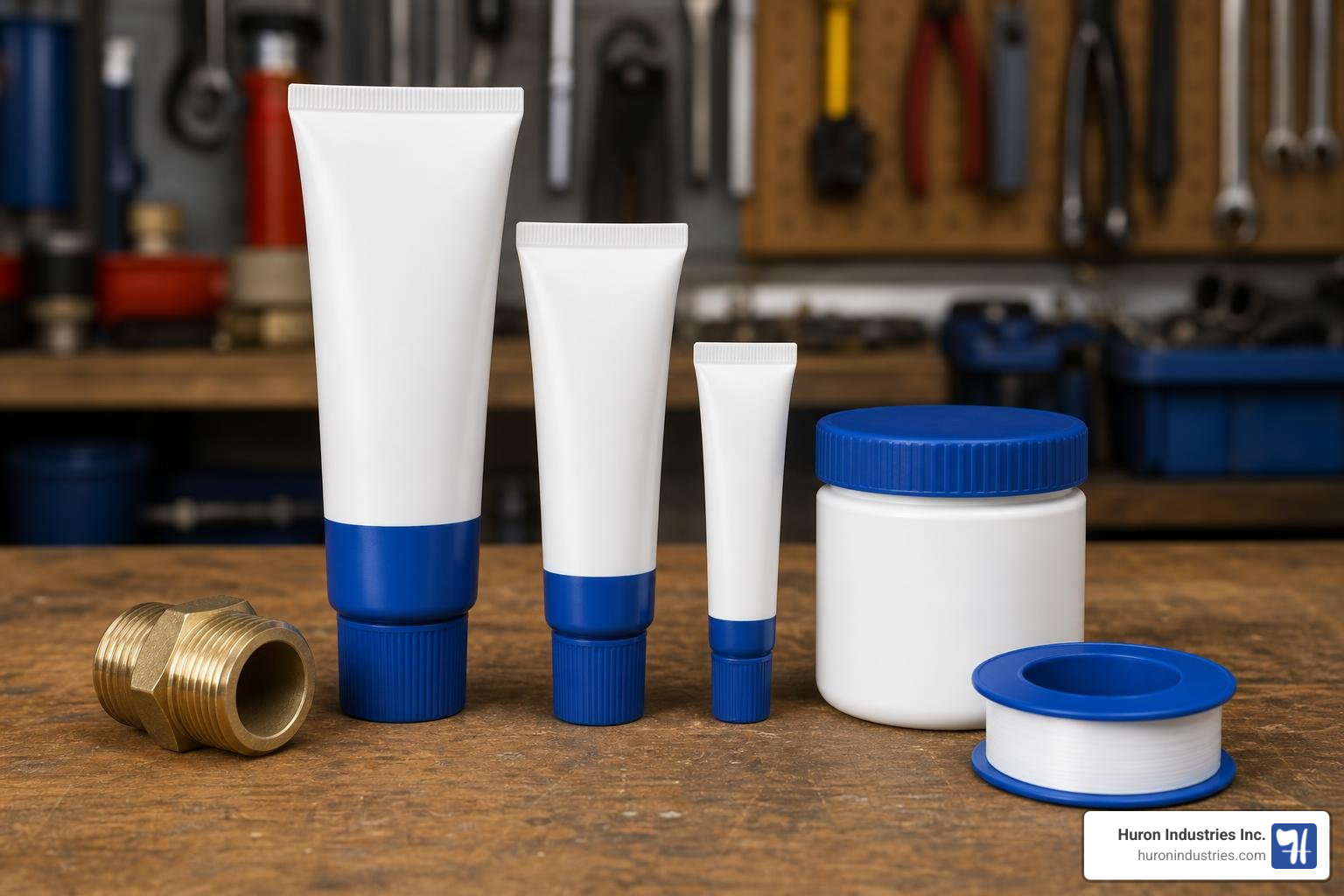
Formula 8 is available in several convenient sizes to suit different industrial needs:
- 15-Gram Tube: Perfect for field service kits, small maintenance jobs, or including as a value-add accessory in product shipments.
- 100-Gram Tube: The standard workhorse size. It features a specially designed, extended application tip that allows for easy, precise, one-handed application — even in tight, hard-to-reach spaces.
- 650-Gram Jar: Ideal for high-volume production lines or busy maintenance shops where technicians prefer to apply the paste with a brush.
Frequently Asked Questions About Formula 8
Can Formula 8 be used in wet or aqueous conditions?
No. As mentioned earlier, Formula 8 is formulated with a water-soluble carrier. If exposed to water, moisture, or aqueous solutions, the sealant will wash away.
For wet, damp, or underwater applications, you must use a waterproof alternative. If you are dealing with gas lines or specialized dry systems, you can learn more about matching sealants to your specific media in our guide on Gas Pipe Thread Sealant Neolube.
Does Formula 8 require any curing time before system startup?
None at all! Because Formula 8 does not rely on solvent evaporation or chemical cross-linking to seal, there is zero cure time. The moment you torque the joint together, the physical barrier is formed. You can immediately pressurize, test, and put your system back into service, saving valuable hours of maintenance downtime.
How does Formula 8 compare to high-purity nuclear-grade sealants?
While Formula 8 is an exceptional choice for general industrial, oxygen, and cryogenic systems, the nuclear power sector operates under a unique set of ultra-strict regulations. In nuclear reactor environments, halogenated compounds (like PTFE, which contains fluorine) are highly restricted due to the risk of stress-corrosion cracking on sensitive stainless steel components under intense radiation and heat.
For those critical nuclear applications, industry pros rely on high-purity, halogen-free, colloidal-graphite sealants. Our flagship product line, Neolube®, is specifically engineered to meet these demanding standards.
To learn why high-purity graphite is the trusted standard in nuclear systems, read our comprehensive overview on Why Nuclear and Industrial Pros Trust Neolube 100 Thread Sealant. You can also explore our full range of certified lubricants on our Neolube page or visit our online Shop to find the perfect match for your regulated application.
Conclusion
Choosing the right thread sealant is not just about stopping a minor drip; it is about ensuring the safety, efficiency, and longevity of your entire industrial operation. Whether you are managing cryogenic liquid lines, high-pressure oxygen systems, or complex hydraulic machinery, formula 8 thread sealant offers a reliable, thixotropic, non-clogging alternative to traditional PTFE tapes.
At Huron Industries Inc., we have been manufacturing and supplying certified, high-purity specialty lubricants, thread sealants, and anti-seize compounds since 1971. From our home base in Port Huron, Michigan, we pride ourselves on helping engineers, maintenance pros, and procurement officers solve their toughest sealing challenges.
If you are ready to upgrade your sealing program or need expert advice on matching the right compound to your critical service applications, explore our Pipe Thread Sealant solutions or reach out to our technical team today. We are here to help you stop the leak and feel the seal!