
Stop Stainless Steel Thread Galling Before It Starts
To prevent stainless steel thread galling, clean the threads, apply a thin and even coat of stainless steel thread lubricant, assemble slowly by hand, and use the torque value specified for lubricated fasteners. Do not use impact tools for final tightening. Stainless-on-stainless threads can generate heat and weld at tiny contact points before the joint is fully tight.
A suitable anti-seize or thread lubricant leaves a protective film between the mating surfaces. That film reduces friction, helps prevent corrosion-driven seizure, and makes future removal far less likely.
The coefficient of friction for Neolube No. 1.1 of 0.15 has not been tested or approved for this.
I am Nicholas Cunha, founder of CreatiVertical and a technical content specialist working with Huron Industries Inc. on industrial lubricants, sealants, and stainless steel thread lubricant applications. The four methods below focus on practical controls that help maintenance and engineering teams avoid seized stainless fasteners and costly rework.
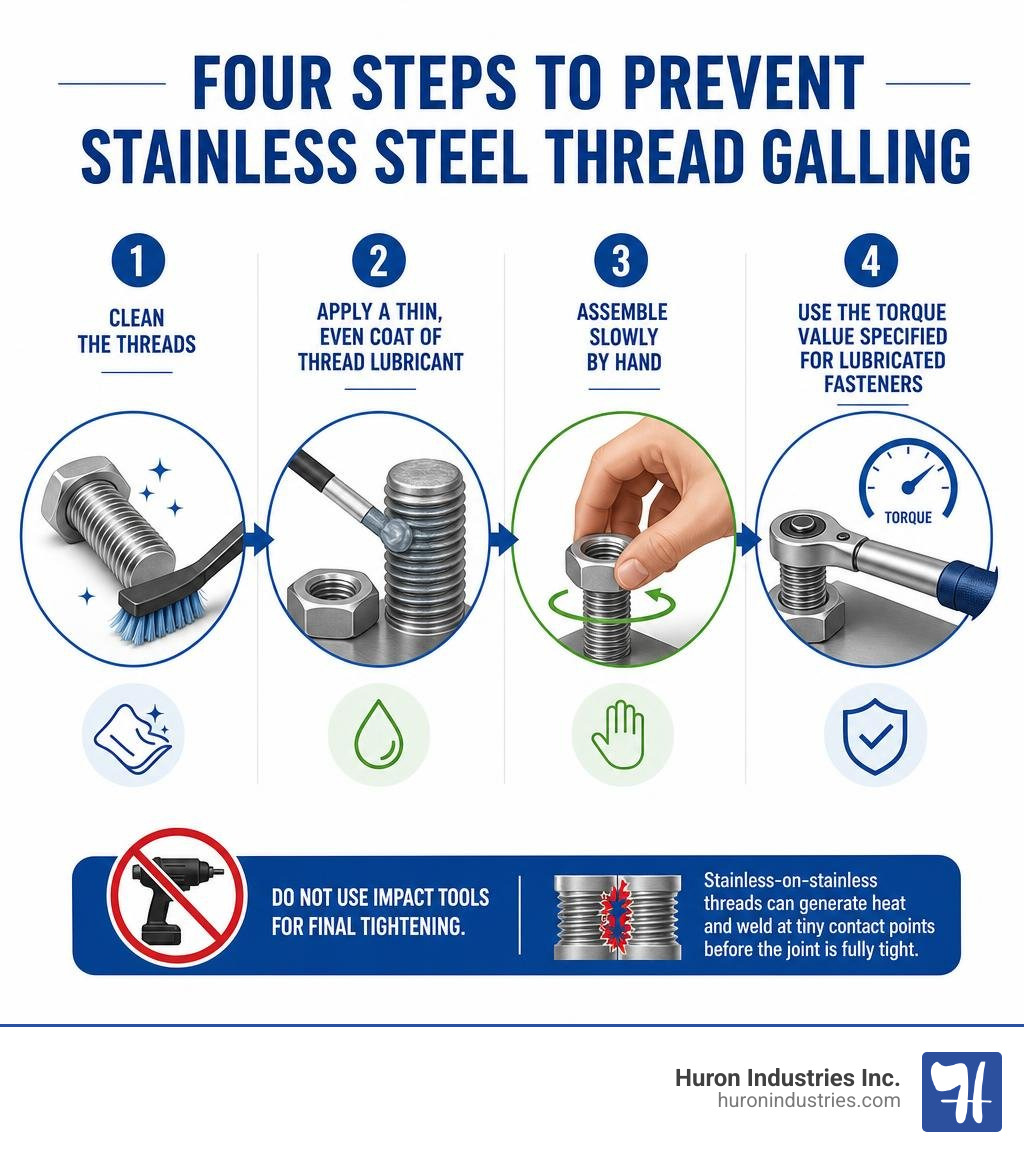
Stainless steel thread lubricant terms you need:
Understanding Thread Galling and Why Stainless Fasteners Seize
If you have ever threaded a 316 stainless nut onto a matching stud only to have it freeze solid halfway down, you know the sinking feeling of thread galling. It feels as if the metal has fused into a single block—and mechanically, that is almost exactly what happened. In the workshop, we often joke that thread galling is like two fasteners getting married without the option of divorce.
Stainless steel gets its corrosion resistance from a microscopically thin, self-healing passive oxide film made of chromium oxide. This protective barrier naturally shields the base metal from oxidation. However, under high contact stress and sliding friction, that microscopic oxide layer gets wiped away.
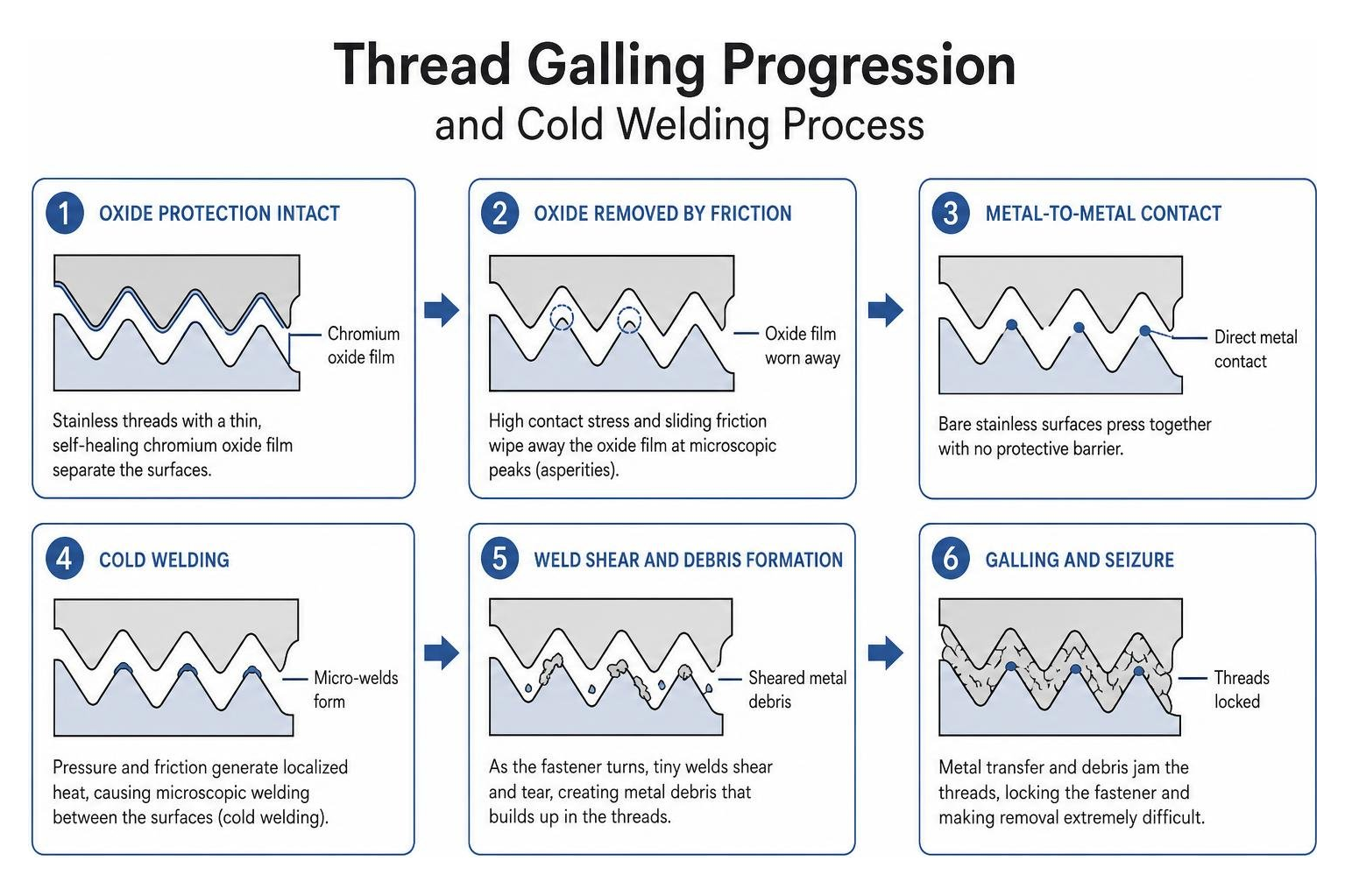
When two bare, unlubricated stainless steel surfaces press against each other under load, the microscopic peaks and valleys (asperities) on the mating threads touch. Without the oxide film to separate them, direct metal-to-metal contact generates intense localized frictional heat. This pressure and heat cause micro-welding—a phenomenon known as cold welding. As the fastener continues turning, these tiny welds tear, shear, and ball up into metal debris, jamming the threads permanently.
The risk multiplies when environmental factors come into play. In coastal, chemical, or high-humidity installations, moisture and dissolved salts can trigger galvanic corrosion or crevice corrosion if dissimilar metals or improper lubricants are introduced. Using a non-corrosive formula ensures the joint remains protected mechanically and chemically across years of service.
4 Practical Ways to Prevent Galling on Stainless Threads
Galling is entirely preventable once you control assembly speed, surface friction, metallurgical pairing, and clamping force. Here is a direct comparison of the four primary galling prevention methods:
| Method | Primary Mechanism | Best Suited For | Key Implementation Tip |
|---|---|---|---|
| 1. Speed Control | Eliminates frictional heat buildup | Manual assembly, structural bolts | Avoid high-RPM power tools; use manual wrenches |
| 2. Alloy Pairing | Differences in hardness prevent micro-welding | Critical joints, frequent disassembly | Pair 304 bolts with 316 nuts or Nitronic 60 |
| 3. Thread Lubrication | Provides physical boundary layer under load | All stainless threaded joints | Coat thread roots evenly with stable solids |
| 4. Torque Adjustment | Prevents over-tensioning and bolt yield | Flanged piping, high-pressure equipment | Lower tightening torque using correct K-factors |
Learning how to use anti-seize for threads without making a total mess keeps equipment clean and prevents over-application from contaminating sensitive downstream systems.
1. Slow Down Installation Speed and Avoid Impact Drivers
High rotational speed is the fastest route to a seized fastener. When an operator runs a stainless steel nut down a long stud using a pneumatic or cordless impact driver, the rapid RPMs generate rapid heat buildup along the thread crests. Because austenitic stainless steels (like 304 and 316) have lower thermal conductivity than standard carbon steels, that heat cannot dissipate quickly. It concentrates directly on the contact flanks.
To eliminate speed-induced seizing:
- Run nuts down slowly by hand or with low-RPM manual tools.
- Never use high-speed impact wrenches to drive stainless hardware into final seating.
- Maintain a smooth, steady turning cadence to keep friction temperatures well below the micro-welding threshold.
- Finish tightening with a calibrated manual torque wrench.
2. Pair Differing Alloy Grades and Hardness Levels
When identical metals with identical hardness levels rub together, their crystal lattices shear and fuse easily. If your design permits, pair fasteners made from differing stainless alloy grades or different hardness levels.
- Standard Stainless Pairing: Use a 304 (A2) stainless steel bolt paired with a 316 (A4) stainless steel nut. The slight variation in alloy composition and work-hardening rates reduces the likelihood of identical crystal shearing.
- Engineered Anti-Galling Alloys: For severe-service joints subject to frequent maintenance, specify specialized gall-resistant alloys such as Nitronic 60 or Nitronic 50 for either the male or female component. These alloys work-harden rapidly at the surface to resist micro-welding.
- Hardness Differential: Aim for a hardness differential of at least 30 to 50 Brinell between the mating threads whenever custom machining studs and tapped holes.
3. Apply the Right Stainless Steel Thread Lubricant Formulation
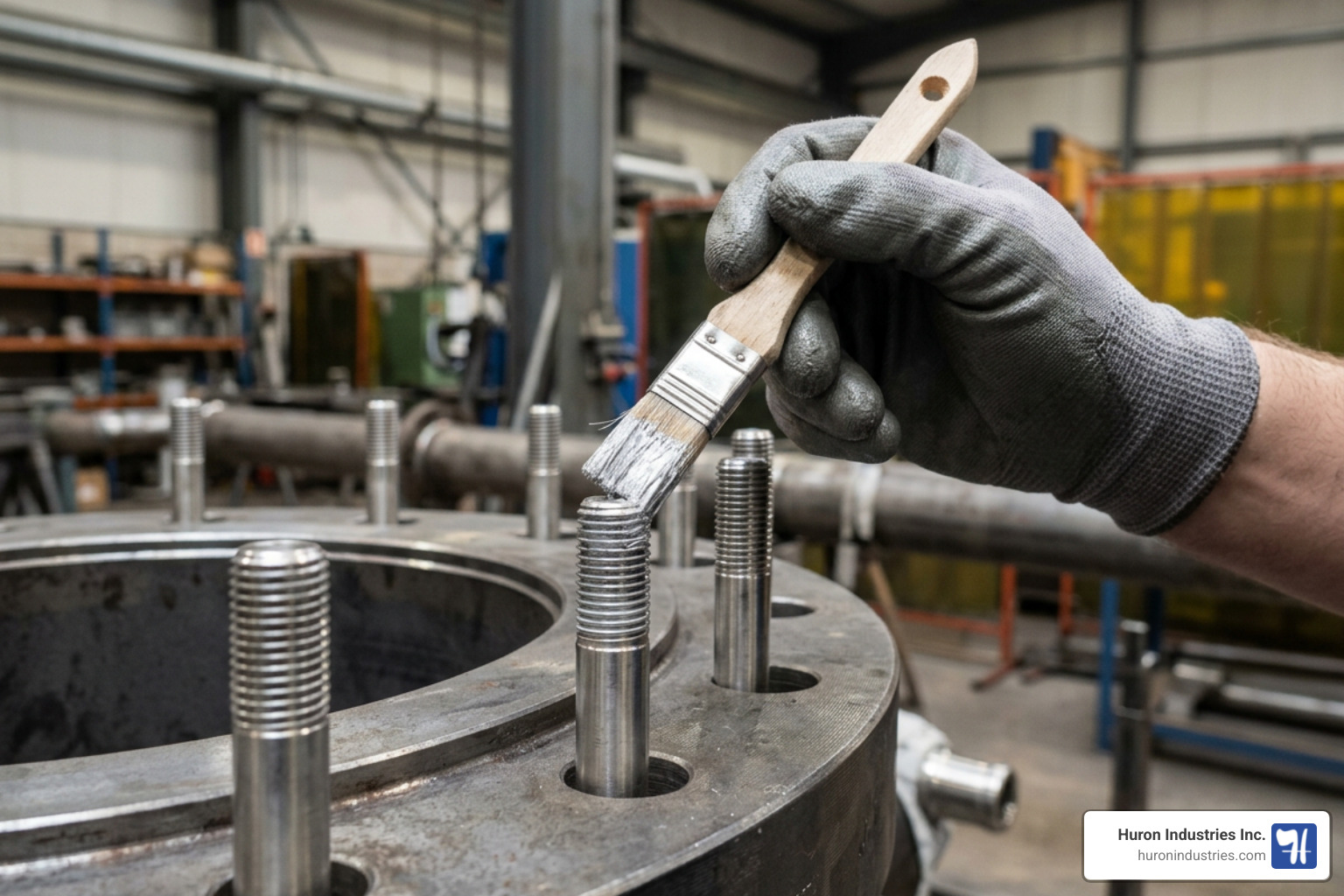
The most reliable, universally applicable defense against galling is placing a resilient physical barrier between the threads. Under extreme clamping pressures, liquid carrier oils can squeeze out of the thread roots. A dedicated anti-seize paste contains solid lubricating particles—such as high-purity graphite, nickel flake, or synthetic ceramics—that remain trapped between the asperities.
These solid particles provide boundary lubrication. As the nut turns, the solids shear smoothly along their internal planes, carrying the mechanical load and preventing raw metal-to-metal contact. This boundary film prevents the breakdown of the chromium oxide layer, allowing smooth tightening and effortless disassembly years later.
4. Adjust Tightening Torque Values and Calculate K-Factors
Applying a high-performance thread lubricant drastically reduces the coefficient of friction ($mu$). Because roughly 85% to 90% of the torque applied to a dry bolt goes solely toward overcoming friction under the bolt head and across the threads, lubricating a fastener dramatically changes the torque-tension relationship.
If you tighten a lubricated stainless bolt to the dry torque specification listed in a generic standard, you will generate excessive clamping tension. This can stretch the fastener past its yield point, strip the threads, or crush flange gaskets.
The relationship between torque, bolt diameter, and tension is governed by the torque formula:
$$T = K cdot D cdot F$$
- $T$ = Tightening torque (lb-in or N-m)
- $K$ = Nut factor / friction factor
- $D$ = Nominal bolt diameter (inches or meters)
- $F$ = Target bolt preload / clamp load (lbf or N)
A dry, unlubricated stainless steel fastener typically exhibits a high, erratic K-factor between 0.20 and 0.30. Once an anti-seize compound or thread lubricant is applied, that K-factor generally drops to between 0.13 and 0.17. You must reduce your target torque setting accordingly (often by 20% to 40% compared to dry specs) to achieve the exact target clamp load without over-stressing the joint.
Selecting the Best Stainless Steel Thread Lubricant for Your Environment
Choosing the correct compound requires matching the lubricant chemistry to your operating temperature, environmental exposure, and regulatory requirements.
Understanding how to choose the best anti-seize thread lubricant for any job ensures your assembly survives harsh operational stresses.
Nickel, Copper, and Ceramic Formulations Compared
- Nickel-Based Formulations: Nickel flake anti-seize is widely regarded as a primary choice for high-temperature stainless steel applications. It resists service temperatures up to 2600°F (1427°C) and contains no low-melting-point metals that could embrittle exotic alloys.
- Copper-Based Formulations: Copper anti-seize offers exceptional conductivity and protects up to 1800°F (982°C). However, in marine or offshore salt-spray settings, pairing copper with stainless steel can accelerate galvanic corrosion due to dissimilar metal potential.
- Synthetic Ceramic Formulations: Metal-free ceramic pastes provide clean, non-conductive protection up to 2800°F (1538°C). They eliminate all risk of galvanic reaction and are popular in braking systems and mixed-alloy assemblies.
When to Use a Metal-Free Stainless Steel Thread Lubricant
Metal-free formulations are essential when metal particles could contaminate a process or cause sensor failures:
- Food and Beverage Processing: Requires NSF H1 registered lubricants that are non-toxic, odorless, and safe for incidental food contact.
- Exhaust and Oxygen Sensors: Metallic pastes containing copper, zinc, or lead can poison catalytic coatings and zirconia oxygen sensor elements. Metal-free ceramic or pure synthetic pastes prevent galling without fouling electronics.
- High-Purity Manufacturing: Cleanroom and pharmaceutical pipe unions rely on metal-free PTFE or synthetic pastes to prevent airborne particulate contamination.
High-Purity Graphite and Regulated Industrial Solutions
In critical industries such as commercial nuclear power generation, naval propulsion, and aerospace, fasteners face intense radiation, high thermal stress, and strict chemical purity mandates. Standard industrial greases containing sulfur, lead, or halogens can induce intergranular stress corrosion cracking in sensitive austenitic stainless steels and nickel alloys.
For these environments, nuclear-grade colloidal graphite lubricants like Neolube are manufactured to meet stringent specifications like MIL-L-24131C. Knowing why sensitive metal pipes need low halogen and low sulfur sealants helps maintenance engineers safeguard high-value infrastructure from chemical degradation.
Frequently Asked Questions About Stainless Fastener Lubrication
How does thread lubricant affect torque values on stainless bolts?
Thread lubricants reduce friction across the thread flanks and beneath the bolt head. Because less torque is wasted fighting friction, more applied rotational force converts directly into tensile bolt stretch (clamp load). When using a lubricated fastener, you must lower your torque wrench setting using the lubricant's certified K-factor (typically 0.13 to 0.17) to prevent over-stretching the bolt or stripping the threads.
Can copper-based anti-seize cause corrosion on stainless steel?
In dry indoor environments, copper-based anti-seize performs reliably. However, when exposed to moisture, salt spray, or chemical electrolytes, copper particles can create a galvanic couple with stainless steel. This accelerates pitting and galvanic corrosion. For harsh marine, chemical, or high-purity environments, nickel-based, colloidal graphite, or metal-free ceramic lubricants are safer alternatives.
What is the correct way to apply anti-seize to threaded connections?
Clean all male and female threads with a degreaser and a wire brush to remove grit and old oils. Apply a smooth, even coating of anti-seize directly into the thread roots of the male fastener over the entire length that will engage the nut or tapped hole. Apply a light film under the bolt head or washer face to ensure consistent friction reduction during tightening. Avoid globbing excess paste beyond the engagement area.
Conclusion
Thread galling does not have to be an inevitable cost of working with stainless steel fasteners. By slowing down installation speeds, selecting compatible alloy pairings, adjusting torque calculations for friction reduction, and applying a certified thread lubricant, you can eliminate seized hardware and costly downtime for good.
At Huron Industries Inc., we have spent decades manufacturing high-purity graphite lubricants, thread sealants, and specialty anti-seize solutions engineered for demanding industrial, marine, and nuclear applications. For specialized piping and high-temperature joints, explore our guide on high temperature anti-seize vs thread sealant to select the right product for your next assembly.