
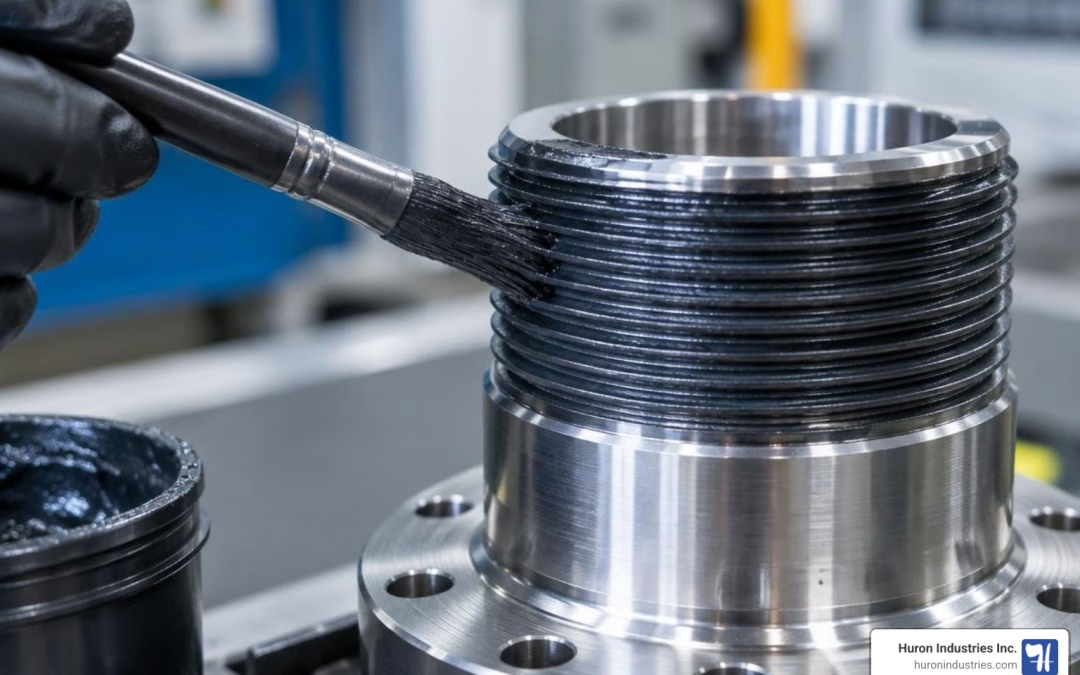
Choosing Colloidal Graphite for Nuclear Components
For limited-clearance nuclear components, choose the lubricant by its approved use, purity limits, temperature rating, and material compatibility. Neolube No. 1.1 is a MIL-L-24131C-qualified dry-film anti-seize and thread lubricant for nuclear plants, including close-fitting moving parts. It is rated to 400°F in continuous service and 850°F intermittently. If a close-tolerance pipe joint also needs a seal, Neolube No. 1260 is a thread-sealing paste rated to 1175°F and 2300 psi under GE D50YP12.
The important distinction is dry-film lubrication versus thread sealing. This guide explains how to check the standards and limits before choosing either one, with a focus on colloidal graphite for nuclear use.
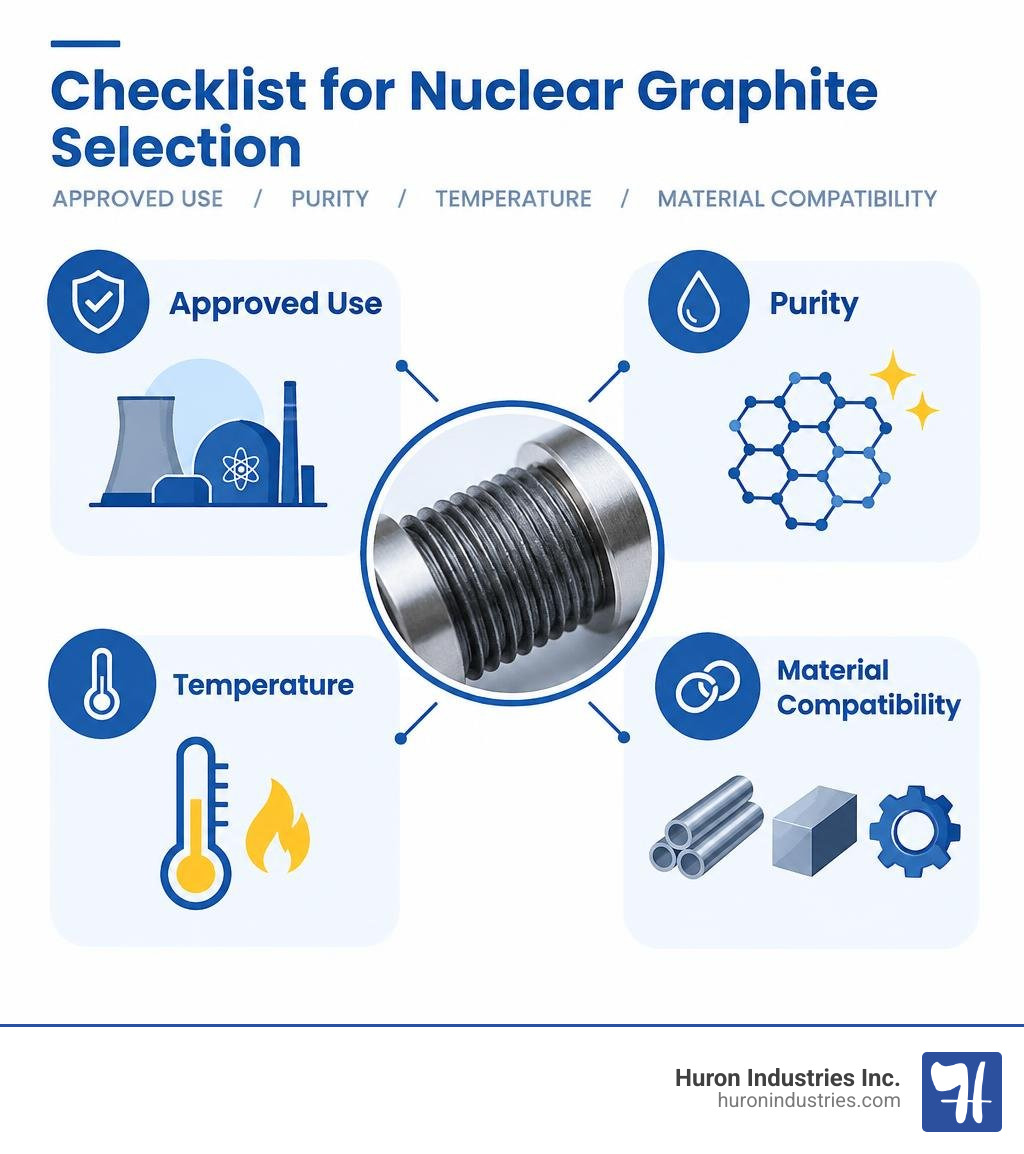
Quick colloidal graphite nuclear terms:
Fundamentals of Colloidal Graphite for Nuclear Reactor Environments
A colloidal dispersion consists of microscopic solid particles distributed evenly throughout a continuous liquid phase without settling out rapidly. In nuclear environments, this behavior is essential. Solid lubricants applied as coarse powders or heavy greases can clump, migrate, or clog narrow interfaces. Colloidal suspensions ensure that ultra-pure carbon structures reach deep into microscopic surface asperities.
According to established physical chemistry classifications documented in the IUPAC Compendium of Chemical Terminology, colloidal systems involve particles with dimensions roughly between 1 nanometer and 1 micrometer dispersed within a medium. In commercial dry-film products engineered for tight tolerances, maintaining precise sub-micron and fine particle sizing prevents interference with component clearances. For example, in Neolube No. 1.1, 90% of the graphite particles measure 4 microns or smaller, with a maximum particle size threshold of 10 microns.
Formulating Stable Colloidal Suspensions and Dispersions
Creating a stable colloidal graphite suspension requires balancing particle size reduction, surface chemistry, and carrier volatility. The manufacturing process relies on precision milling to produce uniform flakes of high-purity furnace graphite. These particles are dispersed into a volatile carrier liquid, typically high-purity isopropanol.
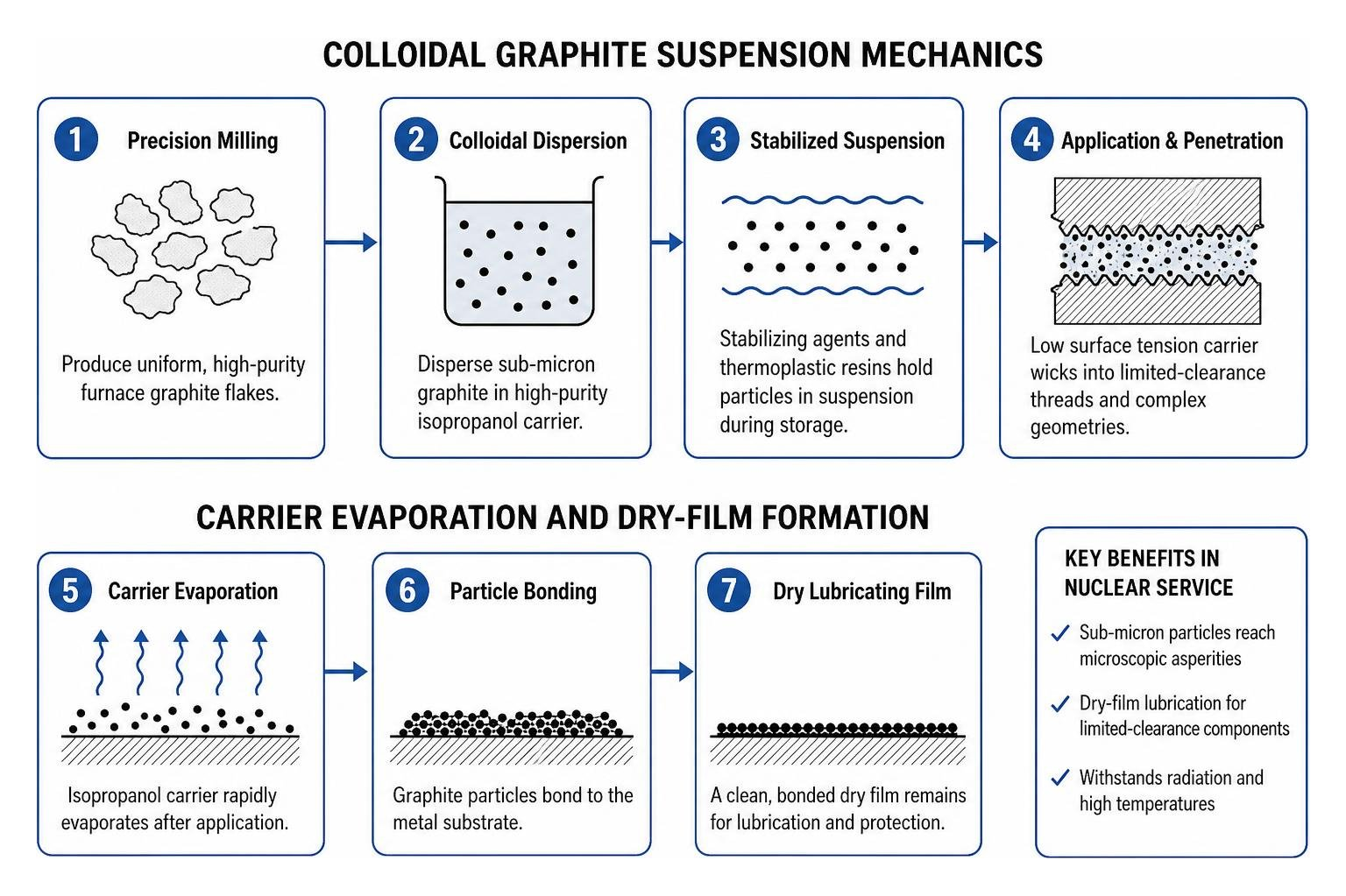
The carrier vehicle acts as a transport medium. Because isopropanol has low surface tension, it wicks into limited-clearance threaded connections and complex mechanical geometries. Once applied, the carrier rapidly evaporates, leaving behind a bonded dry lubricating film. Stabilizing agents and thermoplastic resins hold the graphite particles in suspension during storage and help them adhere cleanly to metal substrates upon drying.
Radiation Resistance and Thermal Stability Profiles
Nuclear reactor cores and primary containment systems present intense radiation fields that degrade organic oils, greases, and standard synthetic compounds. Conventional hydro-carbon lubricants cross-link, polymerize, and turn into abrasive sludge when subjected to ionizing radiation.
In contrast, high-purity graphite maintains its hexagonal crystal lattice structure under intense neutron bombardment and gamma radiation. Testing on Neolube No. 1260 at Oak Ridge National Laboratory demonstrated that the material withstood neutron fluences of 5.5 × 10^21 NVT at 1000°C and gamma radiation exposures of 1.5 × 10^9 rads (1.5 × 10^11 ergs per gram) with no apparent degradation. Similarly, Neolube No. 2 has demonstrated reliable performance in fields reaching 1 × 10^9 rads. Selecting a radiation-resistant thread sealant or dry lubricant ensures that component threads do not gall during maintenance outages. The extreme thermal stability of nuclear graphite prevents thermal breakdown under operating temperatures.
Performance Standards for Colloidal Graphite Nuclear Formulations
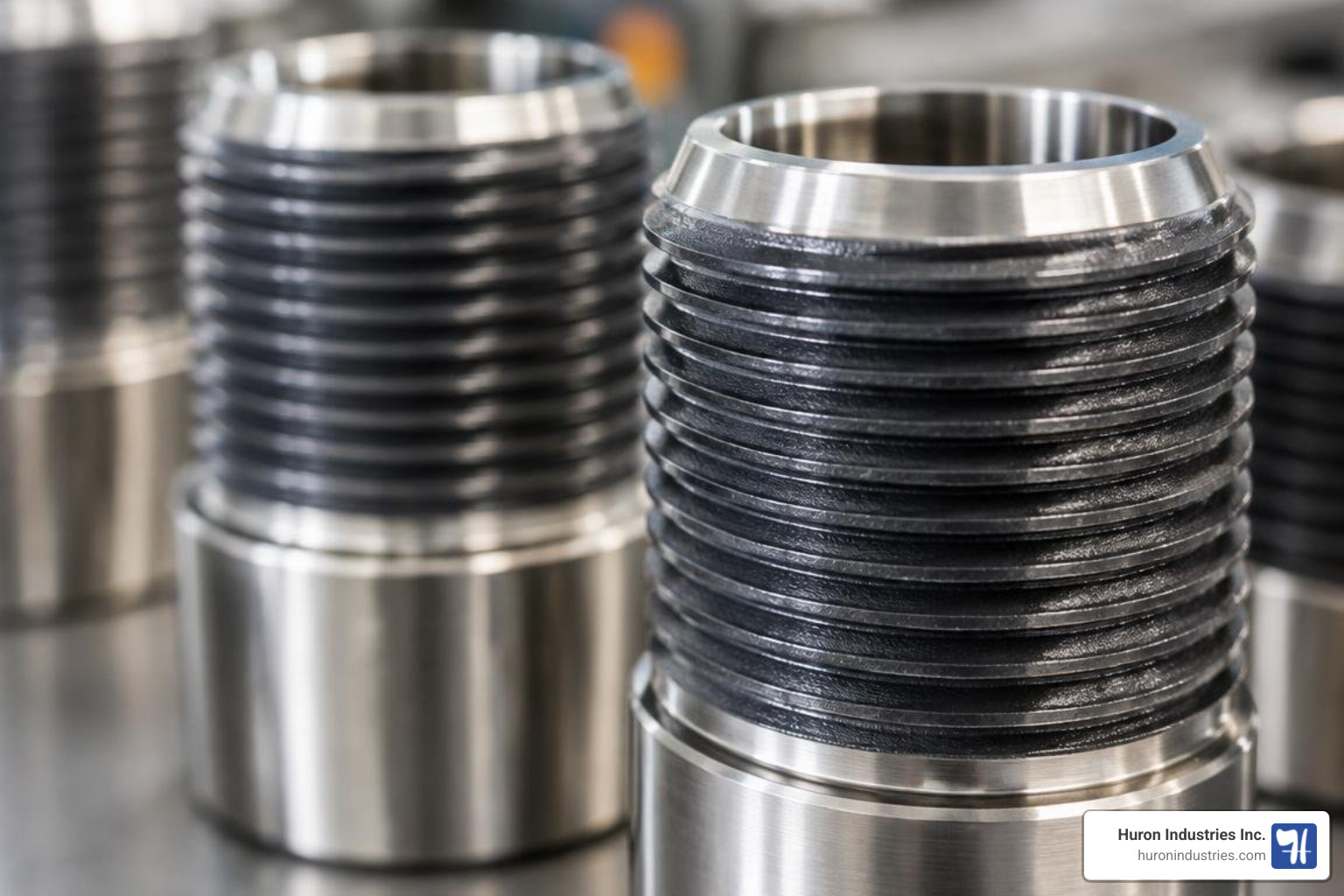
Nuclear-grade lubricants must comply with rigorous military and commercial specifications to ensure material integrity and process safety. The benchmark military standard is MIL-L-24131C, which governs high-purity colloidal graphite lubricants designed for naval nuclear propulsion units and commercial reactor facilities. Qualification under this standard requires documented adherence to strict chemical purity limits, non-corrosiveness, and consistent film adhesion.
For sealing and anti-seize paste applications in critical service, General Electric standard GE D50YP12 Rev 2 establishes requirements for non-metallic materials in nuclear power generation systems. Meeting these standards confirms that products provide dependable lubricity while protecting structural alloys.
| Product | Form / Carrier | Temperature Rating | Pressure Rating | Key Qualification / Primary Use |
|---|---|---|---|---|
| Neolube No. 1.1 | Dry-film liquid / Isopropanol | 400°F (204°C) continuous; 850°F (454°C) intermittent | Atmospheric dry film | MIL-L-24131C; reactor anti-seize and limited-clearance moving parts |
| Neolube No. 2 | Dry-film liquid / Isopropanol | 400°F (204°C) continuous; 850°F (454°C) intermittent | Atmospheric dry film | Electrically conductive coating, static bleed, buss bars; limited-clearance parts |
| Neolube No. 1260 | Anti-seize paste / Organic carrier | 1175°F (635°C) | 2300 psi (16 MPa) | GE D50YP12; close-tolerance pipe joint thread sealant in critical service |
| Neolube No. 100 | Liquid thread sealant | 300°F (149°C) | System pipe pressure | Pipe thread sealant for fossil, solar, and hydro plant piping |
| MoS2 in Isopropanol | Dry-film dispersion | Per MIL-L-24478 | Atmospheric dry film | MIL-L-24478; threaded, limited-clearance metal parts (not for 300-series/17-4 SS) |
Purity Thresholds for Colloidal Graphite Nuclear Applications
Strict impurity control prevents stress corrosion cracking, intergranular attack, and liquid metal embrittlement in reactor pressure boundaries. Halogens (fluorine, chlorine, bromine, iodine) and sulfur are aggressively restricted because they promote pitting and crack propagation in austenitic stainless steels and nickel-chromium alloys.
Neolube No. 1.1 maintains strict elemental thresholds:
- Total solids content: 3.3% ± 0.50% (with graphite accounting for 75% ± 5% of total solids)
- Ash content: maximum 0.75% of total solids
- Fluorine: maximum 20 ppm
- Chlorine: maximum 200 ppm
- Sulfur: maximum 200 ppm
- Lead: maximum 150 ppm
Neolube No. 1260 maintains a maximum halogen limit of 450 ppm (with typical production batches testing below 25 ppm) and a maximum embrittling metals threshold of 500 ppm (typically below 250 ppm). Verifying material traceability across the nuclear supply chain ensures that every delivered batch meets these strict chemical profiles.
Colloidal Graphite Films in Core Systems
When applied to metal components, colloidal graphite forms a smooth, non-migrating dry film that adheres directly to the substrate. Because the carrier fluid evaporates completely within minutes, there is no wet residue to attract airborne particulates, flake off into coolant streams, or foul filtration systems.
Regarding friction values, it is important to note that the coefficient of friction for Neolube No. 1.1 of 0.15 has not been tested or approved for this specific design parameter. Engineers should qualify torque-tension relationships based on validated plant procedures rather than uncertified coefficient assumptions.
Application Strategies for Reactor Components and Instrumentation
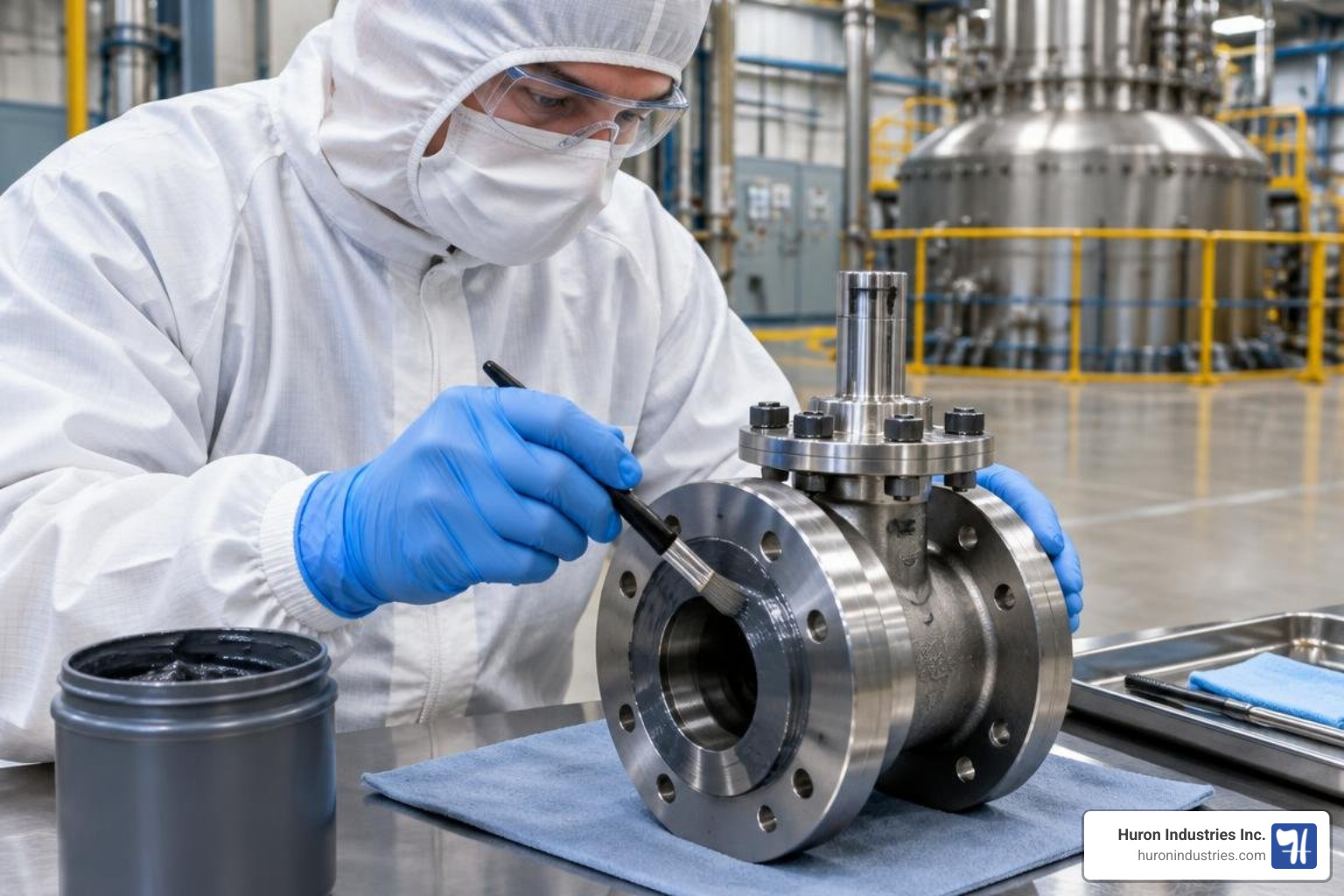
Applying lubricants within reactor systems requires clear alignment with component tolerances and operating parameters. For comprehensive plant maintenance, following established nuclear reactor lubrication guidelines ensures that technicians do not apply excessive product or introduce incompatible chemistries into critical assemblies.
Selecting Colloidal Graphite Nuclear Lubricants for Close-Tolerance Parts
Limited-clearance mechanisms—such as control rod drive mechanism (CRDM) lead screws, precision valve stems, instrument guide tubes, and internal threaded fasteners—cannot tolerate thick paste buildups. For these parts, an ultra-thin dry film provides effective anti-seize protection without altering component clearances.
Neolube No. 1.1 provides non-corrosive dry-film lubrication that prevents metal-to-metal galling during assembly and subsequent teardown. For applications requiring electrical conductivity alongside lubrication, Neolube No. 2 provides a conductive dry film suited for electrical switch contacts, buss bars, static bleed paths, and limited-clearance moving parts (as well as brief use during engine assembly and break-in).
Technicians must also observe alloy-specific material restrictions. While MoS2 in isopropanol formulated to MIL-L-24478 provides dry-film lubrication for many limited-clearance threaded metal parts, it must not be used on 300-series or 17-4 PH stainless steels due to sulfur-driven corrosion risks under high operating temperatures. In those instances, an isopropanol-based colloidal graphite dry film remains the industry standard. Reviewing the Neolube dry-film technical guide provides detailed application instructions.
High-Temperature Pipe Sealing and Anti-Seize Paste Deployment
Threaded pipe connections in secondary coolant loops and high-temperature auxiliary systems require sealing as well as anti-seize properties. Neolube No. 1260 is specifically engineered as a thread sealant and anti-seize paste for close-tolerance pipe joints in critical service. It withstands pressures up to 2300 psi (16 MPa) and continuous temperatures up to 1175°F (635°C).
During initial heat-up, the organic carrier in Neolube No. 1260 begins to volatilize at 255°F, experiencing roughly 6% weight loss at 390°F. The remaining high-purity graphite (minimum 99.5% carbon content) remains fully intact within the thread roots, maintaining joint seal integrity and preventing galling. Neolube No. 1260 is incompatible with EPDM, Silicone, and Neoprene elastomers; compatible gasket materials include Nitrile and Viton. For non-nuclear industrial piping (such as fossil, solar, and hydro plant systems), Neolube No. 100 provides dependable thread sealing up to 300°F.
Nuclear Instrumentation and Thin Target Film Preparation
Beyond mechanical lubrication and pipe sealing, colloidal graphite plays a foundational role in radiometric analysis and radiation detection instrumentation. Since the 1960s, nuclear research facilities have used high-purity graphite dispersions to prepare thin supporting films for alpha and beta radiometric targets.
As detailed in classic nuclear research program documentation, graphite's low atomic number (low-Z) minimizes particle scattering and self-absorption during alpha calibration and beta counting. Using electro-spraying or precision dip techniques, researchers apply ultra-thin, uniform colloidal graphite backings that provide both structural support and electrical grounding without attenuating emitted radiation.
Handling, Compliance, and International Trade Classifications
Safe handling of colloidal graphite formulations involves basic industrial hygiene and solvent safety protocols. Because products like Neolube No. 1.1 utilize an isopropanol carrier, the liquid has a flash point of 52°F (11°C). Technicians should apply the product in well-ventilated areas away from open ignition sources, using appropriate eye protection and nitrile gloves.
Once applied to clean, degreased substrates via brush, spray, or dipping, the film air-dries within approximately five minutes at ambient temperatures. Detailed safety instructions are available across the safety technical datasheets. For secondary containment facilities managing non-radiological plant maintenance, granular sorbents like NEOSafe encapsulate oil, fuel, and hydraulic fluid spills cleanly: scoop a perimeter to contain the spill, pour bulk powder over the pool, allow it to encapsulate the liquid without dripping, and sweep the residue into a disposal bucket (NEOSafe Max is NSF-certified for food processing and cold-chain facilities).
Global Export and Tariff Classification under HS 3801.20
International shipment of colloidal graphite products requires proper Harmonized System (HS) classification. Under Chapter 38 of the World Customs Organization tariff schedule, colloidal and semi-colloidal carbon products are governed by specific subheadings:
- HS 3801.10: Artificial graphite (bulk powders, blocks, plates)
- HS 3801.20: Colloidal or semi-colloidal graphite
- HS 3801.30: Carbonaceous pastes for electrodes and furnace linings
- HS 3801.90: Other preparations based on graphite or other carbon
Aqueous and solvent-based suspensions of colloidal graphite fall under subheading 3801.20. For customs compliance, documentation must clearly distinguish liquid colloidal suspensions from dry artificial graphite powders to ensure accurate tariff treatment.
Operational Limitations and Material Incompatibilities
While colloidal graphite is versatile, plant engineers must respect its operational boundaries:
- Temperature Ceilings: Neolube No. 1.1 and No. 2 are rated for 400°F (204°C) continuous service and up to 850°F (454°C) intermittent exposure. They should not be used in primary containment zones exceeding 400°F continuous temperatures.
- Oxygen Systems: Colloidal graphite lubricants must never be introduced into pure oxygen or enriched oxygen systems due to ignition risks.
- Elastomer Incompatibilities: Paste carriers in products like Neolube No. 1260 degrade EPDM, Neoprene, and Silicone rubbers; use only Viton or Nitrile sealing elements.
Frequently Asked Questions about Nuclear Colloidal Graphite
What advantages do colloidal graphite dry films offer in radiation fields?
High-purity colloidal graphite dry films do not cross-link, sludge, or decompose when exposed to heavy gamma and neutron irradiation. Unlike wet greases that migrate and capture debris, the dry film forms a clean, bonded microscopic layer that stays positioned on limited-clearance threads and moving parts.
How do impurity limits prevent reactor component embrittlement?
Strict limits on halogens (fluorine, chlorine), sulfur, lead, and low-melting-point metals prevent chemical reactions that cause stress corrosion cracking and intergranular embrittlement in stainless steel and nickel-alloy components under high temperature and stress.
What is the distinction between MIL-L-24131C and commercial graphite lubricants?
MIL-L-24131C requires verified high-purity furnace graphite, strict particle size distribution (90% under 4 microns), low ash content, and trace-element certification. Standard commercial graphite lubricants often contain uncontrolled mineral fillers, larger particle sizes, and halogen levels that exceed nuclear safety thresholds.
Conclusion
Selecting the correct anti-seize and lubricating compound for limited-clearance nuclear components requires strict adherence to technical datasheets, certified purity standards, and temperature thresholds. Whether deploying Neolube No. 1.1 for dry-film anti-seize protection, Neolube No. 2 for conductive assemblies, or Neolube No. 1260 for high-temperature pipe sealing, Huron Industries Inc. provides fully traceable, certified formulations engineered for critical service. Beyond nuclear and industrial maintenance, Huron also supplies specialized solutions such as CaseLube precision reloading lubricant for high-tolerance case sizing. Matching the approved product specification to your operational environment ensures plant safety, component longevity, and regulatory compliance.