
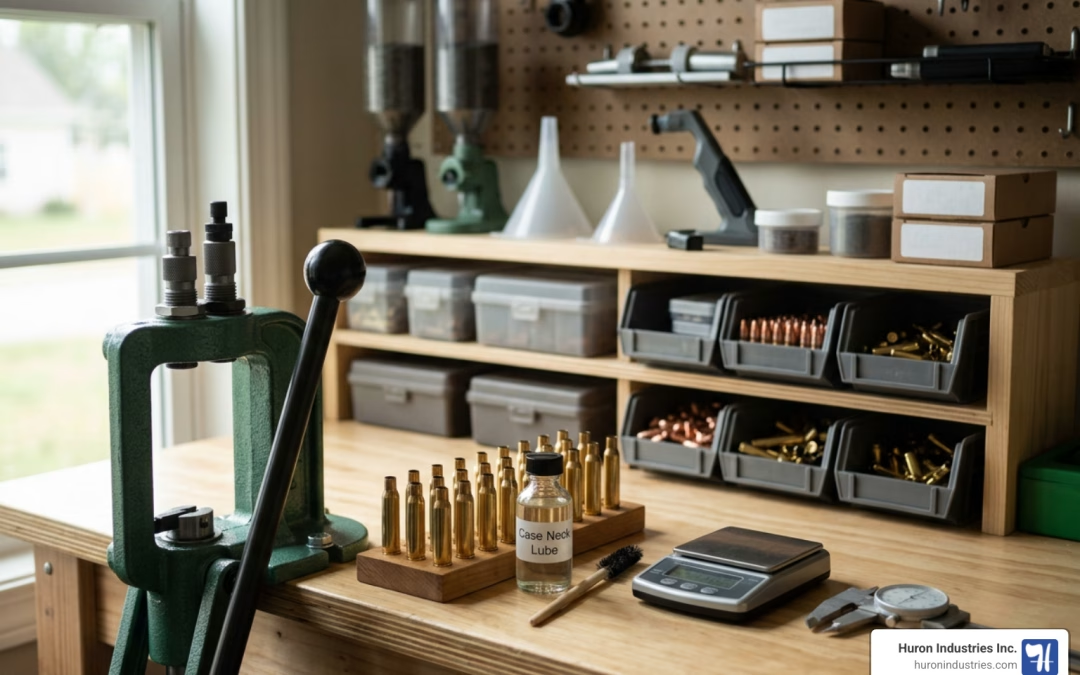
Is Colloidal Graphite CaseLube Right for Your Reloading Bench?
For case-neck sizing and bullet seating, colloidal graphite CaseLube is worth considering if you want a thin, dry lubricant inside the neck. Its isopropanol carrier evaporates, leaving a graphite film that reduces friction. Apply a light, even coat and let it dry before sizing or seating.
CaseLube has the same formulation as Neolube No. 2, but costs less because it is not lot-controlled. That makes it a practical choice for reloaders seeking a dry-film case-neck lubricant.
This guide to colloidal graphite CaseLube draws on Huron Industries' technical documentation and product specifications to make specialty lubricant details easier to understand.
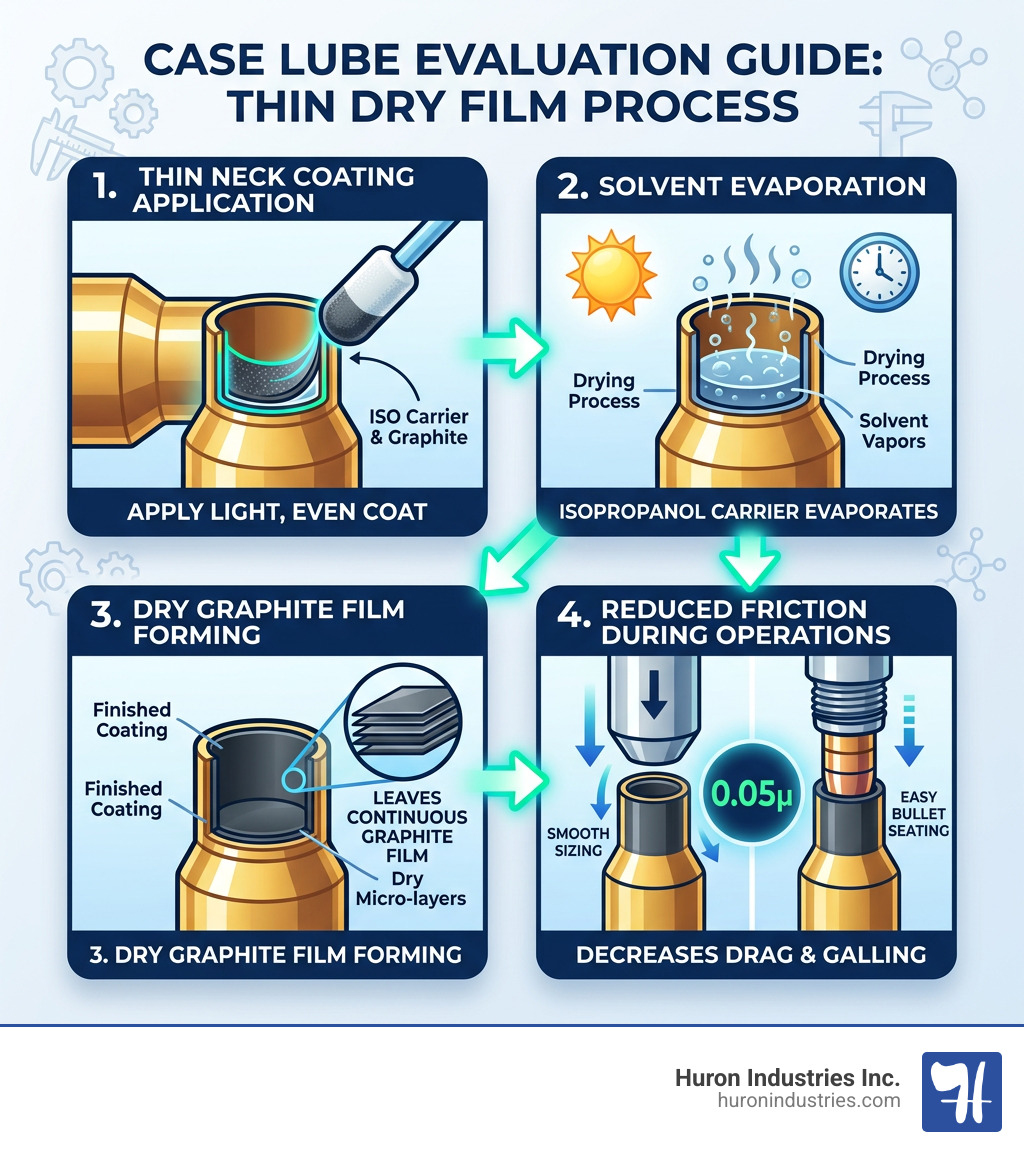
Simple guide to colloidal graphite CaseLube terms:
Understanding Colloidal Graphite CaseLube and Its Chemistry
When you work at a reloading bench, friction is your constant sparring partner. Every time an expander ball drags through a bottleneck cartridge or a bullet seats into tight brass, microscopic surface roughness creates resistance. A thin, dry film can reduce that resistance without leaving a wet residue inside the neck.
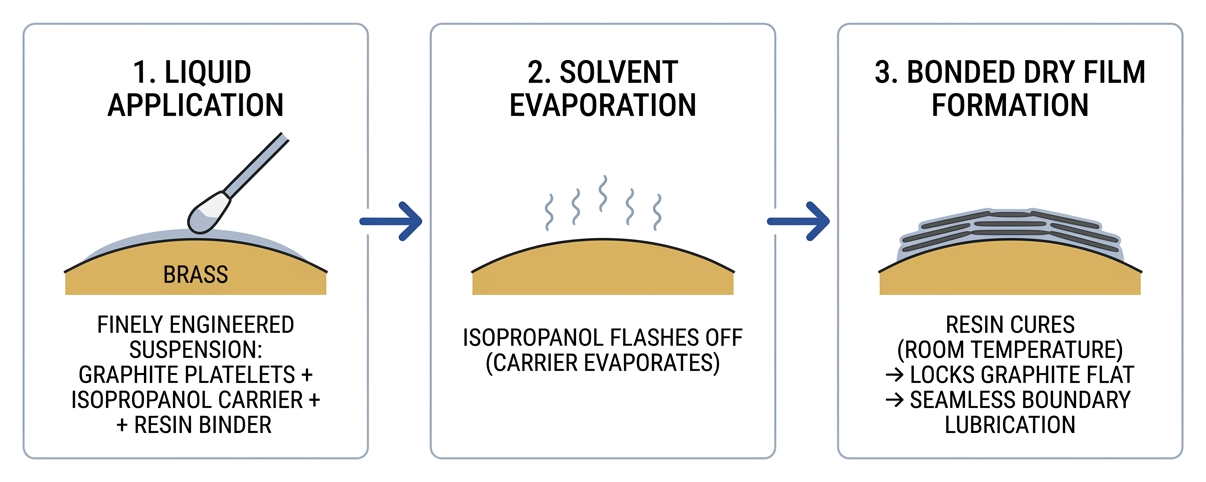
This is where understanding solid lubricant properties transforms your reloading workflow. Colloidal graphite is not just ground-up pencil lead mixed with alcohol; it is a finely engineered suspension of high-purity crystalline carbon platelets held in an isopropanol carrier alongside a specialized thermoplastic resin binder.
In liquid form, the carrier allows you to apply an ultra-thin layer across internal neck surfaces. As the alcohol evaporates, the thermoplastic resin cures at room temperature, locking the graphite platelets flat against the brass substrate. The resulting dry film shears easily between mechanical contact points, providing seamless boundary lubrication without a drop of wet residue.
What Makes CaseLube's Colloidal Graphite Unique?
Particle size dictates whether a dry film acts as a smooth lubricant or an abrasive paste. If graphite flakes are too coarse, they cluster unevenly, causing erratic seating depth and variable neck tension.
CaseLube relies on tight particle dimensioning. You can explore the physics behind 5-micron graphite to see why scale matters so much in tight-tolerance mechanical systems. CaseLube’s graphite distribution ensures:
- 90% of all particles measure 4 microns or smaller in their maximum dimension.
- Absolute ceiling: No particle in the suspension exceeds 10 microns.
- Solids balance: Total solids content is calibrated to 3.3% (± 0.50%), with graphite making up 75% (± 5%) of those solids.
This balance delivers a dry coating that holds up across a broad thermal range. The cured dry film maintains a continuous service temperature rating of 400°F (204°C) and handles intermittent thermal spikes up to 850°F (454°C). Because it is sold specifically for handloaders without the costly overhead of military lot-testing certifications, you get high-end dry film performance at an affordable price.
The Formulation Link Between CaseLube and Neolube No. 2
For decades, handloaders searching for clean neck lubricants looked to specialty supply houses for Neolube No. 2. As detailed in the technical notes on Neolube 2, it is known for high purity and stability in commercial and naval nuclear applications.
CaseLube and Neolube No. 2 share the exact same underlying chemical formulation: pure colloidal graphite dispersed in isopropanol with a thermoplastic resin binder.
The differences come down strictly to regulatory packaging and end-use customization:
- Quality control pathways: Neolube No. 2 is batch-tracked and lot-certified for regulated industrial and commercial environments. CaseLube skips formal lot-control paperwork, drastically lowering production overhead.
- Packaging: CaseLube ships in simple open-top bottles in 2 oz and 8 oz sizes.
CaseLube for Dry Neck Lubrication
Choosing a case-neck lubricant requires controlled application and a clean, dry interior surface. A bonded dry film is designed to remain in place after the carrier evaporates.
| Stage / Parameter | CaseLube Process | Key Characteristic | Operational Benefit |
|---|---|---|---|
| Application | Apply inside case neck | Ultra-thin liquid dispersion | Controlled coverage without pooling at shoulder |
| Film Formation | Isopropanol carrier flashes off | Rapid room-temperature air dry (~5 min) | Fast turnaround on the loading block |
| Cured State | Bonded colloidal graphite dry film | Chemically inert carbon layer | Zero migration; safe for powder and primers |
| Die & Seating Use | Expander sizing & bullet seating | Resilient boundary lubrication | Consistent bullet release and reduced neck runout |
Evaluating Colloidal Graphite CaseLube for Consistent Sizing
When brass enters a full-length sizing die, the carbide or steel expander ball drags through the inside of the neck on the downstroke. If the neck interior is unlubricated, that expander ball pulls on the brass, stretching the case shoulder and introducing neck runout.
Applying CaseLube produces smooth expander passes that prevent brass galling. By establishing an even interface, it helps in reducing case neck friction and extreme spread, leading to more consistent bullet release pressures across a 50-round string of fire. The dry film will not migrate or deteriorate during extended ammunition storage, keeping bullet pull weights uniform whether you shoot your handloads tomorrow or next season.
Managing Residue and Powder Contamination Risks
A common fear among new reloaders is that introducing graphite into a cartridge case will contaminate the powder charge or deaden primer ignition.
With CaseLube, the isopropanol carrier evaporates within minutes. The remaining graphite is chemically inert, non-corrosive, and firmly bonded to the brass by its resin matrix. It remains bonded to the interior neck surface after the carrier evaporates.
Step-by-Step Guide: How to Apply CaseLube for Precision Reloading
Achieving uniform lubrication requires good technique. You want an ultra-thin layer that covers the bearing surface of the neck without pooling at the shoulder junction.
- Prep and Clean Your Brass: Start with clean, deprimed cartridge cases. Ensure the interior neck walls are free of heavy carbon build-up or debris.
- Agitate the Bottle: Colloidal graphite settles over time. Shake the CaseLube container vigorously for 20 to 30 seconds until the suspended solids are fully dispersed.
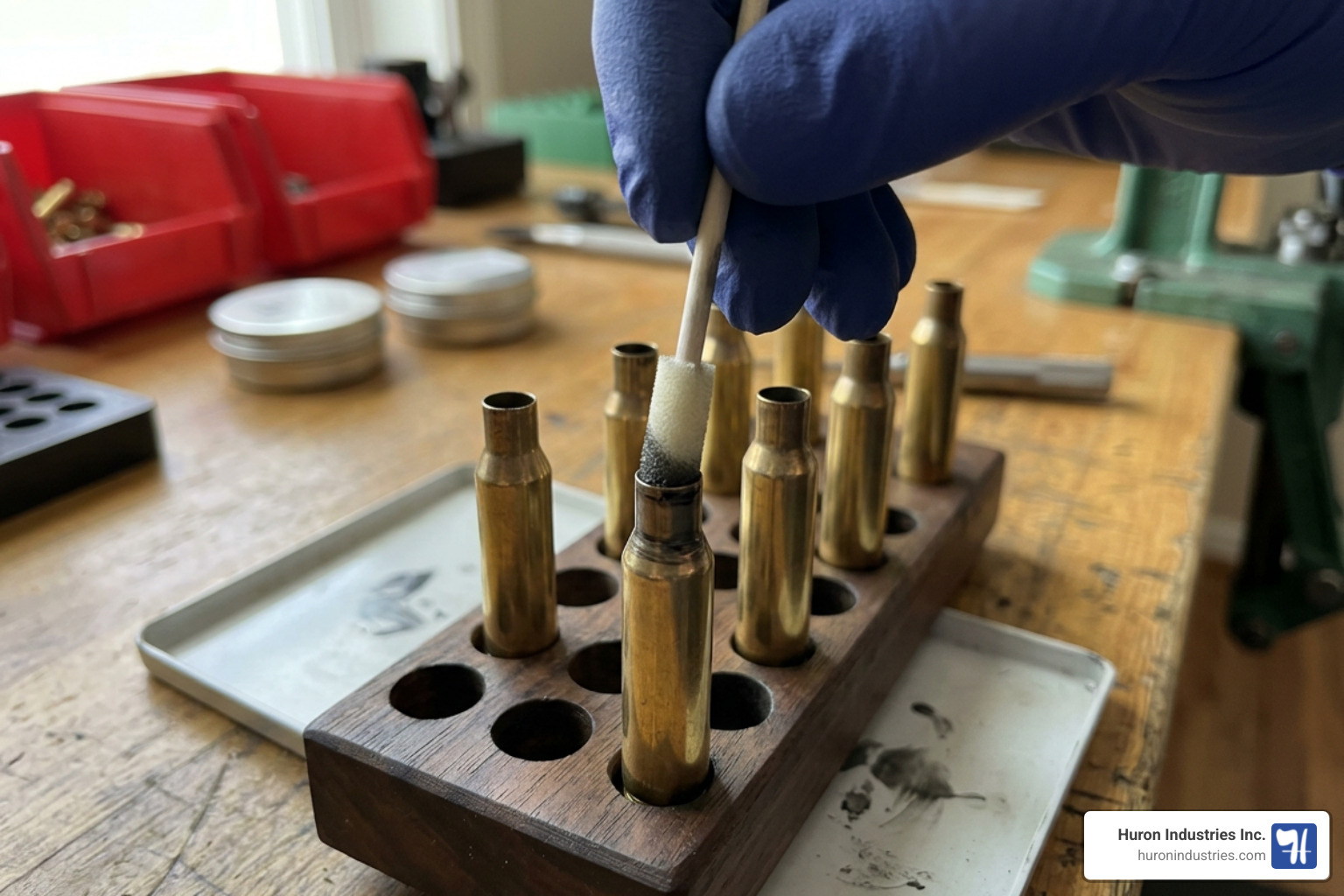
- Charge the Applicator: Apply a small amount of liquid to a suitable clean applicator. Use only enough to create a light, even coat inside the neck. Learn more about the exact technique in this guide on applying liquid graphite to case necks.
- Coat the Interior Neck: Insert the applicator into the case mouth, rotating it 360 degrees against the interior wall. A single swift pass deposits an even layer from the mouth down to the neck-shoulder junction.
- Allow Solvent Flash-Off: Stand the cases upright in a loading block for approximately 5 minutes. The glossy wet appearance will turn into a smooth, matte-charcoal dry finish.
- Size or Seat: Run the brass through your sizing die or proceed directly to bullet seating on pre-sized brass.
Safe Handling and Flammability Precautions
Because CaseLube uses pure isopropanol as its liquid carrier, respect the basic chemistry when working at your bench.
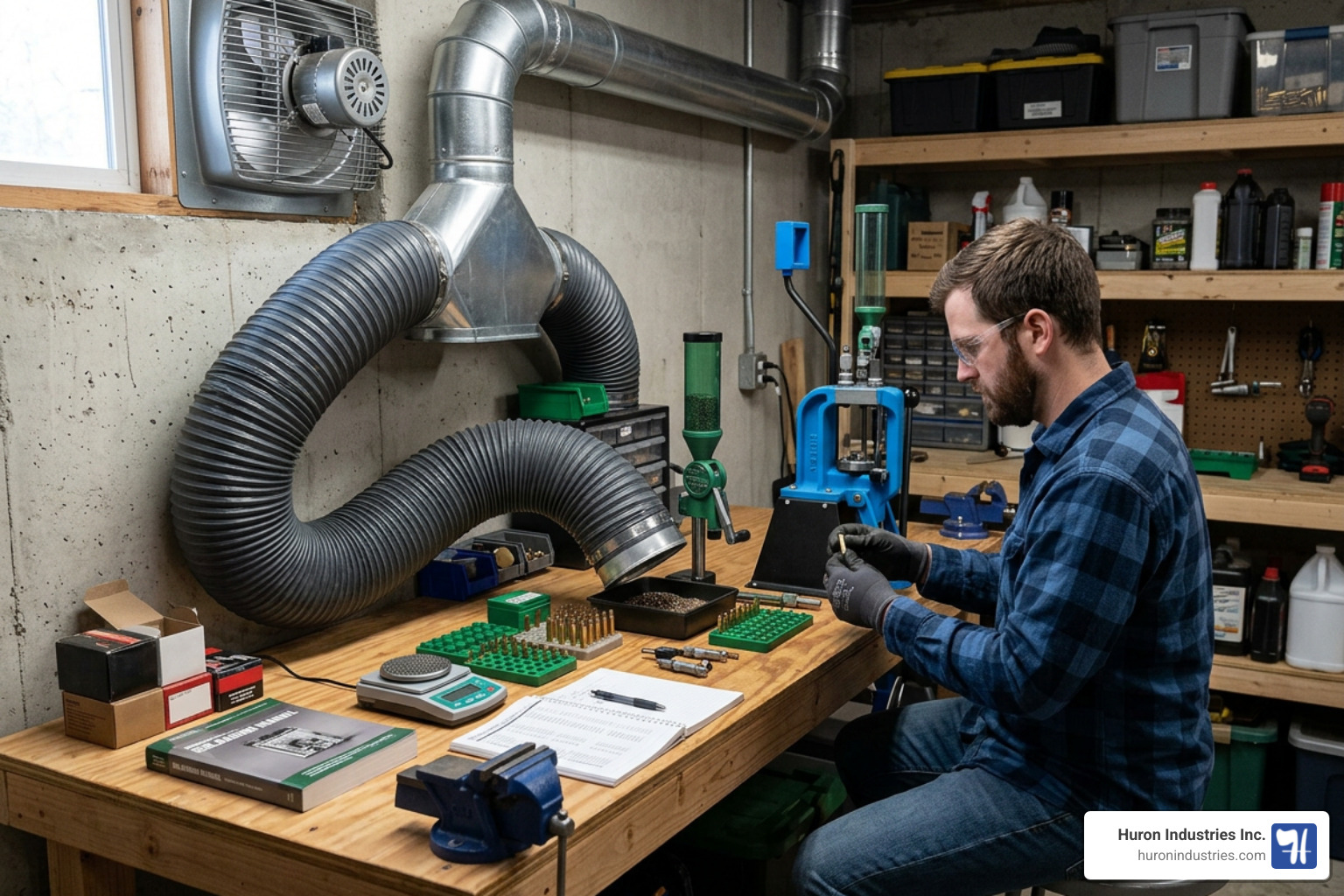
The carrier has a flash point of 52°F (11°C), making the liquid highly flammable. Follow these practices for handling CaseLube safely:
- Ventilation: Work in an area with good airflow to allow alcohol vapors to dissipate quickly.
- Ignition Sources: Keep open flames, space heaters, and soldering irons away from your lube station.
- PPE: Wear nitrile gloves and basic eye protection to prevent skin drying or accidental splashes.
- Storage: Tightly close the bottle immediately after use to prevent solvent evaporation and product thickening.
Use CaseLube Only for Case-Neck Lubrication
For broader background on industrial colloidal graphite coatings, see Huron's technical resource. CaseLube is intended for case-neck lubrication in precision reloading. Apply it as a thin coating inside clean, dry case necks, then allow the isopropanol carrier to evaporate before sizing or bullet seating.
Because graphite conducts electricity, keep CaseLube away from electrical contacts, insulated gaps, and surfaces where an unintended conductive path could cause a short.
Frequently Asked Questions About Colloidal Graphite Lubricants
Will dry graphite contaminate powder or primers inside the cartridge?
No. Once the isopropanol carrier has completely evaporated (about 5 minutes), the graphite is fixed to the brass by its thermoplastic resin binder. It forms an inert, bonded solid film that will not migrate into primer flash holes or interact chemically with modern smokeless propellants.
How long does CaseLube take to dry before sizing or seating bullets?
Under normal ambient bench conditions (70°F / 21°C and moderate humidity), CaseLube dries in roughly 5 minutes. You will see the wet, glossy black sheen transform into an even, matte-charcoal film. Once it turns matte, the solvent has flashed off, and your brass is ready for sizing or bullet seating.
Where should CaseLube be used?
CaseLube is intended for case-neck lubrication in precision reloading. Apply it to clean, dry interior case necks, then allow the carrier to evaporate before sizing or bullet seating.
Conclusion
Huron Industries Inc. has manufactured high-purity graphite lubricants in Port Huron, MI since 1971. Huron's flagship Neolube No. 1.1 is qualified to MIL-L-24131C and continues to serve critical naval and commercial nuclear power facilities, while Neolube No. 2 shares the same dry-film graphite chemistry for industrial and commercial nuclear applications without mil-spec certification. CaseLube brings that same colloidal chemistry straight to your reloading press.
A thin, bonded dry film can reduce neck expander drag, support consistent bullet seating depths, and keep the case neck free of wet residue.
Ready to streamline your brass preparation? Choose the size that fits your reloading volume:
- 2 oz CaseLube bottle — Ideal for trying out the dry-film method or running precision batch loads ($29.99).
- 8 oz CaseLube bottle — Best for high-volume competition and hunting cartridge preparation ($99.99).
Explore full technical specifications and ordering details directly on the official CaseLube product page.