
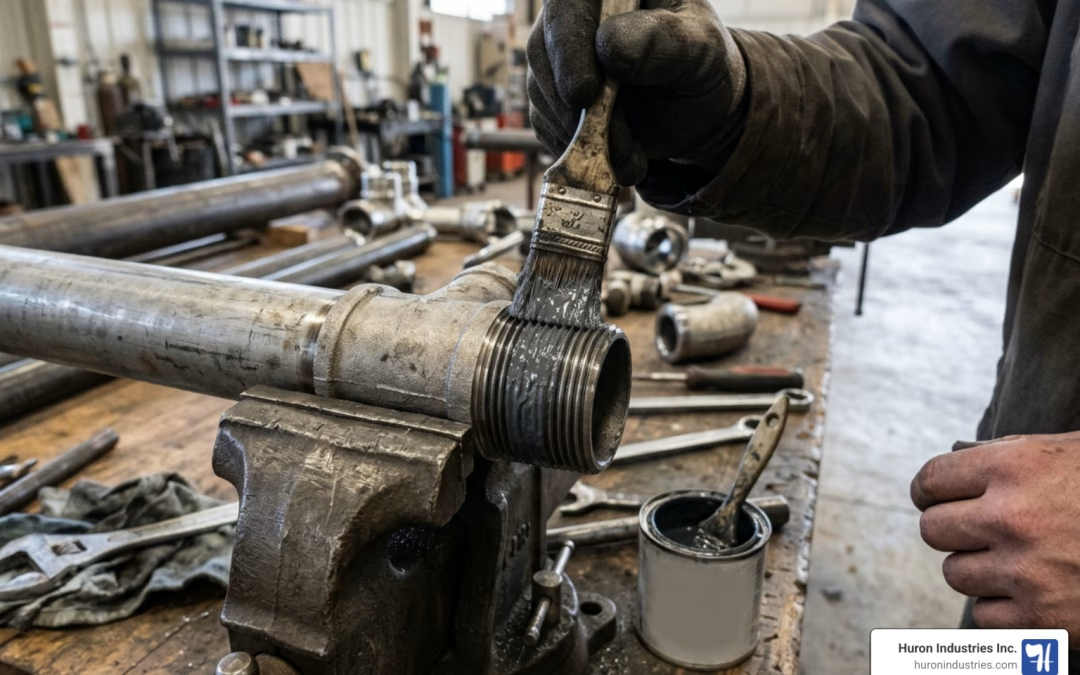
Why Graphite Thread Sealant Matters in Extreme Service
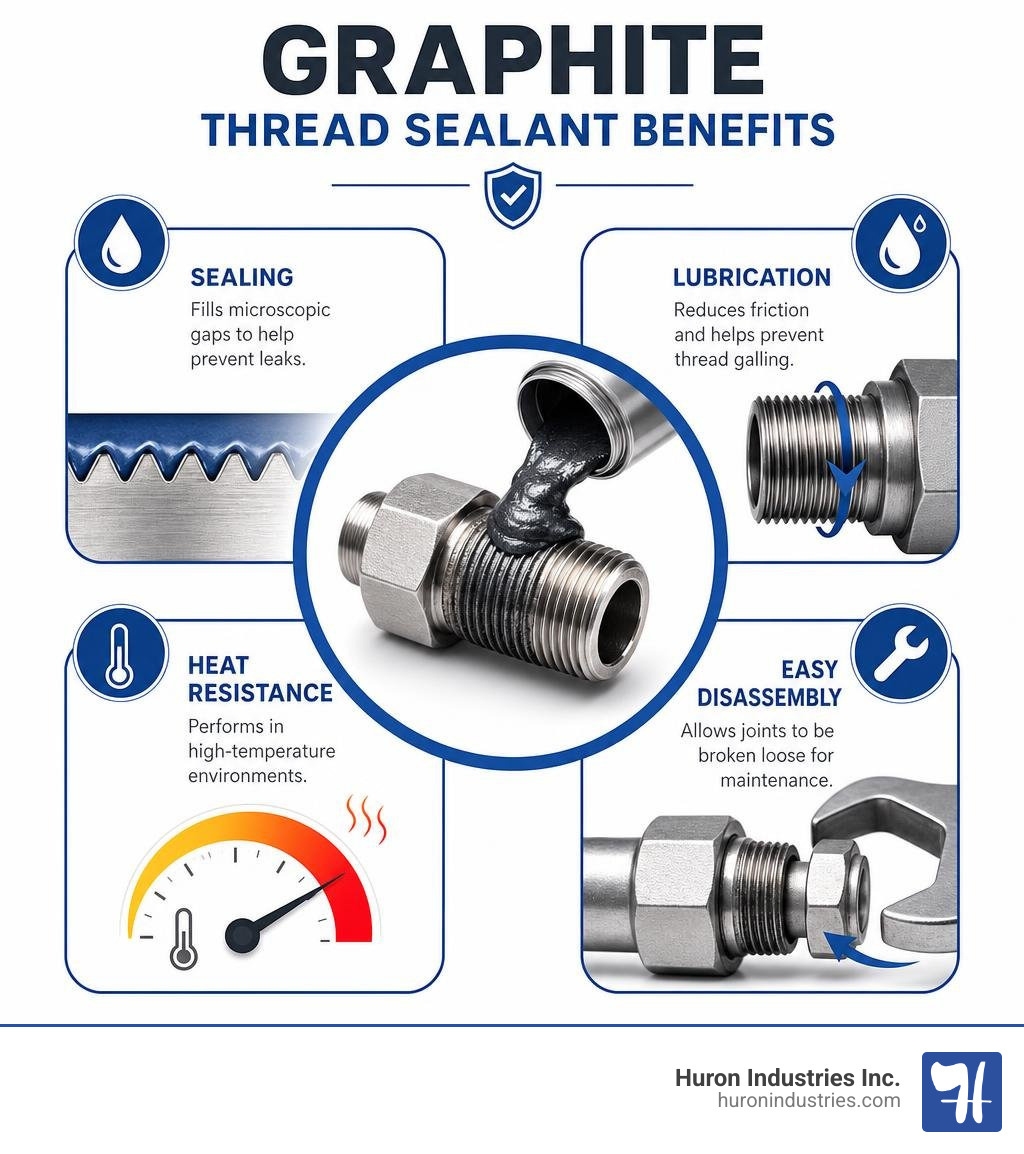
Graphite thread sealant is a non-curing paste or tape that fills the tiny gaps in threaded joints while also lubricating the threads. Engineers use it when heat, pressure, thermal cycling, or strict contamination limits make PTFE tape and ordinary pipe compounds a poor fit.
High-purity graphite pastes can seal close-fitting, small-diameter threaded joints at temperatures up to 635 C (1175 F) and standard pressures up to 16 MPa (2,300 psi), depending on the product and joint design. Unlike many polymer-based sealants, graphite remains effective after the carrier changes at high heat, and it does not cure into a hard, brittle layer.
That matters in critical piping systems. A sealant must help prevent leaks, resist thread galling, and still allow maintenance crews to break a joint apart years later. In nuclear and other sensitive service, low levels of chlorides, halogens, sulfur, and embrittling metals are equally important because trace contaminants can contribute to corrosion problems in stressed alloys.
I am Nicholas Cunha, founder of CreatiVertical, where I help Huron Industries Inc. explain specialized products such as graphite thread sealant to engineering, maintenance, and procurement teams. The sections ahead cover how these sealants work, where their limits are, and how to apply them correctly.
Graphite thread sealant word guide:
Understanding Graphite Thread Sealant Chemistry and Mechanics
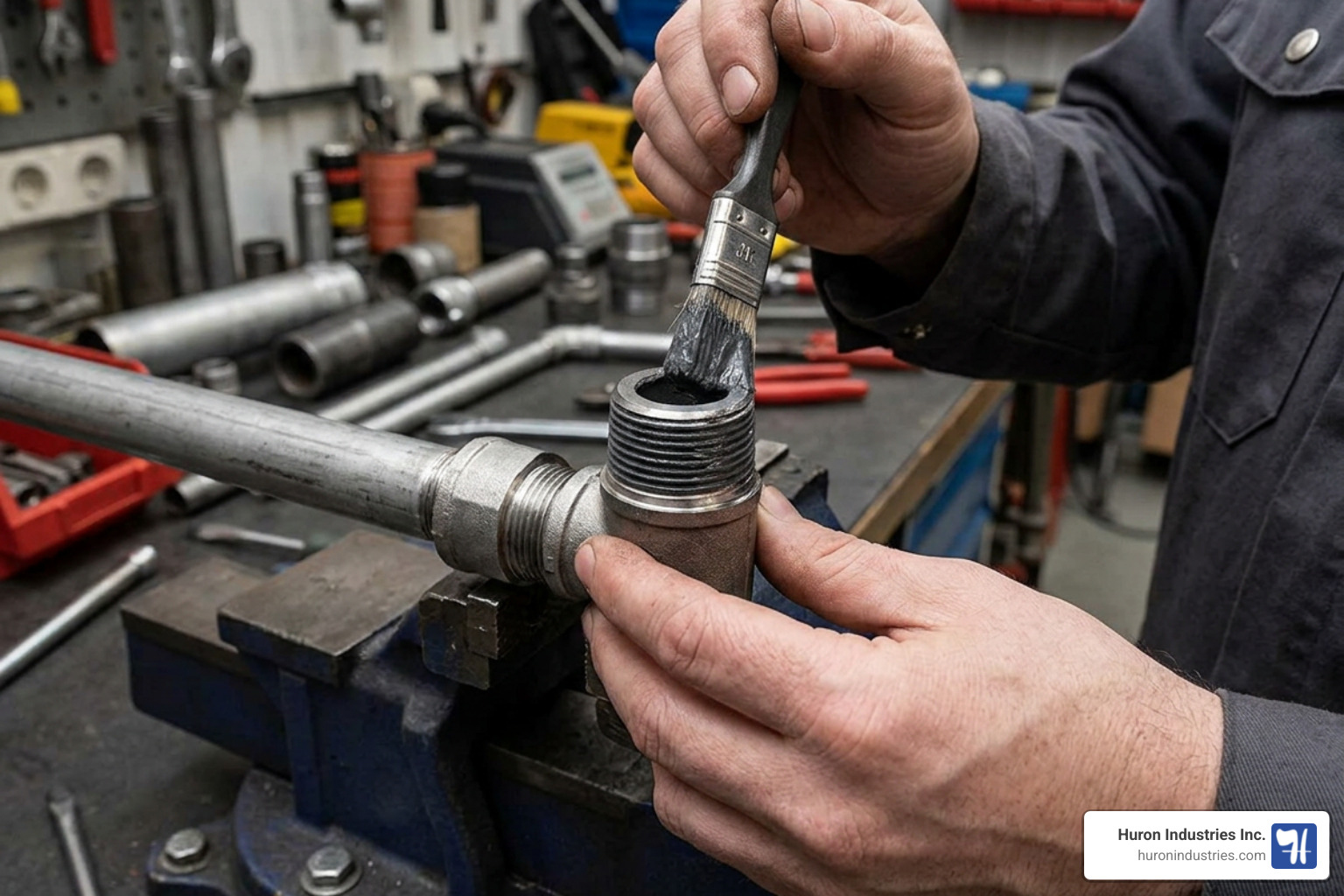
When you look closely at standard machined pipe threads—whether National Pipe Taper (NPT) or British Standard Pipe Taper (BSPT)—the metal surfaces are not perfectly smooth. Microscopic machining marks, tool chatter, and flank imperfections create minute spiral leak paths across the connection.
Standard pipe thread sealant compounds fill these voids with polymers, oils, or elastomeric binders. However, under extreme thermal stress, conventional binders volatilize or char, turning the paste into a crumbly ash that blows out under line pressure.
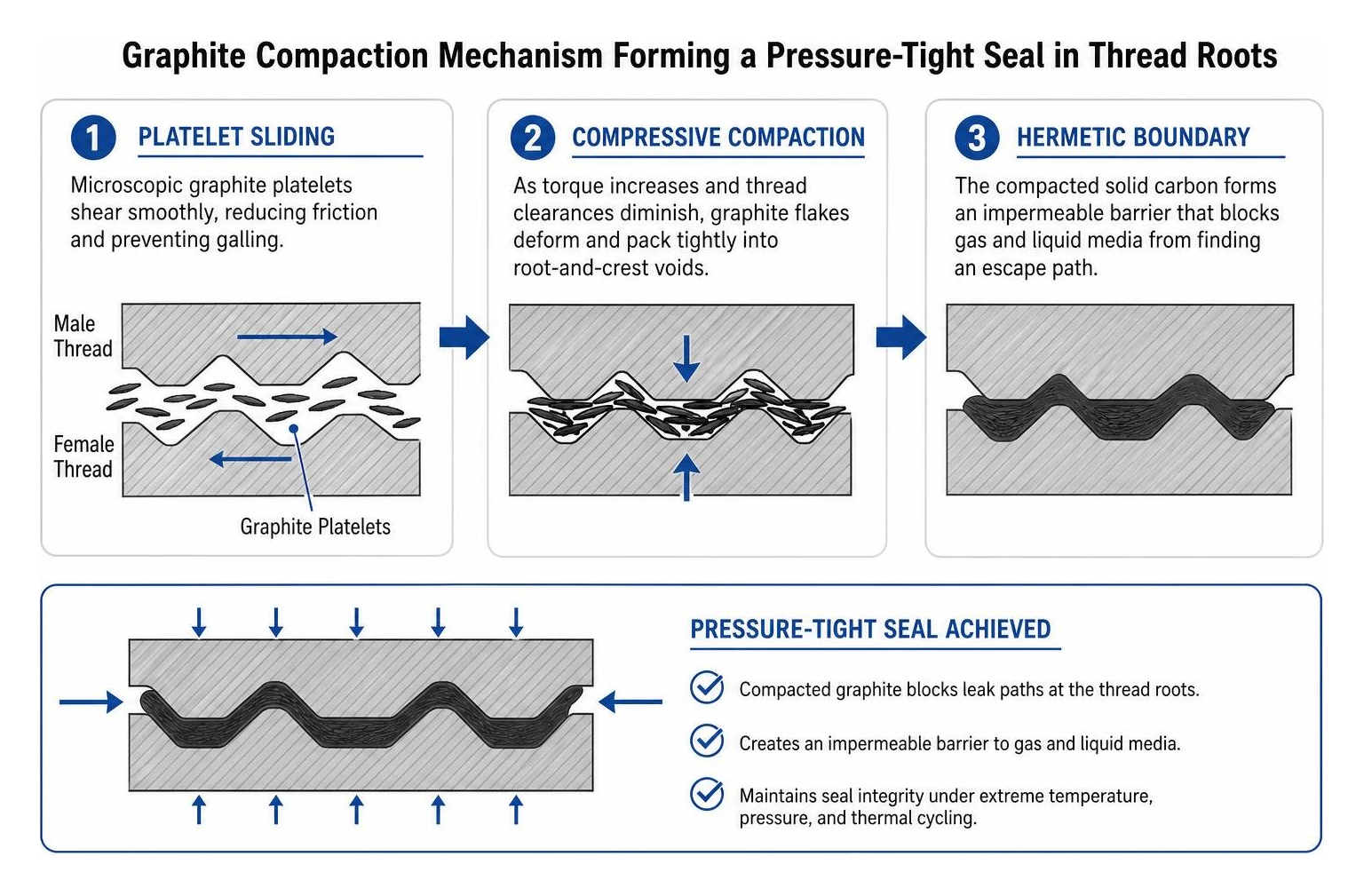
Graphite operates under an entirely different mechanical and physical principle. Mineral graphite consists of stacked planar sheets of carbon atoms arranged in a hexagonal crystal lattice. These microscopic graphene platelets are held together by weak van der Waals forces. When you tighten a threaded connection coated in high-purity graphite paste:
- Platelet Sliding: The microscopic carbon sheets shear smoothly across one another, reducing friction and preventing galling between mating metal flanks.
- Compressive Compaction: As torque increases and thread clearances diminish, the graphite flakes deform and pack tightly into root-and-crest voids.
- Hermetic Boundary: The compacted solid carbon forms an impermeable barrier that blocks gas and liquid media from finding an escape path.
Because carbon is chemically inert across a vast pH spectrum (pH 0 to 14), it resists chemical attack from strong acids, alkaline washes, aromatic hydrocarbons, and high-pressure superheated steam.
Formulations: Nuclear-Grade Graphite vs Colloidal Suspensions
Thread sealants utilize different carrier systems and graphite morphologies depending on the exact service conditions. In critical industrial applications, nuclear sealants the unsung heroes of reactor containment rely on graphite purity levels of at least 99.5% combined with nuclear-grade petroleum or synthetic carriers.
- High-Density Pastes: These formulations blend high-purity natural flake graphite with a refined, low-volatility carrier. The carrier provides smooth dispensing, precise thread wetting, and joint assembly lubricity. When temperatures surpass the carrier's boiling threshold, the graphite matrix remains behind to maintain the physical seal.
- Colloidal Suspensions: Colloidal graphite systems suspend micro-fine graphite particles in a volatile carrier (such as isopropanol). Upon application, the carrier evaporates rapidly, leaving behind an ultra-thin, dry, bonded graphite lubricating film that prevents galling in close-tolerance instrument lines without introducing excess organic bulk.
Graphite Thread Sealant vs Conventional Sealing Materials
To understand why severe-service facilities specify graphite, consider how it compares against traditional joint compounds, anaerobic chemical resins, and PTFE tape. When evaluating pipe thread sealant vs PTFE tape, PTFE often suffers from cold flow (creep) under heavy mechanical loading and decomposes into corrosive fluorinated gases at temperatures above 260°C (500°F).
| Performance Feature | High-Purity Graphite Paste | Conventional Pipe Dope | Anaerobic Resins | PTFE Tape |
|---|---|---|---|---|
| Max Service Temperature | Up to 635°C (1175°F) | ~150°C to 200°C | ~150°C to 180°C | ~260°C (500°F) |
| Pressure Rating (Standard) | 16 MPa (2,300 psi) | 1,000 to 2,000 psi | Up to 10,000 psi | 2,000 to 5,000 psi |
| Curing Mechanism | Non-curing / non-hardening | Dries / hardens slowly | Chemical polymerization | None (solid film) |
| Disassembly Characteristics | Clean, non-destructive | Variable (can stick) | Difficult (requires heat) | Easy, but risks stringing |
| Risk of System Ingestion | Minimal (no tape shreds) | Low to medium | Zero | High (thread stringing) |
| Radiation Stability | Exceptional | Poor (degrades/crosslinks) | Poor | Poor (embrittles) |
Performance Limits: Extreme Temperature, Pressure, and Thermal Cycling
In demanding thermal systems, high temperature thread sealant critical service formulations maintain structural stability where other sealing compounds vaporize or crack. Graphite exhibits an exceptionally low coefficient of thermal expansion, ensuring that as pipe walls expand and contract during continuous thermal cycling, the seal does not lose contact or develop micro-annular leak channels.
High-Temperature Stability and TGA Degradation Thresholds
Thermogravimetric Analysis (TGA) provides clear insight into how graphite thread paste behaves under increasing thermal loads. The testing process demonstrates that evaluating condition performance thermal stability depends on understanding carrier loss versus solid sealant retention:
- Initial Mass Loss (125°C / 255°F): Light fractions of the petroleum-based carrier begin gentle volatilization.
- Carrier Burn-Off (200°C / 390°F): Approximately 6% total mass loss occurs as the liquid carrier finishes burning off or evaporating.
- Solid Matrix Integrity (up to 635°C / 1175°F): The pure carbon solid phase remains completely stable, holding compression within the thread roots and maintaining an unbroken seal.
Because the functional sealing element is elemental carbon, the joint remains leak-tight long after liquid carriers have dissipated.
Pressure Ratings, Joint Geometry, and Pipe Size Constraints
Standard high-purity graphite thread pastes are engineered for small-diameter, close-tolerance threaded joints—specifically pipe sizes 2 inches (50.8 mm OD) and smaller.
- Pressure Containment: In standard NPT and BSPT pipe configurations, graphite paste reliably contains pressures up to 16 MPa (2,300 psi). Specialty metal-free, high-solids graphite formulations engineered for larger oilfield casing and non-shouldered tubulars can withstand working medium pressures reaching 52 MPa to 70 MPa (up to 10,000 psi).
- Geometry Considerations: Thread sealants rely on metal-to-metal flank contact to support the compacted graphite. As pipe diameters exceed 2 inches, machining tolerances loosen, hoop stresses increase, and root clearances widen. For larger pipe dimensions, engineers generally transition from threaded joints to flanged connections fitted with flexible graphite sheet gaskets.
Nuclear Purity Standards and Corrosion Prevention
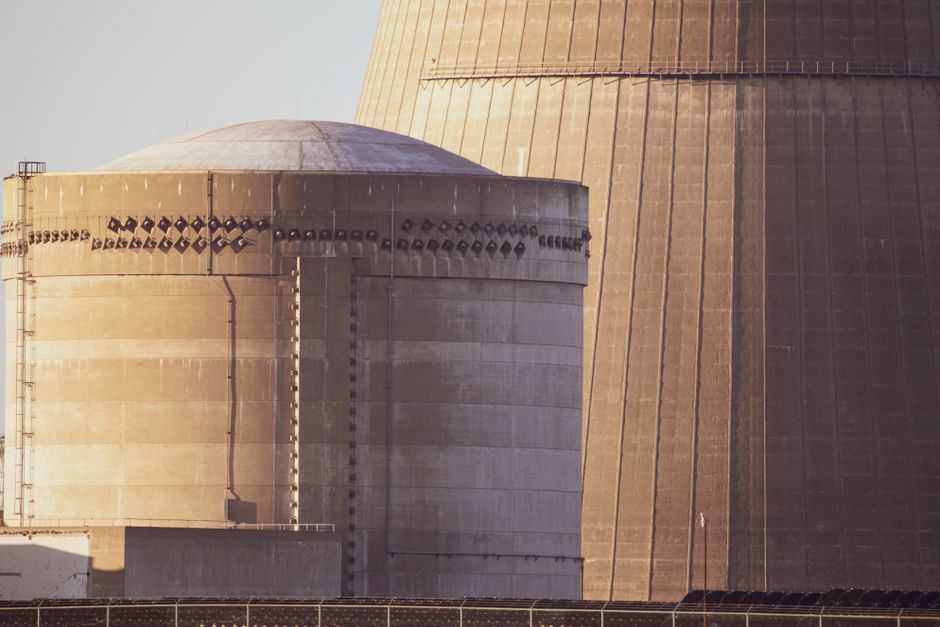
In nuclear power generation, petrochemical refining, and aerospace systems, thread sealants must meet rigorous chemical purity thresholds. High-strength stainless steels (such as 304L, 316L), Inconel, and zirconium alloys are highly susceptible to Intergranular Stress Corrosion Cracking (IGSCC) when exposed to trace chemical contaminants under elevated temperatures.
This is why sensitive metal pipes need low halogen and low sulfur sealants: leachable halogens attack the protective passive chromium oxide layer of the pipe wall, initiating pitting that rapidly propagates into catastrophic structural stress cracking.
Halogen, Chloride, and Sulfur Limits for Critical Systems
To protect piping integrity, nuclear-certified formulations must comply with strict non-metallic material standards, such as General Electric specification D50YP12 Rev 2 and military specification MIL-L-24131C. Choosing a certified low halogen thread sealant ensures trace impurities remain far below hazardous thresholds:
- Total Halogens (as Cl): < 25 ppm
- Leachable Chlorides: < 10 ppm
- Total Chlorine: < 10 ppm
- Total Fluorine: < 25 ppm
- Total Sulfur: < 150 ppm
- Total Nitrite: < 1 ppm
- Total Nitrate: < 10 ppm
- Total Embrittling Heavy Metals: < 250 ppm combined (with no single metal exceeding 200 ppm, strictly limiting antimony, bismuth, cadmium, lead, tin, and zinc)
Controlling these levels prevents both chemical pitting and liquid metal embrittlement across critical high-pressure cooling circuits.
Differentiating Graphite Thread Sealant from Anti-Seize Compounds
Engineers often ask whether a thread sealant can be swapped for an anti-seize paste, or vice versa. The debate over high temperature anti-seize vs thread sealant comes down to particle distribution, carrier formulation, and intended function:
- Anti-Seize Pastes: Formulated primarily to control friction, provide a uniform K-factor (torque coefficient), and prevent metal galling under high clamp loads. They do not necessarily form a pressure-tight, void-free seal across spiral thread paths.
- Graphite Thread Sealants: Engineered with a specific particle size distribution to bridge thread roots, block fluid migration, and deliver lubricity during make-up.
Fortunately, high-purity graphite thread paste acts as a dual-function solution. Because it is a non-hardening vs hard-setting thread sealant, it delivers excellent anti-seize lubrication on bolts and studs while simultaneously serving as a hermetic pipe joint seal. Joints assembled with non-hardening graphite paste can be disassembled cleanly years later without thread galling or damaged pipe walls.
Best Practices for Application, Handling, and Disassembly
Achieving a leak-free seal in severe-service piping requires proper joint preparation and careful product handling. Browse our thread sealant category to select the right container size and formulation for your specific field requirements.
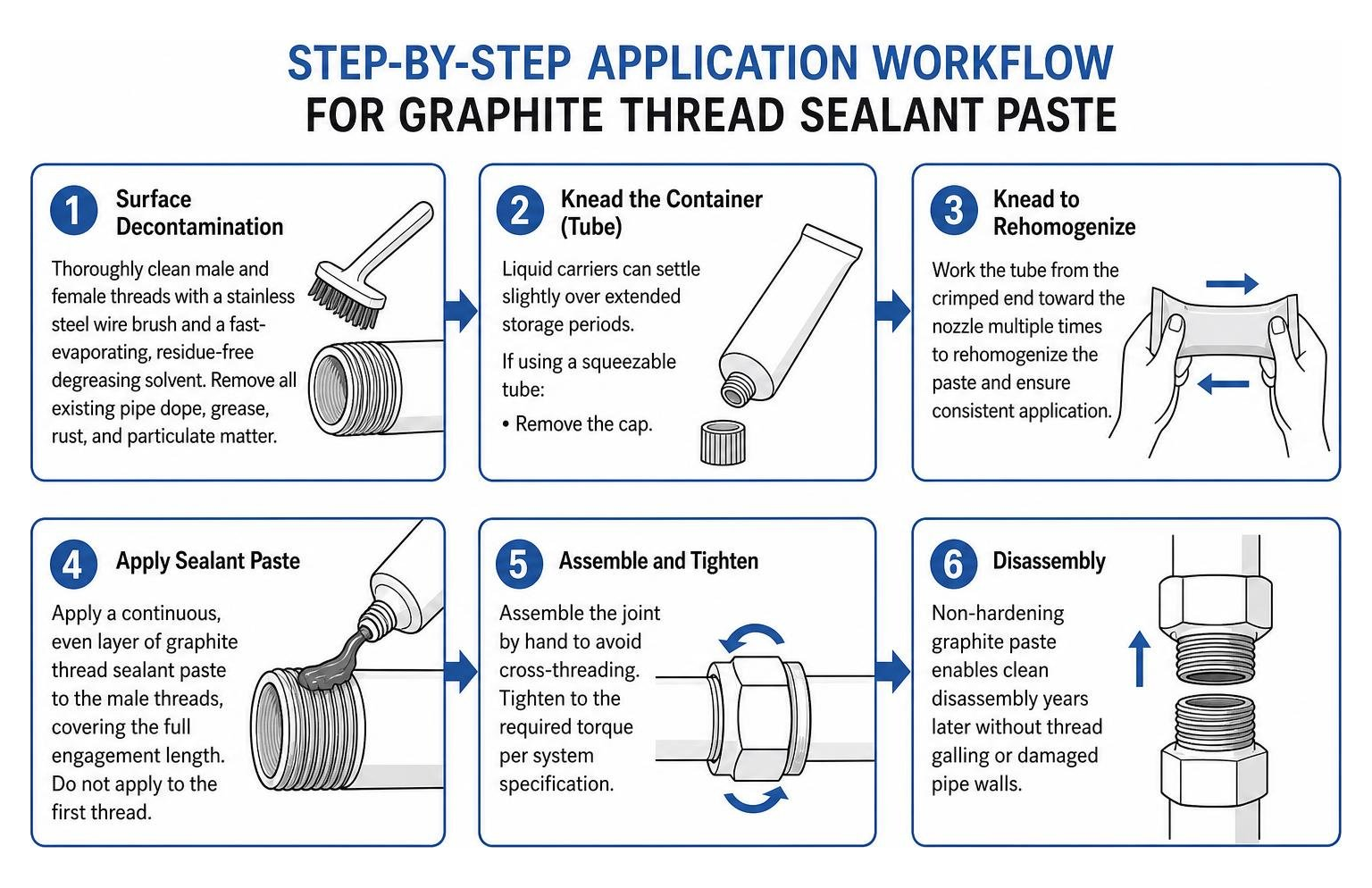
Step-by-Step Joint Preparation and Tube Kneading
- Surface Decontamination: Thoroughly clean male and female threads using a stainless steel wire brush and a fast-evaporating, residue-free degreasing solvent. Remove all existing pipe dope, grease, rust, and particulate matter.
- Knead the Container: Liquid carriers can settle slightly over extended storage periods. If using a squeezable tube:
- Remove the cap.
- Squeeze gently to express any trapped pocket of air (burping the tube).
- Replace the cap tightly.
- Thoroughly knead the tube between your fingers for 30 to 60 seconds to re-homogenize the graphite paste.
- Application Coverage: Apply paste evenly across the male threads, brushing or spreading the compound in the direction of the thread spiral. Ensure thread roots and crests are completely filled.
- Pro Tip: Leave the first thread bare if you must strictly avoid introducing paste into high-purity process fluid lines.
- Joint Assembly: Thread the joint together by hand to ensure proper alignment, then torque the connection to your engineering specification.
- Immediate Startup: Because high-purity graphite paste does not require chemical curing or drying time, the system can be pressurized immediately after tightening.
- Container Storage: Tightly replace the tube cap immediately after use. Store containers at or below 38°C (100°F) in clean storage lockers. Nuclear-grade polyethylene squeeze tubes protect the product against particulate and atmospheric contamination, ensuring a minimum shelf life of 2 years from first use.
Selecting Graphite Paste for Severe Industrial Service
Graphite thread paste provides versatile performance across extreme operating conditions:
- Cryogenic and Extreme Cold: Functions effectively down to -240°C (-400°F) without turning brittle.
- Superheated Steam: Maintains joint integrity in high-pressure steam distribution systems up to 635°C (1175°F).
- Aggressive Chemicals: Resists chemical attack across the full pH 0 to 14 range, making it suitable for acids, caustic washes, aromatic solvents, and hydrocarbons.
Frequently Asked Questions About Graphite Thread Sealants
Does graphite thread sealant cure or harden over time?
No. Unlike anaerobic chemical threadlockers or solvent-evaporating pipe dopes, graphite thread sealant is a non-curing, non-hardening compound. It retains its physical pliability and lubricity throughout years of extreme thermal service. This non-hardening property allows maintenance technicians to disassemble joints during planned outages without galling threads or using high-heat torches.
What is the maximum pipe diameter suitable for high-purity graphite paste?
High-purity graphite paste is rated for close-fitting, tapered threaded pipe joints up to 2 inches (50.8 mm OD). As pipe diameters exceed 2 inches, thread clearances widen significantly, increasing the risk that high line pressures could displace non-curing paste. For systems larger than 2 inches, flanged joints with flexible graphite sheet gaskets are standard engineering practice.
Can graphite thread paste be used on stainless steel and sensitive alloys?
Yes. In fact, high-purity graphite paste is the premier sealant choice for austenitic stainless steels (304, 316), Inconel, Monel, and titanium alloys. Because nuclear-grade formulations restrict leachable chlorides (<10 ppm) and total halogens (<25 ppm), they eliminate the risk of stress corrosion cracking and pitting corrosion commonly caused by inferior industrial sealants.
Reliable Sealing for Demanding Industrial Environments
When operating conditions push beyond the thermal and chemical limits of standard sealing tapes and curing compounds, graphite thread sealant provides the structural resilience engineers need. By combining chemical inertness, high-temperature stability up to 635°C, and certified low-halogen purity, nuclear-grade graphite pastes keep critical piping systems leak-free while safeguarding long-term asset integrity.
To explore certified high-purity sealing compounds engineered for demanding high-temperature lines, explore our high-pressure thread sealant 2300 psi formulation.